
Guides
Autonomous Workflow Design and Logic Routing
Autonomous Workflow Design and Logic Routing
This pillar covers the development of AI systems that can independently re-route tasks based on real-time data and reasoning, transitioning from static decision trees to dynamic, intent-driven logic. Guides cover 'How to build self-correcting supply chain logic,' 'Implementing recursive task loops for autonomous procurement,' and 'Reasoning-based error handling in claims processing' for industries with complex, volatile workflows like logistics and finance.
How to Architect an Intent-Driven Workflow Engine
This guide explains how to design a workflow engine that interprets high-level business goals (intents) and dynamically generates task sequences. You'll learn to map intents to executable actions using a semantic layer, implement a reasoning module with models like GPT-4 or Claude 3, and design a state machine that adapts to real-time context. The architecture enables systems to move beyond rigid, pre-defined flows.
Setting Up Dynamic Logic Routing for Real-Time Data
Learn to build a routing layer that evaluates incoming data streams and autonomously directs tasks to the most appropriate handler or agent. This guide covers implementing decision functions using vector similarity and rule-based triggers, integrating with event brokers like Apache Kafka, and designing fallback mechanisms. It's essential for applications in logistics, finance, and IoT where conditions change instantly.
How to Design Recursive Task Loops for Autonomous Procurement
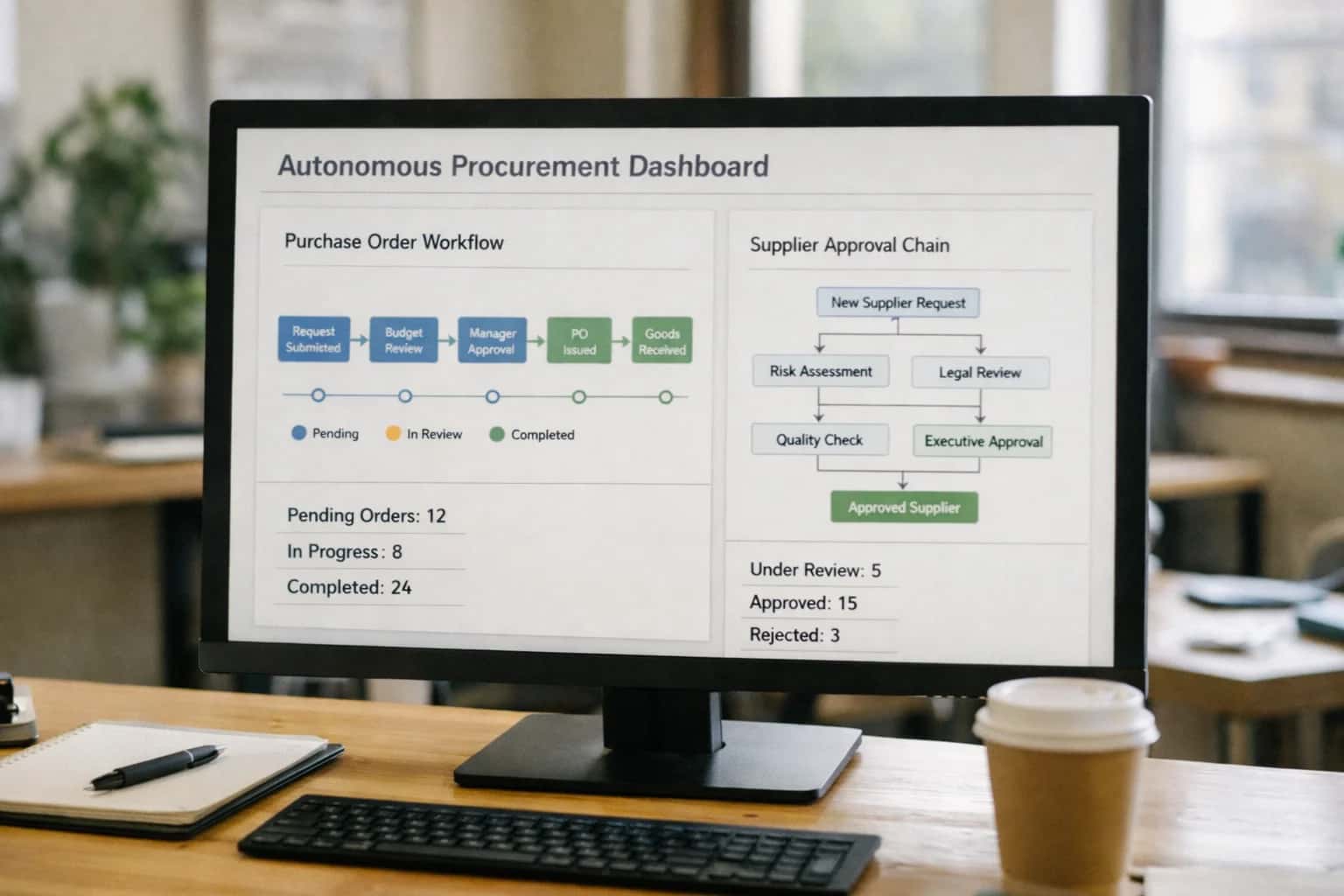
This guide details the architecture for self-correcting procurement workflows. You'll implement loops where an AI agent places an order, monitors fulfillment status via APIs, and recursively triggers re-routing or supplier negotiation if delays occur. We'll cover defining success criteria, setting recursion depth limits to prevent infinite loops, and integrating with ERP systems like SAP or Oracle.
Implementing Reasoning-Based Error Handling in Claims Processing
Move beyond simple rule-based exceptions to systems that diagnose and remediate workflow errors using causal reasoning. This guide shows how to use a **Small Language Model (SLM)** fine-tuned on claims data to classify error types, suggest corrective actions (e.g., request additional documentation), and update the workflow state. Includes patterns for logging reasoning traces for auditability.
How to Build a Dynamic Decision Layer Over Static Workflows
Learn to augment legacy, rule-based systems (like BPMN engines) with an intelligent overlay. This guide explains how to intercept workflow events, use an **LLM or a neuro-symbolic system** to evaluate context, and override or suggest alternative paths without rewriting the core engine. This is a critical strategy for modernizing insurance underwriting or loan approval systems.
Setting Up Autonomous Re-Routing for Volatile Logistics
Build a system that continuously monitors GPS, weather, and traffic APIs to dynamically re-route shipments. This guide covers implementing cost-benefit analysis for route changes, defining escalation protocols for human-in-the-loop intervention, and using tools like **LangChain** to orchestrate decision agents. You'll create a resilient supply chain that minimizes delays autonomously.
How to Design a Logic Router for Complex, Multi-Step Processes
Architect a central router that decomposes a high-level objective (e.g., 'onboard a corporate client') into a dependency graph of sub-tasks. This guide covers using directed acyclic graphs (DAGs) to model processes, implementing a scheduler that respects resource constraints, and designing a **monitoring system** to track progress and detect bottlenecks in real-time.
Setting Up Intent Recognition for Autonomous Task Assignment
Implement a system that classifies unstructured user requests (emails, chat messages) into actionable workflow intents. This guide walks through fine-tuning a classifier model, extracting key entities, and mapping the parsed intent to a specific workflow or agent pool. It's the foundation for autonomous customer support and internal ticketing systems.
How to Build a Self-Optimizing Workflow with Multi-Criteria Evaluation
Create workflows that don't just complete tasks but seek to optimize for multiple, often competing objectives (e.g., speed, cost, quality). This guide explains implementing a scoring function, using **multi-armed bandit algorithms** for exploration vs. exploitation, and setting up a feedback loop to continuously tune decision parameters based on historical outcomes.
How to Implement Context-Aware Logic Branching
Learn to design workflow branches that activate based on a rich, real-time context rather than simple IF-THEN rules. This guide covers building a context aggregator from user profiles, system state, and external data, and using embedding-based similarity to match context to the most relevant pre-defined or generated workflow path. Essential for personalized customer journeys.
How to Design a System for Handling Workflow Exceptions Autonomously
Go beyond alerting humans. This guide details building an exception handler that diagnoses common failure modes (e.g., API timeout, data validation error), retrieves remediation playbooks via **Agentic RAG**, and executes corrective scripts. You'll learn to define exception severity levels and integrate with **Human-in-the-Loop (HITL) Governance Systems** for critical issues.
Launching a Predictive Rerouting Engine for Supply Chain Disruptions
Build a system that uses machine learning to predict disruptions (port closures, supplier issues) and proactively reroutes workflows before they fail. This guide covers integrating forecasting models, setting confidence thresholds for automated action, and designing simulation environments to stress-test rerouting logic. It turns reactive workflows into proactive systems.
How to Architect a Feedback Loop for Continuous Workflow Optimization
Implement a closed-loop system where every workflow outcome is measured, analyzed, and used to refine future logic. This guide covers instrumenting workflows for telemetry, storing outcomes in a vector database for pattern analysis, and using A/B testing frameworks to deploy improved routing rules. This is the core of creating truly learning systems.
Setting Up a Real-Time Workflow Monitoring and Intervention System
Deploy dashboards and automated sentinels that track key performance indicators (KPIs) like cycle time and error rates across running workflows. This guide explains setting up alerts using tools like **Prometheus**, defining automated intervention triggers (e.g., 'if SLA breach imminent, escalate'), and creating rollback procedures for faulty automated decisions.
Partnered with leading AI, data, and software stack.





How We Work
Custom AI workflows for your Business
One-fit-all AI don't work for modern businesses. At Inferensys, we aim to understand your business & custom requirements; which we use to define most efficient agentic workflows, the data, and the tools for your business.
01
Review the use case
We understand the task, the users, and where AI can actually help.
Read more02
Pick the right approach
We define what needs search, automation, or product integration.
Read more03
Build the first useful version
We implement the part that proves the value first.
Read more04
Improve from there
We add the checks and visibility needed to keep it useful.
Read moreThe first call is a practical review of your use case and the right next step.
Talk to Us