Context-aware logic branching replaces static decision trees with dynamic path selection. Instead of evaluating a single variable (e.g., IF user_type == 'premium'), you build a context aggregator that continuously composes a holistic state from user profiles, system telemetry, and external APIs like weather or market data. This rich context vector is then matched against a library of pre-defined workflow paths using embedding-based similarity search, selecting the most relevant branch for the current situation. This approach is foundational for creating adaptive systems in our pillar on Autonomous Workflow Design and Logic Routing.

Guide
How to Implement Context-Aware Logic Branching
A step-by-step guide to designing workflow branches that activate based on a rich, real-time context rather than simple IF-THEN rules. Learn to build a context aggregator and use embedding-based similarity for dynamic routing.
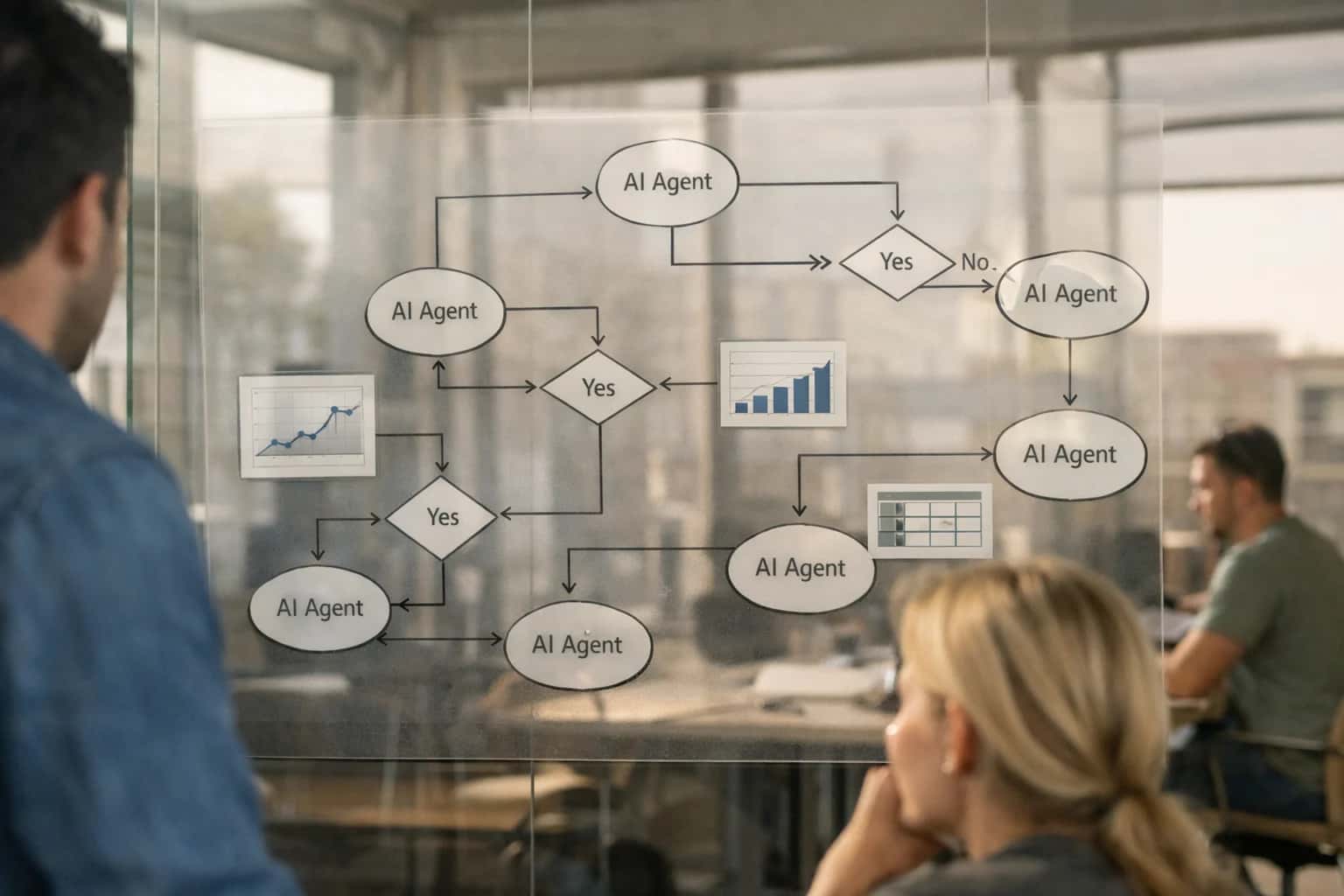
This guide explains how to build workflow branches that activate based on a rich, real-time context rather than simple IF-THEN rules, enabling personalized and resilient systems.
To implement this, first instrument your application to emit context signals to an event stream. Use a vector database to store embeddings of your known workflow intents. For each incoming task, generate an embedding of its live context and query the database for the k-nearest intents. The top match triggers the corresponding workflow branch. Crucially, design a fallback mechanism and integrate with Human-in-the-Loop (HITL) Governance Systems for low-confidence matches. This creates a system that personalizes customer journeys and autonomously adapts to volatile conditions, a core capability for modern finance and logistics applications.
LOGIC BRANCHING
Static vs. Context-Aware Workflow Comparison
This table contrasts the core architectural and operational differences between traditional static workflows and dynamic, context-aware systems.
| Feature | Static Workflow | Context-Aware Workflow |
|---|---|---|
Decision Logic | Pre-defined IF-THEN rules | Dynamic evaluation of aggregated context |
Adaptability | ||
Personalization | None or rule-based segments | Embedding-based similarity matching |
Error Handling | Manual escalation or hard-coded fallback | Reasoning-based diagnosis and autonomous remediation |
Data Integration | Structured inputs only | Aggregates user profiles, system state, and real-time external data |
Optimization Loop | Manual analysis and redeployment | Built-in feedback for continuous logic refinement |
Development Overhead | Low initial, high maintenance | High initial, lower long-term maintenance |
Use Case Fit | Stable, predictable processes | Volatile domains like logistics, finance, and personalized customer journeys |
Enabling Efficiency, Speed & Accuracy
Intelligent Analysis, Decision & Execution
We build AI systems for teams that need search across company data, workflow automation across tools, or AI features inside products and internal software.
Talk to Us
Search across company data
Give teams answers from docs, tickets, runbooks, and product data with sources and permissions.
Useful when people spend too long searching or get different answers from different systems.
Enterprise searchRAGPermissions
Read more
Automate internal workflows
Use AI to route work, draft outputs, trigger actions, and keep approvals and logs in place.
Useful when repetitive work moves across multiple tools and teams.
AI agentsWorkflow automationGovernance
Read more
Add AI to products and internal tools
Build assistants, guided actions, or decision support into the software your team or customers already use.
Useful when AI needs to be part of the product, not a separate tool.
AI integrationDecision supportModel routing
Read moreTROUBLESHOOTING
Common Mistakes
Implementing context-aware logic branching is a powerful step beyond static workflows, but developers often stumble on the same pitfalls. This section addresses the most frequent errors, from misrepresenting context to creating fragile routing logic, and provides concrete solutions.
A noisy context aggregator stems from treating all data sources as equally important. Context is not just more data; it's the relevant subset of data needed for a specific decision.
Common Mistake: Dumping raw user profiles, system logs, and API feeds into a single JSON blob and calling it 'context.'
Solution: Implement a context scoring layer. Before aggregation, weight each data source based on the current workflow intent. For a shipping reroute decision, GPS and weather APIs have high weight; the user's subscription tier has low weight. Use a simple scoring model or a rule-based filter to prune irrelevant signals, ensuring your context vector is dense with signal, not noise.
Related: Learn to build a proper semantic layer in our guide on How to Architect an Intent-Driven Workflow Engine.

About the author
Prasad Kumkar
CEO & MD, Inference Systems
Prasad Kumkar is the CEO & MD of Inference Systems and writes about AI systems architecture, LLM infrastructure, model serving, evaluation, and production deployment. Over 5+ years, he has worked across computer vision models, L5 autonomous vehicle systems, and LLM research, with a focus on taking complex AI ideas into real-world engineering systems.
His work and writing cover AI systems, large language models, AI agents, multimodal systems, autonomous systems, inference optimization, RAG, evaluation, and production AI engineering.
LinkedIn
Limited slotsGet a Free AI Consultation
Partnered with leading AI, data, and software stack.





How We Work
Custom AI workflows for your Business
One-fit-all AI don't work for modern businesses. At Inferensys, we aim to understand your business & custom requirements; which we use to define most efficient agentic workflows, the data, and the tools for your business.
01
Review the use case
We understand the task, the users, and where AI can actually help.
Read more02
Pick the right approach
We define what needs search, automation, or product integration.
Read more03
Build the first useful version
We implement the part that proves the value first.
Read more04
Improve from there
We add the checks and visibility needed to keep it useful.
Read moreThe first call is a practical review of your use case and the right next step.
Talk to Us