Building an AI platform for continuous GMP adherence requires a shift from manual, siloed processes to an agentic orchestration of specialized AI modules. The core architecture integrates data from Manufacturing Execution Systems (MES), Laboratory Information Management Systems (LIMS), and quality documents into a unified knowledge graph. This enables cross-functional data flows where agents for document control, deviation management, and audit readiness can collaborate, ensuring the entire quality system maintains a state of perpetual inspection readiness. This approach is foundational to our pillar on Regulatory Intelligence and Pharma Compliance Automation.

Guide
How to Build an AI Platform for Continuous GMP Adherence
A developer tutorial for building a unified AI platform that orchestrates compliance agents for document control, deviation management, and audit readiness to maintain perpetual GMP adherence.
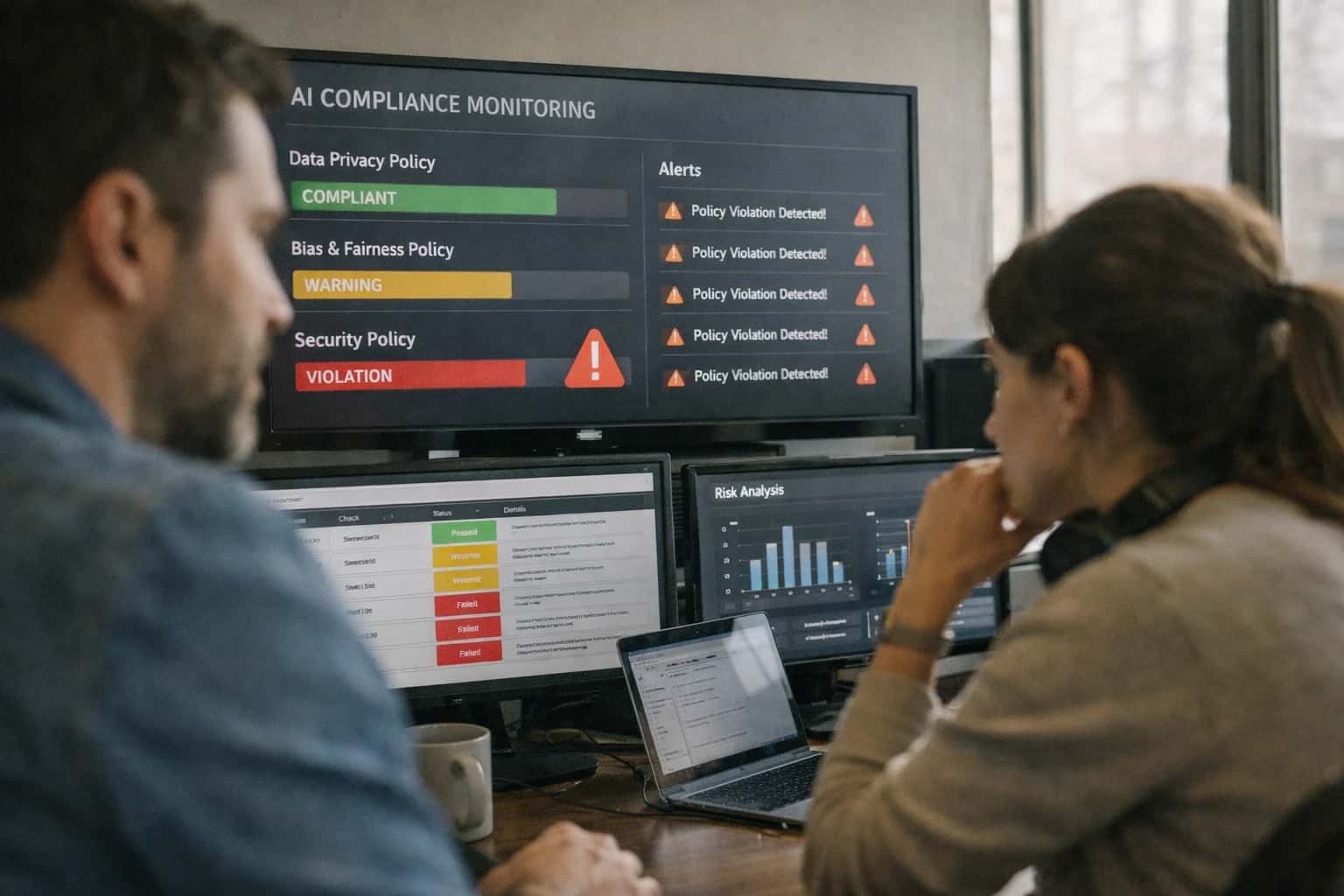
This guide outlines the development of a unified platform that orchestrates multiple compliance agents for end-to-end GMP coverage. It integrates modules for document management, training compliance, audit readiness, and batch record review into a cohesive system.
You will implement this by designing autonomous workflows where agents trigger and validate each other's actions. For example, a deviation detected by an anomaly detection agent automatically initiates a root-cause analysis by another agent and logs the event in an audit trail compliant with FDA 21 CFR Part 11. Practical development involves using frameworks for multi-agent system (MAS) orchestration to manage communication and conflict resolution. The result is a self-correcting platform that proactively manages risks, drastically reducing manual overhead and closing compliance gaps before they become findings. This connects deeply with related guides on How to Architect an AI-Powered GMP Compliance Platform and How to Design an AI System for Automated Documentation Compliance.
ARCHITECTURAL PILLARS
Key Concepts: The Platform Architecture
A continuous GMP adherence platform is built on core architectural pillars that integrate data, intelligence, and automation. These are the foundational components you must design and implement.
01
The Unified Data Fabric
A continuous GMP platform requires a single source of truth that aggregates data from disparate systems like LIMS, MES, QMS, and IoT sensors. This is not a data lake; it's a semantic layer that maps relationships between batches, deviations, procedures, and personnel. Key design patterns include:
- Event-driven ingestion for real-time data streams
- Entity-relationship modeling to connect quality events to root causes
- Immutable audit logs that satisfy 21 CFR Part 11 requirements Without this fabric, agents operate in silos with incomplete context, leading to flawed decisions.
02
Agentic Workflow Orchestrator
This is the central nervous system that coordinates specialized compliance agents (e.g., for document review, deviation triage, audit simulation). It uses a directed acyclic graph (DAG) to model complex, stateful processes like a CAPA investigation. The orchestrator's responsibilities are:
- Dynamic task routing based on agent capabilities and workload
- State persistence to maintain context across long-running workflows
- Conflict resolution when multiple agents provide conflicting recommendations This component transforms linear procedures into adaptive, parallelized execution, a core principle of Multi-Agent System (MAS) Orchestration.
03
Regulatory Knowledge Graph
Static rule engines fail under evolving regulations. A knowledge graph dynamically maps internal SOPs, batch records, and training curricula to external regulatory clauses from the FDA, EMA, and ICH. It enables:
- Semantic search for inspectors' ad-hoc queries
- Impact analysis when a new guideline is published
- Proactive gap detection by comparing actual practices to required controls Building this requires entity extraction from regulatory documents and continuous vector embedding to maintain semantic alignment, a technique central to Agentic Retrieval-Augmented Generation (RAG).
04
Human-in-the-Loop (HITL) Governance Layer
Full automation is neither legal nor desirable for high-stakes GMP decisions. The HITL layer provides programmatic oversight by:
- Setting confidence thresholds for autonomous agent actions (e.g., auto-close a deviation only if probability > 99%)
- Implementing escalation queues for human review of high-risk or novel events
- Maintaining a tamper-evident audit trail of every human override or approval This architecture ensures the system remains a decision-support tool under ultimate human authority, which is a critical design pattern for building trustworthy Human-in-the-Loop (HITL) Governance Systems.
05
Real-Time Inference Engine
Batch processing creates compliance lag. The inference engine performs sub-second analysis on streaming data to detect anomalies as they happen. It combines:
- Time-series forecasting to predict parameter excursions in environmental monitoring
- Computer vision models for real-time label verification on packaging lines
- Natural language processing to scan operator log entries for non-conformance language Deploying this requires edge computing for low-latency sensor data and a model registry for version-controlled, validated algorithms, aligning with practices for Edge Inference and Distributed Computing Grids.
06
Compliance State Monitor
Perpetual inspection readiness requires a live dashboard of the organization's compliance health. This component continuously scores risk across dimensions like documentation, training, and process performance. It provides:
- Predictive risk scores for manufacturing lines and suppliers
- Automated evidence compilation for simulated audit questions
- Drill-down capabilities from a high-level score to the underlying data point or deviation This transforms compliance from a periodic assessment to a continuously measured key performance indicator (KPI), enabling proactive management as detailed in guides on Setting Up a Predictive Compliance Risk Engine.
FOUNDATIONAL ARCHITECTURE
Step 1: Define Your Core Compliance Agents
The first step in building an AI platform for continuous GMP adherence is to architect your core compliance agents. These are specialized, autonomous modules that handle distinct regulatory functions.
Start by mapping your Good Manufacturing Practice (GMP) obligations to discrete agent roles. Essential agents include a Document Control Agent for SOP lifecycle management, a Deviation Management Agent for anomaly detection and routing, and a Training Compliance Agent to monitor personnel qualifications. Each agent must have a clear, singular objective, such as "ensure all documents are reviewed before the 30-day deadline" or "classify and initiate investigation for all out-of-spec results within one hour." This modular design aligns with principles of Multi-Agent System (MAS) Orchestration.
Implement each agent using a reasoning loop: perceive data from sources like your Manufacturing Execution System (MES) or Laboratory Information Management System (LIMS), decide on an action using fine-tuned rules or a small language model (SLM), and act by updating records or triggering workflows. For example, your Deviation Agent should integrate with real-time process data to perceive an excursion, decide its severity using a classification model, and act by creating an incident in your Quality Management System (QMS). This creates the foundation for autonomous workflow design.
CORE PLATFORM COMPONENTS
Agent Specification and Data Sources
This table compares the three primary agent types required for a continuous GMP adherence platform, detailing their data sources, core functions, and integration requirements.
| Agent Type | Document & Training Compliance Agent | Audit & Deviation Management Agent | Batch Record & Environmental Monitoring Agent |
|---|---|---|---|
Primary Data Source | Document Management System (DMS), Learning Management System (LMS) | Quality Management System (QMS), Manufacturing Execution System (MES) | Electronic Batch Records (EBR), IoT Sensor Networks, LIMS |
Core Function | Automate SOP lifecycle, validate training records, ensure version control | Detect deviations, initiate CAPAs, perform autonomous root cause analysis | Review batch records in real-time, predict environmental excursions, enable real-time release |
Regulation Focus | 21 CFR Part 11, EU GMP Annex 11 | FDA 21 CFR 211, ICH Q10 | FDA 21 CFR 211.188, EU GMP Annex 1 |
Key AI Capability | NLP for regulatory keyword compliance, agentic RAG for document retrieval | Anomaly detection, causal inference, neuro-symbolic reasoning for logic checks | Computer vision for handwritten entries, time-series forecasting, predictive analytics |
Integration Complexity | Medium | High | High |
Output for Human-in-the-Loop | Approval requests for revised SOPs, overdue training alerts | Proposed root cause and CAPA plan for review, high-risk deviation alerts | Flagged discrepancies for investigation, predicted out-of-spec alerts |
Related System | How to Design an AI System for Automated Documentation Compliance | How to Implement an AI-Based Deviation Management System | How to Design an AI System for Real-Time Environmental Monitoring |
Enabling Efficiency, Speed & Accuracy
Intelligent Analysis, Decision & Execution
We build AI systems for teams that need search across company data, workflow automation across tools, or AI features inside products and internal software.
Talk to Us
Search across company data
Give teams answers from docs, tickets, runbooks, and product data with sources and permissions.
Useful when people spend too long searching or get different answers from different systems.
Enterprise searchRAGPermissions
Read more
Automate internal workflows
Use AI to route work, draft outputs, trigger actions, and keep approvals and logs in place.
Useful when repetitive work moves across multiple tools and teams.
AI agentsWorkflow automationGovernance
Read more
Add AI to products and internal tools
Build assistants, guided actions, or decision support into the software your team or customers already use.
Useful when AI needs to be part of the product, not a separate tool.
AI integrationDecision supportModel routing
Read moreTROUBLESHOOTING
Common Mistakes
Building an AI platform for continuous GMP adherence is complex. These are the most frequent technical pitfalls developers encounter and how to fix them.
This happens when you build point solutions without a central orchestration layer. Each module (e.g., document management, deviation handling) operates on isolated data, preventing cross-functional insights.
The Fix:
- Design a central event bus (e.g., Apache Kafka) as the system's backbone.
- Implement a canonical data model for core entities like
Batch,Deviation, andDocument. - Use agentic workflows where specialized agents publish and subscribe to events on this bus. For example, a
DeviationDetectionAgentpublishes an event that aCAPAInitiationAgentconsumes. This approach is foundational to Multi-Agent System (MAS) Orchestration.

About the author
Prasad Kumkar
CEO & MD, Inference Systems
Prasad Kumkar is the CEO & MD of Inference Systems and writes about AI systems architecture, LLM infrastructure, model serving, evaluation, and production deployment. Over 5+ years, he has worked across computer vision models, L5 autonomous vehicle systems, and LLM research, with a focus on taking complex AI ideas into real-world engineering systems.
His work and writing cover AI systems, large language models, AI agents, multimodal systems, autonomous systems, inference optimization, RAG, evaluation, and production AI engineering.
LinkedIn
Limited slotsGet a Free AI Consultation
Partnered with leading AI, data, and software stack.





How We Work
Custom AI workflows for your Business
One-fit-all AI don't work for modern businesses. At Inferensys, we aim to understand your business & custom requirements; which we use to define most efficient agentic workflows, the data, and the tools for your business.
01
Review the use case
We understand the task, the users, and where AI can actually help.
Read more02
Pick the right approach
We define what needs search, automation, or product integration.
Read more03
Build the first useful version
We implement the part that proves the value first.
Read more04
Improve from there
We add the checks and visibility needed to keep it useful.
Read moreThe first call is a practical review of your use case and the right next step.
Talk to Us