Real-time environmental monitoring is a GMP-critical activity for aseptic processing, tracking parameters like particulate counts, temperature, humidity, and differential pressure. Designing an AI system for this requires integrating IoT sensor streams with predictive time-series models to detect anomalies and forecast excursions before they breach limits. This transforms compliance from a reactive, manual log-checking process into a proactive, automated safeguard for product quality and patient safety.

Guide
How to Design an AI System for Real-Time Environmental Monitoring
A developer guide to building an AI system that integrates IoT sensors, computer vision, and predictive models for continuous monitoring of cleanrooms and critical utilities. Learn to process streaming data, predict excursions, and automate compliance reporting.
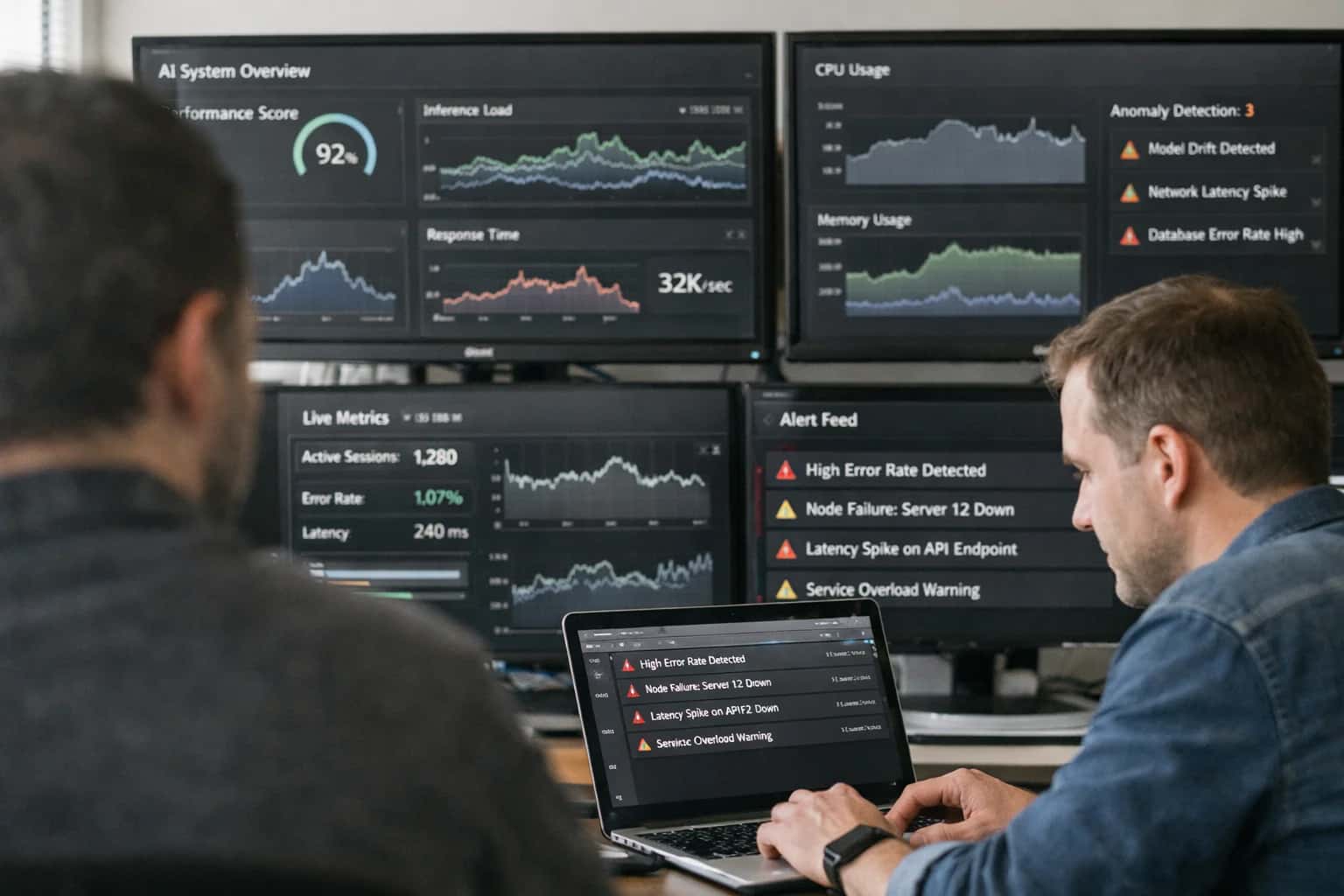
GUIDE
Introduction
Learn to architect an AI system that continuously monitors critical environmental parameters in pharmaceutical cleanrooms, predicting excursions to ensure compliance and product safety.
This guide provides the architectural blueprint. You will learn to ingest and process high-frequency sensor data, implement anomaly detection algorithms, and build a dashboard for live oversight. The system automates alerting and generates audit-ready compliance reports, directly supporting your regulatory intelligence strategy. We'll cover practical steps for sensor integration, model selection, and deploying the system within a GMP compliance platform.
ARCHITECTURE PRIMER
Key Concepts
Designing a real-time environmental monitoring system requires a layered architecture that ingests streaming sensor data, applies predictive analytics, and automates compliance workflows. These concepts form the foundation for building a robust, proactive system.
01
Sensor Fusion & IoT Data Ingestion
Real-time monitoring starts with sensor fusion—aggregating data from diverse IoT devices (e.g., particulate counters, thermohygrometers, differential pressure sensors). You must design a scalable ingestion layer using protocols like MQTT or OPC UA to handle high-frequency, time-series data streams. Key considerations include:
- Data validation at the edge to filter noise and outliers.
- Unified timestamping to synchronize readings across the facility.
- Buffering and backpressure handling to prevent data loss during network interruptions. This creates a single source of truth for all environmental parameters.
02
Time-Series Forecasting for Excursion Prediction
Moving from monitoring to prediction requires time-series models like Prophet, LSTM networks, or N-BEATS. These models analyze historical trends to forecast parameter drift (e.g., rising particle counts) before they breach limits. Implementation involves:
- Feature engineering with rolling averages and seasonal decomposition.
- Training on normal operational data to establish a baseline.
- Setting dynamic confidence intervals to trigger predictive alerts. This enables proactive interventions, shifting from reactive compliance to preventive control, a core goal of modern Good Manufacturing Practice (GMP).
03
Computer Vision for Aseptic Process Verification
In cleanrooms, computer vision (CV) provides non-invasive monitoring of critical manual processes. Deploying CV models for tasks like gowning verification or viable particle detection on settle plates involves:
- Using YOLO or Segment Anything Model (SAM) for real-time object detection.
- Edge deployment on local GPUs to ensure low-latency analysis.
- Integrating findings with the central environmental monitoring database. This adds a visual reasoning layer to the sensor network, automating checks that are prone to human error.
04
Automated Alerting & Escalation Logic
A static threshold alarm is insufficient. You must implement multi-tiered alerting logic that considers context. The system should:
- Correlate alerts (e.g., a pressure drop coinciding with a door event).
- Apply severity scoring based on the parameter, location, and duration of the excursion.
- Route alerts via predefined escalation chains (e.g., SMS for critical, email for advisory).
- Integrate with ticketing systems like Jira or ServiceNow to auto-generate deviation records. This ensures the right person is notified with the right context for immediate action, a principle shared with Human-in-the-Loop (HITL) Governance Systems.
05
Compliance Reporting & Audit Trail Generation
The system must autonomously generate compliance artifacts. This requires designing a reporting engine that:
- Aggregates raw data, alerts, and corrective actions into structured reports (e.g., Environmental Monitoring Summary).
- Implements immutable logging for all data transactions and configuration changes to satisfy FDA 21 CFR Part 11 requirements.
- Uses templates to auto-populate regulatory documents, ensuring consistency and reducing manual effort. This creates a continuous, audit-ready state, directly supporting the goals of an AI-Powered GMP Compliance Platform.
06
System Integration & Data Orchestration
The monitoring system does not operate in isolation. Its value is multiplied by integration with other enterprise systems. Key integrations include:
- Manufacturing Execution System (MES) to correlate environmental data with batch operations.
- Laboratory Information Management System (LIMS) to import viable particle counts.
- Quality Management System (QMS) to auto-initiate deviations or CAPAs when excursions occur. Orchestrating these data flows requires a robust API layer and potentially an event-driven architecture using tools like Apache Kafka. This turns isolated data into actionable intelligence across the organization.
FOUNDATION
Step 1: Define the System Architecture
A robust architecture is the blueprint for a reliable, scalable, and compliant real-time environmental monitoring system. This step establishes the core components and data flows.
Begin by mapping the data pipeline from edge to cloud. Define the IoT sensor layer (e.g., particulate counters, thermohygrometers), the edge gateway for initial data aggregation and filtering, and the cloud ingestion service. Specify the time-series database (e.g., TimescaleDB, InfluxDB) for raw metric storage and the stream processing engine (e.g., Apache Kafka, AWS Kinesis) for real-time analysis. This ensures low-latency data flow from cleanroom sensors to your analytics models. For a deeper dive on orchestrating such data flows, see our guide on Autonomous Workflow Design and Logic Routing.
Next, design the analytics and intelligence layer. This includes microservices for predictive models (e.g., Prophet, LSTM networks) to forecast parameter excursions, a rules engine for immediate GMP breach detection, and an agentic workflow orchestrator to automate alerts and corrective actions. Integrate a reporting service that auto-generates compliance documentation. Crucially, architect for Human-in-the-Loop (HITL) Governance by designing clear intervention points and audit logs, as detailed in our HITL Governance Systems pillar. This creates a closed-loop system that predicts, detects, and responds.
FOR ENVIRONMENTAL EXCURSION FORECASTING
Predictive Model Comparison
A comparison of time-series forecasting models for predicting parameter excursions in cleanroom monitoring.
| Model / Feature | LSTM Network | Prophet | Isolation Forest | Vector Autoregression (VAR) |
|---|---|---|---|---|
Primary Use Case | Sequence prediction for multi-sensor data | Seasonality & trend forecasting | Real-time anomaly detection | Multi-variable interdependency modeling |
Training Data Requirement | Large historical dataset (>6 months) | Moderate, handles missing data | Minimal, unsupervised | Large, balanced panel data |
Inference Latency | < 100 ms | < 50 ms | < 10 ms | < 200 ms |
Handles Multivariate Inputs | ||||
Explainability of Predictions | Low (black box) | High (decomposable trends) | Medium (anomaly score) | High (coefficient analysis) |
Integration Complexity | High (custom TensorFlow/PyTorch) | Low (standard Python API) | Medium (scikit-learn) | Medium (statsmodels) |
Best for Predicting | Complex temporal patterns in particulate counts | Long-term humidity & temperature cycles | Sudden, unexpected spikes in any parameter | Correlated shifts in pressure & airflow |
Common Implementation Mistake | Ignoring sequence length for real-time streams | Overfitting to irrelevant seasonal cycles | Setting contamination parameter too high | Assuming stationarity without testing |
Enabling Efficiency, Speed & Accuracy
Intelligent Analysis, Decision & Execution
We build AI systems for teams that need search across company data, workflow automation across tools, or AI features inside products and internal software.
Talk to Us
Search across company data
Give teams answers from docs, tickets, runbooks, and product data with sources and permissions.
Useful when people spend too long searching or get different answers from different systems.
Enterprise searchRAGPermissions
Read more
Automate internal workflows
Use AI to route work, draft outputs, trigger actions, and keep approvals and logs in place.
Useful when repetitive work moves across multiple tools and teams.
AI agentsWorkflow automationGovernance
Read more
Add AI to products and internal tools
Build assistants, guided actions, or decision support into the software your team or customers already use.
Useful when AI needs to be part of the product, not a separate tool.
AI integrationDecision supportModel routing
Read moreENVIRONMENTAL MONITORING
Common Mistakes
Designing AI for real-time environmental monitoring in pharma cleanrooms is a high-stakes engineering challenge. These are the most frequent technical pitfalls developers encounter and how to avoid them.
High latency often stems from a centralized architecture where all IoT sensor data is sent to a cloud server for processing. For critical parameters like particulate counts, this round-trip time can cause unacceptable delays.
The fix is an edge-first architecture. Deploy lightweight inference models directly on edge gateways or microcontrollers at the sensor source. Use a protocol like MQTT for efficient, low-latency messaging. Only send aggregated data and high-severity alerts to the central platform. This approach is a core principle of our guide on Edge Inference and Distributed Computing Grids.
python# Example: Simple edge rule engine on a gateway def check_particulate(sensor_value, threshold): if sensor_value > threshold: # Immediate local action & alert trigger_local_alarm() publish_mqtt('alerts/cleanroom1', {'excursion': True}) # Send routine data less frequently publish_mqtt('telemetry/cleanroom1', {'value': sensor_value})

About the author
Prasad Kumkar
CEO & MD, Inference Systems
Prasad Kumkar is the CEO & MD of Inference Systems and writes about AI systems architecture, LLM infrastructure, model serving, evaluation, and production deployment. Over 5+ years, he has worked across computer vision models, L5 autonomous vehicle systems, and LLM research, with a focus on taking complex AI ideas into real-world engineering systems.
His work and writing cover AI systems, large language models, AI agents, multimodal systems, autonomous systems, inference optimization, RAG, evaluation, and production AI engineering.
LinkedIn
Limited slotsGet a Free AI Consultation
Partnered with leading AI, data, and software stack.





How We Work
Custom AI workflows for your Business
One-fit-all AI don't work for modern businesses. At Inferensys, we aim to understand your business & custom requirements; which we use to define most efficient agentic workflows, the data, and the tools for your business.
01
Review the use case
We understand the task, the users, and where AI can actually help.
Read more02
Pick the right approach
We define what needs search, automation, or product integration.
Read more03
Build the first useful version
We implement the part that proves the value first.
Read more04
Improve from there
We add the checks and visibility needed to keep it useful.
Read moreThe first call is a practical review of your use case and the right next step.
Talk to Us