Energy harvesting integration is the engineering discipline of designing electronic systems—particularly for the Internet of Things (IoT) and edge devices—to capture, condition, and utilize ambient energy from sources like photovoltaic (light), piezoelectric (vibration), thermoelectric (heat gradients), and RF (radio waves). The core objective is to supplement or entirely replace finite battery power, enabling perpetual operation or dramatically extended device lifetimes in remote or inaccessible locations. This requires a co-design approach spanning the energy transducer, power management integrated circuit (PMIC), storage element (e.g., capacitor or thin-film battery), and the ultra-low-power compute load, typically a microcontroller running TinyML models.

Glossary
Energy Harvesting Integration
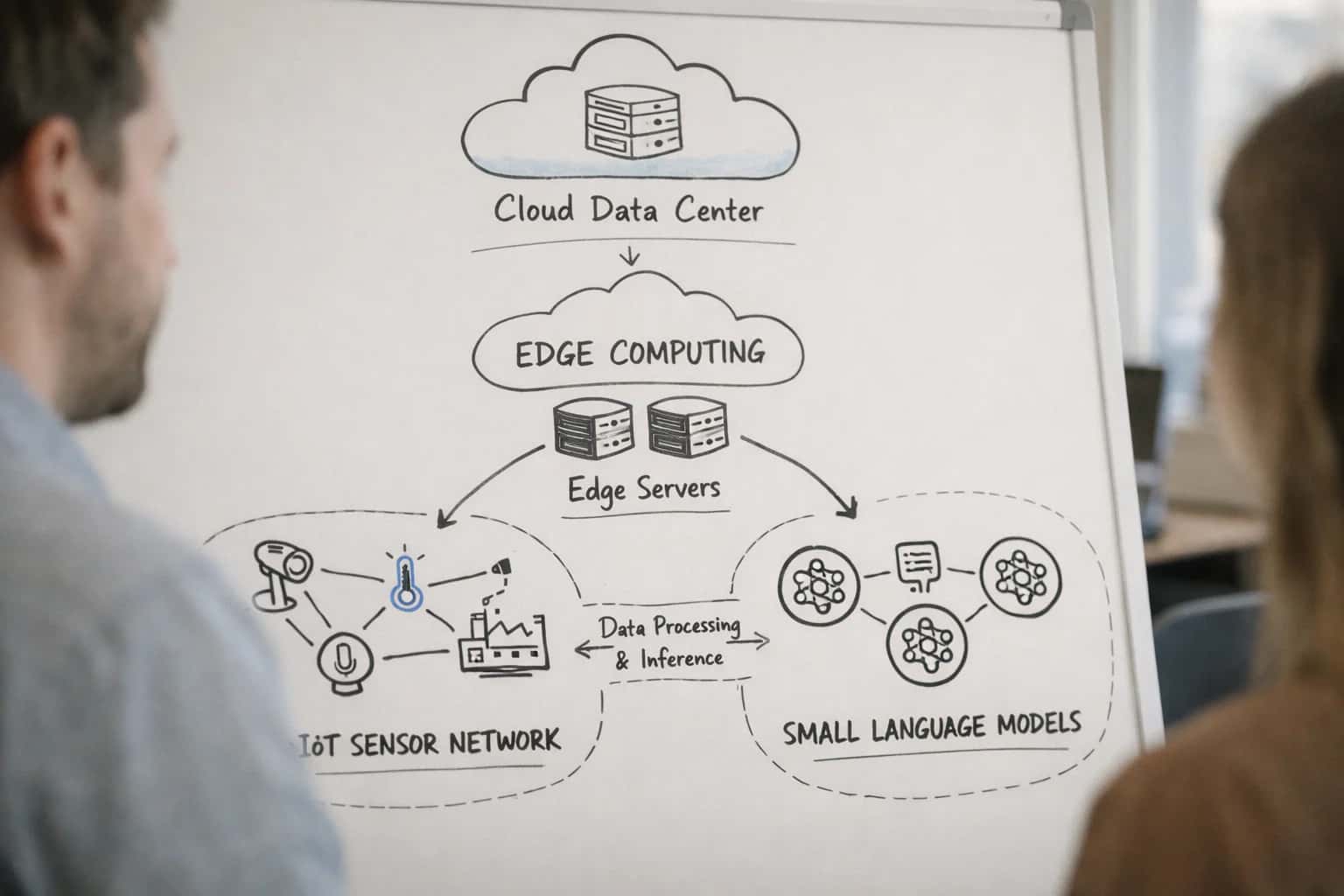
What is Energy Harvesting Integration?
Energy harvesting integration is the design of electronic systems to capture and utilize ambient energy from the environment to power computation, enabling self-sustaining or battery-less IoT and edge devices.
Successful integration hinges on matching the intermittent and low-power nature of harvested energy with the device's duty cycle and computational demands. Techniques like Maximum Power Point Tracking (MPTT), adaptive sampling, and duty cycling are critical. The system must operate within an energy budget, often targeting energy-neutral operation where long-term consumption does not exceed harvesting. This defines a strict energy-accuracy trade-off, influencing model architecture choices, inference scheduling, and the use of wake-on-event triggers from an always-on (AON) domain to minimize idle power.
Key Components of an Integrated System
An integrated energy harvesting system for TinyML devices is a multi-disciplinary design challenge. It requires the co-optimization of power electronics, energy storage, and ultra-low-power compute to enable reliable, battery-less operation.
Harvesting Transducers
These are the primary components that convert ambient energy into electrical energy. The choice of transducer dictates the system's operational environment and available power budget.
- Photovoltaic (PV) Cells: Convert light (indoor/outdoor) into DC power. Efficiency is highly dependent on light intensity and spectrum.
- Piezoelectric Generators: Convert mechanical vibration or pressure (e.g., from machinery, footsteps) into AC power via material strain.
- Thermoelectric Generators (TEGs): Generate power from temperature gradients (e.g., body heat, industrial processes) using the Seebeck effect.
- RF Energy Harvesters: Capture and rectify ambient radio frequency energy from sources like Wi-Fi, cellular, or dedicated RF transmitters.
Power Management IC (PMIC)
The PMIC is the critical intermediary between the variable, low-power harvesting source and the stable power rails required by the digital load (MCU, sensors). Its core functions are:
- Impedance Matching & Maximum Power Point Tracking (MPPT): Dynamically adjusts the electrical load on the harvester to extract the maximum available power, which varies with environmental conditions.
- AC-to-DC Rectification: Converts the alternating current (AC) from sources like piezoelectric harvesters into usable direct current (DC).
- Voltage Boosting/Regulation: Steps up the typically low, variable harvester voltage (e.g., 10s-100s of mV) to a stable system voltage (e.g., 1.8V, 3.3V).
- Cold-Start Circuitry: A dedicated ultra-low-power circuit that can bootstrap the system from a completely depleted state using the tiny initial energy from the harvester.
Energy Storage Element
Because ambient energy is often intermittent and variable, a storage buffer is essential to smooth supply and meet peak computational demands. Selection involves a trade-off between capacity, leakage, and charge/discharge characteristics.
- Supercapacitors (Ultracapacitors): Offer high power density and millions of charge cycles with very low leakage. Ideal for frequent, rapid charge/discharge cycles but have lower energy density than batteries.
- Thin-Film Batteries: Provide higher energy density in a small form factor. Modern variants like solid-state lithium have low self-discharge rates suitable for long-term energy storage.
- Hybrid Storage: A common architecture pairs a small supercapacitor to handle immediate peak loads with a thin-film battery for longer-term energy reserve, managed by the PMIC.
Ultra-Low-Power Load (TinyML System)
The computational load must be meticulously designed for energy-proportional computing. This is the integrated system's consumer of harvested energy.
- Microcontroller Unit (MCU): Selected for its nanoamp-level deep sleep currents and microamp/MHz active power consumption. Features like an Always-On (AON) domain are critical.
- Power-Aware TinyML Model: A model compressed via quantization and pruning, often deployed in a low-power inference mode. Architectures like early exit networks can further reduce average compute.
- Wake-on-Event Sensors: Analog sensors with comparators or digital sensors with built-in finite-state machines that can trigger an interrupt without waking the main MCU, enabling duty cycling.
- Power Gating & Clock Gating: Used aggressively at the hardware level to shut down unused peripherals and logic blocks.
Energy-Aware Runtime & Scheduler
This is the software intelligence that orchestrates the entire system based on available energy. It moves beyond simple duty cycling to energy-constrained scheduling.
- Energy Budgeting: The runtime monitors the state of charge of the storage element (e.g., capacitor voltage) to predict the available energy budget for the next operational cycle.
- Task Prioritization & Shedding: It schedules critical sensing and inference tasks first. Non-essential tasks (e.g., higher-fidelity sampling, model retraining) are deferred or skipped if the energy budget is low.
- Adaptive Performance Scaling: Dynamically adjusts system parameters like sensor sampling rate, MCU clock frequency (DVFS), or model precision based on the current energy harvest rate and task urgency.
- Goal: Energy-Neutral Operation: The scheduler's ultimate objective is to balance long-term energy consumption with harvesting, striving for perpetual operation.
System Integration & Co-Design
Successful integration is not merely connecting components; it requires a holistic, co-designed approach where each part is optimized in the context of the others.
- Matching Time Constants: Aligning the harvester's power profile (milliseconds for vibration, seconds for light), the storage element's charge time, and the load's burst duration.
- Cross-Layer Optimization: The TinyML model's architecture (e.g., sparsity) influences the MCU's active power, which dictates the PMIC's efficiency requirements, which depends on the harvester's output impedance.
- Energy Profiling Tools: Essential for measuring real power consumption of different operational states (sensing, inference, radio TX) to inform the scheduler's models and validate energy-neutral operation.
- Form Factor & Environment: The physical placement of transducers (e.g., solar cell location) and thermal management for TEGs are critical mechanical design considerations.
Energy Harvesting Integration
Energy harvesting integration is the design of electronic systems, particularly for IoT and edge devices, to capture and utilize ambient energy from sources like light, vibration, or RF waves to supplement or replace battery power.
Energy harvesting integration is the engineering discipline of designing systems to power TinyML devices from ambient sources like light, vibration, or thermal gradients. This approach aims for energy-neutral operation, where long-term consumption matches harvested input, enabling potentially perpetual function. The core challenge is managing the intermittent and variable nature of ambient power, which requires sophisticated power management and energy-constrained scheduling to ensure reliable computation.
Successful integration demands co-design across the power subsystem, computational load, and ML model. Key techniques include Maximum Power Point Tracking (MPPT) to optimize energy extraction, adaptive sampling rates to match data acquisition to available power, and duty cycling to align intensive inference bursts with energy availability. This creates a complex energy-accuracy trade-off, where model architecture and task scheduling must dynamically adapt to the real-time energy budget.
Common Ambient Energy Sources
Ambient energy sources provide the power for energy-harvesting systems. Each source is characterized by its power density, availability, and the specific transducers required for conversion into usable electrical energy.
Electromagnetic Induction
Electromagnetic induction harvests energy from time-varying magnetic fields, typically generated by AC power lines or electric motors, using a coil.
- Typical Power Density: µW to mW range, dependent on field strength and frequency.
- Key Transducer: Pick-up coil (inductor).
- Characteristics: Effective near infrastructure with strong, predictable 50/60 Hz fields (e.g., near electrical panels). Can be designed for non-contact energy transfer in specific applications.
Pyroelectric (Time-Varying Heat)
Pyroelectric materials generate a temporary voltage when they experience a change in temperature over time, unlike thermoelectric which requires a spatial gradient.
- Typical Power Density: Lower than thermoelectric for steady-state sources, but can pulse higher with rapid temperature fluctuations.
- Key Transducer: Pyroelectric crystal (e.g., PZT, LiTaO₃).
- Characteristics: Ideal for harvesting from intermittent or moving heat sources, such as people walking through a doorway or machinery with cyclical operation. Output is pulsed.
Frequently Asked Questions
Energy harvesting integration enables IoT and edge devices to operate perpetually by capturing ambient energy. This FAQ addresses the core engineering challenges and design principles for building self-sustaining, power-aware TinyML systems.
Energy harvesting integration is the system-level design practice of capturing ambient energy from the environment—such as light, vibration, thermal gradients, or RF waves—and conditioning it to power electronic devices, often replacing or supplementing batteries. It works by employing transducers (e.g., photovoltaic cells, piezoelectric elements) to convert ambient energy into electrical energy, which is then managed by a power management integrated circuit (PMIC). The PMIC performs Maximum Power Point Tracking (MPPT), stores energy in a capacitor or thin-film battery, and provides regulated voltage to the main system-on-chip and its always-on (AON) domain. The core design challenge is matching highly variable, low-power energy sources with the intermittent, duty-cycled operation of the compute and radio subsystems to achieve energy-neutral operation.
Enabling Efficiency, Speed & Accuracy
Intelligent Analysis, Decision & Execution
We build AI systems for teams that need search across company data, workflow automation across tools, or AI features inside products and internal software.
Talk to Us
Search across company data
Give teams answers from docs, tickets, runbooks, and product data with sources and permissions.
Useful when people spend too long searching or get different answers from different systems.

Automate internal workflows
Use AI to route work, draft outputs, trigger actions, and keep approvals and logs in place.
Useful when repetitive work moves across multiple tools and teams.

Add AI to products and internal tools
Build assistants, guided actions, or decision support into the software your team or customers already use.
Useful when AI needs to be part of the product, not a separate tool.

About the author
Prasad Kumkar
CEO & MD, Inference Systems
Prasad Kumkar is the CEO & MD of Inference Systems and writes about AI systems architecture, LLM infrastructure, model serving, evaluation, and production deployment. Over 5+ years, he has worked across computer vision models, L5 autonomous vehicle systems, and LLM research, with a focus on taking complex AI ideas into real-world engineering systems.
His work and writing cover AI systems, large language models, AI agents, multimodal systems, autonomous systems, inference optimization, RAG, evaluation, and production AI engineering.
Partnered with leading AI, data, and software stack.





How We Work
Custom AI workflows for your Business
One-fit-all AI don't work for modern businesses. At Inferensys, we aim to understand your business & custom requirements; which we use to define most efficient agentic workflows, the data, and the tools for your business.
01
Review the use case
We understand the task, the users, and where AI can actually help.
Read more02
Pick the right approach
We define what needs search, automation, or product integration.
Read more03
Build the first useful version
We implement the part that proves the value first.
Read more04
Improve from there
We add the checks and visibility needed to keep it useful.
Read moreThe first call is a practical review of your use case and the right next step.
Talk to Us