PEFT for Model Editing is a technique that applies parameter-efficient fine-tuning (PEFT) to correct or update specific factual knowledge within a pre-trained model by training only a small set of additional parameters, such as a LoRA adapter. This approach enables precise 'model repairs'—like correcting an outdated fact or adding a new entity—without the computational cost of full retraining and while minimizing unintended side-effects on the model's broader capabilities.

Glossary
PEFT for Model Editing
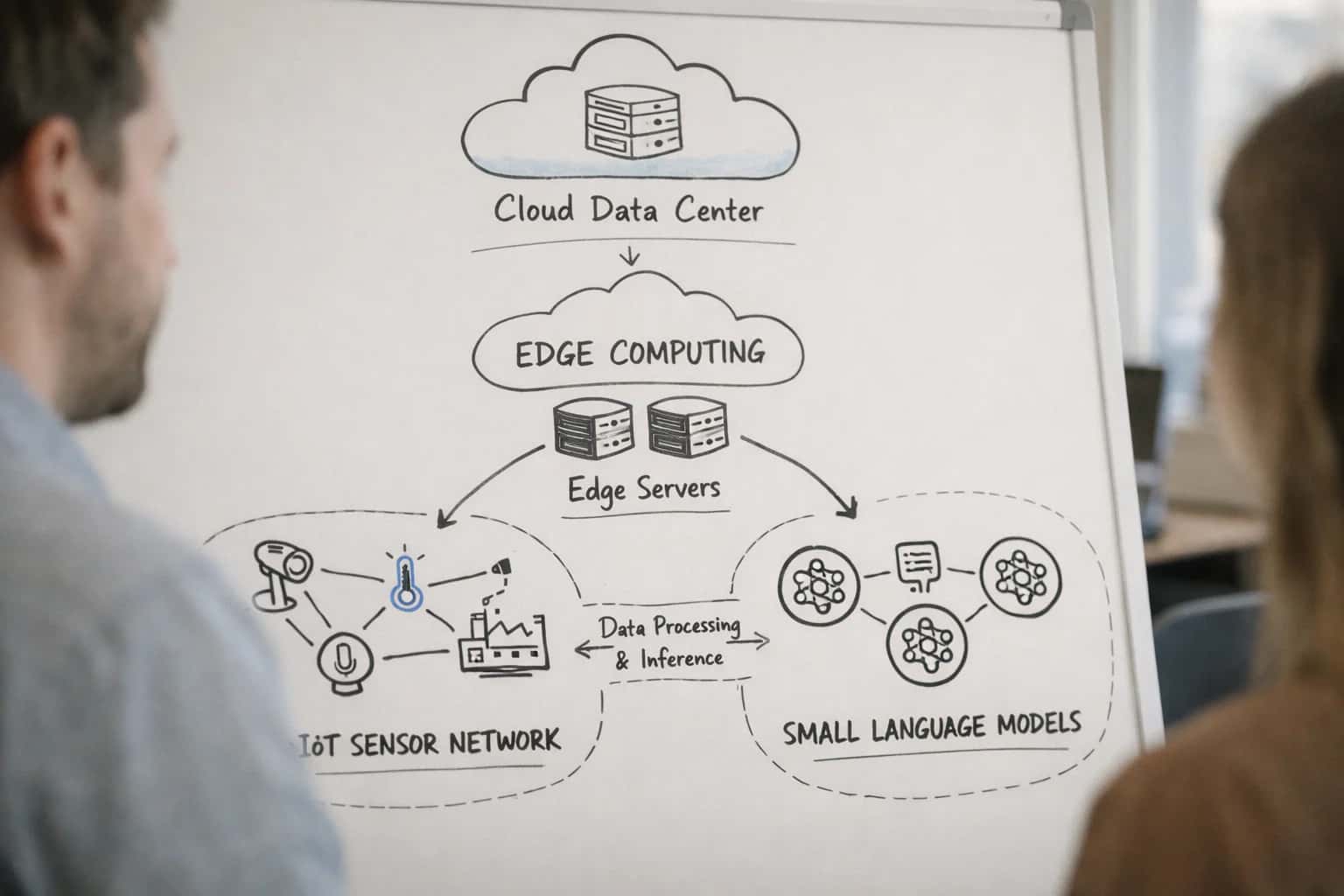
PEFT for Model Editing is the application of parameter-efficient fine-tuning to make localized, factual updates to a base model's knowledge by training a small adapter, enabling efficient and targeted model repairs directly on edge devices.
TECHNIQUE
What is PEFT for Model Editing?
PEFT for Model Editing is the application of parameter-efficient fine-tuning to make localized, factual updates to a base model's knowledge.
The process involves isolating the target knowledge, often via a contrastive dataset of correct and incorrect statements, and fine-tuning a small adapter module or low-rank matrices. This creates a compact 'delta' that modifies the model's behavior for the specific edit. The technique is foundational for on-device model editing, allowing efficient, localized updates directly on edge hardware without cloud dependency, supporting applications in continual learning and factual maintenance.
TARGETED MODEL REPAIR
Key Features of PEFT for Model Editing
PEFT for Model Editing applies parameter-efficient fine-tuning to make precise, factual updates to a base model's knowledge. By training only a small adapter, it enables efficient, localized corrections directly on edge devices.
01
Localized Factual Updates
PEFT for Model Editing enables targeted corrections to a model's knowledge without retraining the entire network. This is achieved by training a small adapter module (e.g., a LoRA matrix) on a minimal dataset containing the corrected fact and its context.
- Mechanism: The adapter learns a parameter delta that, when combined with the frozen base model, alters the model's output for a specific factual query.
- Example: Correcting a model's outdated knowledge that "The CEO of Company X is John Smith" to "The CEO of Company X is Jane Doe" by fine-tuning on a few corrected sentence pairs.
- Precision: Updates are designed to be localized, minimizing unintended side effects on the model's general knowledge or performance on unrelated tasks.
02
On-Device Execution
The core efficiency of PEFT allows the model editing process—training and inference—to occur entirely on the edge device. This is critical for applications requiring data privacy, low latency, or operation in disconnected environments.
- Training Loop: A lightweight edge training loop performs forward/backward passes on the adapter parameters using locally stored correction data.
- Resource Profile: Designed for low-memory PEFT, the process operates within the RAM, compute, and power constraints of edge hardware (e.g., smartphones, IoT gateways).
- Benefit: Eliminates the need to send sensitive or proprietary data to the cloud for model updates, ensuring data sovereignty and reducing bandwidth costs.
03
Delta Deployment & OTA Updates
This feature enables a highly efficient software update model for deployed AI systems. Only the small, trained adapter weights (the 'delta') are distributed, not the multi-gigabyte base model.
- PEFT Delta Deployment: The update package contains only the KB- or MB-sized adapter file, which is integrated with the pre-deployed base model on the device.
- Over-the-Air (OTA) PEFT: Adapter deltas can be wirelessly pushed to a fleet of devices to remotely patch factual errors, update product information, or apply regulatory changes.
- Impact: Reduces update bandwidth by orders of magnitude compared to full-model updates and enables rapid, scalable model repairs.
04
Modular & Swappable Adapters
Edited knowledge is encapsulated within discrete, independent adapter modules. This modularity allows for dynamic management of multiple corrections or domain-specific knowledge sets on a single device.
- Runtime Adapter Loading: The inference engine can dynamically load the specific adapter required for a given context or user query.
- Hot-Swappable Adapters: Adapters can be switched in and out of a running inference session, enabling A/B testing of corrections, user-specific personalization, or task-specific behavior without restarting the application.
- Organization: Adapters can be versioned and managed separately, creating an auditable trail of model edits.
05
Privacy-Preserving by Design
PEFT for Model Editing aligns with privacy-first AI principles. The correction data never leaves the device, and the resulting adapter can be further protected with privacy-enhancing technologies.
- On-Device Data: The factual corrections used for training are processed locally.
- Private PEFT: Techniques like PEFT with Differential Privacy (DP) can be applied during adapter training. DP adds calibrated noise to gradients, providing a mathematical guarantee that the final adapter weights do not reveal specifics of the individual correction examples.
- Federated PEFT Potential: For corrections learned across a device fleet, only the small adapter updates (not raw data) could be aggregated, minimizing privacy risk.
06
Hardware-Aware Optimization
The technique is designed with the constraints of edge hardware in mind, often involving co-design with the deployment stack to ensure efficiency.
- Quantization-Aware PEFT: Adapters can be trained using simulated low-precision arithmetic (e.g., INT8), ensuring they remain effective when deployed alongside a quantized base model on edge TPUs or NPUs.
- Toolchain Integration: Supported by edge ML deployment frameworks. For example, TFLite with PEFT allows for converting and running adapter-augmented models in TensorFlow Lite.
- Memory Management: Optimized for low peak RAM usage during both the editing (training) and inference phases, a necessity for microcontroller-level deployments.
COMPARISON
PEFT for Model Editing vs. Alternative Methods
A technical comparison of methods for making localized, factual updates to a pre-trained model's knowledge, highlighting the trade-offs between efficiency, specificity, and resource requirements.
| Feature / Metric | PEFT for Model Editing (e.g., LoRA Adapters) | Full Model Fine-Tuning | Prompt-Based Editing (In-Context Learning) | External Knowledge Base (RAG) |
|---|---|---|---|---|
Core Mechanism | Trains small adapter weights (delta) on corrective data | Retrains all model parameters on updated dataset | Prepends corrective facts/examples to the input prompt | Queries an external, updatable vector store or database at inference |
Parameter Efficiency | ||||
Update Specificity | High (localized to affected knowledge) | Low (global update, risk of catastrophic forgetting) | High (context-specific) | High (isolated to external store) |
On-Device Viability | ||||
Update Bandwidth Cost | < 1 MB (adapter only) |
| ~1-10 KB (prompt text) | Varies (index updates) |
Inference Latency Overhead | Low (< 5% for merged adapters) | None | High (increased context length) | High (retrieval + generation) |
Knowledge Persistence | Permanent (weights updated) | Permanent (weights updated) | Temporary (per session) | Permanent (in external store) |
Scalability for Mass Edits | Moderate (requires training per edit/batch) | Low (cost prohibitive) | Low (context window limits) | High (independent store management) |
Preserves Base Model Capabilities | ||||
Example Use Case | Correcting a model's outdated fact about a product spec | Completely retraining a model on a new company knowledge base | Temporarily providing the correct CEO name in a chat prompt | Connecting a chatbot to a live company documentation API |
PEFT FOR MODEL EDITING
Frequently Asked Questions
PEFT for Model Editing applies parameter-efficient fine-tuning to make localized, factual updates to a base model's knowledge. This FAQ addresses how this technique enables efficient, on-device model corrections.
PEFT for Model Editing is the application of parameter-efficient fine-tuning (PEFT) techniques to make precise, localized updates to a pre-trained model's knowledge or behavior by training only a small set of additional parameters, such as a LoRA adapter or prompt embeddings. This approach enables efficient correction of factual errors, updating of outdated information, or patching of undesirable behaviors without the computational cost of full model retraining. The core mechanism involves freezing the vast majority of the base model's weights and learning a compact parameter delta that, when combined with the base model, produces the desired edited output. This delta is often task-specific, allowing for targeted repairs—like correcting a model's answer about a specific historical date—while leaving its general knowledge intact. The resulting edited model is the sum of the original weights and the learned delta, enabling lightweight storage and deployment, which is ideal for edge and on-device AI scenarios where models must be updated directly in the field.
Enabling Efficiency, Speed & Accuracy
Intelligent Analysis, Decision & Execution
We build AI systems for teams that need search across company data, workflow automation across tools, or AI features inside products and internal software.
Talk to Us
Search across company data
Give teams answers from docs, tickets, runbooks, and product data with sources and permissions.
Useful when people spend too long searching or get different answers from different systems.
Enterprise searchRAGPermissions
Read more
Automate internal workflows
Use AI to route work, draft outputs, trigger actions, and keep approvals and logs in place.
Useful when repetitive work moves across multiple tools and teams.
AI agentsWorkflow automationGovernance
Read more
Add AI to products and internal tools
Build assistants, guided actions, or decision support into the software your team or customers already use.
Useful when AI needs to be part of the product, not a separate tool.
AI integrationDecision supportModel routing
Read more
About the author
Prasad Kumkar
CEO & MD, Inference Systems
Prasad Kumkar is the CEO & MD of Inference Systems and writes about AI systems architecture, LLM infrastructure, model serving, evaluation, and production deployment. Over 5+ years, he has worked across computer vision models, L5 autonomous vehicle systems, and LLM research, with a focus on taking complex AI ideas into real-world engineering systems.
His work and writing cover AI systems, large language models, AI agents, multimodal systems, autonomous systems, inference optimization, RAG, evaluation, and production AI engineering.
LinkedIn
Limited slotsGet a Free AI Consultation
Partnered with leading AI, data, and software stack.





How We Work
Custom AI workflows for your Business
One-fit-all AI don't work for modern businesses. At Inferensys, we aim to understand your business & custom requirements; which we use to define most efficient agentic workflows, the data, and the tools for your business.
01
Review the use case
We understand the task, the users, and where AI can actually help.
Read more02
Pick the right approach
We define what needs search, automation, or product integration.
Read more03
Build the first useful version
We implement the part that proves the value first.
Read more04
Improve from there
We add the checks and visibility needed to keep it useful.
Read moreThe first call is a practical review of your use case and the right next step.
Talk to Us