PEFT for Domain Adaptation tailors a large, frozen base model by training only a small set of additional or modified parameters—such as LoRA matrices or adapter modules—on data from a target domain. This creates a compact, domain-specific 'delta' that adjusts the model's behavior for contexts like a particular factory's sensor patterns, a geographic region's speech accents, or a user demographic's interaction style, without the cost of full retraining.

Glossary
PEFT for Domain Adaptation
PEFT for Domain Adaptation is the use of parameter-efficient fine-tuning methods to adapt a general-purpose pre-trained model to a specific edge deployment environment by learning a compact set of domain-specific parameters.
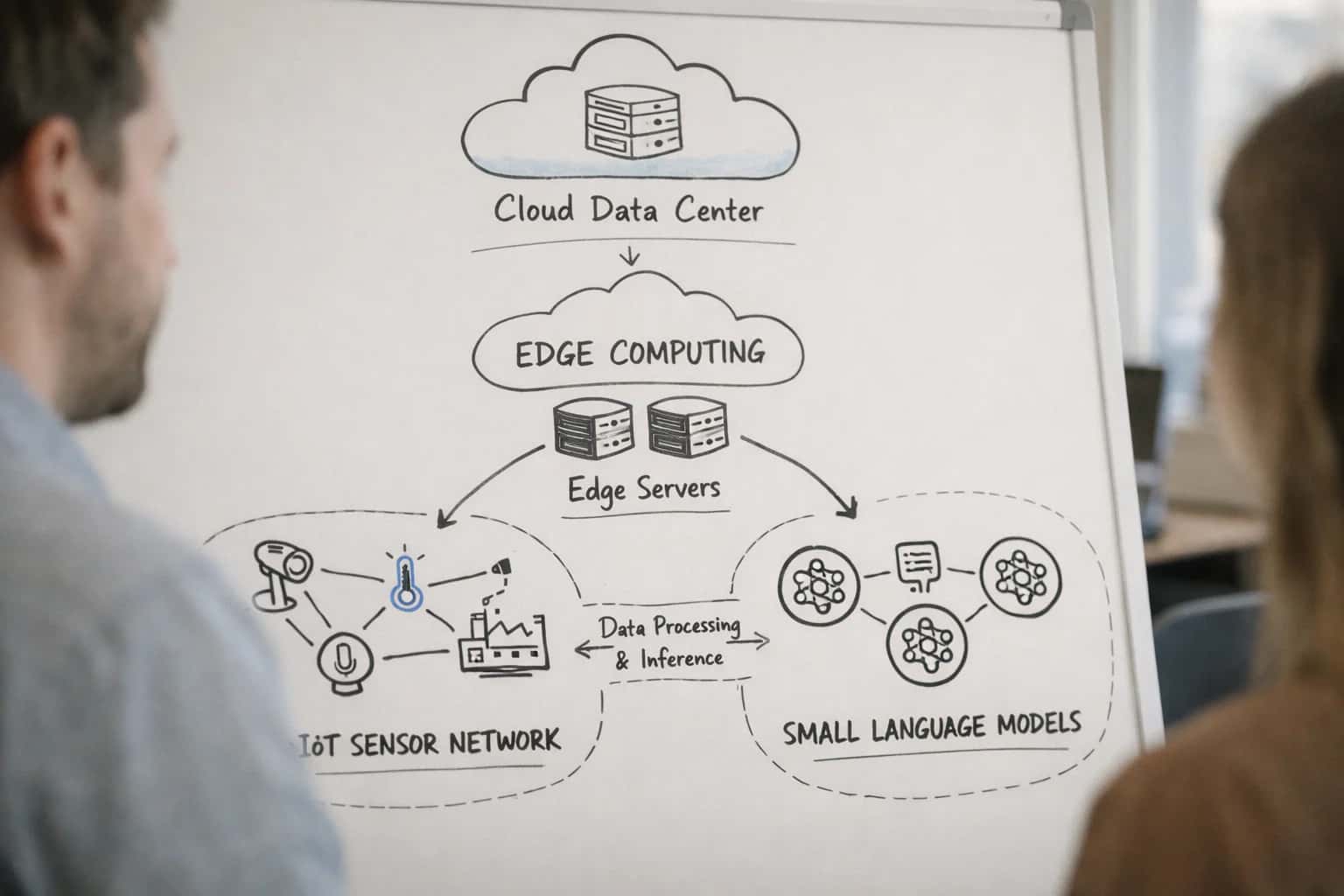
PARAMETER-EFFICIENT FINE-TUNING
What is PEFT for Domain Adaptation?
PEFT for Domain Adaptation is the application of parameter-efficient fine-tuning methods to specialize a general-purpose pre-trained model for a specific operational environment or data distribution.
The technique is foundational for edge AI, enabling efficient, on-device personalization and adaptation where data privacy, low latency, and bandwidth constraints are paramount. By updating only a tiny fraction of the total parameters, it allows rapid deployment of specialized models, supports over-the-air updates of just the adapter weights, and facilitates federated learning scenarios where devices collaboratively learn domain adaptations without sharing raw data.
PEFT FOR DOMAIN ADAPTATION
Core Mechanisms and Techniques
Domain adaptation with PEFT involves specialized techniques to efficiently align a general-purpose model with the unique statistical properties of a target environment, such as a specific sensor suite, user demographic, or geographic location, by updating only a compact set of parameters.
01
Adapter-Based Domain Specialization
This technique inserts small, trainable neural network modules (Adapters) between the frozen layers of a pre-trained model. During adaptation, only these adapter parameters are updated using domain-specific data. This allows a single base model (e.g., a vision transformer) to host multiple, lightweight domain experts—such as one adapter for urban street scenes and another for rural road conditions—that can be dynamically loaded at the edge based on the deployment context.
02
Low-Rank Adaptation (LoRA) for Edge Domains
LoRA is a dominant PEFT method that approximates the weight update for a pre-trained matrix with the product of two low-rank matrices. For domain adaptation, this is highly efficient:
- Minimal Overhead: The low-rank matrices (e.g., rank=8) are orders of magnitude smaller than the original weights.
- Mergeable Weights: After training, the adapter matrices can be merged with the base model for zero-inference-overhead deployment, or kept separate for hot-swapping.
- Example: Adapting a keyword spotting model for a specific factory's acoustic environment by training LoRA matrices on local noise and command samples.
03
Prompt & Prefix Tuning for Contextual Shifts
Instead of modifying model weights, these methods optimize continuous embedding vectors that are prepended to the input or hidden states. For domain adaptation on edge devices:
- Prefix Tuning: Learns a sequence of task-specific vectors that steer the model's attention for the target domain.
- Efficiency: Only these prefix parameters are stored and updated, requiring minimal memory—ideal for updating a model's behavior for a new regional dialect or user interface without altering its core knowledge.
- Use Case: Quickly adapting a language model for technical support in a specific industry by learning a domain-specific prompt embedding.
04
Sparse & Selective Fine-Tuning
This approach identifies and updates only a strategic subset of the model's original parameters that are most relevant to the domain shift. Techniques include:
- Diff Pruning: Learns a sparse "diff" vector applied to a subset of base weights.
- BitFit: Updates only the bias terms within the model.
- Domain Relevance Scoring: Uses metrics to select neurons or attention heads most sensitive to the new domain's data. This maximizes adaptation impact per updated parameter, crucial for memory-constrained on-device training loops.
05
Delta Tuning & Modular Composition
This is the overarching paradigm where adaptation is conceptualized as learning a small parameter change (delta). The core techniques (Adapters, LoRA) are implementations of this idea. For edge deployment, it enables:
- Modular Storage: The base model and multiple domain deltas (e.g., for different sensor types) are stored separately.
- Composition: Deltas can be added or composed (e.g., a base delta for manufacturing plus a specific delta for Machine A).
- Bandwidth-Efficient Updates: Only the small delta file needs to be distributed Over-the-Air (OTA) to update all devices in a fleet to a new domain version.
06
Hardware-Aware PEFT Optimization
Effective edge deployment requires co-designing the PEFT method with the target hardware's constraints.
- Quantization-Aware Training (QAT): Fine-tuning adapter parameters while simulating INT8/FP16 precision ensures stability post-deployment.
- Memory-Aware Algorithms: Techniques are chosen or designed to minimize peak RAM usage during the on-device training loop, a critical constraint for microcontrollers.
- Compiler Integration: Adapter operations are optimized via frameworks like TensorFlow Lite or Edge Impulse to leverage available NPU/DSP accelerators, turning abstract efficiency into real latency and power gains.
COMPARISON
PEFT for Domain Adaptation vs. Traditional Methods
A feature and performance comparison between Parameter-Efficient Fine-Tuning (PEFT) approaches and traditional full fine-tuning for adapting models to specific edge domains.
| Feature / Metric | PEFT for Domain Adaptation | Traditional Full Fine-Tuning | No Adaptation (Base Model) |
|---|---|---|---|
Primary Adaptation Mechanism | Learns compact domain-specific parameters (e.g., LoRA matrices, Adapters) | Updates all or a large subset of the base model's parameters | Uses generic pre-trained weights; no domain-specific learning |
Compute & Memory Cost for Adaptation | Low (1-10% of base model parameters) | Very High (100% of base model parameters) | None |
Typical Adaptation Time | Minutes to hours on edge-grade hardware | Hours to days on cloud/GPU clusters | N/A |
Update/Deployment Bandwidth | < 10 MB (adapter delta only) | 100s MB to GB+ (full model checkpoint) | N/A |
On-Device Inference Memory Overhead | Low (adds 1-5% to base model footprint) | High (requires full updated model in memory) | Baseline (base model only) |
Privacy & Data Sovereignty | High (data never leaves device; only small, abstract updates may be shared) | Low (requires centralizing sensitive domain data for training) | High (no training data required) |
Support for Per-Device/User Personalization | |||
Catastrophic Forgetting Risk | Very Low (base model knowledge is frozen) | High (can overwrite general knowledge) | N/A |
Domain-Specific Accuracy Gain | High (targeted, efficient learning) | Very High (maximum representational capacity) | Low (generic knowledge only) |
Hardware & Toolchain Requirements | Optimized for edge runtimes (TFLite, ONNX Runtime); supports quantization | Requires full training infrastructure (GPUs, frameworks like PyTorch) | Standard inference runtime |
PEFT FOR DOMAIN ADAPTATION
Frequently Asked Questions
Parameter-Efficient Fine-Tuning (PEFT) enables the rapid customization of large pre-trained models for specific edge environments. This FAQ addresses how these techniques work for domain adaptation on resource-constrained devices.
PEFT for Domain Adaptation is the application of parameter-efficient fine-tuning methods to specialize a general-purpose, pre-trained model for a specific deployment environment—such as a particular factory's acoustic signature, a geographic region's visual conditions, or a user demographic's linguistic patterns—by learning and deploying only a compact set of domain-specific parameters (the 'delta') while the core model remains frozen.
This approach is critical for edge AI because it allows a single, powerful base model (e.g., a vision transformer or a time-series encoder) to be efficiently tailored to countless unique real-world contexts without the prohibitive cost of full retraining for each scenario. The adaptation focuses on capturing the statistical distribution shift between the model's original training data and the target domain's data. By updating only a small fraction of the total parameters (often less than 1-5%), it minimizes the computational, memory, and energy overhead required for both the adaptation phase and the subsequent inference, making it feasible for on-device learning.
Enabling Efficiency, Speed & Accuracy
Intelligent Analysis, Decision & Execution
We build AI systems for teams that need search across company data, workflow automation across tools, or AI features inside products and internal software.
Talk to Us
Search across company data
Give teams answers from docs, tickets, runbooks, and product data with sources and permissions.
Useful when people spend too long searching or get different answers from different systems.
Enterprise searchRAGPermissions
Read more
Automate internal workflows
Use AI to route work, draft outputs, trigger actions, and keep approvals and logs in place.
Useful when repetitive work moves across multiple tools and teams.
AI agentsWorkflow automationGovernance
Read more
Add AI to products and internal tools
Build assistants, guided actions, or decision support into the software your team or customers already use.
Useful when AI needs to be part of the product, not a separate tool.
AI integrationDecision supportModel routing
Read more
About the author
Prasad Kumkar
CEO & MD, Inference Systems
Prasad Kumkar is the CEO & MD of Inference Systems and writes about AI systems architecture, LLM infrastructure, model serving, evaluation, and production deployment. Over 5+ years, he has worked across computer vision models, L5 autonomous vehicle systems, and LLM research, with a focus on taking complex AI ideas into real-world engineering systems.
His work and writing cover AI systems, large language models, AI agents, multimodal systems, autonomous systems, inference optimization, RAG, evaluation, and production AI engineering.
LinkedIn
Limited slotsGet a Free AI Consultation
Partnered with leading AI, data, and software stack.





How We Work
Custom AI workflows for your Business
One-fit-all AI don't work for modern businesses. At Inferensys, we aim to understand your business & custom requirements; which we use to define most efficient agentic workflows, the data, and the tools for your business.
01
Review the use case
We understand the task, the users, and where AI can actually help.
Read more02
Pick the right approach
We define what needs search, automation, or product integration.
Read more03
Build the first useful version
We implement the part that proves the value first.
Read more04
Improve from there
We add the checks and visibility needed to keep it useful.
Read moreThe first call is a practical review of your use case and the right next step.
Talk to Us