Continual Edge Learning (CEL) is a machine learning paradigm enabling a deployed model on a resource-constrained device to learn sequentially from new data streams without catastrophic forgetting, using Parameter-Efficient Fine-Tuning (PEFT) techniques like Low-Rank Adaptation (LoRA). This allows the model to adapt to new tasks, personalize for users, or adjust to domain shifts entirely on-device, preserving data privacy and operational autonomy by eliminating the need for cloud retraining.

Glossary
Continual Edge Learning
Continual Edge Learning is a system capability where an edge device uses Parameter-Efficient Fine-Tuning (PEFT) to sequentially adapt a model to new tasks or data over time, while mitigating catastrophic forgetting within local resource constraints.
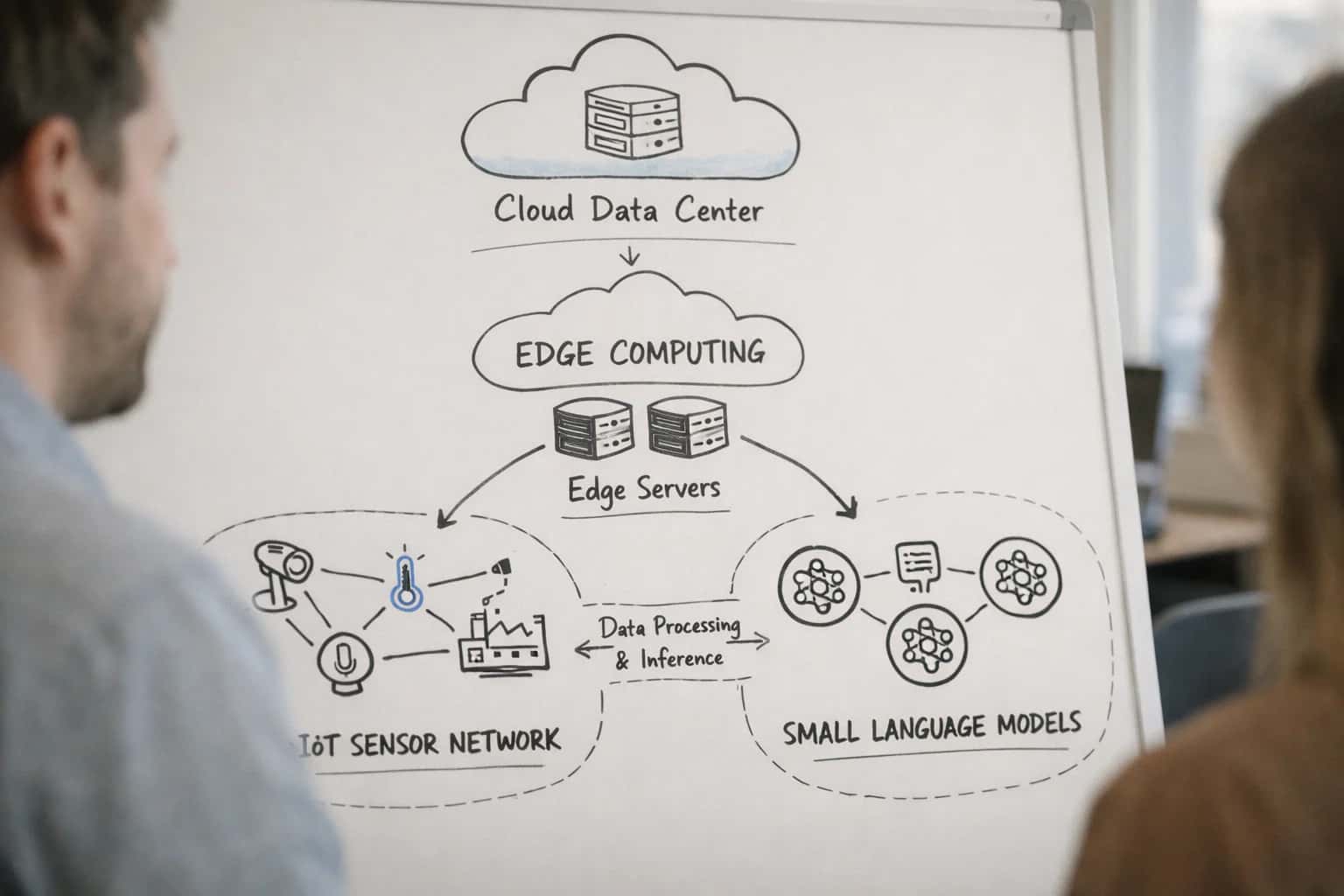
SYSTEM CAPABILITY
What is Continual Edge Learning?
Continual Edge Learning is a system capability where an edge device uses PEFT techniques to sequentially adapt a model to new tasks or data distributions over time, while employing strategies to mitigate catastrophic forgetting, all within local resource constraints.
The core engineering challenge of CEL is balancing adaptation with stability under strict memory, compute, and power budgets. Systems implement replay buffers, regularization, or modular PEFT adapters to protect previously learned knowledge. This capability is foundational for applications like predictive maintenance, where a sensor model must continually refine its understanding of a specific machine's degradation patterns without forgetting general fault signatures learned during initial training.
ARCHITECTURAL ELEMENTS
Core Components of a Continual Edge Learning System
A Continual Edge Learning system is a closed-loop architecture that enables an on-device model to adapt sequentially to new tasks or data distributions. Its core components manage the local learning process, resource constraints, and knowledge integration.
01
Local PEFT Training Loop
The on-device software routine that executes the parameter-efficient fine-tuning process. It performs forward/backward passes using only locally generated data, updating a small subset of parameters (e.g., LoRA matrices, adapter layers). This loop must operate within strict memory, compute, and power budgets, often using optimizers like SGD with momentum and managing micro-batches of data. It is the engine of continuous adaptation.
02
Catastrophic Forgetting Mitigation
A set of algorithms integrated into the training loop to preserve knowledge from previous tasks while learning new ones. Key strategies include:
- Elastic Weight Consolidation (EWC): Penalizes changes to parameters deemed important for past tasks.
- Experience Replay: Stores a small, representative subset of old data in a replay buffer for periodic retraining.
- Regularized PEFT: Applies sparsity or orthogonality constraints to adapter weights to minimize interference. These mechanisms are critical for maintaining model stability over time.
03
Resource-Constrained Orchestrator
The system-level controller that manages the lifecycle of continual learning. It makes critical decisions based on available resources, such as:
- Triggering adaptation only when sufficient new data is collected and device state (battery, temperature, idle cycles) permits.
- Managing the replay buffer size and pruning strategy.
- Handling checkpointing of adapter states to non-volatile memory. This component ensures learning occurs without degrading the device's primary function or exceeding its limits.
05
Privacy-Preserving Data Manager
Handles the local data lifecycle required for training. This includes:
- Secure, on-device storage for the training dataset and replay buffer.
- Data preprocessing and augmentation pipelines that run locally.
- Optional privacy filters that apply techniques like differential privacy to training gradients or sanitize data before storage. This component ensures that sensitive user or operational data never leaves the device, which is a foundational requirement for consumer and industrial applications.
06
Lightweight Evaluation Module
A minimalistic monitoring system that runs on-device to assess the performance of the adapted model. It tracks key metrics like task accuracy, loss on a held-out validation set, and inference latency. This feedback is used by the orchestrator to decide if a new adapter is performing adequately or if a rollback to a previous stable state is necessary. It provides the essential feedback for a self-regulating system.
SYSTEM CAPABILITY
How Does Continual Edge Learning Work?
Continual Edge Learning is a system capability where an edge device uses PEFT techniques to sequentially adapt a model to new tasks or data distributions over time, while employing strategies to mitigate catastrophic forgetting, all within local resource constraints.
Continual Edge Learning operates through a local Edge Training Loop that executes on-device. This loop uses Parameter-Efficient Fine-Tuning (PEFT) methods, like Low-Rank Adaptation (LoRA), to update only a tiny subset of the model's parameters with new, locally collected data. This process occurs entirely within the device's strict memory and power budgets, enabling adaptation without cloud connectivity or transferring sensitive raw data off the device.
To prevent catastrophic forgetting of previously learned tasks, the system employs strategies such as rehearsal (storing a small buffer of old data), elastic weight consolidation, or training separate, task-specific adapters. The compact PEFT Delta—the small set of updated weights—can then be deployed Over-the-Air (OTA) to other devices, enabling efficient fleet-wide learning while the core base model remains stable and shared.
CONTINUAL EDGE LEARNING
Examples and Use Cases
Continual Edge Learning enables devices to adapt autonomously over time. These cards illustrate its practical applications across industries, highlighting how small, efficient updates solve real-world problems on constrained hardware.
01
Personalized Voice Assistants
A smart speaker uses Continual Edge Learning to adapt its keyword spotting and speech recognition model to a specific user's accent, vocabulary, and home environment. Using a PEFT method like Edge-LoRA, the device fine-tunes a small adapter on-device.
- Process: The base acoustic model remains frozen. Only a low-rank adapter is updated with local audio data.
- Benefit: Improves accuracy for 'wake word' detection and command understanding without sending private conversations to the cloud.
- Outcome: The device becomes more responsive to its primary user over time, while the core model remains efficient for all users.
< 50 MB
Adapter Memory
On-Device
Data Privacy
02
Predictive Maintenance on Factory Robots
An industrial robotic arm is equipped with vibration and thermal sensors. A pre-trained anomaly detection model is deployed to its edge controller. Using Continual Edge Learning, the model adapts to the arm's unique 'normal' operational signature.
- Process: An Edge Training Loop runs during scheduled downtime, using PEFT for Sensor Data to update a small set of parameters against new vibration patterns.
- Benefit: Catches subtle, machine-specific wear patterns that a generic model would miss, enabling true predictive maintenance.
- Outcome: Reduces unplanned downtime by predicting bearing failures weeks in advance, with all learning occurring locally on the factory floor.
> 95%
Early Detection Rate
Local Only
Data Sovereignty
04
Medical Device Personalization
A wearable glucose monitor uses a model to predict blood sugar trends. Continual Edge Learning enables the device to personalize its predictions to the individual user's physiology and daily routines.
- Process: Using Private PEFT techniques, the device trains a user-specific adapter on local health data. Methods like PEFT with Differential Privacy can be applied to ensure no raw health data leaks from the adapter weights.
- Benefit: Delivers more accurate, personalized health insights while keeping all sensitive biometric data on the wearable.
- Outcome: Improves patient outcomes through tailored predictions and enhances compliance with strict healthcare data regulations like HIPAA.
HIPAA/GDPR
Compliant by Design
05
Federated Fleet Learning for Autonomous Vehicles
A fleet of delivery robots encounters new, rare road scenarios (e.g., unique construction signage). Each robot uses Continual Edge Learning to adapt its perception model locally. Federated PEFT aggregates these learnings.
- Process: Each robot trains a small PEFT adapter (e.g., for its vision backbone) to handle the new scenario. Only the tiny adapter updates, not the full model, are sent to a central server for secure aggregation.
- Benefit: The entire fleet's collective intelligence improves without any vehicle sharing raw camera footage, preserving privacy and saving bandwidth.
- Outcome: Enables scalable, privacy-preserving improvement of autonomy algorithms across a globally distributed system.
~100 KB
Update Size
Decentralized
Learning
COMPARISON
Continual Edge Learning vs. Related Paradigms
A technical comparison of Continual Edge Learning with other adaptation and deployment paradigms, highlighting key architectural and operational differences.
| Feature / Metric | Continual Edge Learning | On-Device PEFT | Federated Learning | Traditional Cloud Fine-Tuning |
|---|---|---|---|---|
Primary Objective | Sequential task adaptation on a single device over time | One-time adaptation of a model on a device | Collaborative model improvement across a device fleet | Centralized model training or adaptation |
Learning Scope | Sequential tasks or non-stationary data streams | Single, static task or domain | Single, static global task | Single, static task or domain |
Key Challenge Addressed | Catastrophic forgetting in resource-constrained environments | Memory and compute limits for on-device adaptation | Data privacy and communication bandwidth | Compute cost and data centralization |
Data Locality | Data never leaves the device | Data never leaves the device | Raw data never leaves devices; only updates are shared | Data is centralized to a cloud/server |
Update Granularity | Small PEFT adapters per task/experience | Small PEFT adapter for the target task | Full model or PEFT adapter updates aggregated from devices | Full model parameter updates |
Communication Overhead | None (purely local) or OTA for adapter distribution | None (purely local) | High for full model, Low for PEFT (adapter-only) | Very High (data transfer to cloud) |
Typical Hardware Target | Mid-tier edge devices (e.g., Raspberry Pi, Jetson) | Broad range (mobile phones to microcontrollers) | Cross-device (phones, IoT devices) | Cloud GPUs/TPUs |
Privacy Guarantee | Strong (local data processing) | Strong (local data processing) | Strong (via cryptographic aggregation) | Weak (data is centrally stored) |
Adaptation Trigger | Continuous, driven by local data distribution shift | One-off, triggered by deployment or user action | Periodic, server-coordinated rounds | Manual, engineer-initiated cycles |
Inference Flexibility | Dynamic adapter stacking/selection for multiple learned tasks | Single, static adapter for the deployed task | Single, static global model | Single, static fine-tuned model |
Example Use Case | A security camera adapting to new objects over seasons | Personalizing a voice assistant on a smartphone | Improving a next-word prediction model across phones | Training a customer service chatbot on proprietary logs |
CONTINUAL EDGE LEARNING
Frequently Asked Questions
Continual Edge Learning enables devices to adapt AI models locally over time. This FAQ addresses the core mechanisms, challenges, and applications of this critical capability for on-device intelligence.
Continual Edge Learning is a system capability where an edge device uses Parameter-Efficient Fine-Tuning (PEFT) techniques to sequentially adapt a pre-trained model to new tasks or data distributions over time, while employing strategies to mitigate catastrophic forgetting, all within local computational, memory, and power constraints.
Unlike traditional cloud-based training, the entire learning loop—data collection, gradient computation, and parameter updates—occurs on the device itself. This enables privacy preservation, real-time personalization, and operational resilience in disconnected environments. The core challenge is balancing the need to learn from new data with the imperative to retain previously acquired knowledge, using only the limited resources of an edge node.
Enabling Efficiency, Speed & Accuracy
Intelligent Analysis, Decision & Execution
We build AI systems for teams that need search across company data, workflow automation across tools, or AI features inside products and internal software.
Talk to Us
Search across company data
Give teams answers from docs, tickets, runbooks, and product data with sources and permissions.
Useful when people spend too long searching or get different answers from different systems.
Enterprise searchRAGPermissions
Read more
Automate internal workflows
Use AI to route work, draft outputs, trigger actions, and keep approvals and logs in place.
Useful when repetitive work moves across multiple tools and teams.
AI agentsWorkflow automationGovernance
Read more
Add AI to products and internal tools
Build assistants, guided actions, or decision support into the software your team or customers already use.
Useful when AI needs to be part of the product, not a separate tool.
AI integrationDecision supportModel routing
Read more
About the author
Prasad Kumkar
CEO & MD, Inference Systems
Prasad Kumkar is the CEO & MD of Inference Systems and writes about AI systems architecture, LLM infrastructure, model serving, evaluation, and production deployment. Over 5+ years, he has worked across computer vision models, L5 autonomous vehicle systems, and LLM research, with a focus on taking complex AI ideas into real-world engineering systems.
His work and writing cover AI systems, large language models, AI agents, multimodal systems, autonomous systems, inference optimization, RAG, evaluation, and production AI engineering.
LinkedIn
Limited slotsGet a Free AI Consultation
Partnered with leading AI, data, and software stack.





How We Work
Custom AI workflows for your Business
One-fit-all AI don't work for modern businesses. At Inferensys, we aim to understand your business & custom requirements; which we use to define most efficient agentic workflows, the data, and the tools for your business.
01
Review the use case
We understand the task, the users, and where AI can actually help.
Read more02
Pick the right approach
We define what needs search, automation, or product integration.
Read more03
Build the first useful version
We implement the part that proves the value first.
Read more04
Improve from there
We add the checks and visibility needed to keep it useful.
Read moreThe first call is a practical review of your use case and the right next step.
Talk to Us