Edge Impulse with PEFT denotes a specialized workflow within the Edge Impulse development platform that incorporates parameter-efficient fine-tuning methodologies. This integration allows engineers to collect sensor data, design features, and perform efficient model adaptation for TinyML applications entirely through a streamlined web interface. The platform automates the process of injecting and training compact adapter modules, such as Low-Rank Adaptation (LoRA) or Adapters, into a frozen base model, drastically reducing the compute, memory, and data required for on-device personalization.

Glossary
Edge Impulse with PEFT
Edge Impulse with PEFT is the integration of parameter-efficient fine-tuning workflows into the Edge Impulse platform, enabling efficient on-device model adaptation for TinyML applications through a streamlined web interface.
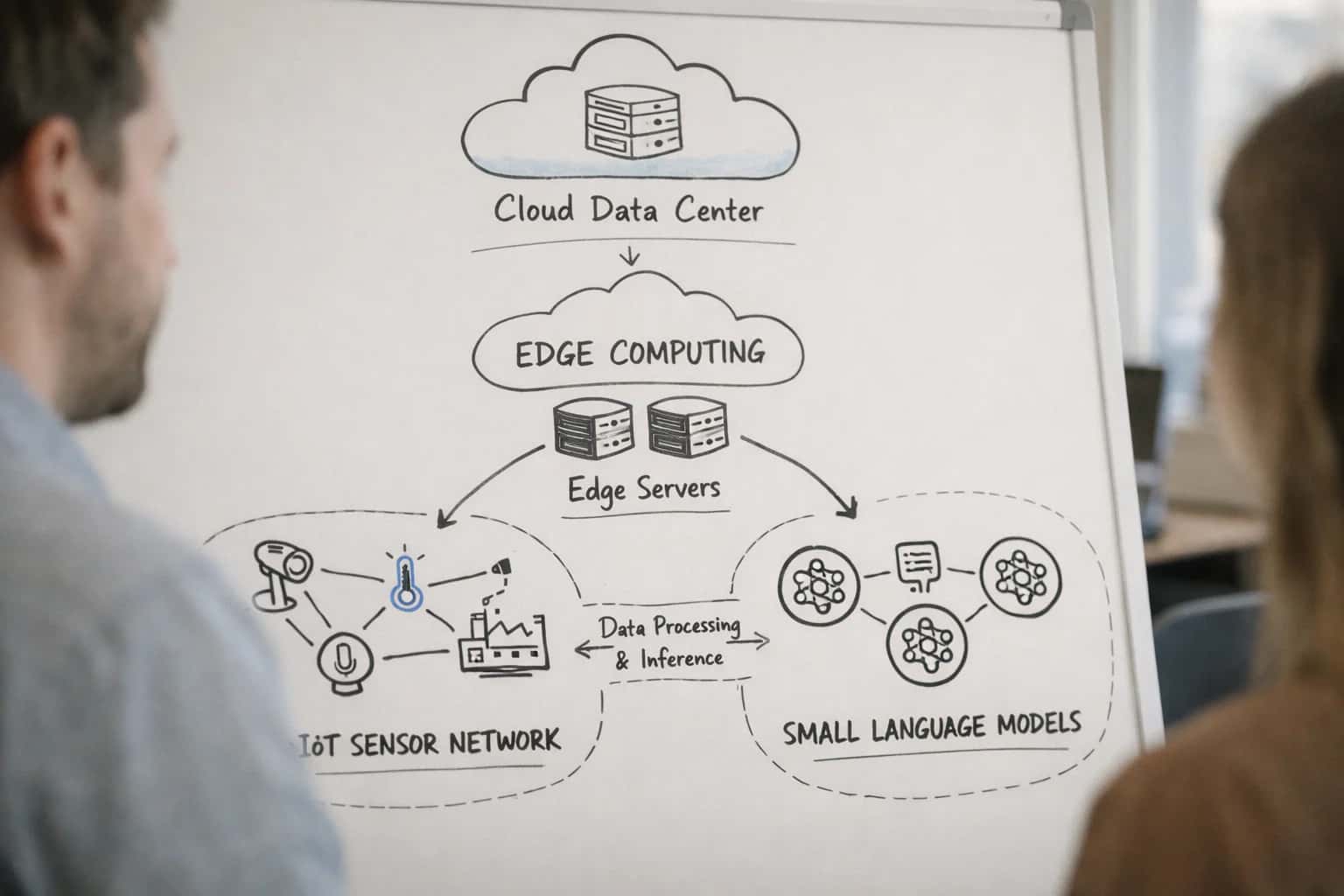
TINYML PLATFORM INTEGRATION
What is Edge Impulse with PEFT?
Edge Impulse with PEFT is the integration of Parameter-Efficient Fine-Tuning (PEFT) workflows into the Edge Impulse platform, enabling developers to adapt large pre-trained models for on-device inference using minimal computational resources.
This capability is critical for deploying adaptable AI on resource-constrained microcontrollers and edge devices. By leveraging PEFT within Edge Impulse, developers can perform domain adaptation for specific sensor environments, enable user-specific personalization with private on-device data, and deploy updates via Over-the-Air (OTA) PEFT delta files. The platform handles the underlying complexity of quantization-aware training and TFLite conversion, ensuring the final adapted model is optimized for efficient execution on target hardware like ARM Cortex-M or ESP32 chips.
PLATFORM CAPABILITIES
Key Features of Edge Impulse with PEFT
Edge Impulse integrates Parameter-Efficient Fine-Tuning (PEFT) into its end-to-end TinyML development platform, enabling developers to adapt powerful pre-trained models for edge devices through a streamlined, web-based workflow.
01
Unified Data-to-Deployment Pipeline
Edge Impulse provides a single platform for the entire PEFT workflow. Developers can:
- Collect and label sensor data directly from connected devices.
- Design DSP blocks to extract optimal features for time-series or audio models.
- Select a pre-trained model from a curated hub or upload a custom base model.
- Configure PEFT parameters (e.g., LoRA rank, adapter placement) via a visual interface.
- Initiate training which runs optimized, hardware-aware fine-tuning jobs in the cloud or via enterprise compute.
- Deploy the adapted model as a production-ready C++ library, Arduino library, or WebAssembly module.
02
Hardware-Optimized PEFT Implementations
The platform abstracts hardware constraints by automatically applying optimizations for the target deployment device:
- Quantization-Aware Training (QAT): PEFT training incorporates simulated quantization (e.g., INT8) to ensure adapter weights perform accurately when deployed with quantized base models.
- Memory-Constrained Adapter Design: Recommends PEFT configurations (like LoRA rank) based on the target MCU's available RAM and flash memory.
- Accelerator Compatibility: Generates deployment code optimized for specific NPUs, DSPs, or CPU instruction sets (e.g., ARM CMSIS-NN).
- Static Memory Allocation: Produces inference code with fixed, predictable memory footprints critical for MCUs.
03
Streamlined On-Device Learning Loop
Edge Impulse facilitates the complete edge learning cycle, enabling models to adapt after deployment:
- Data Collection & Triggering: Devices can be configured to collect new training data based on specific triggers (e.g., user feedback, anomaly detection).
- Secure Data Upload: New, labeled data is encrypted and uploaded to the project.
- Incremental PEFT Retraining: A new adapter is trained on the combined dataset, leveraging previous adapters as a starting point for efficient continual learning.
- Delta Deployment: Only the small, updated adapter weights (the 'delta') are sent Over-the-Air (OTA) to the device fleet.
- Runtime Adapter Swapping: The edge inference engine can hot-swap the new adapter module without rebooting, enabling seamless model updates.
04
Enterprise-Grade Collaboration & MLOps
The platform scales PEFT development across teams and production fleets:
- Version Control for Adapters: Track different adapter versions (e.g., for different device models, users, or locations) alongside base model versions.
- A/B Testing & Canary Deployment: Deploy different PEFT adapters to subsets of a device fleet to compare performance metrics before full rollout.
- Performance Monitoring: Collect real-time inference metrics (latency, memory usage, accuracy) from deployed devices to monitor adapter performance.
- Access Controls & Audit Logs: Manage team permissions for data, models, and deployment jobs, with full activity logging for compliance.
05
Pre-Trained Model Hub & Transfer Learning
Accelerates development by providing optimized base models and facilitating knowledge transfer:
- Curated Model Zoo: Access pre-trained models for common edge tasks (keyword spotting, visual wake words, anomaly detection) that are architected for PEFT.
- Domain-Adaptive Base Models: Start from models pre-trained on large, diverse sensor datasets, reducing the amount of target data needed for effective PEFT.
- Cross-Modal Adaptation: Use a vision transformer base model and adapt it via PEFT for a time-series sensor task, leveraging learned representations.
- Benchmarking: Compare the performance (accuracy, latency, footprint) of different base model and PEFT technique combinations on your target hardware.
06
Privacy-Preserving & Federated Learning Ready
Supports development of private, on-device adaptation workflows:
- Local Training Simulation: The cloud-based training job accurately simulates the memory and compute constraints of on-device PEFT training.
- Federated Learning Orchestration: The platform can orchestrate federated learning rounds where devices train local PEFT adapters and only send weight updates for secure aggregation.
- Differential Privacy (DP) Integration: Optionally add DP noise to PEFT gradients during training to provide mathematical privacy guarantees.
- Data Sovereignty: Keep all sensitive training data on-premises or within a specified cloud region while using the platform's orchestration and tooling.
PLATFORM INTEGRATION
How Edge Impulse with PEFT Works
Edge Impulse with PEFT integrates parameter-efficient fine-tuning workflows into the Edge Impulse platform, enabling developers to adapt large pre-trained models for TinyML applications directly through a streamlined web interface.
Edge Impulse with PEFT is a platform integration that embeds parameter-efficient fine-tuning (PEFT) methodologies, such as Low-Rank Adaptation (LoRA) or Adapters, into the standard Edge Impulse development workflow. This allows engineers to start from a large, pre-trained model hosted in the cloud, collect sensor data via the platform's device ingestion tools, and then fine-tune the model by training only a small subset of parameters. The process is managed through the web-based studio, abstracting the complexity of implementing PEFT algorithms from scratch.
The output is a highly optimized, deployable model combining a frozen base with a tiny, trained adapter. This PEFT-adapted model is then automatically converted and exported by Edge Impulse's EON Compiler into a format (e.g., TensorFlow Lite) suitable for deployment on resource-constrained edge devices and microcontrollers. This end-to-end flow enables efficient on-device adaptation for tasks like sensor anomaly detection or keyword spotting, drastically reducing the cloud compute and data transfer typically required for full model retraining.
EDGE IMPULSE WITH PEFT
Common Use Cases and Examples
The integration of Parameter-Efficient Fine-Tuning (PEFT) into the Edge Impulse platform enables developers to efficiently adapt models for specific sensor data and deployment targets. These cards outline key applications where this combination delivers significant value for TinyML and on-device AI.
WORKFLOW COMPARISON
Edge Impulse PEFT vs. Traditional Edge AI Workflows
This table contrasts the streamlined, integrated approach of Edge Impulse's PEFT workflow with the fragmented, resource-intensive traditional methods for adapting models on edge devices.
| Workflow Phase | Edge Impulse PEFT Workflow | Traditional Edge AI Workflow |
|---|---|---|
Data Collection & Labeling | Integrated web interface for sensor data ingestion and automated labeling. | Manual scripting, use of disparate tools (e.g., Jupyter, custom scripts). |
Model Adaptation Method | Built-in, optimized PEFT (e.g., LoRA) targeting only adapter parameters. | Full model fine-tuning or manual implementation of PEFT libraries. |
Compute Requirement for Adaptation | Managed cloud or on-device training with automatic resource optimization. | High-power cloud GPUs or complex on-device engineering for training loop. |
Deployment Artifact | Single, optimized model file with fused adapters or runtime-loadable adapter weights. | Multiple artifacts: base model, separate adapter weights, custom inference code. |
Update Mechanism | Over-the-Air (OTA) delta updates for adapters; seamless integration. | Full model re-deployment or complex manual patching of weights. |
Memory Footprint (Inference) | Minimal increase for fused adapters; efficient runtime loading for swappable adapters. | Significant overhead for full fine-tuned model or unoptimized adapter integration. |
Toolchain Integration | End-to-end platform: data, training, deployment, and monitoring. | Disparate MLOps tools requiring significant integration engineering. |
Personalization & Multi-Task Support | Native support for user-specific adapters and hot-swapping via runtime. | Custom-engineered solution for model switching or multi-head architectures. |
EDGE IMPULSE WITH PEFT
Frequently Asked Questions
Edge Impulse with PEFT integrates parameter-efficient fine-tuning into a streamlined TinyML development platform. This FAQ addresses how developers can use this combination to build, adapt, and deploy efficient machine learning models directly on resource-constrained edge devices.
Edge Impulse with PEFT denotes the integration of parameter-efficient fine-tuning (PEFT) workflows into the Edge Impulse platform, allowing developers to collect sensor data, design features, and perform efficient on-device model adaptation for TinyML applications through a streamlined web interface. This combination provides a managed environment where the complexities of data engineering, model architecture, and hardware deployment are abstracted, enabling the application of advanced adaptation techniques like Low-Rank Adaptation (LoRA) or Adapters to pre-trained models without the need for extensive cloud compute. The goal is to enable domain adaptation and personalization directly on microcontrollers and other edge devices by training only a small subset of the model's parameters, drastically reducing memory, compute, and energy requirements compared to full model fine-tuning.
Enabling Efficiency, Speed & Accuracy
Intelligent Analysis, Decision & Execution
We build AI systems for teams that need search across company data, workflow automation across tools, or AI features inside products and internal software.
Talk to Us
Search across company data
Give teams answers from docs, tickets, runbooks, and product data with sources and permissions.
Useful when people spend too long searching or get different answers from different systems.
Enterprise searchRAGPermissions
Read more
Automate internal workflows
Use AI to route work, draft outputs, trigger actions, and keep approvals and logs in place.
Useful when repetitive work moves across multiple tools and teams.
AI agentsWorkflow automationGovernance
Read more
Add AI to products and internal tools
Build assistants, guided actions, or decision support into the software your team or customers already use.
Useful when AI needs to be part of the product, not a separate tool.
AI integrationDecision supportModel routing
Read more
About the author
Prasad Kumkar
CEO & MD, Inference Systems
Prasad Kumkar is the CEO & MD of Inference Systems and writes about AI systems architecture, LLM infrastructure, model serving, evaluation, and production deployment. Over 5+ years, he has worked across computer vision models, L5 autonomous vehicle systems, and LLM research, with a focus on taking complex AI ideas into real-world engineering systems.
His work and writing cover AI systems, large language models, AI agents, multimodal systems, autonomous systems, inference optimization, RAG, evaluation, and production AI engineering.
LinkedIn
Limited slotsGet a Free AI Consultation
Partnered with leading AI, data, and software stack.





How We Work
Custom AI workflows for your Business
One-fit-all AI don't work for modern businesses. At Inferensys, we aim to understand your business & custom requirements; which we use to define most efficient agentic workflows, the data, and the tools for your business.
01
Review the use case
We understand the task, the users, and where AI can actually help.
Read more02
Pick the right approach
We define what needs search, automation, or product integration.
Read more03
Build the first useful version
We implement the part that proves the value first.
Read more04
Improve from there
We add the checks and visibility needed to keep it useful.
Read moreThe first call is a practical review of your use case and the right next step.
Talk to Us