A Normative Compliance Checker is a computational engine that algorithmically evaluates a sequence of agent actions against a formalized corpus of deontic rules—obligations, permissions, and prohibitions—to detect violations and quantify adherence. It serves as the runtime enforcement mechanism within a Normative Multi-Agent System (Normative MAS), ensuring that autonomous behavior remains within legally or contractually defined boundaries.

Glossary
Normative Compliance Checker
An algorithmic engine that evaluates a trace of agent actions against a formalized set of deontic rules to detect violations and measure adherence to a normative framework.
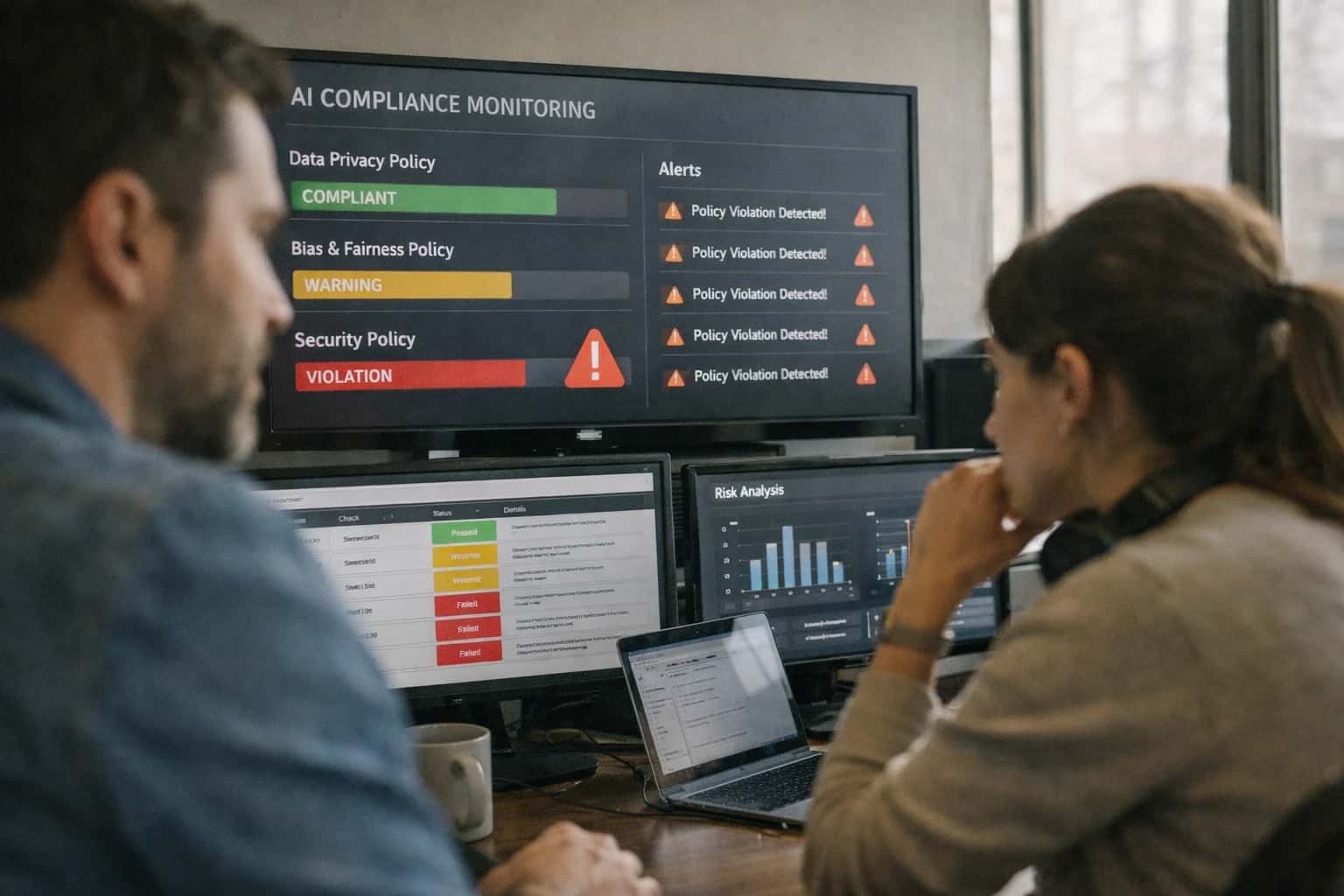
AUTOMATED NORM VERIFICATION
What is Normative Compliance Checker?
An algorithmic engine that evaluates a trace of agent actions against a formalized set of deontic rules to detect violations and measure adherence to a normative framework.
The checker operates by parsing an action trace and cross-referencing each state transition against activated norms, often using Deontic Event Calculus to track obligation lifecycles. When a conflict or violation is detected, the engine triggers resolution strategies derived from the Normative Hierarchy or flags the deviation for human review, providing a deterministic audit trail for regulatory compliance.
NORMATIVE COMPLIANCE CHECKER
Core Architectural Properties
The foundational design elements that define a robust Normative Compliance Checker, enabling precise, auditable, and scalable evaluation of agent actions against formalized deontic rules.
01
Formal Rule Representation
The engine relies on a formal deontic logic (e.g., Input/Output Logic, Defeasible Deontic Logic) to encode norms unambiguously. This moves beyond natural language to represent obligations, permissions, and prohibitions as mathematical relations. This formalism is critical for resolving normative conflicts and handling contrary-to-duty (CTD) obligations without logical paradoxes like Chisholm's Paradox.
02
Action Trace Ingestion
The checker consumes a structured, time-ordered action trace from an agent or multi-agent system. This trace must be semantically aligned with the formal rule model. Key properties include:
- Immutability: The trace must be tamper-proof for audit integrity.
- Completeness: All relevant state changes and actions must be logged.
- Temporal Precision: Timestamps are crucial for evaluating dynamic deontic logic and time-bound obligations.
03
Conflict Detection Engine
A core sub-system that algorithmically identifies normative conflicts—situations where two or more applicable rules prescribe incompatible actions. It applies resolution strategies based on a defined normative hierarchy:
- Lex Superior: Higher authority prevails.
- Lex Specialis: More specific rule overrides general.
- Lex Posterior: Later rule overrides earlier. The output is a resolved set of active norms for the evaluation phase.
04
Compliance Evaluation & Verdict
The central processing unit that maps the ingested action trace against the conflict-free set of active norms. It evaluates each action for fulfillment, violation, or non-applicability. The verdict is not just binary; it can model complex states like partial compliance or identify the specific point of a contrary-to-duty violation. The reasoning path must be fully auditable.
05
Explainability & Audit Trail
Every compliance verdict must be accompanied by a complete, machine-readable audit trail. This trail explicitly states:
- The specific norm(s) evaluated.
- The action(s) in the trace that triggered the evaluation.
- The logical inference steps taken, including any conflict resolution applied. This ensures algorithmic explainability, allowing human operators to audit and contest automated decisions.
06
Integration with Deontic RAG
For systems operating on unstructured legal text, the compliance checker integrates with a Deontic RAG architecture. Instead of manually encoded rules, the checker's formal model is dynamically grounded by retrieving and parsing relevant statutes or contracts in real-time. This ensures that the normative framework is always citation-backed and jurisdictionally accurate, with a normative faithfulness metric validating the grounding.
NORMATIVE COMPLIANCE
Frequently Asked Questions
Clear answers to common questions about how algorithmic engines evaluate agent actions against formalized deontic rules to detect violations and measure adherence.
A Normative Compliance Checker is an algorithmic engine that evaluates a trace of agent actions against a formalized set of deontic rules to detect violations and measure adherence to a normative framework. It operates by ingesting a sequence of timestamped events—such as contract executions, access requests, or autonomous agent decisions—and comparing each action against a knowledge base of encoded obligations, permissions, and prohibitions. The engine typically employs temporal deontic logic or event calculus to track the lifecycle of each norm: when it activates, whether it has been fulfilled, if a deadline has been missed, or if a contrary-to-duty obligation has been triggered. The output is a structured compliance report identifying violations, their severity, and the specific rules breached, enabling both real-time intervention and post-hoc auditability.
NORMATIVE COMPLIANCE CHECKER
Deployment Scenarios
Practical architectures and integration patterns for deploying a Normative Compliance Checker within enterprise legal and autonomous agent systems.
01
Real-Time Agentic Guardrail
Deploy the checker as a synchronous runtime guardrail for autonomous agents. Before an agent executes a tool call or external action, the proposed action trace is evaluated against the formalized deontic rule base.
- Latency Budget: Sub-100ms evaluation required for real-time blocking.
- Integration: Wraps the agent's action dispatcher via a gRPC or REST endpoint.
- Outcome: Returns
PERMITTED,OBLIGATORY, orVIOLATIONwith the specific rule citation.
< 100 ms
Target Latency
03
Contract Lifecycle Compliance
Embed the checker into a Contract Lifecycle Management (CLM) system. Upon contract ingestion, clauses are parsed into deontic formulas. The checker then monitors execution events—like delivery notices or payment milestones—against these extracted obligations.
- Event:
Payment_Received(Date),Notice_Sent(Date). - Rule:
OBLIGATORY(Payment) BEFORE Deadline. - Action: Triggers an alert if a normative conflict or violation is detected.
04
Smart Contract Verification
Integrate the checker with a deontic smart contract platform. Before on-chain execution, the checker formally verifies that the proposed transaction does not violate any encoded prohibitions or unfulfilled obligations.
- Formalism: Translates Solidity or legal prose into Input/Output Logic pairs.
- Benefit: Prevents illegal state transitions at the VM level.
- Use Case: Automated escrow release conditioned on the satisfaction of all normative prerequisites.
05
Knowledge Graph Validation
Use the checker as a SHACL-based validator for enterprise knowledge graphs. Deontic rules are expressed as SHACL shapes with deontic semantics. The checker validates RDF triples to ensure the graph does not contain logically inconsistent normative states.
- Standard: Deontic SHACL.
- Process: Validates that if a triple asserts a
Permission, no conflictingProhibitionexists for the same subject-action pair. - Result: Guarantees a coherent, queryable normative knowledge base.
06
Generative AI Output Filter
Position the checker as a deontic guardrail downstream of a Large Language Model. When the LLM generates legal advice or contract text, the checker parses the output to identify any hallucinated obligations or internally contradictory permissions.
- Metric: Evaluated using a Normative Faithfulness Metric.
- Action: Automatically redacts or flags text that violates the source statutes.
- Goal: Ensure high citation integrity in AI-generated legal documents.
COMPARATIVE ANALYSIS
Normative Compliance Checker vs. Related Systems
Distinguishing the Normative Compliance Checker from adjacent legal AI and formal verification systems based on core function, temporal orientation, and reasoning framework.
| Feature | Normative Compliance Checker | Legal RAG System | Formal Model Checker |
|---|---|---|---|
Primary Function | Evaluates agent action traces against deontic rules to detect violations | Retrieves relevant legal passages to ground generative outputs | Exhaustively verifies system states against temporal logic specifications |
Core Reasoning Framework | Deontic Logic (Obligation, Permission, Prohibition) | Semantic Similarity and Information Retrieval | Temporal Logic (LTL, CTL) and State Exploration |
Temporal Orientation | Post-hoc analysis of completed action sequences | Real-time or on-demand retrieval during generation | Pre-deployment verification of all possible future states |
Handles Contrary-to-Duty Obligations | |||
Primary Output | Violation report with traceability to specific norms | Citation-backed natural language answer | Counterexample trace or exhaustive proof of correctness |
Normative Conflict Resolution | Lex specialis and lex superior precedence chains | ||
State Space Coverage | Evaluates only the executed trace | Evaluates only the retrieved context window | Exhaustive state space exploration (may face state explosion) |
Typical Deployment Context | Audit, compliance monitoring, agent oversight | Legal research, document drafting, question answering | Safety-critical software, hardware verification, protocol design |
Enabling Efficiency, Speed & Accuracy
Intelligent Analysis, Decision & Execution
We build AI systems for teams that need search across company data, workflow automation across tools, or AI features inside products and internal software.
Talk to Us
Search across company data
Give teams answers from docs, tickets, runbooks, and product data with sources and permissions.
Useful when people spend too long searching or get different answers from different systems.
Enterprise searchRAGPermissions
Read more
Automate internal workflows
Use AI to route work, draft outputs, trigger actions, and keep approvals and logs in place.
Useful when repetitive work moves across multiple tools and teams.
AI agentsWorkflow automationGovernance
Read more
Add AI to products and internal tools
Build assistants, guided actions, or decision support into the software your team or customers already use.
Useful when AI needs to be part of the product, not a separate tool.
AI integrationDecision supportModel routing
Read more
About the author
Prasad Kumkar
CEO & MD, Inference Systems
Prasad Kumkar is the CEO & MD of Inference Systems and writes about AI systems architecture, LLM infrastructure, model serving, evaluation, and production deployment. Over 5+ years, he has worked across computer vision models, L5 autonomous vehicle systems, and LLM research, with a focus on taking complex AI ideas into real-world engineering systems.
His work and writing cover AI systems, large language models, AI agents, multimodal systems, autonomous systems, inference optimization, RAG, evaluation, and production AI engineering.
LinkedIn
Limited slotsGet a Free AI Consultation
Partnered with leading AI, data, and software stack.





How We Work
Custom AI workflows for your Business
One-fit-all AI don't work for modern businesses. At Inferensys, we aim to understand your business & custom requirements; which we use to define most efficient agentic workflows, the data, and the tools for your business.
01
Review the use case
We understand the task, the users, and where AI can actually help.
Read more02
Pick the right approach
We define what needs search, automation, or product integration.
Read more03
Build the first useful version
We implement the part that proves the value first.
Read more04
Improve from there
We add the checks and visibility needed to keep it useful.
Read moreThe first call is a practical review of your use case and the right next step.
Talk to Us