A deontic smart contract is a computable legal agreement that translates normative modalities—obligation, permission, and prohibition—into deterministic, executable code deployed on a distributed ledger. Unlike traditional smart contracts that merely execute conditional transfers, a deontic smart contract explicitly models the deontic status of parties, distinguishing between what an agent must do, may do, and must not do within a given legal context.

Glossary
Deontic Smart Contract
A computable contract that formally encodes obligations, permissions, and prohibitions as executable code, enabling automated enforcement and verification of normative clauses on a blockchain or distributed ledger.
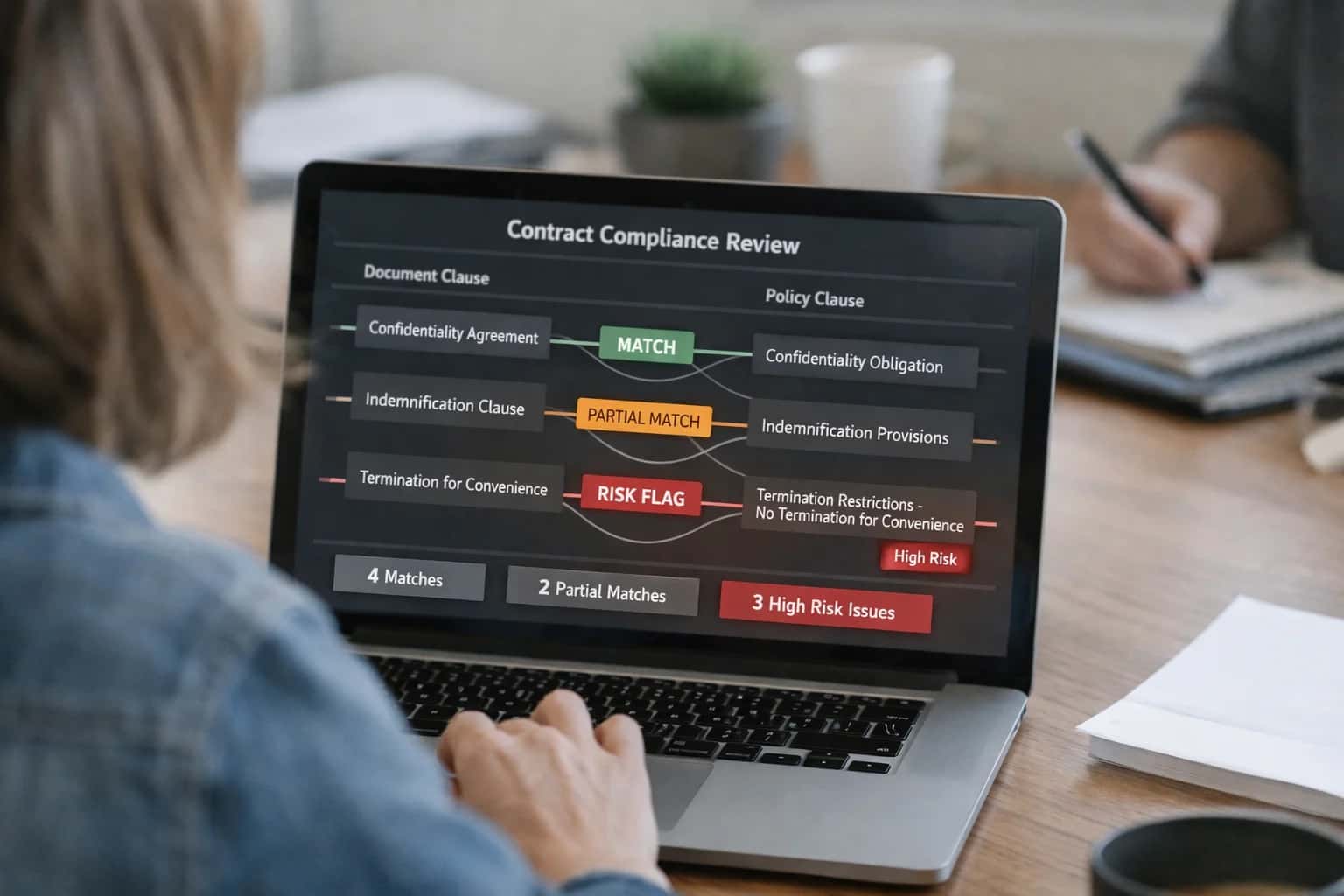
NORMATIVE AUTOMATION
What is a Deontic Smart Contract?
A computable contract that formally encodes obligations, permissions, and prohibitions as executable code, enabling automated enforcement and verification of normative clauses on a blockchain or distributed ledger.
These contracts leverage formal deontic logic to handle normative complexities such as contrary-to-duty obligations and normative conflicts, enabling the system to reason about violations and apply fallback rules automatically. By integrating with LegalRuleML or ODRL deontic semantics, they provide a machine-readable representation of legal duties that can be verified for compliance, audited for breaches, and enforced through cryptographic mechanisms without relying on discretionary human interpretation.
NORMATIVE CODE ARCHITECTURE
Key Features of Deontic Smart Contracts
Deontic smart contracts extend traditional transactional logic by formally encoding obligations, permissions, and prohibitions as executable code, enabling automated enforcement of normative clauses on distributed ledgers.
01
Formal Encoding of Norms
Translates legal obligations, permissions, and prohibitions into deterministic code using deontic modal logic operators. Unlike simple conditional transfers, these contracts model Ought-Implies-Can constraints, contrary-to-duty obligations for breach scenarios, and normative hierarchies that resolve conflicts via lex superior or lex specialis principles.
02
Contrary-to-Duty Handling
Implements fallback execution paths when primary obligations are violated, solving the classic Chisholm's Paradox in executable form. For example:
- Primary duty: Deliver goods by Q3
- CTD obligation: If delivery fails, apply penalty rate and extend deadline by 30 days
- Tertiary CTD: If penalty unpaid, escalate to arbitration clause
03
Normative Conflict Resolution
Embeds resolution strategies directly into contract logic to handle incompatible obligations:
- Lex Superior: Constitutional provisions override statutes
- Lex Specialis: Specific clauses override general ones
- Lex Posterior: Later amendments supersede earlier versions This prevents deadlock states where the contract cannot determine which rule to execute.
04
Temporal Obligation Lifecycle
Tracks the full lifecycle of each normative clause using Deontic Event Calculus semantics:
- Activation: Condition triggers the obligation
- Fulfillment: Required action is performed and verified
- Violation: Deadline passes without compliance
- Expiration: Obligation becomes moot due to changed circumstances Each state transition is immutably recorded on-chain.
05
Hohfeldian Rights Modeling
Disambiguates legal positions using Hohfeldian jural correlatives rather than vague 'rights' language:
- Right/Duty: Party A has a claim; Party B bears the correlative duty
- Privilege/No-Right: Party A may act; Party B cannot demand otherwise
- Power/Liability: Party A can alter legal relations; Party B is subject to that change
- Immunity/Disability: Party A is shielded; Party B lacks the power to alter
06
Defeasible Reasoning Integration
Incorporates non-monotonic logic so that conclusions can be retracted when new evidence emerges. A contract clause may be overridden by:
- Force majeure declarations
- Regulatory changes detected by oracles
- Supervening illegality determinations This prevents rigid execution when the normative context shifts, maintaining legal validity.
DECODING DEONTIC EXECUTION
Frequently Asked Questions
Clear, technically precise answers to the most common questions about encoding legal obligations, permissions, and prohibitions directly into executable blockchain logic.
A Deontic Smart Contract is a computable agreement that formally encodes obligations, permissions, and prohibitions as executable code on a distributed ledger. Unlike a standard smart contract that executes purely deterministic, non-normative logic (e.g., 'if X, then transfer Y'), a deontic smart contract models the normative state of an agreement. It explicitly tracks whether an action is obligatory, permitted, or prohibited for a given agent. This introduces a layer of semantic reasoning about duties. For example, a standard contract might simply freeze funds upon a missed deadline. A deontic smart contract, grounded in Standard Deontic Logic (SDL), can model the conditional fallout: it recognizes a Contrary-to-Duty (CTD) Obligation, triggering a secondary remedial obligation (e.g., a penalty clause) rather than just halting execution. This bridges the gap between legal intent and code, enabling automated enforcement of normative clauses that standard deterministic scripts cannot represent.
Enabling Efficiency, Speed & Accuracy
Intelligent Analysis, Decision & Execution
We build AI systems for teams that need search across company data, workflow automation across tools, or AI features inside products and internal software.
Talk to Us
Search across company data
Give teams answers from docs, tickets, runbooks, and product data with sources and permissions.
Useful when people spend too long searching or get different answers from different systems.
Enterprise searchRAGPermissions
Read more
Automate internal workflows
Use AI to route work, draft outputs, trigger actions, and keep approvals and logs in place.
Useful when repetitive work moves across multiple tools and teams.
AI agentsWorkflow automationGovernance
Read more
Add AI to products and internal tools
Build assistants, guided actions, or decision support into the software your team or customers already use.
Useful when AI needs to be part of the product, not a separate tool.
AI integrationDecision supportModel routing
Read more
About the author
Prasad Kumkar
CEO & MD, Inference Systems
Prasad Kumkar is the CEO & MD of Inference Systems and writes about AI systems architecture, LLM infrastructure, model serving, evaluation, and production deployment. Over 5+ years, he has worked across computer vision models, L5 autonomous vehicle systems, and LLM research, with a focus on taking complex AI ideas into real-world engineering systems.
His work and writing cover AI systems, large language models, AI agents, multimodal systems, autonomous systems, inference optimization, RAG, evaluation, and production AI engineering.
LinkedIn
Limited slotsGet a Free AI Consultation
Partnered with leading AI, data, and software stack.





How We Work
Custom AI workflows for your Business
One-fit-all AI don't work for modern businesses. At Inferensys, we aim to understand your business & custom requirements; which we use to define most efficient agentic workflows, the data, and the tools for your business.
01
Review the use case
We understand the task, the users, and where AI can actually help.
Read more02
Pick the right approach
We define what needs search, automation, or product integration.
Read more03
Build the first useful version
We implement the part that proves the value first.
Read more04
Improve from there
We add the checks and visibility needed to keep it useful.
Read moreThe first call is a practical review of your use case and the right next step.
Talk to Us