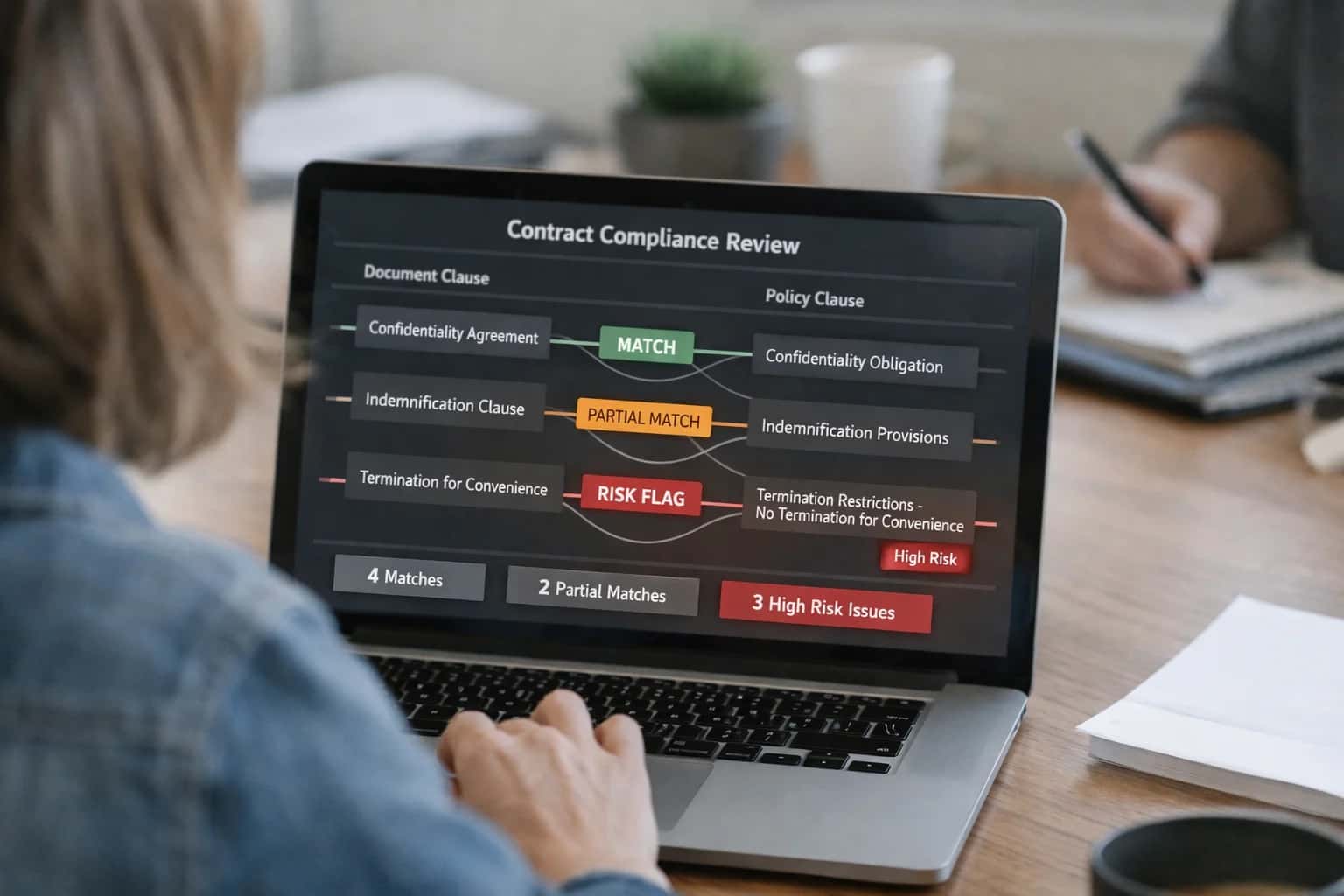
Termination clause detection is a specialized natural language processing task that automatically locates and classifies provisions governing how a contractual relationship may be dissolved. The process distinguishes between termination for convenience—allowing a party to exit without breach—and termination for cause, triggered by material default, insolvency, or failure to meet performance metrics. Modern systems employ fine-tuned transformer models trained on annotated legal corpora to identify these semantically distinct clause types with high precision.

Glossary
Termination Clause Detection
The automated identification of provisions governing the cessation of a contract, including termination for convenience, for cause, and associated notice periods.
CONTRACT ANALYSIS
What is Termination Clause Detection?
Termination clause detection is the automated identification and extraction of contractual provisions governing the cessation of an agreement, distinguishing between termination for convenience, for cause, and associated notice period obligations.
Beyond binary classification, detection engines extract structured data points including notice period durations, cure periods, and the specific triggering events enumerated in the contract. This capability integrates with broader obligation extraction and semantic clause classification pipelines, enabling legal operations teams to automatically surface termination rights across thousands of agreements. The technology reduces manual review time while ensuring consistent identification of exit rights that carry significant financial and operational consequences.
SYSTEM CAPABILITIES
Key Characteristics of Termination Clause Detection Systems
Modern termination clause detection systems combine semantic classification, temporal reasoning, and deontic logic parsing to move beyond keyword matching toward true legal understanding.
01
Semantic Trigger Classification
Distinguishes between termination for convenience, termination for cause, and automatic expiration using contextual language understanding rather than simple keyword matching. The system analyzes the linguistic structure surrounding trigger phrases to determine the precise legal mechanism at play.
- Identifies material breach thresholds and cure period language
- Classifies insolvency and change-of-control triggers
- Differentiates mutual vs. unilateral termination rights
02
Notice Period Extraction
Parses and normalizes the temporal requirements embedded in termination provisions, converting natural language expressions into structured, machine-readable timelines.
- Extracts advance notice durations (e.g., '30 days', 'three calendar months')
- Identifies the method of notice delivery (written, electronic, certified mail)
- Calculates effective termination dates based on delivery triggers and business day conventions
03
Cure Period Recognition
Detects provisions granting a breaching party the right to remedy a default before termination takes effect. The system identifies the cure period duration, the commencement trigger (notice receipt vs. breach occurrence), and any materiality qualifiers.
- Distinguishes between curable and non-curable breaches
- Links cure rights to specific breach categories (payment vs. performance)
- Flags the absence of cure periods as elevated risk indicators
04
Post-Termination Obligation Mapping
Identifies and structures the surviving obligations that persist beyond contract termination, including confidentiality, indemnification, dispute resolution, and payment of accrued amounts.
- Extracts survival period durations for each obligation category
- Links post-termination duties to their governing clauses
- Flags inconsistencies between termination and survival language
05
Cross-Reference Resolution
Resolves internal references within termination clauses that point to defined terms, schedules, or other contract sections. The system traces definitional chains to surface the complete legal meaning.
- Resolves 'Material Adverse Change' definitions referenced in termination triggers
- Links 'Cause' definitions to enumerated breach lists in exhibits
- Surfaces circular or broken cross-references as drafting anomalies
06
Jurisdictional Default Rule Integration
Layers statutory default termination rules onto contractual provisions to identify gaps where the agreement is silent. The system applies UCC Article 2, CISG, or common law defaults based on governing law extraction.
- Flags where contractual silence creates statutory default exposure
- Compares negotiated notice periods against jurisdiction-specific reasonableness standards
- Identifies mandatory non-waivable termination rights under consumer protection statutes
TERMINATION CLAUSE DETECTION
Frequently Asked Questions
Answers to the most common technical and operational questions about automating the identification and extraction of contract termination provisions.
Termination clause detection is the automated process of identifying and classifying contractual provisions that govern the cessation of an agreement using natural language processing (NLP) models. The system works by ingesting unstructured contract text, segmenting it into logical clauses, and applying a fine-tuned classification model—typically a transformer-based architecture—to determine whether a given clause constitutes a termination provision. Modern detection pipelines employ a two-stage architecture: a semantic clause segmentation step that identifies clause boundaries using layout and linguistic cues, followed by a multi-label classifier that distinguishes termination clauses from adjacent provisions like renewal, expiration, or suspension. The classifier is trained on annotated corpora of commercial agreements, learning to recognize trigger phrases such as 'right to terminate,' 'termination for cause,' and 'notice of termination,' while also understanding the deontic structure of obligations and permissions that characterize these provisions.
COMPARATIVE ANALYSIS
Termination Clause Detection vs. Related Techniques
How automated termination clause detection differs from adjacent contract analysis tasks in scope, output, and technical approach.
| Feature | Termination Clause Detection | Obligation Extraction | Semantic Clause Classification |
|---|---|---|---|
Primary objective | Locate provisions governing contract cessation | Identify mandatory duties and responsible parties | Categorize sentences into predefined legal types |
Key output | Clause text with termination type and notice period | Structured tuple: trigger, action, party | Labeled clause with confidence score |
Handles temporal constraints | |||
Extracts notice periods | |||
Distinguishes termination for cause vs. convenience | |||
Requires deontic logic modeling | |||
Typical accuracy benchmark | 94-97% F1 | 88-92% F1 | 95-98% F1 |
Downstream use case | Obligation cessation triggers | Contractual duty tracking | Document triage and routing |
Enabling Efficiency, Speed & Accuracy
Intelligent Analysis, Decision & Execution
We build AI systems for teams that need search across company data, workflow automation across tools, or AI features inside products and internal software.
Talk to Us
Search across company data
Give teams answers from docs, tickets, runbooks, and product data with sources and permissions.
Useful when people spend too long searching or get different answers from different systems.
Enterprise searchRAGPermissions
Read more
Automate internal workflows
Use AI to route work, draft outputs, trigger actions, and keep approvals and logs in place.
Useful when repetitive work moves across multiple tools and teams.
AI agentsWorkflow automationGovernance
Read more
Add AI to products and internal tools
Build assistants, guided actions, or decision support into the software your team or customers already use.
Useful when AI needs to be part of the product, not a separate tool.
AI integrationDecision supportModel routing
Read more
About the author
Prasad Kumkar
CEO & MD, Inference Systems
Prasad Kumkar is the CEO & MD of Inference Systems and writes about AI systems architecture, LLM infrastructure, model serving, evaluation, and production deployment. Over 5+ years, he has worked across computer vision models, L5 autonomous vehicle systems, and LLM research, with a focus on taking complex AI ideas into real-world engineering systems.
His work and writing cover AI systems, large language models, AI agents, multimodal systems, autonomous systems, inference optimization, RAG, evaluation, and production AI engineering.
LinkedIn
Limited slotsGet a Free AI Consultation
Partnered with leading AI, data, and software stack.





How We Work
Custom AI workflows for your Business
One-fit-all AI don't work for modern businesses. At Inferensys, we aim to understand your business & custom requirements; which we use to define most efficient agentic workflows, the data, and the tools for your business.
01
Review the use case
We understand the task, the users, and where AI can actually help.
Read more02
Pick the right approach
We define what needs search, automation, or product integration.
Read more03
Build the first useful version
We implement the part that proves the value first.
Read more04
Improve from there
We add the checks and visibility needed to keep it useful.
Read moreThe first call is a practical review of your use case and the right next step.
Talk to Us