Governing Law Extraction is the computational process of pinpointing the clause that selects the legal framework for a contract. It distinguishes the governing law (substantive rules for interpretation) from the forum selection clause (the physical location for litigation), a critical nuance for cross-jurisdictional harmonization and risk analysis.

Glossary
Governing Law Extraction
The NLP task of automatically locating and classifying the contractual clause that specifies which jurisdiction's substantive laws will govern the agreement.
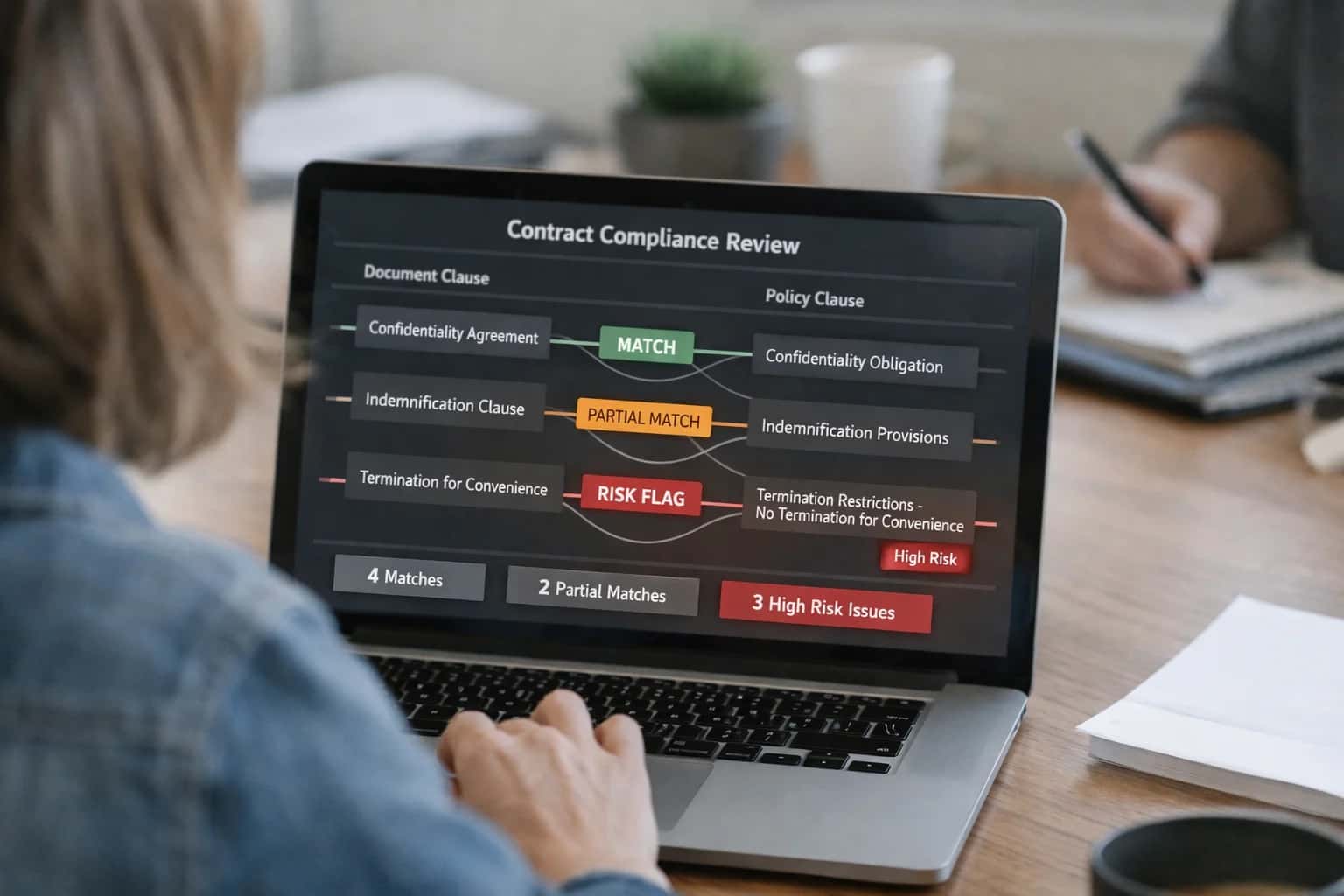
CONTRACT INTELLIGENCE
What is Governing Law Extraction?
Governing Law Extraction is the automated NLP task of identifying and isolating the specific contractual provision that designates which jurisdiction's substantive laws will interpret and govern the agreement.
This task relies on semantic clause classification models trained to recognize jurisdictional signals like 'construed in accordance with the laws of' while ignoring boilerplate references. Accurate extraction feeds obligation extraction and dispute resolution parsing pipelines, ensuring downstream AI systems apply the correct statutory framework.
SYSTEM ARCHITECTURE
Core Characteristics of Governing Law Extraction Systems
The extraction of governing law clauses requires systems that go beyond simple keyword matching to handle complex syntactic structures, cross-references, and jurisdictional hierarchies.
01
Jurisdictional Entity Recognition
The system must identify and normalize jurisdictional entities—not just country names but sub-national units like states, provinces, and cantons. A clause referencing 'the laws of the State of New York' requires the model to recognize New York as a U.S. state jurisdiction, not a city. Advanced systems map extracted entities to standardized jurisdictional ontologies (e.g., ISO 3166 codes) to enable cross-document comparison. Ambiguous references like 'the laws of Georgia' require contextual disambiguation between the U.S. state and the sovereign nation.
02
Choice-of-Law vs. Forum Selection Disambiguation
A critical distinction in extraction logic: governing law clauses specify which substantive law interprets the contract, while forum selection clauses designate where disputes are litigated. These are often conflated but carry distinct legal consequences. Sophisticated extraction systems parse compound clauses like 'This Agreement shall be governed by Delaware law, and the parties submit to the exclusive jurisdiction of the federal courts in Manhattan' into two separate, linked data fields. Failure to disambiguate leads to incorrect risk assessments in multi-jurisdictional deals.
03
Exclusion of Conflicts-of-Law Rules
Many governing law clauses include a renvoi exclusion—language stating that the chosen jurisdiction's substantive law applies, but not its conflict-of-laws principles. Example: 'governed by the laws of England and Wales, without regard to its conflict of laws rules.' The extraction system must detect this exclusion as a binary flag because its presence prevents a court from applying the law of a different jurisdiction through the chosen forum's choice-of-law doctrine. Missing this nuance can invalidate the entire jurisdictional analysis.
04
Hierarchical and Cascading Jurisdiction Parsing
Complex commercial agreements may specify cascading or hierarchical governing law structures. For instance, a clause might state that the contract is governed by California law, except for intellectual property matters governed by U.S. federal law, with arbitration administered under ICC rules. Extraction systems must model these as nested or conditional data structures rather than flat key-value pairs. The output schema must accommodate a primary jurisdiction with an array of exception-override pairs, each with its own scope trigger.
05
Negative Extraction and Absence Handling
Not all contracts contain an explicit governing law clause. In such cases, the extraction system must return a null or absent classification rather than hallucinating a jurisdiction. Default rules—such as the closest connection test under Rome I in the EU or UCC default provisions in the U.S.—may apply, but the extraction engine should not infer these. The system must distinguish between 'clause present but unparseable' and 'clause absent,' logging the distinction for downstream human review workflows.
06
Substantive vs. Procedural Law Segmentation
Governing law clauses typically designate substantive law (rights and duties of parties), while procedural matters are governed by the law of the forum (lex fori). Some clauses explicitly segment these: 'substantive law of Switzerland; procedural law of the arbitral seat.' Extraction systems must parse this segmentation when present and tag extracted jurisdictions with law type metadata (substantive, procedural, or both). This granularity is essential for dispute risk modeling and arbitration strategy planning.
GOVERNING LAW EXTRACTION
Frequently Asked Questions
Clarifying the technical and legal nuances behind the automated identification and interpretation of governing law provisions in contractual agreements.
Governing Law Extraction is the automated natural language processing (NLP) task of pinpointing the specific clause within a contract that designates which jurisdiction's substantive laws will interpret and govern the agreement. Unlike simple keyword search, this process involves semantic clause classification to distinguish the governing law provision from related but distinct clauses like venue, jurisdiction, or arbitration. The extraction model identifies the chosen legal system (e.g., 'the laws of the State of Delaware') and maps it to a standardized legal ontology, enabling cross-document analysis and risk assessment at scale.
Enabling Efficiency, Speed & Accuracy
Intelligent Analysis, Decision & Execution
We build AI systems for teams that need search across company data, workflow automation across tools, or AI features inside products and internal software.
Talk to Us
Search across company data
Give teams answers from docs, tickets, runbooks, and product data with sources and permissions.
Useful when people spend too long searching or get different answers from different systems.
Enterprise searchRAGPermissions
Read more
Automate internal workflows
Use AI to route work, draft outputs, trigger actions, and keep approvals and logs in place.
Useful when repetitive work moves across multiple tools and teams.
AI agentsWorkflow automationGovernance
Read more
Add AI to products and internal tools
Build assistants, guided actions, or decision support into the software your team or customers already use.
Useful when AI needs to be part of the product, not a separate tool.
AI integrationDecision supportModel routing
Read more
About the author
Prasad Kumkar
CEO & MD, Inference Systems
Prasad Kumkar is the CEO & MD of Inference Systems and writes about AI systems architecture, LLM infrastructure, model serving, evaluation, and production deployment. Over 5+ years, he has worked across computer vision models, L5 autonomous vehicle systems, and LLM research, with a focus on taking complex AI ideas into real-world engineering systems.
His work and writing cover AI systems, large language models, AI agents, multimodal systems, autonomous systems, inference optimization, RAG, evaluation, and production AI engineering.
LinkedIn
Limited slotsGet a Free AI Consultation
Partnered with leading AI, data, and software stack.





How We Work
Custom AI workflows for your Business
One-fit-all AI don't work for modern businesses. At Inferensys, we aim to understand your business & custom requirements; which we use to define most efficient agentic workflows, the data, and the tools for your business.
01
Review the use case
We understand the task, the users, and where AI can actually help.
Read more02
Pick the right approach
We define what needs search, automation, or product integration.
Read more03
Build the first useful version
We implement the part that proves the value first.
Read more04
Improve from there
We add the checks and visibility needed to keep it useful.
Read moreThe first call is a practical review of your use case and the right next step.
Talk to Us