Indemnification Clause Identification is the computational task of detecting provisions within a contract where the indemnitor agrees to compensate the indemnitee for covered losses. This process leverages natural language understanding models trained to recognize the syntactic patterns and semantic triggers—such as "hold harmless," "defend," and "indemnify"—that signal a duty to assume another party's legal and financial exposure.

Glossary
Indemnification Clause Identification
The automated process of locating and classifying contractual provisions where one party agrees to compensate another for specific losses, damages, or liabilities, typically involving third-party claims.
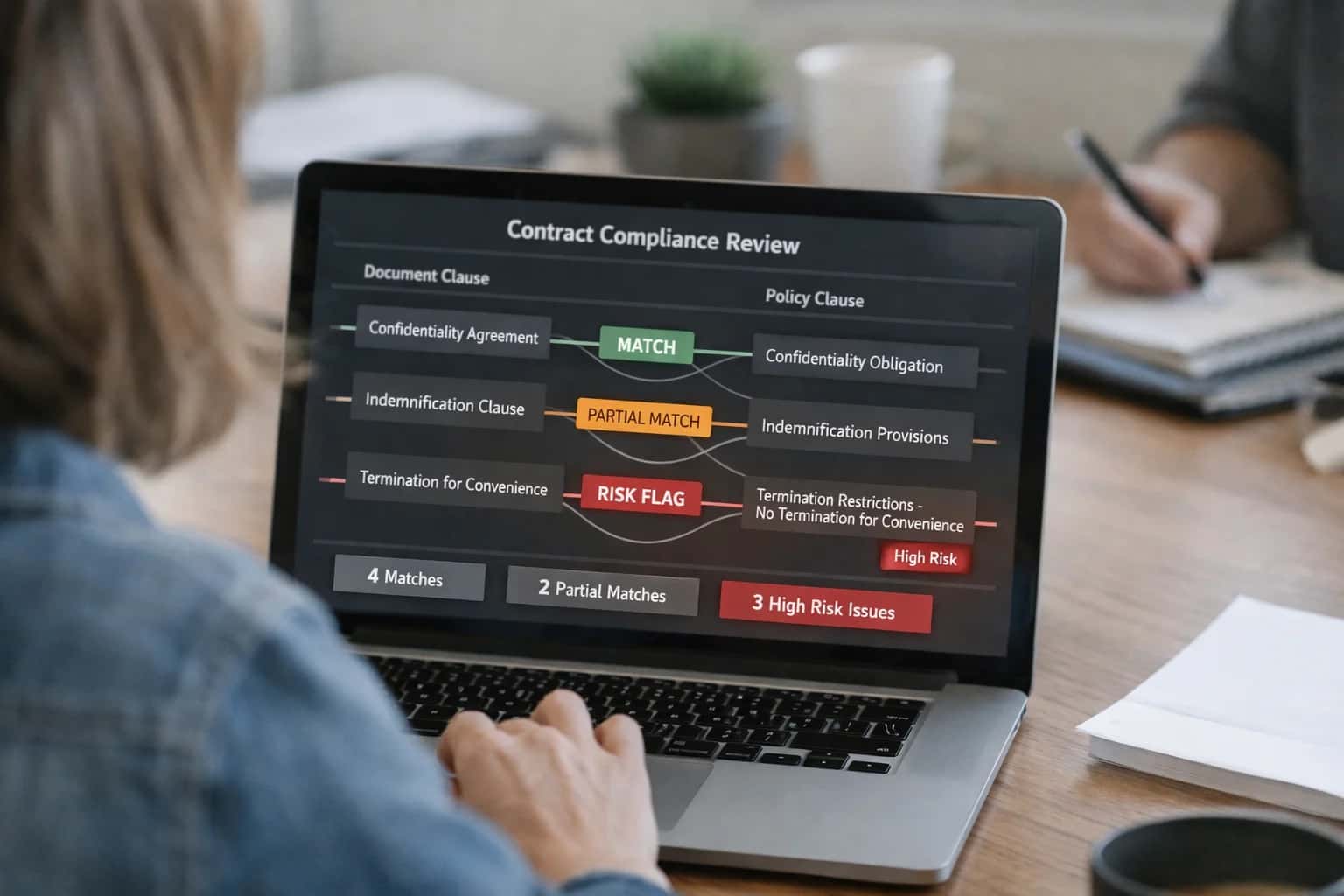
CONTRACT RISK ALLOCATION
What is Indemnification Clause Identification?
The automated process of locating and classifying contractual provisions where one party assumes financial responsibility for specific losses, damages, or liabilities incurred by another party, typically involving third-party claims.
Effective identification requires distinguishing indemnification from related but distinct clauses like limitation of liability or insurance obligations. The model must parse the scope of covered claims, identifying whether the clause addresses third-party claims, first-party losses, or direct damages, while also detecting critical carve-outs for the indemnitee's own negligence, willful misconduct, or breach of contract.
SYSTEM ARCHITECTURE
Key Characteristics of Indemnification Clause Identification Systems
Modern indemnification clause identification systems combine semantic understanding with structural parsing to reliably locate and classify risk-transfer provisions across complex commercial agreements.
01
Semantic Pattern Recognition
Systems must distinguish indemnification language from superficially similar but legally distinct provisions. Key differentiators include:
- Trigger language: Phrases like hold harmless, indemnify and defend, and make whole serve as primary signals
- Third-party claim nexus: True indemnity clauses reference claims brought by or asserted by a non-party, distinguishing them from direct liability provisions
- Survival language: Indemnity obligations often contain explicit survival periods that outlast contract termination
- Carve-out detection: Systems must identify exceptions for gross negligence, willful misconduct, or fraud that modify the scope of indemnification
False positives commonly arise from insurance provisions, release clauses, and assumption of liability language that use similar terminology but serve different legal functions.
02
Structural Position Heuristics
Indemnification clauses exhibit predictable structural patterns within commercial agreements that classification systems exploit:
- Section heading analysis: Headers containing Indemnification, Indemnity, or Third-Party Claims provide high-confidence structural signals
- Cross-reference mapping: Indemnity provisions frequently reference other sections, including Representations and Warranties, Limitation of Liability, and Insurance requirements
- Hierarchical nesting: Sub-clauses detailing specific indemnity procedures (notice, tender of defense, settlement authority) form recognizable nested structures
- Exhibit and schedule linkage: Indemnity obligations often incorporate by reference items listed in disclosure schedules, requiring cross-document traversal
Systems that combine heading-based localization with content-based verification achieve higher precision than either approach alone.
03
Multi-Label Classification Requirements
A single indemnification clause typically requires multiple simultaneous classification labels to capture its full legal effect:
- Directionality: Unilateral (one party indemnifies), mutual (both parties indemnify), or asymmetric (different scopes per party)
- Scope of coverage: First-party claims, third-party claims, or both
- Trigger mechanism: Demand-based, occurrence-based, or claims-made
- Financial boundaries: Presence of caps, baskets, deductibles, or sole recourse limitations
- Procedural obligations: Duty to defend vs. right to defend, control of settlement, cooperation requirements
Flat classification schemes that assign a single label per clause fail to capture these orthogonal dimensions of indemnity obligations.
04
Negligence Carve-Out Detection
One of the most commercially significant and technically challenging aspects of indemnity classification is identifying carve-outs for a party's own negligence:
- Express negligence rule compliance: In jurisdictions like Texas and Louisiana, indemnification for a party's own negligence requires conspicuous, unambiguous language — systems must verify this standard
- Degree modifiers: Distinctions between sole negligence, gross negligence, active negligence, and passive negligence materially alter risk allocation
- Anti-indemnity statute awareness: Many states prohibit indemnification for certain types of negligence in construction, transportation, and service contracts — systems must flag potential statutory conflicts
- Comparative vs. contributory framing: Language allocating liability to the extent caused by vs. regardless of cause signals fundamentally different risk distributions
Failure to correctly classify negligence carve-outs can result in material misrepresentation of a party's actual risk exposure.
05
Cross-Referential Resolution
Indemnification clauses rarely operate in isolation — they form part of an interconnected web of risk allocation provisions:
- Limitation of liability interaction: Indemnity obligations may or may not be carved out from general liability caps — systems must trace this relationship
- Insurance requirement coupling: Indemnity provisions often mandate specific insurance coverage types and limits as financial backing for the obligation
- Survival period inheritance: Indemnity survival periods may be defined in a separate Survival section and incorporated by reference
- Defined term dependency: Critical scope terms like Losses, Claims, and Indemnified Parties are typically defined elsewhere in the agreement
Systems that treat each clause as an independent unit of analysis will systematically misclassify the scope and effect of indemnification obligations.
06
Jurisdictional Variance Modeling
Indemnification clause interpretation varies significantly across legal systems, requiring classification models to account for jurisdictional context:
- Common law vs. civil code: Common law jurisdictions treat indemnity as a contractual right, while civil code systems may imply indemnity obligations under principles of recourse or contribution
- Anti-indemnity statutes: Over 40 U.S. states have enacted statutes limiting or voiding certain indemnity provisions, particularly in construction and service contracts
- Contra proferentem application: Many jurisdictions construe ambiguous indemnity language against the drafter, affecting how classification confidence thresholds should be calibrated
- Governing law extraction: The contract's choice-of-law provision determines which interpretive framework applies, requiring systems to extract and apply this metadata before classification
Production systems must maintain jurisdiction-specific classification models or apply post-classification adjustment rules based on governing law metadata.
INDEMNIFICATION CLAUSE IDENTIFICATION
Frequently Asked Questions
Precise answers to the most common technical and legal-operational questions about automating the identification of indemnification clauses in contracts.
Indemnification clause identification is the automated process of locating and classifying contractual provisions where one party (the indemnitor) agrees to compensate the other (the indemnitee) for specified losses, damages, or liabilities, typically arising from third-party claims. This NLP task involves training domain-specific language models to recognize the unique semantic and syntactic patterns of indemnity language—including trigger phrases like 'shall indemnify,' 'hold harmless,' and 'defend against'—and distinguish them from superficially similar clauses such as warranties or limitation of liability provisions. Modern systems employ transformer-based architectures fine-tuned on annotated legal corpora to achieve high recall on both broad-form and intermediate-form indemnities, while filtering out false positives from insurance provisions and assumption of risk language.
Enabling Efficiency, Speed & Accuracy
Intelligent Analysis, Decision & Execution
We build AI systems for teams that need search across company data, workflow automation across tools, or AI features inside products and internal software.
Talk to Us
Search across company data
Give teams answers from docs, tickets, runbooks, and product data with sources and permissions.
Useful when people spend too long searching or get different answers from different systems.
Enterprise searchRAGPermissions
Read more
Automate internal workflows
Use AI to route work, draft outputs, trigger actions, and keep approvals and logs in place.
Useful when repetitive work moves across multiple tools and teams.
AI agentsWorkflow automationGovernance
Read more
Add AI to products and internal tools
Build assistants, guided actions, or decision support into the software your team or customers already use.
Useful when AI needs to be part of the product, not a separate tool.
AI integrationDecision supportModel routing
Read more
About the author
Prasad Kumkar
CEO & MD, Inference Systems
Prasad Kumkar is the CEO & MD of Inference Systems and writes about AI systems architecture, LLM infrastructure, model serving, evaluation, and production deployment. Over 5+ years, he has worked across computer vision models, L5 autonomous vehicle systems, and LLM research, with a focus on taking complex AI ideas into real-world engineering systems.
His work and writing cover AI systems, large language models, AI agents, multimodal systems, autonomous systems, inference optimization, RAG, evaluation, and production AI engineering.
LinkedIn
Limited slotsGet a Free AI Consultation
Partnered with leading AI, data, and software stack.





How We Work
Custom AI workflows for your Business
One-fit-all AI don't work for modern businesses. At Inferensys, we aim to understand your business & custom requirements; which we use to define most efficient agentic workflows, the data, and the tools for your business.
01
Review the use case
We understand the task, the users, and where AI can actually help.
Read more02
Pick the right approach
We define what needs search, automation, or product integration.
Read more03
Build the first useful version
We implement the part that proves the value first.
Read more04
Improve from there
We add the checks and visibility needed to keep it useful.
Read moreThe first call is a practical review of your use case and the right next step.
Talk to Us