Liability cap parsing is the NLP-driven process of identifying and structuring the specific monetary ceiling on a party's aggregate liability within a contract. It targets the precise numerical value, its associated currency, and the defined time scope—often expressed as a multiple of fees paid or a fixed sum—to transform an unstructured clause into a machine-readable data point for risk analysis.

Glossary
Liability Cap Parsing
The automated extraction of numerical limits, currency values, and exceptions that define the maximum financial exposure of a contracting party.
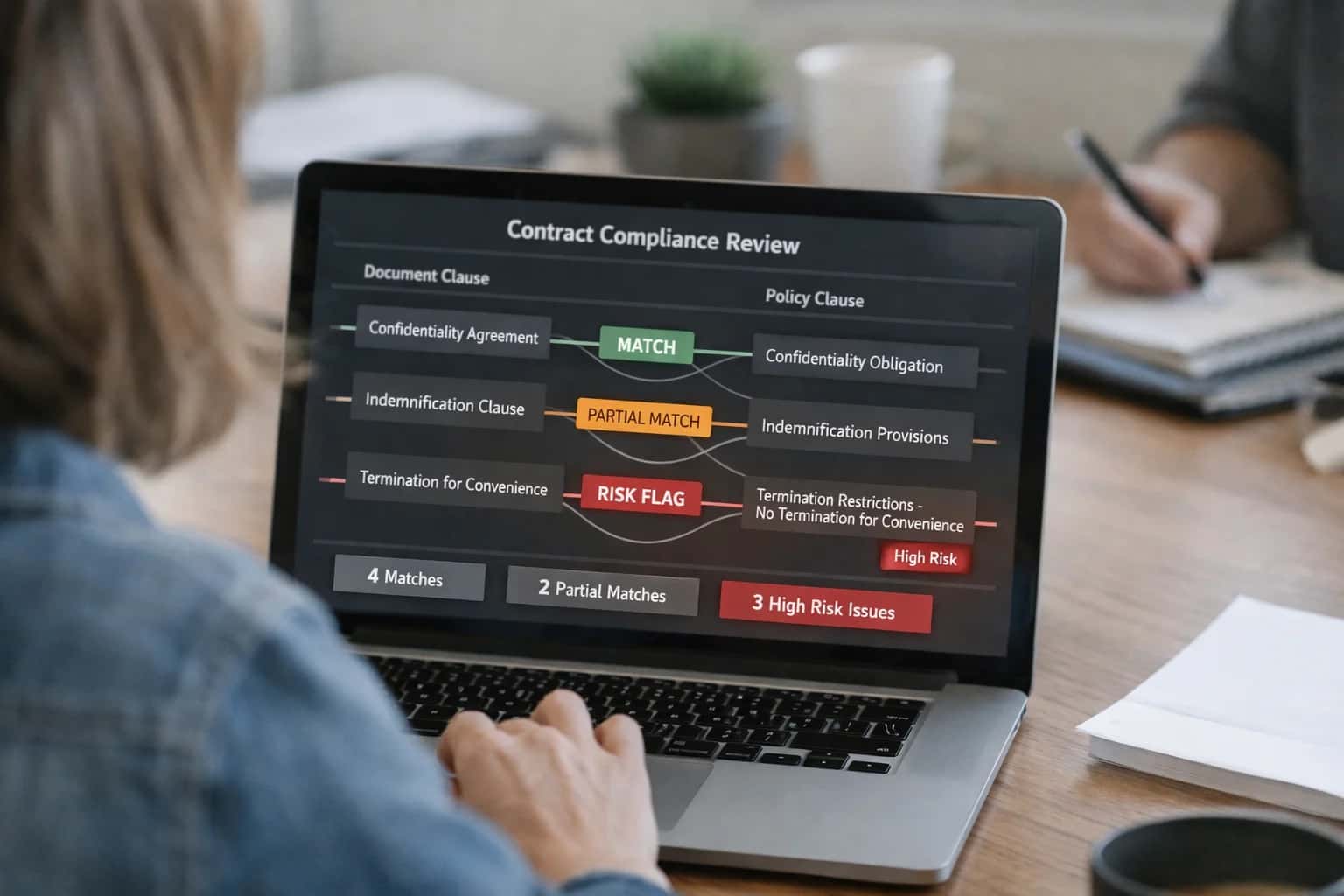
CONTRACT CLAUSE EXTRACTION
What is Liability Cap Parsing?
Liability cap parsing is the automated extraction of numerical limits, currency values, and exceptions that define the maximum financial exposure of a contracting party.
Advanced parsing models must also extract critical carve-outs and exceptions that bypass the cap, such as uncapped liability for gross negligence, fraud, or breaches of confidentiality and intellectual property. This requires the model to semantically link the cap to its exceptions, distinguishing between the general limitation of liability and the specific categories of loss that fall outside the agreed financial ceiling.
FINANCIAL EXPOSURE EXTRACTION
Core Components of Liability Cap Parsing
The automated extraction of numerical limits, currency values, and exceptions that define the maximum financial exposure of a contracting party.
01
Numerical Limit Extraction
The core task of identifying the exact monetary figure that caps a party's aggregate liability. This involves parsing the text for currency symbols, numerical values (both digits and words), and the specific contractual language that ties the cap to a defined scope.
- Pattern Recognition: Models must distinguish between a liability cap ($500,000) and other financial figures like purchase price or insurance requirements.
- Written Number Conversion: The system must accurately parse and convert written numbers (e.g., 'Five Hundred Thousand Dollars') into a standardized numerical format.
- Tiered Caps: Some agreements contain multiple caps for different breach types (e.g., gross negligence vs. ordinary negligence), requiring the parser to link each limit to its triggering condition.
99.5%
Target Extraction Accuracy
02
Currency and Jurisdiction Detection
Liability caps are meaningless without identifying the governing currency. This component detects and normalizes currency designators (USD, EUR, GBP) and links them to the contract's Governing Law clause to resolve ambiguities.
- Symbol Disambiguation: The '$' symbol is used by multiple jurisdictions (USD, CAD, AUD). The parser must cross-reference the governing law or party addresses to assign the correct ISO 4217 currency code.
- Multi-Currency Contracts: In cross-border agreements, different obligations may be capped in different currencies. The system must maintain the integrity of each cap's denomination without conversion unless explicitly stated.
03
Carve-Out and Exception Parsing
A liability cap is rarely absolute. This component identifies exceptions that pierce the cap, allowing for unlimited or separately limited liability for specific breaches.
- Common Carve-Outs: Fraud, willful misconduct, death/bodily injury, breach of confidentiality, and IP infringement are standard exceptions that must be extracted and linked to the main cap.
- Layered Logic: The parser must model the logical hierarchy. For example: 'Neither party's liability shall exceed $1M, except for breach of Section 5 (Confidentiality), which shall be capped at $5M, and for fraud, for which liability shall be unlimited.'
04
Scope and Basket Linkage
The liability cap's meaning is defined by the scope of damages it covers. This component links the numerical cap to its qualifying language, such as 'aggregate liability,' 'direct damages only,' or 'all claims arising under this agreement.'
- Basket Interaction: The parser must identify if a liability cap is tied to a deductible basket (a threshold of losses that must be exceeded before a claim can be made). The cap and basket together define the true financial exposure window.
- Survival Periods: The system must extract the temporal scope—how long after contract termination the cap remains effective—to model the complete risk profile.
05
Party Attribution
Liability caps are often asymmetrical. This component attributes each extracted cap to the correct party or parties, distinguishing between mutual caps and one-sided limitations.
- Named Entity Resolution: The parser must resolve party names, defined terms (e.g., 'Service Provider,' 'Customer'), and pronouns to correctly assign financial exposure to each legal entity.
- Cap Reciprocity: The system flags whether a cap is mutual ('each party's liability...') or unilateral ('Supplier's liability shall not exceed...'), a critical distinction for risk analysis.
06
Fee-Based Cap Calculation
A common liability cap formulation ties the limit to fees paid or payable under the agreement over a specific lookback period. This component extracts the formula and the relevant time window.
- Formula Parsing: The system must interpret language like 'the fees paid by Customer in the 12 months preceding the claim' and structure it as a computable expression.
- Variable Resolution: The parser must identify whether the cap references 'fees paid,' 'fees payable,' or 'the total contract value,' as each yields a different financial outcome.
LIABILITY CAP PARSING
Frequently Asked Questions
Precision answers to the most common technical questions regarding the automated extraction and analysis of contractual liability caps, including numerical limits, currency handling, and exception logic.
Liability Cap Parsing is the automated natural language processing (NLP) task of extracting the specific numerical limits, currency values, and semantic exceptions that define the maximum financial exposure of a contracting party. Unlike simple keyword search, parsing involves understanding the syntactic relationship between the cap figure, the currency denomination, and the scope of covered claims. The system must identify whether the cap is a fixed sum, a multiple of fees paid, or a percentage of contract value, while simultaneously classifying carve-outs for gross negligence, willful misconduct, or third-party indemnity that may pierce the cap entirely. This process transforms unstructured prose into structured data fields suitable for risk aggregation dashboards.
Enabling Efficiency, Speed & Accuracy
Intelligent Analysis, Decision & Execution
We build AI systems for teams that need search across company data, workflow automation across tools, or AI features inside products and internal software.
Talk to Us
Search across company data
Give teams answers from docs, tickets, runbooks, and product data with sources and permissions.
Useful when people spend too long searching or get different answers from different systems.
Enterprise searchRAGPermissions
Read more
Automate internal workflows
Use AI to route work, draft outputs, trigger actions, and keep approvals and logs in place.
Useful when repetitive work moves across multiple tools and teams.
AI agentsWorkflow automationGovernance
Read more
Add AI to products and internal tools
Build assistants, guided actions, or decision support into the software your team or customers already use.
Useful when AI needs to be part of the product, not a separate tool.
AI integrationDecision supportModel routing
Read more
About the author
Prasad Kumkar
CEO & MD, Inference Systems
Prasad Kumkar is the CEO & MD of Inference Systems and writes about AI systems architecture, LLM infrastructure, model serving, evaluation, and production deployment. Over 5+ years, he has worked across computer vision models, L5 autonomous vehicle systems, and LLM research, with a focus on taking complex AI ideas into real-world engineering systems.
His work and writing cover AI systems, large language models, AI agents, multimodal systems, autonomous systems, inference optimization, RAG, evaluation, and production AI engineering.
LinkedIn
Limited slotsGet a Free AI Consultation
Partnered with leading AI, data, and software stack.





How We Work
Custom AI workflows for your Business
One-fit-all AI don't work for modern businesses. At Inferensys, we aim to understand your business & custom requirements; which we use to define most efficient agentic workflows, the data, and the tools for your business.
01
Review the use case
We understand the task, the users, and where AI can actually help.
Read more02
Pick the right approach
We define what needs search, automation, or product integration.
Read more03
Build the first useful version
We implement the part that proves the value first.
Read more04
Improve from there
We add the checks and visibility needed to keep it useful.
Read moreThe first call is a practical review of your use case and the right next step.
Talk to Us