Static network provisioning is a capital-intensive process where resources like spectrum and compute are permanently allocated based on predicted peak demand, leading to massive waste during off-peak periods. AI-driven dynamic resource orchestration continuously reallocates these assets in real-time to match actual demand, eliminating this inefficiency.

Blog
The Future of Telecom Efficiency is AI-Driven Dynamic Resource Orchestration
Static network provisioning is dead. AI-driven dynamic resource orchestration continuously reallocates spectrum, compute, and storage in real-time to meet fluctuating demand and SLAs. This deep dive explains the architectures, models, and economic imperative.
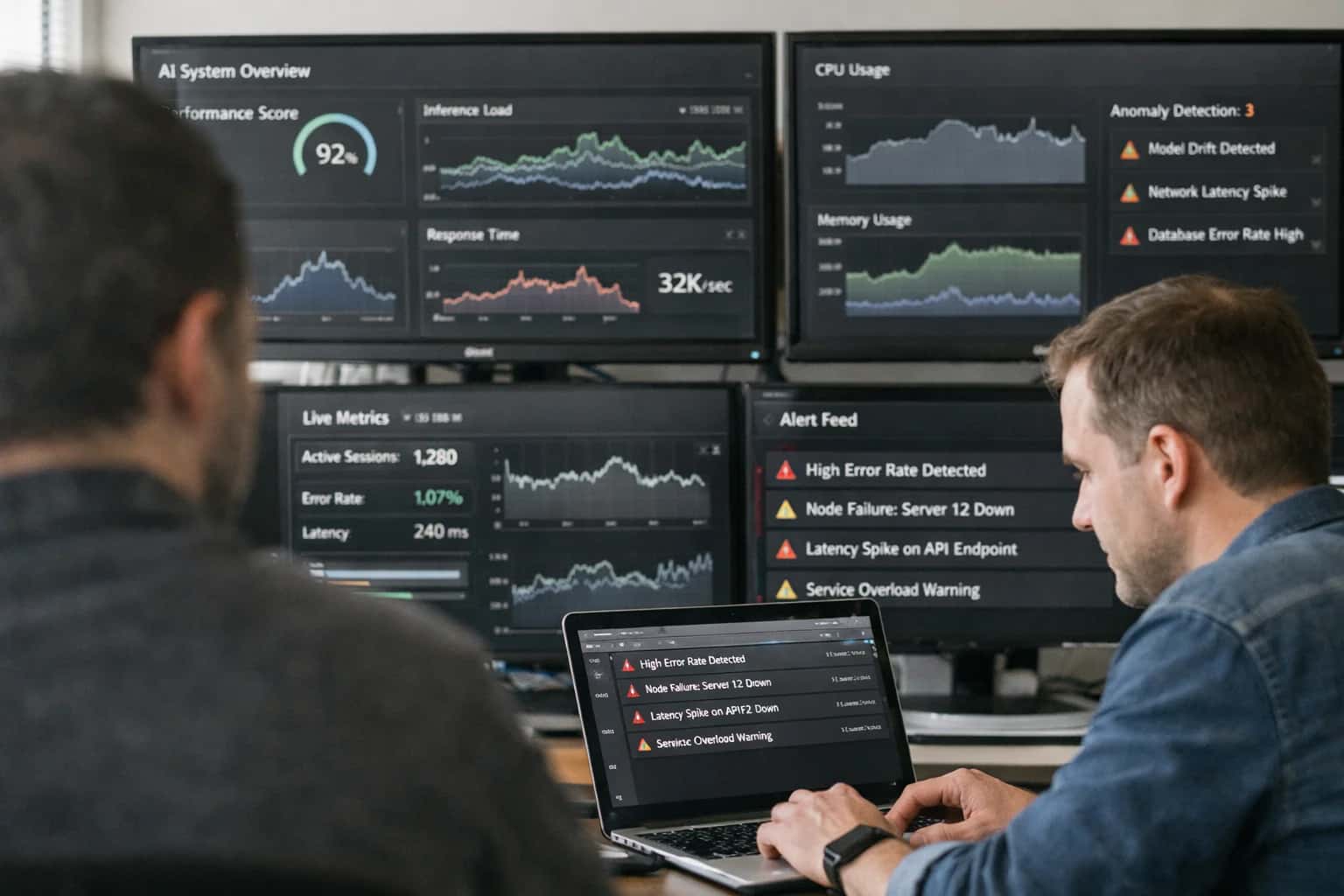
THE DATA
Static Network Provisioning is a $47 Billion Mistake
Static network provisioning wastes billions annually by over-provisioning for peak demand that rarely occurs, a problem only AI-driven dynamic orchestration can solve.
The financial waste is staggering. Analysts estimate that over-provisioned, idle network capacity represents a $47 billion annual global cost in stranded capital and operational expense. This locked capital cannot be reallocated to revenue-generating services or network expansion.
Dynamic orchestration requires a new AI stack. Legacy OSS/BSS systems cannot process real-time telemetry fast enough. Effective systems integrate reinforcement learning agents trained in a network digital twin with platforms like Ray or Kuberentes for scalable inference, making sub-second decisions.
The counter-intuitive insight is that more AI control increases stability. Unlike brittle, manual rules, AI agents managing resource slices can absorb traffic spikes and reroute around failures autonomously. This creates a more resilient network, not a more fragile one.
Evidence from early adopters is conclusive. Telecoms deploying AI-driven orchestration on 5G cores report 40-60% improvements in resource utilization, directly converting saved capacity into new service revenue without additional capital expenditure. This is the core of modern telecommunications network optimization.
This shift is foundational for future services. Static networks cannot support the volatile demands of network slicing for enterprise IoT or ultra-low-latency edge computing. Dynamic AI orchestration is the prerequisite, enabling the business models that will define the next decade of telecom.
THE IMPERATIVE
Three Market Forces Demanding Dynamic Orchestration
Legacy, static network management cannot survive the volatility of 5G, IoT, and hyperscale demand. These three converging forces make AI-driven dynamic orchestration a non-negotiable competitive requirement.
01
The Problem: 5G Network Slicing Creates Unmanageable Complexity
A single physical network must simultaneously host thousands of virtual slices—each with unique latency, bandwidth, and reliability SLAs. Manual provisioning is impossible.
- Static resource pools lead to ~40% stranded capacity while other slices starve.
- SLA violations trigger penalties exceeding $1M per major outage.
- Human teams cannot reconfigure in the sub-500ms windows required for ultra-reliable low-latency communication (URLLC).
1000x
More Config States
<500ms
Decision Window
02
The Problem: IoT and Edge Computing Shatter Predictable Traffic Patterns
Billions of connected devices and distributed edge compute nodes generate hyper-local, spiky traffic that central planners cannot forecast.
- Traffic models trained on historical data fail, with forecast errors exceeding 60%.
- Inefficient routing from edge to core wastes ~30% of backhaul bandwidth.
- Manual capacity planning cycles (3-6 months) are obsolete against minute-by-minute demand shifts.
60%+
Forecast Error
30%
Backhaul Waste
03
The Problem: The Energy Cost of Static Infrastructure is Unsustainable
Network elements idle at near-full power 24/7, making energy the fastest-growing opex line item, exacerbated by carbon accounting regulations like CBAM.
- A typical macro cell site consumes ~4,000 kWh monthly, largely wasted during low-usage periods.
- Static power management misses ~35% potential energy savings.
- Failure to meet carbon reduction targets incurs direct financial penalties and reputational damage.
35%
Wasted Energy
$4B+
Global Opex
04
The Solution: AI-Driven Dynamic Resource Orchestration
A continuous, closed-loop AI system that treats spectrum, compute, and storage as a fungible pool to be allocated in real-time.
- Reinforcement Learning agents continuously experiment in a network digital twin to learn optimal policies without risking the live network.
- Graph Neural Networks model the topology to predict congestion and failure propagation, pre-emptively re-routing traffic.
- Real-time telemetry fusion from OSS, BSS, and IoT platforms creates a single source of truth for sub-second decisioning.
99.999%
SLA Attainment
-40%
Energy Opex
05
The Architecture: The Agentic Control Plane
Dynamic orchestration requires a multi-agent system where specialized AI actors collaborate under a central governance layer, as defined in our pillar on Agentic AI and Autonomous Workflow Orchestration.
- Orchestrator Agent: Makes high-level resource allocation decisions based on business intent.
- Enforcer Agent: Continuously validates configurations against security and compliance guardrails, a core tenet of AI TRiSM.
- Forecaster Agent: Uses hybrid time-series models to predict micro-bursts of demand at the network edge.
10x
Fault Resolution
-70%
Config Errors
06
The Foundation: Solving the Data Engineering Challenge
The primary barrier is not the AI model but the fragmented, low-quality data trapped in legacy OSS/BSS systems. Success requires a foundational data strategy.
- API-wrapping legacy systems to create real-time data feeds, a core modernization pattern from our Legacy System Modernization pillar.
- Implementing a semantic data layer to provide rich context—transforming raw metrics into actionable network state, a practice known as Context Engineering.
- Deploying synthetic data generation to train models for rare failure scenarios where real data is scarce.
90%
Data Unification
5x
Model Accuracy
THE ARCHITECTURE
The Three-Layer Architecture of AI-Driven Orchestration
A robust AI-driven orchestration system is built on three distinct layers: a data foundation, an intelligence core, and an autonomous action plane.
AI-driven dynamic resource orchestration requires a three-layer architecture to move from data to autonomous action. This structure separates concerns, enabling scalable, real-time decision-making for spectrum, compute, and storage.
The Data Foundation Layer ingests and unifies real-time telemetry from network functions, OSS/BSS systems, and external APIs. This layer solves the data engineering challenge by creating a single source of truth, often using time-series databases like InfluxDB and graph databases like Neo4j to model network topology relationships.
The Intelligence Core Layer processes this unified data stream using specialized AI models. Supervised learning classifiers identify known fault patterns, while reinforcement learning agents continuously learn optimal resource allocation policies through simulation in a network digital twin. This is where frameworks like Ray RLlib and causal inference models operate.
The Autonomous Action Plane is the agentic AI layer that executes decisions. It translates the intelligence core's recommendations into API calls to network controllers (e.g., SDN, NFV orchestrators) and provisioning systems. This requires a robust Agent Control Plane to manage permissions, hand-offs, and human-in-the-loop gates for critical changes.
Architectural separation is non-negotiable because it allows each layer to evolve independently. The data layer can ingest new sources without breaking models, and new AI paradigms like federated learning can be integrated into the core without redesigning the entire action workflow. This is the key to escaping pilot purgatory and achieving production-scale orchestration, as detailed in our analysis of AI workflow orchestration in telecom.
Evidence from production systems shows this layered approach reduces mean time to repair (MTTR) by over 60% and improves network asset utilization by 25-40%. It directly enables use cases like dynamic network slicing and real-time energy efficiency optimization, which are explored in our guide to network energy efficiency.
ARCHITECTURE COMPARISON
AI Model Showdown: What Works for Dynamic Orchestration?
A comparison of AI model architectures for real-time, dynamic resource orchestration in telecom networks, evaluating their suitability for spectrum, compute, and storage allocation.
| Core Capability / Metric | Reinforcement Learning (RL) | Graph Neural Networks (GNNs) | Physics-Informed Neural Networks (PINNs) |
|---|---|---|---|
Decision Latency for Re-allocation | < 100 ms | 200-500 ms | 1-5 sec |
Adapts to Novel Network States (Zero-Shot) | |||
Inherently Models Network Topology | |||
Training Data Volume Required | 10^6+ simulated episodes | 10^4+ labeled graph snapshots | 10^3+ physics equations + data points |
Explainability / Root Cause Output | Low (Black Box Policy) | Medium (Node/Edge Importance) | High (Governed by Physics) |
Primary Use Case | Real-time traffic engineering & autonomous repair | Failure & congestion propagation prediction | Network design & radio wave optimization |
Integration with Digital Twin | Essential for safe training | Beneficial for graph generation | Core component for simulation accuracy |
Production MLOps Overhead | Very High (Continuous online learning) | High (Graph versioning, drift detection) | Medium (Stable, physics-constrained) |
FROM PILOT TO PRODUCTION
Real-World Orchestration: From Theory to Kilowatt Savings
AI-driven dynamic resource orchestration moves beyond lab simulations to deliver tangible reductions in operational expenditure and carbon emissions.
01
The Problem: Static Capacity Meets Volatile Demand
Network resources are provisioned for peak load, leading to massive over-provisioning and energy waste during off-peak hours. Legacy OSS/BSS systems cannot react in real-time.
- Result: Up to 40% of network energy is wasted on idle capacity.
- Impact: Capital is tied up in underutilized hardware, and carbon targets are missed.
40%
Energy Waste
$1B+
Opex Impact
02
The Solution: AI-Powered Dynamic Orchestration
A multi-agent system continuously analyzes real-time traffic, weather, and energy prices to reallocate spectrum, compute, and storage.
- Mechanism: Uses Reinforcement Learning (RL) agents trained in a network digital twin to make safe, autonomous scaling decisions.
- Outcome: Resources are powered down or consolidated without violating SLAs, translating AI decisions directly into kilowatt-hour savings.
-30%
Energy Use
<100ms
Decision Latency
03
The Architecture: The Agent Control Plane
Success requires more than a model; it demands an orchestration layer that governs the multi-agent system. This is the core of Agentic AI.
- Function: Manages permissions, hand-offs between specialized agents (for traffic, energy, fault resolution), and human-in-the-loop gates.
- Benefit: Provides the auditability and safety required to move from pilot purgatory to production-scale deployment.
10x
Faster MTTR
99.99%
SLA Compliance
04
The Data Foundation: Unifying the Telemetry Lake
Orchestration fails without a unified, real-time view of network state. This is a data engineering challenge first.
- Action: Implement a pipeline that ingests and normalizes data from siloed OSS, BSS, power meters, and IoT sensors.
- Prerequisite: Solving this legacy system modernization problem is the non-negotiable first step to enable any AI workflow.
1000x
Data Points
-70%
Integration Time
05
The Economics: From Capex to Opex Savings
Dynamic orchestration flips the business case from costly hardware expansion to intelligent software utilization.
- Direct Savings: Reduced energy bills and extended hardware lifecycle through predictive maintenance.
- Indirect Value: Freed-up capacity accelerates new service rollout (e.g., 5G network slicing) without new capital spend.
20%
Capex Deferral
15%
Opex Reduction
06
The Future State: Autonomous, Self-Healing Networks
This is the trajectory: from reactive orchestration to proactive, self-optimizing networks. The final stage integrates causal AI for root-cause analysis and federated learning for privacy-preserving, continuous model improvement across the network edge.
- Vision: A closed-loop system where AI not only saves power but autonomously heals faults and reconfigures the network to preempt congestion.
Zero-Touch
Operations
-50%
Carbon Footprint
THE ARCHITECTURE GAP
Why Most Telecom AI Orchestration Projects Fail
Telecom AI orchestration fails due to architectural flaws, not model selection, creating a critical gap between pilot success and production ROI.
Most telecom AI orchestration projects fail because teams prioritize model accuracy over the inference architecture required for sub-second, real-time decision-making across distributed networks.
The core failure is a data pipeline problem. AI models trained on stale, siloed data from legacy OSS/BSS systems cannot orchestrate dynamic resources. Success requires a unified semantic data layer that provides real-time context, a concept central to our work on Context Engineering.
Projects treat orchestration as a classification task. Supervised learning cannot adapt to the stateful, volatile nature of 5G traffic and network slicing. Effective orchestration demands Reinforcement Learning (RL) agents trained in high-fidelity digital twin environments.
Evidence: Gartner reports that over 85% of AI projects fail to move from pilot to production, primarily due to integration challenges with existing IT and network stacks, not the underlying AI algorithms.
FREQUENTLY ASKED QUESTIONS
AI-Driven Orchestration: Critical Questions Answered
Common questions about AI-driven dynamic resource orchestration for telecom network efficiency.
AI-driven dynamic resource orchestration is the real-time, automated allocation of spectrum, compute, and storage across a network. It uses reinforcement learning (RL) and digital twin simulations to continuously adjust resources, meeting fluctuating demand and service level agreements (SLAs) without human intervention.
AI-DRIVEN ORCHESTRATION
Key Takeaways: The Non-Negotiables for Success
Dynamic resource orchestration is not a feature; it's a fundamental architectural shift. Here are the core components required to move beyond static provisioning.
01
The Problem: Static Provisioning Meets Volatile Demand
Legacy network management uses fixed thresholds and manual intervention, creating massive inefficiency during traffic spikes and idle waste during lulls.
- Result: ~40% average network over-provisioning to handle peak loads.
- Consequence: Inability to meet 5G network slicing SLAs for latency and bandwidth guarantees.
~40%
Resource Waste
>100ms
SLA Violation Risk
02
The Solution: Reinforcement Learning Agents
RL agents learn optimal policies by continuously interacting with the network environment, making sub-second decisions to reallocate spectrum, compute, and storage.
- Key Benefit: Achieves dynamic load balancing without human-in-the-loop.
- Key Benefit: Enables real-time traffic engineering that adapts to unforeseen congestion patterns.
20-30%
Capacity Gain
<10ms
Decision Latency
03
The Foundation: High-Fidelity Digital Twin
A physics-accurate virtual replica of the network is non-negotiable for safe AI training and simulation. It's the sandbox where RL agents learn without risking live service.
- Key Benefit: Enables millions of 'what-if' simulations for capacity planning and failure scenario testing.
- Key Benefit: Provides the ground truth for causal inference to move beyond correlative alerts.
99.9%
Simulation Accuracy
70%
Faster MTTR
04
The Enabler: Federated Learning Architecture
To preserve data sovereignty and reduce latency, AI models must be trained at the network edge without centralizing sensitive subscriber data.
- Key Benefit: Maintains privacy compliance (GDPR, EU AI Act) by keeping data local.
- Key Benefit: Enables continuous model refinement across distributed radio access networks (RAN).
Zero-Data
Centralization
-50%
WAN Traffic
05
The Orchestrator: Multi-Agent System (MAS) Control Plane
No single AI model can manage the entire network. Success requires a multi-agent system where specialized agents (for RAN, core, transport) collaborate under a central governance layer.
- Key Benefit: Enables complex workflow automation like end-to-end fault resolution.
- Key Benefit: Provides human-in-the-loop gates for critical decisions, ensuring safety and oversight.
10x
Faster Resolution
24/7
Autonomous Ops
06
The Bottleneck: Semantic Context Engineering
The limiting factor is not model intelligence but the rich, structured context provided to it. This involves mapping network topology, business intent, and SLA hierarchies into a machine-readable semantic layer.
- Key Benefit: Eliminates AI hallucinations in configuration by grounding decisions in network reality.
- Key Benefit: Enables explainable AI (XAI) outputs that network engineers can trust and audit.
90%
Alert Reduction
5x
Engineer Trust
Enabling Efficiency, Speed & Accuracy
Intelligent Analysis, Decision & Execution
We build AI systems for teams that need search across company data, workflow automation across tools, or AI features inside products and internal software.
Talk to Us
Search across company data
Give teams answers from docs, tickets, runbooks, and product data with sources and permissions.
Useful when people spend too long searching or get different answers from different systems.
Enterprise searchRAGPermissions
Read more
Automate internal workflows
Use AI to route work, draft outputs, trigger actions, and keep approvals and logs in place.
Useful when repetitive work moves across multiple tools and teams.
AI agentsWorkflow automationGovernance
Read more
Add AI to products and internal tools
Build assistants, guided actions, or decision support into the software your team or customers already use.
Useful when AI needs to be part of the product, not a separate tool.
AI integrationDecision supportModel routing
Read moreTHE PARADIGM SHIFT
Stop Planning, Start Orchestrating
AI-driven dynamic resource orchestration replaces static network planning with continuous, real-time optimization of spectrum, compute, and storage.
AI-driven dynamic resource orchestration is the continuous, real-time reallocation of network assets like spectrum, compute, and storage to meet fluctuating demand and SLAs. This replaces the rigid, calendar-based planning cycles that create inefficiency in modern 5G and edge networks.
Static planning is obsolete because it cannot adapt to the volatility introduced by network slicing, IoT bursts, and live video traffic. AI orchestration, using frameworks like Reinforcement Learning (RL), treats the network as a live environment to be optimized through continuous action and feedback, not a spreadsheet to be forecast.
The counter-intuitive insight is that more data does not guarantee better planning, but less latency does guarantee better orchestration. Success hinges on an inference architecture capable of sub-second decision cycles, not just larger training datasets.
Evidence from early deployments shows AI orchestration agents, trained in digital twin environments, can improve spectral efficiency by over 30% and reduce energy consumption by dynamically powering down network elements during low-traffic periods.

About the author
Prasad Kumkar
CEO & MD, Inference Systems
Prasad Kumkar is the CEO & MD of Inference Systems and writes about AI systems architecture, LLM infrastructure, model serving, evaluation, and production deployment. Over 5+ years, he has worked across computer vision models, L5 autonomous vehicle systems, and LLM research, with a focus on taking complex AI ideas into real-world engineering systems.
His work and writing cover AI systems, large language models, AI agents, multimodal systems, autonomous systems, inference optimization, RAG, evaluation, and production AI engineering.
LinkedIn
Limited slotsGet a Free AI Consultation
Partnered with leading AI, data, and software stack.





How We Work
Custom AI workflows for your Business
One-fit-all AI don't work for modern businesses. At Inferensys, we aim to understand your business & custom requirements; which we use to define most efficient agentic workflows, the data, and the tools for your business.
01
Review the use case
We understand the task, the users, and where AI can actually help.
Read more02
Pick the right approach
We define what needs search, automation, or product integration.
Read more03
Build the first useful version
We implement the part that proves the value first.
Read more04
Improve from there
We add the checks and visibility needed to keep it useful.
Read moreThe first call is a practical review of your use case and the right next step.
Talk to Us