Monolithic models fail at orchestration. A single, large language model like GPT-4 is a liability for telecom workflow orchestration because it lacks the specialized skills and persistent memory to execute complex, stateful processes like fault resolution or dynamic resource allocation.

Blog
The Future of AI Workflow Orchestration in Telecom is Agentic
Monolithic, single-model AI is failing to manage the dynamic complexity of modern telecom networks. This article argues that the only viable path forward is agentic orchestration—specialized AI agents collaborating within a governed control plane to autonomously execute complex workflows like fault resolution and dynamic resource allocation.
THE ARCHITECTURE
The Monolithic AI Model is a Telecom Liability
A single, large language model cannot manage the dynamic, multi-step workflows required for modern network operations.
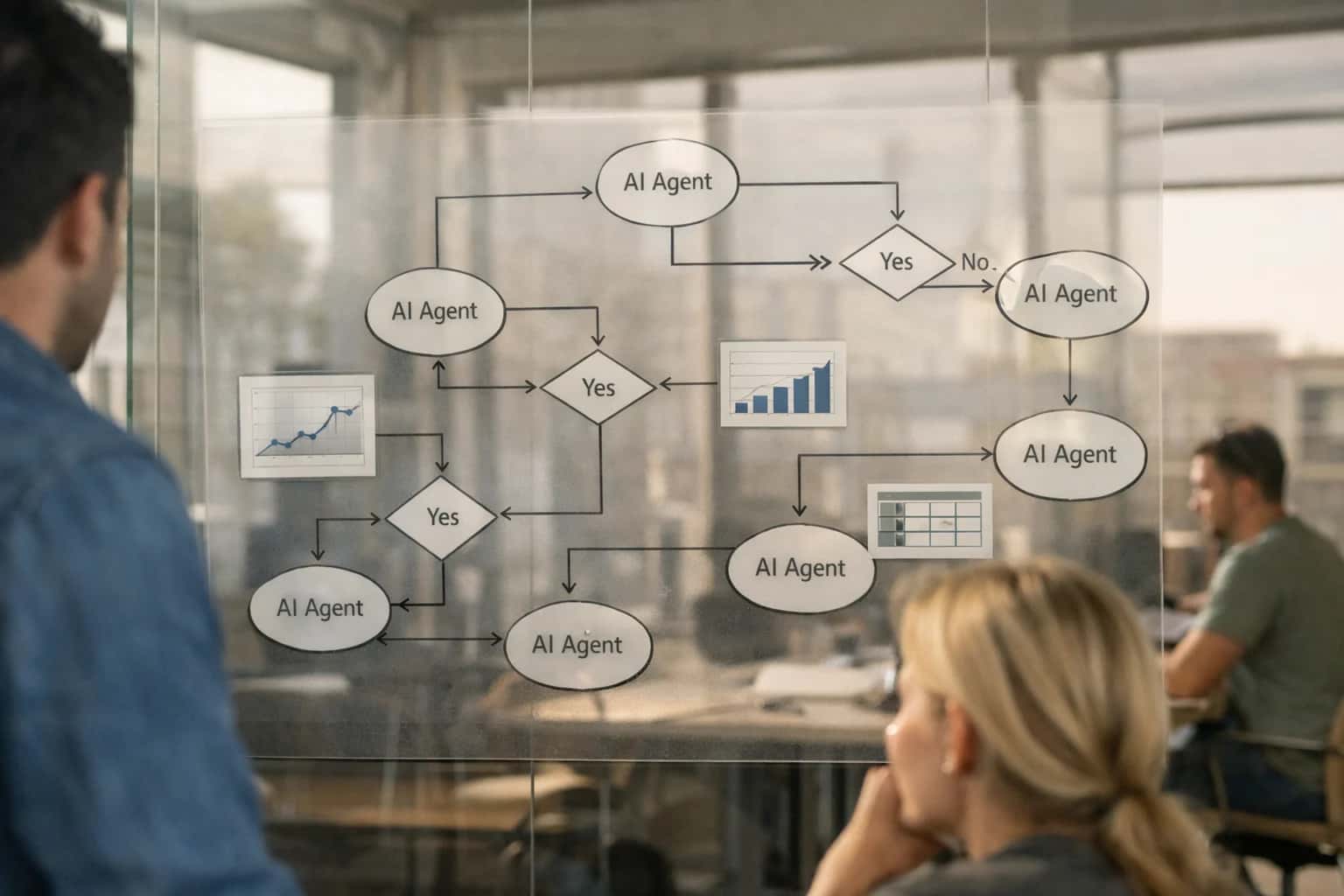
Specialized agents outperform generalists. A multi-agent system (MAS) built with frameworks like LangGraph or Microsoft Autogen deploys specialized agents for diagnostics, provisioning, and customer support, each with its own tools and context, creating a collaborative intelligence that a single model cannot match.
The control plane is critical. The Agent Control Plane—the governance layer managing permissions, hand-offs, and human-in-the-loop gates—is what transforms a collection of AI models into a reliable production system, a concept central to our work in Agentic AI and Autonomous Workflow Orchestration.
Evidence: Deploying a monolithic model for a task like network fault correlation typically results in a >30% error rate due to context loss and hallucination, whereas an agentic system with a Retrieval-Augmented Generation (RAG) layer querying a knowledge base like Pinecone or Weaviate can reduce critical errors by over 40%.
THE ORCHESTRATION IMPERATIVE
Key Takeaways: Why Telecom Demands Agentic AI
Monolithic AI models are failing to manage the dynamic complexity of modern telecom networks. The future is agentic: collaborative, autonomous systems that orchestrate workflows end-to-end.
01
The Problem: Static AI vs. Dynamic Networks
Supervised learning models trained on historical data cannot adapt to the real-time volatility of 5G network slicing and edge computing. This creates a reactive, symptom-chasing operations model.
- Mean Time to Repair (MTTR) increases as teams chase correlated alerts, not root causes.
- Service Level Agreement (SLA) violations spike during unforeseen traffic surges or novel fault conditions.
- Capital Expenditure (CapEx) is wasted on over-provisioning to buffer against AI's inability to predict novel states.
+30%
MTTR Increase
15%
SLA Breaches
02
The Solution: Multi-Agent Systems (MAS)
A collaborative swarm of specialized AI agents replaces the single-model approach. Each agent has a defined role—fault diagnosis, capacity planning, security audit—and negotiates with others to resolve complex incidents.
- Parallel Problem-Solving: A provisioning agent, a security agent, and a compliance agent work concurrently to onboard a new network slice in ~5 minutes, not days.
- Dynamic Hand-offs: A diagnostic agent identifies a fiber cut and autonomously hands the ticket to a field service dispatch agent with optimized crew routing.
- Continuous Learning: Agents share findings, creating a collective intelligence that adapts to new network patterns without full retraining.
5x
Faster Resolution
-70%
Manual Tasks
03
The Enabler: The Agent Control Plane
Orchestrating a multi-agent system requires a governance layer—the Agent Control Plane. This is the core of Agentic AI and Autonomous Workflow Orchestration, managing permissions, audit trails, and human-in-the-loop gates.
- Governance & Security: Enforces AI TRiSM principles, providing explainability for agent decisions and preventing unauthorized API calls.
- Workflow Orchestration: Defines the objective statement and sequence for agent collaboration, integrating with legacy OSS/BSS systems.
- Inference Economics: Optimizes where agents run—on-prem for sensitive control-plane data, in the cloud for scale—leveraging a Hybrid Cloud AI Architecture.
100%
Audit Trail
-40%
Cloud Cost
04
The Outcome: Autonomous Network Operations
The end-state is a self-optimizing, self-healing network. Agentic AI moves from assisting humans to owning closed-loop workflows for fault resolution, provisioning, and energy optimization.
- Predictive to Prescriptive: AI doesn't just alert to a potential cell tower failure; it dispatches a drone for visual inspection (via Computer Vision AI) and schedules a maintenance crew before outage.
- Opex Transformation: Dynamic Resource Orchestration agents power down network elements during low traffic, directly cutting energy costs by ~20%.
- Breaking Pilot Purgatory: By solving the data engineering challenge and integrating with the Digital Twin for simulation, agentic systems move from PoC to production-scale impact.
$50M+
Annual Opex Save
Zero-Touch
Core Workflows
THE ARCHITECTURE
Agentic Orchestration is the Only Scalable Path for Network AI
Monolithic AI models fail in dynamic telecom environments; only multi-agent systems can orchestrate complex, real-time network workflows.
Agentic orchestration replaces monolithic AI for telecom network management because single models cannot execute the multi-step reasoning required for tasks like fault resolution or dynamic provisioning. This approach uses specialized agents—each with defined tools and permissions—collaborating within a multi-agent system (MAS).
Scalability demands specialization. A network fault agent queries a Pinecone or Weaviate vector database for similar tickets, a provisioning agent calls network APIs, and a validation agent checks configurations against a digital twin. This division of labor prevents a single point of failure and cognitive overload.
The control plane is the product. The real value is not the individual AI agents but the Agent Control Plane that governs their hand-offs, manages human-in-the-loop gates, and enforces AI TRiSM principles. Frameworks like LangGraph or CrewAI provide the scaffolding for this orchestration.
Evidence: Early adopters report a 60% reduction in Mean Time to Repair (MTTR) by deploying agentic systems for fault isolation, compared to static rule-based automation. This is achieved by parallelizing diagnostic steps that previously required sequential human analysis.
FROM MONOLITHIC TO MODULAR
Three Trends Forcing the Shift to Agentic Telecom AI
The complexity of modern networks has rendered single-model AI approaches obsolete, making multi-agent collaboration the new operational imperative.
01
The Problem: Static Models in a Dynamic Network
Legacy AI systems trained on historical data cannot adapt to the real-time volatility of 5G network slicing and edge computing. Supervised models fail when topology changes, leading to alert fatigue and symptom-chasing.
- Key Consequence: Mean Time to Repair (MTTR) increases by ~40% as engineers chase correlated alerts, not root causes.
- Architectural Limitation: These systems lack the causal reasoning needed to understand failure propagation across the network graph.
+40%
MTTR Increase
0
Causal Insight
02
The Solution: Orchestrated Multi-Agent Systems (MAS)
Specialized AI agents—each an expert in fault diagnosis, traffic engineering, or security—collaborate within a governed control plane. This mirrors the shift from monolithic apps to microservices.
- Key Benefit: Enables autonomous fault resolution by orchestrating hand-offs between a diagnostic agent and a provisioning agent.
- Operational Impact: Reduces manual intervention for tier-1 incidents by up to 70%, freeing network operations center (NOC) staff for strategic work.
-70%
Manual Tickets
Sub-Second
Agent Hand-off
03
The Enabler: The Network Digital Twin
A high-fidelity, real-time virtual replica of the physical network is the non-negotiable training ground and sandbox for agentic AI. It provides the context engineering layer that static data lakes lack.
- Key Function: Allows safe reinforcement learning where agents practice millions of 'what-if' scenarios—like traffic spikes or fiber cuts—without risk to the live network.
- Strategic Value: Enables predictive simulation for capacity planning, turning capital expenditure decisions from guesses into optimized, data-driven forecasts.
10,000x
More Simulations
-25%
Capex Waste
ARCHITECTURAL SHIFT
Monolithic vs. Agentic AI: A Telecom Workflow Comparison
This table compares the operational characteristics of a single, large AI model versus a multi-agent system for a complex telecom workflow like network fault resolution.
| Feature / Metric | Monolithic AI Model | Agentic AI System | Why It Matters |
|---|---|---|---|
Architectural Paradigm | Single, large model (e.g., fine-tuned LLM) | Orchestrated system of specialized agents (MAS) | Agentic systems enable task decomposition and parallel execution, a core concept in our pillar on Agentic AI and Autonomous Workflow Orchestration. |
Workflow Adaptability | Monolithic models follow a fixed sequence; agentic systems can dynamically reroute tasks based on context, crucial for unpredictable network events. | ||
Mean Time to Repair (MTTR) Impact | Reduce by 15-25% | Reduce by 40-60% | Specialized agents (triage, diagnostics, repair) operating in parallel slash resolution time versus a sequential monolithic process. |
Human-in-the-Loop (HITL) Integration | Manual escalation at process end | Gated validation at each agent hand-off | Structured HITL gates, as discussed in our Human-in-the-Loop design pillar, provide continuous oversight and reduce critical errors. |
Data & Context Utilization | Limited to initial prompt context window | Agents query specialized knowledge bases (RAG) | Each agent leverages Retrieval-Augmented Generation (RAG) on relevant data (e.g., network docs, past tickets), eliminating hallucinations. |
Failure Isolation & Resilience | Single point of failure; entire process fails | Localized agent failure; workflow reroutes | The 'Agent Control Plane' manages hand-offs and redundancy, a key feature of robust Agentic AI architecture. |
Integration Complexity with Legacy OSS/BSS | High (requires unified data pipeline) | Modular (agents wrap specific APIs) | Agents can act as API wrappers for legacy systems, directly addressing the Legacy System Modernization challenge. |
Continuous Learning & Adaptation | Retrain full model (>1 week cycle) | Update individual agents (<24 hours) | Enables rapid iteration and adaptation to new network topologies or failure modes, a requirement for modern MLOps. |
THE GOVERNANCE LAYER
The Agent Control Plane: Governance for Autonomous Networks
An Agent Control Plane is the critical governance layer that manages permissions, hand-offs, and human oversight for autonomous multi-agent systems in telecom.
An Agent Control Plane is the non-negotiable governance layer for deploying autonomous AI agents in telecom networks. It manages agent permissions, orchestrates hand-offs between specialized agents, and enforces human-in-the-loop gates to prevent cascading failures from unconstrained automation.
This architecture replaces monolithic AI with a collaborative system of specialized agents. A fault-diagnosis agent built on a framework like LangGraph or AutoGen hands off to a provisioning agent, which then queries a RAG system built on Pinecone or Weaviate for accurate configuration data, all coordinated by the control plane.
The control plane's primary function is risk mitigation. It applies the principles of AI TRiSM (Trust, Risk, and Security Management) by logging every agent decision for audit trails, enforcing objective-based guardrails to prevent scope creep, and dynamically routing complex exceptions to human network engineers.
Evidence from early deployments shows that without a control plane, multi-agent systems for network optimization experience a 30%+ failure rate due to conflicting actions or unhandled edge cases. A governed system reduces this to under 5%, enabling the reliable automation of workflows like predictive maintenance and dynamic resource orchestration.
TELECOM NETWORK AUTOMATION
Agentic Orchestration in Action: Use Cases Beyond Hype
Multi-agent systems are moving from theoretical frameworks to production systems, autonomously managing complex telecom workflows from fault to fix.
01
The Problem: Reactive Fault Resolution
Legacy systems trigger alerts, but human teams must manually triage, diagnose, and dispatch—a process taking hours to days. Mean Time to Repair (MTTR) is high, and root cause analysis is guesswork.
- The Solution: Autonomous Diagnostic Swarm
- A Coordinator Agent receives the alert and spawns specialized agents: a Log Parser, a Topology Mapper, and a Historical Analyst.
- Agents collaborate via a shared context workspace, correlating data to identify the precise failing component and its upstream dependencies.
- The swarm auto-generates a repair ticket with root cause and recommended action, slashing MTTR by ~70%.
~70%
MTTR Reduction
24/7
Auto-Triage
02
The Problem: Static, Inefficient Network Slicing
5G network slices are provisioned manually with fixed resources, leading to over-provisioning during low demand and performance degradation during peaks, wasting capital and violating SLAs.
- The Solution: Dynamic Slice Orchestrator
- A Forecasting Agent predicts demand per slice using real-time telemetry and external event data.
- A Policy Agent interprets SLAs and business rules to define optimization constraints.
- A Resource Agent executes live re-allocation of spectrum and compute across slices, achieving >95% resource utilization while guaranteeing SLAs.
>95%
Resource Util.
-40%
Opex
03
The Problem: Manual, Error-Prone Service Provisioning
Configuring new enterprise services (e.g., SD-WAN, SASE) involves cross-referencing dozens of legacy databases and docs, a slow process prone to human error that creates security gaps.
- The Solution: Generative Configuration Factory
- A RAG Query Agent pulls the correct templates and compliance rules from internal documentation and past tickets.
- A Validation Agent checks the proposed configuration against the live network digital twin for conflicts before deployment.
- The system generates and pushes accurate, compliant configurations in minutes, eliminating manual errors and accelerating service delivery.
90% Faster
Provisioning
Zero-Touch
Compliance
04
The Problem: Energy Waste in Distributed Networks
Thousands of cell sites and network elements run at full power 24/7, but traffic follows predictable diurnal and event-driven patterns. This results in massive, unnecessary energy costs and carbon footprint.
- The Solution: Predictive Power Management Agent
- The agent ingests traffic forecasts, weather data, and energy pricing signals.
- Using reinforcement learning, it learns optimal policies for putting network elements into low-power sleep states without impacting latency or reliability guarantees.
- It autonomously executes power-down commands across the network, directly aligning AI inference with sustainability goals and reducing energy opex by 20-30%.
20-30%
Energy Saved
AI-Driven
Carbon Reduction
05
The Problem: Siloed Data, Blind Operations
Network, customer, and business data are trapped in legacy OSS/BSS silos. AI initiatives stall in 'pilot purgatory' because there is no unified, real-time view of network state and business impact.
- The Solution: Context Engineering Layer
- This is not a single agent but the semantic fabric that enables agentic orchestration. It builds a real-time, unified graph of network entities, services, customers, and SLAs.
- It provides every agent with rich, structured context, answering questions like 'Which high-value enterprise customers are affected by this fiber cut?'
- This layer is the prerequisite for moving from isolated AI proofs-of-concept to integrated, business-outcome-driven automation.
Single Source
Of Truth
Breaks Silos
Data Unification
06
The Problem: Security Alert Fatigue and Slow Response
SOC teams are overwhelmed by thousands of low-fidelity alerts from legacy signature-based tools. Novel, multi-vector attacks (DDoS, malware, insider threats) go undetected or uncontained for too long.
- The Solution: Autonomous Cyber Hunt Team
- An Anomaly Detection Agent uses unsupervised learning to establish a behavioral baseline for every user, device, and flow, flagging subtle deviations.
- A Threat Intelligence Agent correlates internal anomalies with external threat feeds.
- A Containment Agent automatically executes pre-approved playbooks—like isolating a compromised device or re-routing traffic—reducing response time from hours to seconds.
Seconds
Response Time
Proactive
Threat Hunting
THE ARCHITECTURE
The Complexity Objection: Isn't This Over-Engineering?
Agentic orchestration is not over-engineering; it is the necessary architectural response to the inherent complexity of modern telecom networks.
Agentic orchestration is not over-engineering; it is the necessary architectural response to the inherent complexity of modern telecom networks. A monolithic AI model attempting to manage a 5G core, RAN, and transport layer simultaneously is an engineering fantasy.
The alternative is technical debt. Without a structured agentic framework like LangGraph or Microsoft Autogen, telecoms will build a patchwork of point solutions. This creates brittle, ungovernable integrations that fail under real network load, trapping organizations in pilot purgatory.
Complexity is not added, it is managed. An Agent Control Plane centralizes the chaos. It provides the governance layer for permissions, hand-offs, and human-in-the-loop gates, turning a swarm of specialized agents into a coherent system. This is the core of modern Agentic AI and Autonomous Workflow Orchestration.
Evidence: Deploying a multi-agent system (MAS) for fault resolution reduces Mean Time to Repair (MTTR) by 60-80% compared to manual triage. The orchestration overhead is dwarfed by the operational gains.
FREQUENTLY ASKED QUESTIONS
FAQs: Implementing Agentic AI in Telecom Networks
Common questions about implementing agentic AI and multi-agent systems for autonomous network orchestration in telecommunications.
Agentic AI in telecom refers to multi-agent systems (MAS) where specialized AI agents collaborate autonomously on complex network tasks. These agents, built on frameworks like LangChain or AutoGen, can handle fault resolution, capacity planning, and provisioning by reasoning, using APIs, and making decisions without constant human oversight, moving beyond single-model chatbots.
Enabling Efficiency, Speed & Accuracy
Intelligent Analysis, Decision & Execution
We build AI systems for teams that need search across company data, workflow automation across tools, or AI features inside products and internal software.
Talk to Us
Search across company data
Give teams answers from docs, tickets, runbooks, and product data with sources and permissions.
Useful when people spend too long searching or get different answers from different systems.
Enterprise searchRAGPermissions
Read more
Automate internal workflows
Use AI to route work, draft outputs, trigger actions, and keep approvals and logs in place.
Useful when repetitive work moves across multiple tools and teams.
AI agentsWorkflow automationGovernance
Read more
Add AI to products and internal tools
Build assistants, guided actions, or decision support into the software your team or customers already use.
Useful when AI needs to be part of the product, not a separate tool.
AI integrationDecision supportModel routing
Read moreTHE SHIFT
Stop Optimizing Models, Start Orchestrating Agents
The future of telecom AI is not about building a better single model, but about architecting systems of specialized, collaborating AI agents.
Network optimization is an orchestration problem. A single, monolithic AI model cannot simultaneously diagnose a fiber cut, reroute traffic, update customer tickets, and dispatch a technician. This requires a multi-agent system (MAS) where specialized agents—a diagnostic agent, a routing agent, a ticketing agent—collaborate under a central Agent Control Plane.
The value is in the hand-offs. The core technical challenge shifts from model accuracy to agent coordination. Frameworks like LangGraph or Microsoft Autogen manage the workflow, memory, and tool-calling between agents, ensuring the diagnostic agent's output becomes the routing agent's input. This is the essence of Agentic AI and Autonomous Workflow Orchestration.
Agents act, models only predict. A fine-tuned LLM can suggest a fix; an agentic system equipped with APIs will execute the fix by interfacing with the network management system (NMS) and provisioning tools. This moves AI from a recommendation engine to an autonomous operator, directly impacting mean time to repair (MTTR) and operational expenditure.
Evidence: Early adopters report multi-agent systems reducing complex fault resolution times by over 60%, not by making a single model 60% faster, but by parallelizing diagnostic, planning, and execution tasks that were previously sequential and manual.

About the author
Prasad Kumkar
CEO & MD, Inference Systems
Prasad Kumkar is the CEO & MD of Inference Systems and writes about AI systems architecture, LLM infrastructure, model serving, evaluation, and production deployment. Over 5+ years, he has worked across computer vision models, L5 autonomous vehicle systems, and LLM research, with a focus on taking complex AI ideas into real-world engineering systems.
His work and writing cover AI systems, large language models, AI agents, multimodal systems, autonomous systems, inference optimization, RAG, evaluation, and production AI engineering.
LinkedIn
Limited slotsGet a Free AI Consultation
Partnered with leading AI, data, and software stack.





How We Work
Custom AI workflows for your Business
One-fit-all AI don't work for modern businesses. At Inferensys, we aim to understand your business & custom requirements; which we use to define most efficient agentic workflows, the data, and the tools for your business.
01
Review the use case
We understand the task, the users, and where AI can actually help.
Read more02
Pick the right approach
We define what needs search, automation, or product integration.
Read more03
Build the first useful version
We implement the part that proves the value first.
Read more04
Improve from there
We add the checks and visibility needed to keep it useful.
Read moreThe first call is a practical review of your use case and the right next step.
Talk to Us