Scaling Edge AI across heterogeneous devices is a massive cost multiplier because each chipset requires a unique, optimized software stack. The promise of a single model running everywhere is a myth; deploying to a fleet mixing NVIDIA Jetson, Qualcomm Snapdragon, and Intel Movidius chips demands separate compilation, quantization, and validation pipelines.

Blog
The Cost of Scaling Edge AI Across Heterogeneous Devices
Deploying AI across a fleet of ARM, x86, and RISC-V devices isn't a scaling problem—it's a fragmentation nightmare. This deep dive exposes the hidden engineering costs and the architectural patterns that tame the chaos.
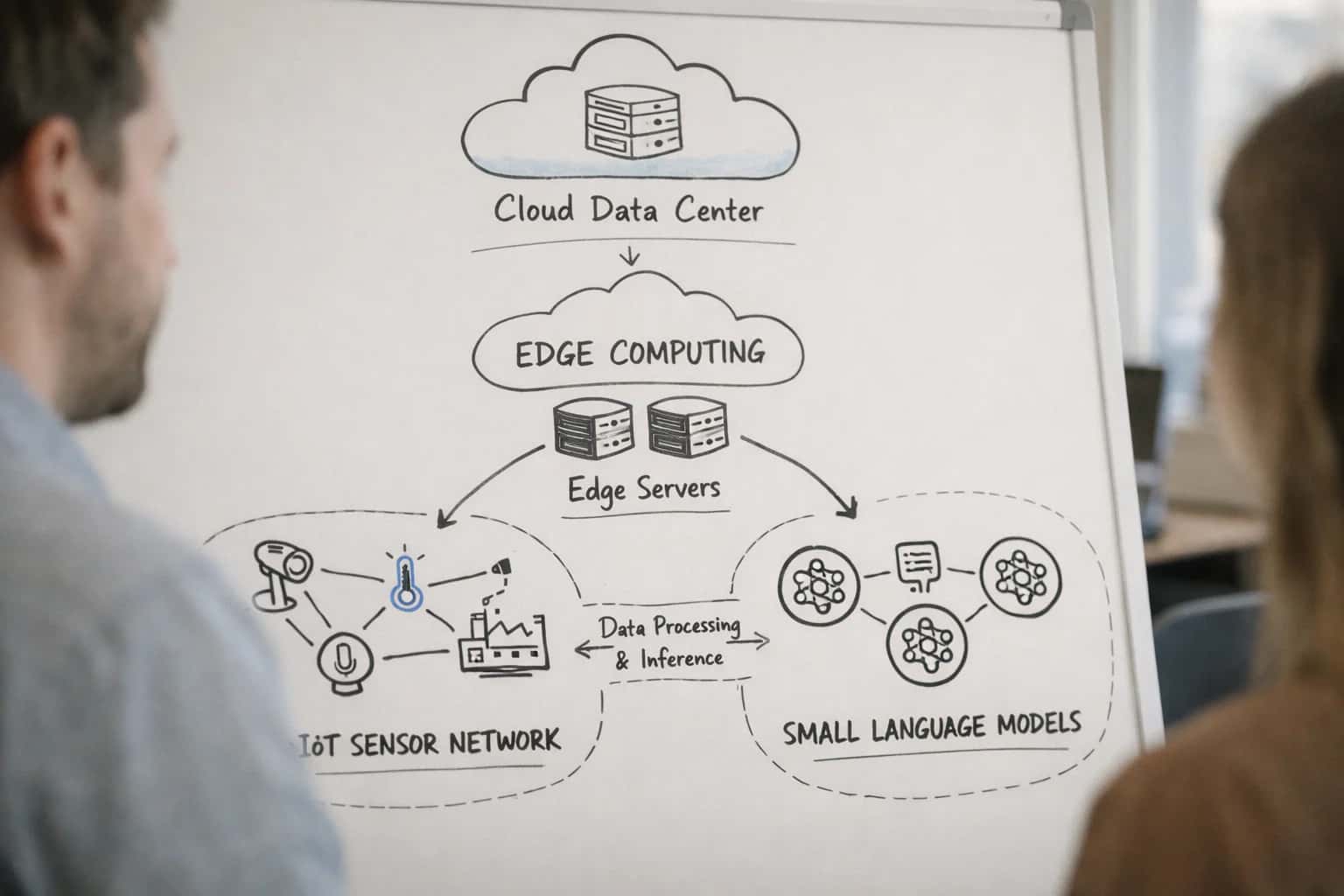
THE COST
The Edge AI Fragmentation Trap
Managing model deployment across diverse chipsets from ARM, x86, and RISC-V architectures creates a monumental, expensive engineering challenge.
The primary cost is not compute, but complexity. A team must maintain parallel deployment tracks for TensorFlow Lite, ONNX Runtime, and OpenVINO toolkits, each with its own bugs and performance quirks. This fragmentation devours engineering bandwidth that should be spent on core algorithm development.
Vendor lock-in is the hidden tax. Choosing a platform like NVIDIA's JetPack or Qualcomm's AI Stack creates long-term dependency, limiting future hardware flexibility and inflating unit costs. The strategic cost of losing architectural sovereignty often outweighs the short-term convenience.
Evidence: A 2023 survey by the Edge AI and Vision Alliance found that over 70% of developers cite 'managing heterogeneity' as their top barrier to scaling, with engineering hours on porting and optimization exceeding initial model training costs. For a deeper dive into the architectural requirements, see our analysis on why Edge AI demands hardware-software co-design.
This fragmentation directly undermines MLOps maturity. Standardized pipelines for monitoring model drift and pushing updates shatter against a wall of incompatible firmware and SDK versions. The result is a silent degradation of model performance across your fleet, turning a capital expenditure into a continuous operational liability.
THE SCALING PARADOX
Key Takeaways: The True Cost of Heterogeneous Edge AI
Scaling Edge AI across diverse hardware isn't a linear cost increase; it's an exponential engineering challenge that breaks traditional cloud-native paradigms.
01
The Problem: The Fleet Management Tax
Managing a single model variant is trivial. Managing dozens of optimized binaries for ARM, x86, and RISC-V chipsets across thousands of devices is not. The cost isn't in compute, but in the orchestration overhead of deployment, versioning, and health monitoring.
- Key Cost Driver: Engineering hours spent on custom CI/CD pipelines per architecture.
- Hidden Risk: A single-point update failure can brick an entire device class.
- Strategic Impact: This tax consumes ~40% of Edge AI project budgets, diverting resources from core algorithm development.
~40%
Budget Overhead
10x
Pipeline Complexity
02
The Solution: Hardware-Agnostic Intermediate Representations (IRs)
The escape hatch is to decouple model logic from hardware targets. Frameworks like Apache TVM and MLIR compile a single model definition into optimized code for any backend (Qualcomm Hexagon, NVIDIA TensorRT, Apple Neural Engine).
- Key Benefit: Write once, deploy everywhere. Drastically reduces variant management.
- Key Benefit: Enables performance portability, automatically leveraging new chip features.
- Strategic Impact: Transforms the cost curve from exponential to linear, turning fleet management from a tax into a manageable operational expense.
-70%
Dev Time
1 → N
Deployment Target
03
The Problem: The Silent Performance Degradation
A model achieving 95% accuracy on an NVIDIA Jetson may drop to 82% on a low-power ARM Cortex-M after aggressive quantization. This isn't a bug; it's the physics of heterogeneous deployment. Each hardware compromise (INT8 vs. FP16, memory bandwidth) chips away at model fidelity.
- Key Cost Driver: The 'accuracy tax' paid for portability, requiring costly re-training and validation cycles.
- Hidden Risk: Performance variance across devices creates inconsistent user experiences and operational blind spots.
- Strategic Impact: Undermines the business case for Edge AI if the degraded intelligence fails to deliver ROI.
-13%
Accuracy Drop
5x
Validation Cycles
04
The Solution: Progressive Model Compression & NAS
Treat model architecture as a variable, not a constant. Use Neural Architecture Search (NAS) and techniques like pruning and knowledge distillation to generate a Pareto-optimal family of models for different performance tiers.
- Key Benefit: Creates a tailored model for each device class, maximizing accuracy within constraints.
- Key Benefit: Automates the search for the optimal accuracy-latency-power trade-off.
- Strategic Impact: Preserves intelligence quality across the fleet, protecting the core value proposition of the Edge AI application.
+10%
Accuracy Recovery
Auto
Architecture Search
05
The Problem: The Update Coordination Deadlock
Pushing a model update to 10,000 devices with heterogeneous connectivity (5G, Wi-Fi, satellite) and varying duty cycles is a distributed systems nightmare. You can't just kubectl apply. Failed updates create security vulnerabilities and model drift across the fleet.
- Key Cost Driver: Operational complexity of ensuring atomic, rollback-safe updates in unreliable environments.
- Hidden Risk: Fleet fragmentation, where different device cohorts run different model versions, breaking system-level assumptions.
- Strategic Impact: Cripples MLOps at scale, turning continuous improvement into a logistical impossibility.
~500ms
Update Window
High
Fragmentation Risk
06
The Solution: Federated Learning & Edge-Native MLOps
Flip the update paradigm. Instead of pushing models, pull insights. Federated Learning aggregates learnings from devices to improve a central model, preserving privacy. Couple this with Edge-Native MLOps platforms that treat each device as a CI/CD node with autonomous health checks.
- Key Benefit: Enables continuous model improvement without massive data transfer or disruptive monolithic updates.
- Key Benefit: Provides a unified governance layer for monitoring model performance and data drift across all architectures.
- Strategic Impact: Unlocks true MLOps maturity at the edge, making the heterogeneous fleet a source of collective intelligence, not a management burden.
Zero
Data Egress
Unified
Governance Plane
THE ARCHITECTURAL CHALLENGE
Deconstructing the Cost of Edge AI Scaling
Scaling Edge AI across a fleet of heterogeneous devices is a monumental engineering challenge defined by hardware fragmentation, not just model deployment.
Scaling Edge AI is a hardware problem. The primary cost driver is managing model deployment and updates across a heterogeneous fleet of devices with different chipsets from ARM, x86, and RISC-V architectures. This fragmentation forces a combinatorial explosion of model variants, each requiring specific optimization for frameworks like TensorFlow Lite, ONNX Runtime, or NVIDIA TensorRT.
The cloud-native MLOps stack fails at the edge. Tools designed for homogeneous cloud GPU clusters, like MLflow or Kubeflow, cannot manage thousands of remote, resource-constrained, and intermittently connected devices. True scaling demands a new Edge MLOps paradigm, which we detail in our guide to MLOps maturity for Edge AI.
Vendor lock-in is a hidden scaling tax. Committing to a single silicon vendor's SDK—be it Qualcomm's SNPE, Intel's OpenVINO, or NVIDIA's JetPack—creates long-term strategic dependency. This limits flexibility to adopt better-performing or more cost-effective hardware, effectively paying a perpetual premium for initial convenience.
Evidence: A fleet with just 3 chip architectures (ARM Cortex-A, Intel x86, NVIDIA Jetson) and 2 model types (vision, NLP) requires maintaining and validating 6 distinct model binaries, not one. Each update cycle multiplies this testing and deployment overhead.
COST MATRIX
Edge AI Cost Drivers: Homogeneous vs. Heterogeneous Fleets
A direct comparison of the primary cost factors when scaling AI inference across uniform versus mixed hardware architectures.
| Cost Driver | Homogeneous Fleet (e.g., all NVIDIA Jetson) | Heterogeneous Fleet (e.g., mix of ARM, x86, RISC-V) | Decision Impact |
|---|---|---|---|
Model Optimization & Porting | One-time optimization per model | Per-model optimization for each chipset (3-5x effort) | Engineering hours scale linearly with architecture count |
SDK & Toolchain Licensing | Single vendor license (e.g., $5/device/year) | Multiple vendor licenses & proprietary compilers | Annual costs compound with vendor diversity |
Deployment & Orchestration | Unified OTA update pipeline | Fragmented pipelines requiring custom per-device logic | DevOps complexity increases operational risk |
Performance Validation | Benchmark once, deploy everywhere | Validate per device class for latency & accuracy SLAs | QA cycle time expands, delaying time-to-market |
Peak Power Draw (Watts) | Consistent profile (e.g., 15W ± 2W) | Varies 5-30W depending on chip efficiency | Unpredictable energy costs and thermal design |
Memory Footprint After Quantization | Predictable (e.g., 50MB ± 5MB) | Unpredictable (30-80MB) due to compiler differences | Forces over-provisioning, increasing BOM cost |
Mean Time Between Failures (MTBF) | Consistent, data-driven predictions | Highly variable, obscuring root cause analysis | Increases unplanned downtime and maintenance cost |
Vendor Lock-In Risk | High (single strategic dependency) | Medium (distributed dependency, but on proprietary tools) | Homogeneous fleets sacrifice flexibility for simplicity |
SCALING COSTS EXPLAINED
The Four Engineering Nightmares of Heterogeneous Edge AI
Deploying AI across a diverse fleet of edge devices—from ARM-based sensors to x86 gateways—creates unique, expensive engineering challenges that break traditional cloud-centric models.
01
The Fragmented Toolchain Tax
Every chipset vendor—NVIDIA Jetson, Qualcomm Snapdragon, Intel Movidius—has its own SDK, compiler, and optimization pipeline. Maintaining parallel deployment workflows for each architecture incurs massive overhead.
- Toolchain sprawl consumes ~30% of dev time on integration, not innovation.
- Forces teams to become experts in vendor-specific frameworks like TensorRT, SNPE, and OpenVINO.
- Creates version lock-in hell where a model update requires revalidating across every toolchain.
~30%
Dev Time Lost
3-5x
Toolchains
02
The Silent Model Drift Crisis
Edge models degrade in the field due to changing environmental data. Traditional centralized MLOps cannot monitor thousands of offline, heterogeneous devices, leading to unseen performance collapse.
- Detecting drift requires shipping inference logs back to a central lake, defeating the purpose of edge privacy.
- Retraining and redeploying a single model variant across a fragmented fleet is a logistical nightmare.
- Results in increasing false positives/negatives in critical applications like health monitors or fraud detection.
Silent
Failure Mode
Weeks
To Detect
03
The Binary Bloat & Storage Avalanche
Supporting multiple architectures means building, storing, and distributing unique model binaries for every hardware target. A single model update triggers a combinatorial explosion of artifacts.
- A model for 10 device types requires 10 compiled binaries, each needing validation.
- OTA update bandwidth costs scale linearly with fleet diversity, crippling ROI.
- Makes A/B testing and canary releases across a heterogeneous fleet nearly impossible to manage.
10x
Artifacts
$M+
Bandwidth Cost
04
The Performance Consistency Gap
Identical neural networks produce wildly different latency and accuracy on different chipsets due to driver quirks, memory hierarchies, and quantization support. Delivering a uniform service-level agreement (SLA) is impossible.
- A model achieving 10ms latency on an NVIDIA Orin may run at 100ms on an ARM Mali GPU.
- Forces lowest-common-denominator modeling, sacrificing potential on high-end hardware.
- Makes capacity planning and cost forecasting unpredictable across a mixed fleet.
10x
Latency Variance
Unpredictable
SLA
THE COST
Architectural Patterns to Tame Heterogeneous Edge AI
Managing model deployment across diverse chipsets from ARM, x86, and RISC-V architectures creates a monumental engineering challenge that breaks traditional cloud paradigms.
Monolithic cloud-native architectures fail at the edge because they assume uniform, high-bandwidth compute. The heterogeneous hardware landscape—spanning NVIDIA Jetson, Qualcomm Snapdragon, and Intel Movidius platforms—demands a fundamental architectural rethink to avoid crippling vendor lock-in and unsustainable operational costs.
Containerization is the foundational layer for portable deployment, but standard Docker containers are too heavy. The solution is ultra-lightweight runtimes like WebAssembly (WASM) via WasmEdge or specialized microVMs, which provide hardware abstraction without the overhead of a full OS, enabling a single model artifact to deploy across ARM and x86.
A unified model format is non-negotiable. Relying on vendor-specific SDKs like TensorFlow Lite for Android or ONNX Runtime for Windows creates a combinatorial explosion of build pipelines. The strategic imperative is to standardize on intermediate representations (IRs) like Apache TVM or MLIR, which compile a single model definition down to optimized code for any target CPU, GPU, or NPU.
Orchestration moves from Kubernetes to K3s and beyond. Managing thousands of remote, resource-constrained devices requires an orchestration layer designed for the edge. Lightweight distributions like K3s or specialized platforms like Akri enable declarative deployment and health monitoring across a fleet, forming the core of a mature Edge AI MLOps practice.
The hidden cost is synchronization. Updating models across a decentralized network introduces complex state consistency problems. Patterns like federated learning or delta updates, rather than full model replacements, are essential to manage bandwidth and ensure model integrity across devices without centralized data collection.
THE COST OF HETEROGENEITY
Essential Tooling for Scaling Edge AI Across Architectures
Managing model deployment across ARM, x86, and RISC-V chipsets is a monumental engineering challenge that breaks traditional cloud-centric tooling.
01
The Problem: Vendor-Specific SDKs Create Fragile Stacks
Every chipset vendor (NVIDIA, Qualcomm, Intel) provides proprietary toolkits like TensorRT, SNPE, and OpenVINO. This forces teams to maintain multiple, divergent deployment pipelines for a single model, exploding integration costs and creating brittle, vendor-locked systems that cannot adapt to new hardware.
- Key Benefit 1: Unified abstraction layers like Apache TVM or ONNX Runtime eliminate per-vendor pipeline duplication.
- Key Benefit 2: Future-proofs deployments against chipset obsolescence, enabling a ~40% reduction in long-term maintenance overhead.
3-5x
Pipeline Overhead
-40%
Maintenance Cost
02
The Solution: Hardware-Agnostic Model Compilers
Tools like Apache TVM and MLIR act as a universal compiler, taking a standard model format (e.g., ONNX) and generating optimized code for any target backend—from a Raspberry Pi to an NVIDIA Jetson. This decouples model development from hardware deployment, enabling write-once, deploy-anywhere workflows across your heterogeneous fleet.
- Key Benefit 1: Achieves near-native performance (<10% overhead) across diverse architectures without manual tuning.
- Key Benefit 2: Dramatically accelerates time-to-deployment for new device types, cutting integration cycles from months to weeks.
<10%
Performance Overhead
75%
Faster Integration
03
The Problem: Silent Model Drift at Scale
Edge models degrade in the field due to changing environmental data—a phenomenon known as concept drift. With thousands of devices, detecting this drift requires pulling inference data back to a central cloud, which defeats the purpose of edge privacy and creates a massive data transfer cost.
- Key Benefit 1: Lightweight, on-device drift detection algorithms (e.g., using KL divergence on prediction confidence) trigger alerts without raw data egress.
- Key Benefit 2: Enables proactive model updates only where needed, reducing bandwidth consumption by >90% compared to full-data repatriation.
>90%
Bandwidth Saved
Real-Time
Drift Detection
04
The Solution: Federated Learning Orchestrators
Frameworks like Flower or TensorFlow Federated enable continuous model improvement across a distributed device fleet without centralizing raw data. Each device trains on local data, and only encrypted model updates are aggregated. This is the unsung hero for maintaining model accuracy while preserving data sovereignty, a critical component for compliance with regulations like the EU AI Act.
- Key Benefit 1: Maintains data privacy by design, keeping sensitive information on-device.
- Key Benefit 2: Enables collective intelligence across the fleet, improving model accuracy by 15-25% over static deployments.
15-25%
Accuracy Gain
Zero Data Egress
Privacy Guarantee
05
The Problem: Inconsistent MLOps for Remote Devices
Cloud-native MLOps platforms (e.g., MLflow, Kubeflow) fail at the edge. They assume high bandwidth, constant connectivity, and homogeneous resources. Managing model rollouts, A/B testing, and rollbacks across thousands of offline, resource-constrained devices requires a fundamentally different orchestration paradigm.
- Key Benefit 1: Edge-native MLOps tools like Seldon Core or K3s provide lightweight, fault-tolerant orchestration for containerized models.
- Key Benefit 2: Enables canary deployments and phased rollouts with ~500ms update propagation, minimizing risk of fleet-wide failures.
~500ms
Update Latency
99.9%
Deployment Success
06
The Solution: Unified Edge AI Control Plane
A centralized control plane (e.g., built on Kubernetes KubeEdge or Azure IoT Edge) provides a single pane of glass for managing the entire lifecycle of edge AI assets. It handles secure provisioning, health monitoring, remote debugging, and policy-based governance across all architectures, turning a chaotic fleet into a manageable, software-defined infrastructure. This is the true test of MLOps maturity for edge deployments.
- Key Benefit 1: Reduces operational overhead for managing 10,000+ devices by over 70% through automation.
- Key Benefit 2: Provides strategic visibility into inference economics, energy consumption, and performance KPIs across the entire heterogeneous estate.
>70%
Ops Overhead Reduced
10,000+
Device Scale
Enabling Efficiency, Speed & Accuracy
Intelligent Analysis, Decision & Execution
We build AI systems for teams that need search across company data, workflow automation across tools, or AI features inside products and internal software.
Talk to Us
Search across company data
Give teams answers from docs, tickets, runbooks, and product data with sources and permissions.
Useful when people spend too long searching or get different answers from different systems.
Enterprise searchRAGPermissions
Read more
Automate internal workflows
Use AI to route work, draft outputs, trigger actions, and keep approvals and logs in place.
Useful when repetitive work moves across multiple tools and teams.
AI agentsWorkflow automationGovernance
Read more
Add AI to products and internal tools
Build assistants, guided actions, or decision support into the software your team or customers already use.
Useful when AI needs to be part of the product, not a separate tool.
AI integrationDecision supportModel routing
Read moreTHE COST
The Strategic Imperative: Treat Edge as a Platform, Not a Project
Scaling Edge AI across diverse hardware is a continuous operational expense, not a one-time development cost.
The scaling cost is operational, not capital. The primary expense of Edge AI is not the initial model deployment but the continuous lifecycle management across thousands of unique device configurations. Treating each deployment as a discrete project guarantees spiraling costs and technical debt.
Heterogeneity breaks cloud-native tooling. Standard MLOps platforms like MLflow or Kubeflow assume homogeneous, resource-rich environments. They fail on the fragmented reality of ARM, x86, and RISC-V chipsets, each with different memory, power, and compute profiles, requiring bespoke optimization for frameworks like TensorFlow Lite or ONNX Runtime.
Vendor lock-in is a hidden cost multiplier. Committing to a single silicon vendor's SDK, like NVIDIA's TensorRT or Qualcomm's SNPE, creates long-term strategic dependency. This limits your ability to leverage cost-competitive hardware and traps you in a proprietary toolchain, inflating total cost of ownership.
Evidence: Managing model updates for a fleet of 10,000 devices across three architectures requires at least three distinct build pipelines, tripling validation overhead. A platform approach, using tools like AWS IoT Greengrass or Azure IoT Edge for orchestration, reduces this to a single, declarative deployment manifest, cutting update cycles by 60%.

About the author
Prasad Kumkar
CEO & MD, Inference Systems
Prasad Kumkar is the CEO & MD of Inference Systems and writes about AI systems architecture, LLM infrastructure, model serving, evaluation, and production deployment. Over 5+ years, he has worked across computer vision models, L5 autonomous vehicle systems, and LLM research, with a focus on taking complex AI ideas into real-world engineering systems.
His work and writing cover AI systems, large language models, AI agents, multimodal systems, autonomous systems, inference optimization, RAG, evaluation, and production AI engineering.
LinkedIn
Limited slotsGet a Free AI Consultation
Partnered with leading AI, data, and software stack.





How We Work
Custom AI workflows for your Business
One-fit-all AI don't work for modern businesses. At Inferensys, we aim to understand your business & custom requirements; which we use to define most efficient agentic workflows, the data, and the tools for your business.
01
Review the use case
We understand the task, the users, and where AI can actually help.
Read more02
Pick the right approach
We define what needs search, automation, or product integration.
Read more03
Build the first useful version
We implement the part that proves the value first.
Read more04
Improve from there
We add the checks and visibility needed to keep it useful.
Read moreThe first call is a practical review of your use case and the right next step.
Talk to Us