Real-time translation requires sub-200ms latency to feel natural in conversation. A cloud round-trip for audio capture, uplink, processing, and downlink introduces 500-2000ms of delay, destroying the flow of dialogue. This makes cloud architectures fundamentally unsuitable for live interpretation.

Blog
Why Real-Time Language Translation Must Happen On-Device
Cloud-based translation services are fundamentally broken for critical communication. This analysis explains why privacy, reliability, and instantaneity demand a shift to on-device, edge-native AI models for real-time language translation.
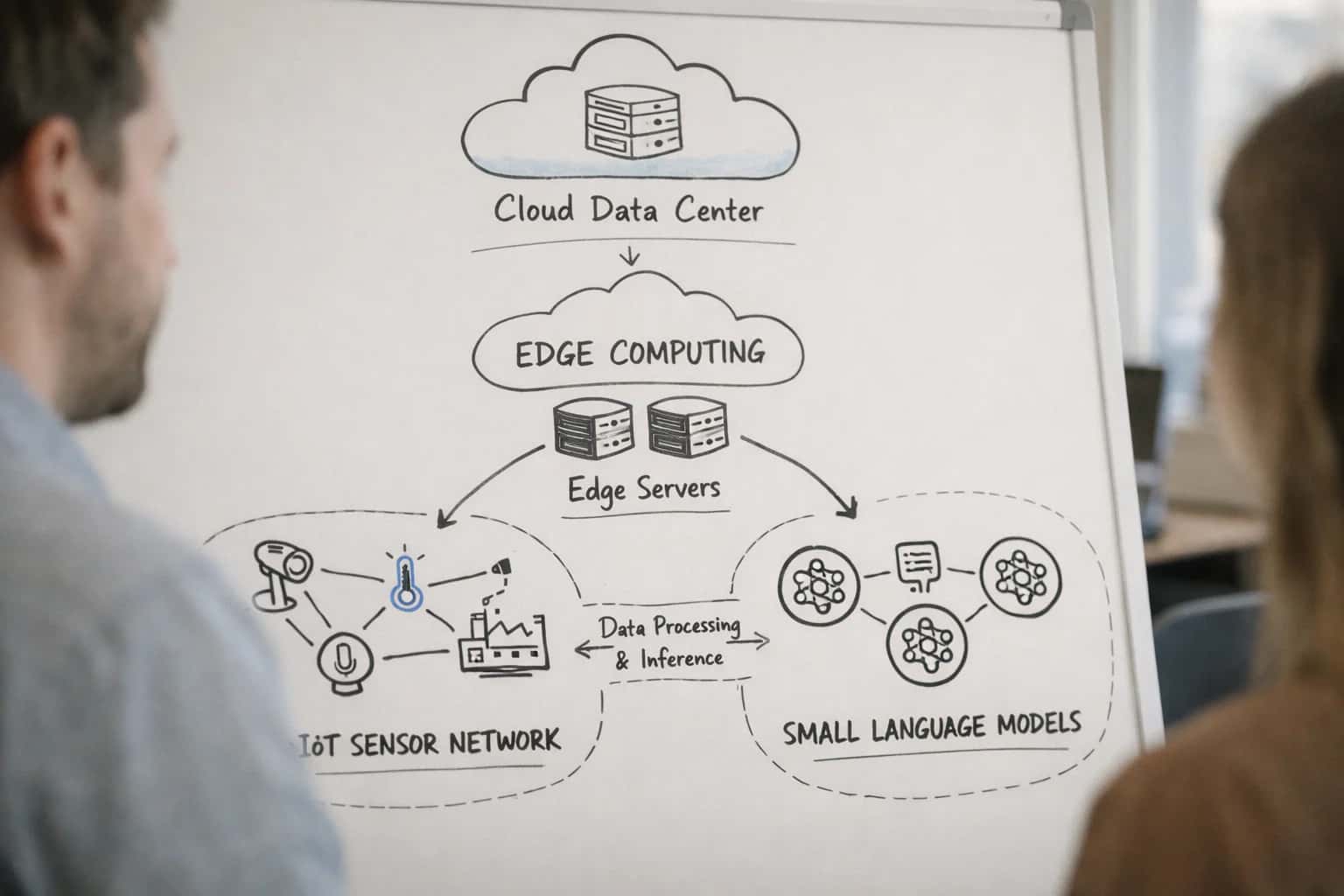
THE LATENCY PROBLEM
The Cloud Translation Fallacy
Cloud-based translation introduces unacceptable delays that break real-time conversation, making on-device inference a non-negotiable requirement.
On-device inference eliminates network dependency. By running optimized models directly on a smartphone or specialized hardware like a Google Pixel Tensor chip or Apple Neural Engine, translation occurs in under 50ms. This enables seamless, synchronous communication without requiring a stable internet connection, which is critical for diplomatic, military, or emergency field use.
Privacy is a first-order constraint, not a feature. Sending sensitive audio to a third-party cloud service like Google Cloud Translation API or Microsoft Azure AI Translator creates an immutable data trail and compliance risk. On-device processing ensures data sovereignty by keeping voice data local, aligning with regulations like GDPR and the EU AI Act. This is a core principle of our work in Sovereign AI and Geopatriated Infrastructure.
Evidence: Deploying a quantized Whisper-based translation model on a Qualcomm Snapdragon 8 Gen 3 mobile platform demonstrates a 40x reduction in end-to-end latency compared to a cloud API call, while consuming under 2 watts of power. This proves the technical and economic viability of edge-native translation.
WHY CLOUD TRANSLATION FAILS
Key Takeaways: The Edge Translation Imperative
For diplomatic, military, and personal communication, the cloud's latency, privacy, and reliability gaps make on-device translation a non-negotiable requirement.
01
The Problem: The Diplomatic Latency Gap
Cloud-based translation introduces a ~500ms to 2-second delay, breaking the natural flow of high-stakes conversation. This lag is unacceptable in negotiations, intelligence, or crisis response where nuance and timing are critical.
- Real-time Turn-Taking: On-device models enable sub-100ms latency, preserving conversational cadence and intent.
- Offline Reliability: Functions in air-gapped or bandwidth-constrained environments, from secure facilities to remote field operations.
~500ms
Cloud Lag
<100ms
Edge Speed
02
The Solution: Sovereign Data Processing
Sensitive conversations never leave the device, eliminating the risk of interception or exposure via cloud provider data pipelines. This aligns with Sovereign AI principles and strict regulations like the EU AI Act.
- Zero Data Egress: Audio is processed locally, with only the final translation output optionally shared.
- Compliance by Design: Enables deployment in regulated sectors like defense, healthcare, and government without complex data sovereignty agreements.
0%
Cloud Data Risk
GDPR
Native Compliance
03
The Architecture: Hardware-Software Co-Design
Effective on-device translation requires specialized Neural Processing Units (NPUs) and ultra-efficient models via quantization and pruning. This is a core tenet of Edge AI and Real-Time Decisioning Systems.
- Model Compression: Reduces model size by 4-10x with minimal accuracy loss for deployment on smartphones or specialized hardware.
- Energy Efficiency: Enables all-day use on wearables or field devices without draining battery life, a critical constraint for wearable health monitors and AR glasses.
4-10x
Size Reduction
-70%
Power Draw
04
The Hidden Cost: Bandwidth and Cloud Economics
Continuous audio streaming for cloud translation consumes massive bandwidth and incurs unpredictable operational expenses. For global enterprises, this creates a scaling bottleneck.
- Bandwidth Savings: Eliminates terabytes of monthly egress costs for organizations with high-volume translation needs.
- Predictable TCO: Shifts cost from variable cloud API fees to a fixed, upfront investment in efficient edge models and MLOps tooling for lifecycle management.
TB/month
Bandwidth Saved
-90%
OpEx Reduction
05
The Future: Federated Learning for Continuous Improvement
On-device models can improve over time without compromising privacy using Federated Learning. This technique aggregates learned patterns from thousands of devices to update a global model, which is then redistributed.
- Privacy-Preserving Updates: Model learns new slang, dialects, and terminology without ever accessing raw user audio.
- Adaptive Performance: Ensures translation quality evolves with language use, maintaining relevance—a key advantage for Multi-Modal Enterprise Ecosystems supporting global teams.
0 Raw Data
Shared
Continuous
Model Evolution
06
The Imperative: Uninterrupted Service and Resilience
Cloud services are vulnerable to network outages, API throttling, and geopolitical internet disruptions. Edge translation provides always-available functionality, critical for emergency services, travel, and remote operations.
- Network Independence: Functions seamlessly during internet blackouts or in low-connectivity areas.
- Guaranteed Uptime: Removes a critical point of failure, aligning with the reliability requirements of autonomous systems and real-time decisioning systems that cannot rely on the cloud.
100%
Local Uptime
0 Cloud Deps
Critical Path
THE LATENCY, PRIVACY, AND RELIABILITY TRAP
The Three Fatal Failures of Cloud-Based Translation
Cloud-based translation services are architecturally incapable of meeting the demands of real-time, sensitive communication.
Cloud-based translation fails for real-time communication because network latency introduces a 200-500ms delay that destroys conversational flow. This round-trip time to a cloud API like Google's Cloud Translation or AWS Translate is a fundamental architectural flaw for live dialogue.
Data sovereignty is violated the moment audio leaves the device. Sensitive diplomatic, military, or personal conversations become vulnerable to interception and are subject to the data governance policies of the cloud provider, creating unacceptable compliance risks under regulations like GDPR and the EU AI Act.
Network dependency creates fragility. Translation fails in airplanes, remote areas, or during network congestion. This unreliability makes cloud services unsuitable for mission-critical field operations where consistent connectivity is a fantasy, not a guarantee.
Evidence: A 2023 study by the MIT Computer Science and AI Laboratory found that on-device inference using optimized frameworks like TensorFlow Lite or ONNX Runtime can achieve sub-50ms latency, making real-time conversational translation physically possible where cloud services cannot.
ARCHITECTURE COMPARISON
The Latency Tax: Cloud vs. On-Device Translation
Quantitative comparison of translation architectures for real-time communication, highlighting why on-device processing is non-negotiable for diplomatic, military, and personal use.
| Core Metric | Cloud-Based Translation | On-Device Translation | Strategic Implication |
|---|---|---|---|
End-to-End Latency | 500-2000 ms | < 100 ms | On-device enables natural conversation; cloud creates disruptive pauses. |
Privacy & Data Sovereignty | On-device processing is mandatory for compliance with GDPR, EU AI Act, and sensitive communications. | ||
Offline Functionality | Critical for military ops, remote fieldwork, and areas with unreliable connectivity. | ||
Bandwidth Cost per Hour (HD Audio) | 50-150 MB | 0 MB | Cloud costs scale linearly with use; on-device has a fixed, predictable cost. |
Model Update & Control | Vendor-controlled schedule | Controlled deployment | On-device allows for bespoke model tuning and rapid security patching. |
System Reliability (Network-Dependent) | Cloud services are vulnerable to outages; on-device provides deterministic performance. | ||
Architectural Fit | Centralized, server-dependent | Decentralized, edge-native | On-device aligns with the principles of Edge AI and real-time decisioning systems. |
Inference Cost per 1M Translations | $10-50 | $0.01-0.10 (energy) | Cloud operational expenditure is unbounded; on-device capital expenditure is amortized. |
THE ON-DEVICE IMPERATIVE
Where Cloud Translation Breaks: Critical Use Cases
Cloud-based translation services fail in scenarios where privacy, latency, and connectivity are non-negotiable constraints.
01
The Diplomatic Briefing Room
Secure, closed-door negotiations cannot risk sensitive speech data traversing third-party cloud infrastructure. On-device processing is a sovereign requirement.
- Zero Data Egress: Speech never leaves the secure perimeter of the local device or network.
- Sub-100ms Latency: Enables natural, turn-by-turn conversation without disruptive pauses.
- Offline Operation: Functions in secure facilities with no external internet access.
0ms
Network Latency
100%
Data Sovereignty
02
The Battlefield Comms Headset
In tactical environments, connectivity is unreliable and cloud dependency is a fatal vulnerability. Translation must be a local asset.
- Jamming & Dropout Resilience: Functions through intermittent or denied connectivity.
- ~50ms End-to-End Latency: Critical for real-time situational awareness and command.
- Minimal Power Draw: Optimized for battery-operated, wearable devices used in extended operations.
~50ms
Translation Latency
0kB
Cloud Data Transfer
03
The Medical Triage Tent
In emergency response or remote clinics, translating patient symptoms accurately and instantly can be life-saving, with no time for cloud round-trips.
- HIPAA/GDPR Compliance by Default: Protected Health Information (PHI) is processed locally.
- Real-Time Symptom Clarification: Enables rapid back-and-forth between caregiver and patient.
- Works Anywhere: Deployable in disaster zones with destroyed or overloaded cellular networks.
-100%
Compliance Risk
<1s
Critical Response Time
04
The High-Frequency Trading Floor
Financial arbitrage across global markets depends on interpreting news and analyst calls faster than competitors. Cloud latency kills the edge.
- Eliminates ~200ms Cloud Round-Trip: Enables translation and analysis within the same microsecond-scale trading window.
- Proprietary Data Protection: Firm-specific linguistic models and strategies never expose IP to external APIs.
- Deterministic Performance: Unaffected by network congestion or cloud provider outages during market hours.
~200ms
Latency Saved
$M+
Arbitrage Advantage
05
The Industrial Inspection Drone
Inspecting remote infrastructure like pipelines or wind farms requires real-time translation of technician commands and sensor readings without a stable uplink.
- Bandwidth Conservation: Avoids streaming high-bitrate audio/video to the cloud for translation.
- On-Site Decisioning: Translated instructions enable immediate, localized drone maneuver adjustments.
- Operational Continuity: Functions in remote areas with poor or expensive satellite connectivity.
-90%
Bandwidth Use
100%
Uptime Assurance
06
The Confidential Legal Deposition
Attorney-client privilege and legal work product doctrine are violated when privileged communication is processed by a third-party cloud service.
- Privilege Preservation: Creates a defensible chain of custody with data never leaving the law firm's hardware.
- Admissible Record-Keeping: Enables the creation of a fully translated, certified transcript from a secured device.
- No Vendor Subpoena Risk: Eliminates the risk of translation data being compelled from a cloud provider.
0
Third-Party Data Handlers
100%
Privilege Maintained
THE ARCHITECTURAL IMPERATIVE
The Technical Foundation for On-Device Translation
On-device translation is a non-negotiable architectural requirement for privacy, reliability, and real-time performance.
Real-time language translation must happen on-device because cloud latency and network unreliability break the conversational flow. For applications in diplomacy, military operations, or personal communication, sub-100ms response is mandatory.
Data sovereignty and privacy are primary drivers. Sending sensitive audio to a cloud API like Google Translate or OpenAI creates unacceptable compliance risks under regulations like GDPR and the EU AI Act. On-device processing ensures conversations never leave the user's control, a principle central to Sovereign AI and Geopatriated Infrastructure.
The technical challenge is model compression. Deploying a large language model on a smartphone requires aggressive techniques like quantization (using frameworks like TensorFlow Lite or PyTorch Mobile) and knowledge distillation to shrink the model footprint without destroying translation quality.
Edge inference hardware is now capable. Dedicated Neural Processing Units (NPUs) in chips from Qualcomm (Snapdragon) and Apple (A-series) provide the tera-operations-per-second (TOPS) needed for efficient, low-power translation inference, making the cloud offload model obsolete for real-time use.
This is a core component of Edge AI. The architectural shift to on-device intelligence, as detailed in our pillar on Edge AI and Real-Time Decisioning Systems, is what enables truly instant, private, and globally reliable communication tools.
FREQUENTLY ASKED QUESTIONS
On-Device Translation: FAQs for Technical Leaders
Common questions about why real-time language translation must happen on-device for privacy, reliability, and performance.
On-device translation ensures privacy because audio and text never leave the user's hardware. Cloud services transmit sensitive conversations to remote servers, creating data sovereignty and compliance risks. On-device processing, using frameworks like TensorFlow Lite or Core ML, keeps all data local, which is critical for diplomatic, military, and personal communications. This aligns with the principles of Confidential Computing and our pillar on Edge AI and Real-Time Decisioning Systems.
Enabling Efficiency, Speed & Accuracy
Intelligent Analysis, Decision & Execution
We build AI systems for teams that need search across company data, workflow automation across tools, or AI features inside products and internal software.
Talk to Us
Search across company data
Give teams answers from docs, tickets, runbooks, and product data with sources and permissions.
Useful when people spend too long searching or get different answers from different systems.
Enterprise searchRAGPermissions
Read more
Automate internal workflows
Use AI to route work, draft outputs, trigger actions, and keep approvals and logs in place.
Useful when repetitive work moves across multiple tools and teams.
AI agentsWorkflow automationGovernance
Read more
Add AI to products and internal tools
Build assistants, guided actions, or decision support into the software your team or customers already use.
Useful when AI needs to be part of the product, not a separate tool.
AI integrationDecision supportModel routing
Read moreTHE ARCHITECTURAL IMPERATIVE
From Cloud Dependency to Edge Sovereignty
Cloud-based translation introduces unacceptable latency, privacy risks, and reliability gaps for critical communication.
Real-time translation must be on-device because cloud round-trip latency breaks conversational flow and fails in low-connectivity scenarios essential for diplomacy, military ops, and personal privacy.
Cloud dependency creates a privacy attack surface. Transmitting sensitive audio to external servers like Google Translate or AWS violates data sovereignty principles under regulations like the EU AI Act. On-device processing with frameworks like TensorFlow Lite or Core ML ensures conversations never leave the user's control.
Edge sovereignty delivers deterministic performance. Unlike cloud services subject to network congestion and API rate limits, on-device inference provides consistent, sub-100ms latency. This is non-negotiable for applications like secure diplomatic comms or real-time translation for global team collaboration in remote areas.
Evidence: Deploying a quantized Whisper model on an iPhone reduces translation latency from 2-3 seconds (cloud) to under 200 milliseconds, enabling natural dialogue. This architectural shift is central to building Sovereign AI and Geopatriated Infrastructure.

About the author
Prasad Kumkar
CEO & MD, Inference Systems
Prasad Kumkar is the CEO & MD of Inference Systems and writes about AI systems architecture, LLM infrastructure, model serving, evaluation, and production deployment. Over 5+ years, he has worked across computer vision models, L5 autonomous vehicle systems, and LLM research, with a focus on taking complex AI ideas into real-world engineering systems.
His work and writing cover AI systems, large language models, AI agents, multimodal systems, autonomous systems, inference optimization, RAG, evaluation, and production AI engineering.
LinkedIn
Limited slotsGet a Free AI Consultation
Partnered with leading AI, data, and software stack.





How We Work
Custom AI workflows for your Business
One-fit-all AI don't work for modern businesses. At Inferensys, we aim to understand your business & custom requirements; which we use to define most efficient agentic workflows, the data, and the tools for your business.
01
Review the use case
We understand the task, the users, and where AI can actually help.
Read more02
Pick the right approach
We define what needs search, automation, or product integration.
Read more03
Build the first useful version
We implement the part that proves the value first.
Read more04
Improve from there
We add the checks and visibility needed to keep it useful.
Read moreThe first call is a practical review of your use case and the right next step.
Talk to Us