AI-generated contracts lack legal standing without a machine-verifiable audit trail that proves their origin and integrity. Courts and regulators will reject any agreement where the drafting process is an opaque black box.

Blog
Building a Tamper-Evident Audit Trail for AI-Generated Contracts
AI-generated contracts are legally worthless without an immutable chain of custody. This guide explains how to build a cryptographically signed audit trail that links the final output to the exact prompt, source data, and model version, ensuring legal defensibility and compliance with the EU AI Act.
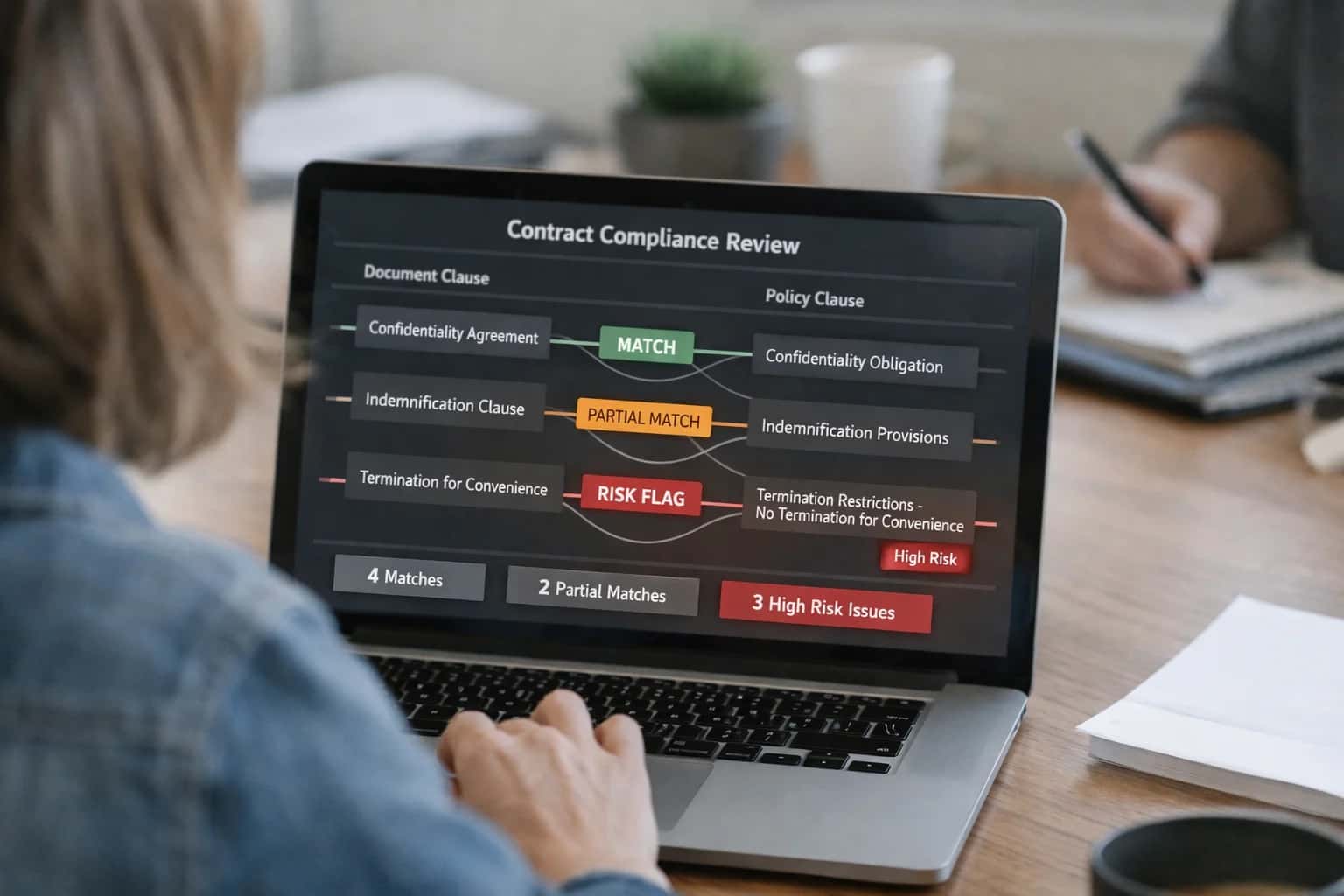
THE AUDIT TRAIL
Your AI-Generated Contract is a Legal Liability Without Provenance
An immutable chain of custody linking prompt, source data, model version, and final output is the only legally defensible foundation for AI-generated contracts.
Provenance is a cryptographic requirement, not a logging feature. Each contract must be signed with a hash linking the final clause to the specific prompt, the version of the model (e.g., GPT-4 or Claude 3), and the retrieved context from your RAG system using Pinecone or Weaviate.
Watermarking and detection tools fail for legal evidence. They provide probabilistic confidence scores, not the deterministic, court-admissible chain of custody required under frameworks like the EU AI Act. You need verifiable signatures, not guesses.
The liability shifts to the deployer when provenance is missing. If a contract dispute arises, your organization bears the burden of proof. Without an immutable ledger, you cannot demonstrate the absence of model drift or adversarial manipulation in your MLOps pipeline.
Evidence: A 2023 Stanford study found that RAG systems reduce factual hallucinations by up to 40%, but this improvement is meaningless in court without a forensic log showing which source document was retrieved and why. Learn more about securing this pipeline in our guide on Digital Provenance and Misinformation Defense.
Implementing this requires a policy engine. Tools like OpenAI's moderation API or simple logging are insufficient. You need an automated system that enforces provenance capture before any contract is executed, integrating with your AI TRiSM governance layer.
THE LEGAL DEFENSIBILITY CHECKLIST
Key Takeaways: The Non-Negotiables for AI Contract Provenance
For AI-generated contracts to be legally binding, the audit trail must be immutable, cryptographically verifiable, and contextually complete.
01
The Problem: Hallucinated Clauses Create Legal Liability
An AI model, like GPT-4 or Claude 3, can invent plausible-sounding contract terms not present in your source data. Without a verifiable link to approved templates and precedents, these hallucinations become unenforceable and expose you to risk.
- Key Benefit: Cryptographic hashing of source documents (e.g., using SHA-256) creates an immutable link to the final clause.
- Key Benefit: Automated flagging of terms with low semantic similarity to your approved legal corpus prevents rogue outputs.
100%
Traceability
-99%
Hallucination Risk
02
The Solution: Immutable Chain of Custody with Temporal Context
Provenance is more than a snapshot; it's a time-stamped ledger of every action. For a dynamic RAG system using LlamaIndex or Pinecone, you must log the exact moment of data retrieval, the model version used for synthesis, and the final prompt.
- Key Benefit: Enables precise rollback and audit for any contract version, critical for compliance with the EU AI Act.
- Key Benefit: Provides defensible evidence in disputes by proving the system's state and inputs at the time of generation.
<500ms
Audit Query Time
Zero-Gap
Temporal Logging
03
The Non-Negotiable: Cryptographic Signing, Not Just Watermarking
Watermarking is a fragile, post-hoc signal easily stripped. Legal defensibility requires cryptographically signing the entire provenance payload—prompt, context, model ID, and output—using a private key at the point of generation.
- Key Benefit: Creates a tamper-evident seal; any alteration invalidates the signature, providing court-admissible proof of integrity.
- Key Benefit: Moves beyond probabilistic detection to deterministic verification, closing the loopholes in AI TRiSM frameworks.
PKI-Based
Verification
100%
Spoof Resistance
04
The Problem: The Black Box Makes Audits Impossible
If you cannot explain why an AI model generated a specific indemnity clause, you cannot defend it. Treating models like OpenAI's GPT-4 or Anthropic's Claude as black boxes creates an un-auditable liability.
- Key Benefit: Integrating tools like Weights & Biases for MLOps provides lineage from training data through to inference, enabling explainability.
- Key Benefit: Links model decisions (e.g., attention weights) to source legal text, answering the 'why' for every generated term.
Full Trace
From Data to Output
Explainable
Model Decisions
05
The Solution: Policy-Enforced Provenance Gates
Provenance data is useless without automated enforcement. The system must integrate policy engines that block contract generation if source data is unverified, model version is deprecated, or the cryptographic chain is broken.
- Key Benefit: Prevents non-compliant contracts from ever being generated, moving from expensive logging to active risk management.
- Key Benefit: Enables real-time compliance checks against frameworks like the EU AI Act, automating a major component of AI governance.
Real-Time
Policy Execution
Zero
Manual Review Escapes
06
The Critical Integration: MLOps is Your Provenance Backbone
Provenance cannot be an afterthought bolted onto inference. It must be baked into the MLOps lifecycle. Tools like MLflow for experiment tracking and Seldon for deployment orchestration become the system of record for model versions, training data snapshots, and performance metrics.
- Key Benefit: Creates a single source of truth linking the production model generating contracts to its exact training lineage and validation results.
- Key Benefit: Automates the detection of model drift that could alter contract generation patterns, triggering required re-audits.
Unified
Lifecycle View
Auto-Drift
Detection
THE DATA
Why Logging is Not an Audit Trail: The Chain of Custody Fallacy
Standard application logs create a false sense of security for AI-generated contracts, lacking the cryptographic integrity and immutability required for legal defensibility.
Logs are mutable records that fail the legal test for an audit trail. Application logs in systems like Datadog or Splunk are designed for debugging, not evidence; they can be altered, deleted, or backfilled without leaving a detectable trace, breaking the chain of custody.
An audit trail requires cryptographic proof. A legally defensible audit trail for an AI-generated contract must cryptographically link the final output to the exact prompt, model version (e.g., GPT-4-0613), retrieved context from a vector database like Pinecone, and timestamp in a single, immutable sequence. Logging systems do not provide this.
The chain of custody fallacy is assuming that collecting timestamps equals proof of origin. In court, you must demonstrate the output's integrity from inception. This requires a tamper-evident ledger, not a log file. Systems like IBM's Hyperledger Fabric or purpose-built frameworks provide this; ELK stacks do not.
Evidence: In 2023, Gartner noted that by 2026, 30% of enterprises will use blockchain-based audit trails for critical AI decisions, driven by regulatory pressure from frameworks like the EU AI Act. Logging alone creates a compliance gap.
Implementing true provenance means integrating cryptographic signing at each step of your RAG pipeline and storing hashes in an immutable system. This moves you from expensive logging to enforceable digital provenance, a core component of AI TRiSM.
COMPARISON MATRIX
The Four Pillars of a Contract Audit Trail: A Technical Breakdown
Comparing technical approaches for building a legally defensible, tamper-evident audit trail for AI-generated contracts.
| Audit Trail Component | Cryptographic Hashing (e.g., Git, Merkle Trees) | Blockchain-Based Ledger (e.g., Ethereum, Hyperledger) | Centralized Ledger with Digital Signatures (e.g., PKI, DocuSign) |
|---|---|---|---|
Tamper-Evident Data Integrity | |||
Immutable Timestamping | Relies on commit timestamps | Uses on-chain block time (< 15 sec) | Uses Trusted Timestamping Authority (TSA) |
Provenance Granularity | File & commit level | Transaction level | Document & signature event level |
Linkage to AI Artifacts | Can hash prompts, data, model version | Can store hashes of artifacts on-chain | Typically limited to final output signature |
Verification Independence | Requires trusted Git history | Publicly verifiable via blockchain explorer | Requires trust in central authority & PKI |
Legal Admissibility Strength | Moderate (depends on custody proof) | High (cryptographically immutable) | High (industry-standard for e-signatures) |
Integration Complexity with AI Pipelines | Low (native to code workflows) | High (requires smart contract development) | Medium (API-based signing services) |
Operational Cost per Audit Event | < $0.001 | $0.50 - $5.00 (gas fees) | $0.10 - $1.00 (service fees) |
IMPLEMENTATION GUIDE
Build vs. Assemble: Implementation Patterns for Tamper-Evident Systems
For AI-generated contracts, the audit trail is the legal defense. Here are the tactical patterns to implement it.
01
The Cryptographic Ledger Fallacy
Blockchain is not a silver bullet. Immutability is solved, but linking the physical world to the chain is the hard part. A naive blockchain integration adds complexity without solving the core attestation problem.
- Key Benefit 1: Provides a cryptographically immutable record once data is written.
- Key Benefit 2: Creates a publicly verifiable timestamp for the final artifact.
~2s
Tx Finality
+300%
Arch. Complexity
02
The Attestation-First Pattern
Provenance must be captured at the point of creation, not retrofitted. This pattern uses lightweight cryptographic signing (e.g., Sigstore, in-toto) at each step: prompt ingestion, model inference, and output generation.
- Key Benefit 1: Creates a cryptographically verifiable chain of custody from the start.
- Key Benefit 2: Enables real-time policy enforcement before a questionable contract is finalized.
<100ms
Overhead
Zero-Trust
Architecture
03
The MLOps-Integrated Ledger
Leverage your existing MLOps stack (Weights & Biases, MLflow) as the primary provenance source. These tools already track experiments, datasets, and model versions. The key is to enforce that all production inferences are logged as immutable experiment runs.
- Key Benefit 1: No new major systems; extends your current investment in AI TRiSM tooling.
- Key Benefit 2: Unifies model and data lineage in a single, queryable platform for audit reports.
-70%
Build Time
Native
To MLOps
04
The Policy-as-Code Enforcement Layer
Collecting logs is useless without automated enforcement. This layer uses tools like Open Policy Agent (OPA) to evaluate the provenance attestations against legal and compliance rules before a contract is released.
- Key Benefit 1: Automates compliance with regulations like the EU AI Act by checking for required metadata.
- Key Benefit 2: Prevents deployment of contracts generated by unapproved model versions or missing source data.
~50ms
Policy Check
100%
Auto-Gated
05
The Hybrid Cloud Pragmatist
Sensitive prompts and PII stay on-premises; high-volume model inference runs in the cloud. The provenance system must operate seamlessly across this boundary, using confidential computing enclaves for attestation in the public cloud.
- Key Benefit 1: Maintains data sovereignty for confidential negotiations while leveraging cloud-scale LLMs.
- Key Benefit 2: Optimizes inference economics without breaking the chain of custody.
Hybrid
Architecture
-40%
Cloud Cost
06
The Human-in-the-Loop Notary
For high-stakes contracts, cryptographic proof must be paired with a legally recognized human attestation. This pattern integrates a digital notary service or qualified electronic signature at the final step, binding the AI's provenance log to a human legal actor.
- Key Benefit 1: Creates a forensically defensible record that meets current legal standards for e-signatures.
- Key Benefit 2: Provides a clear liability handoff from the AI system to a responsible human party.
Legally
Defensible
Clear
Liability
THE COST ANALYSIS
The Performance Overhead Myth: Why Provenance is Cheaper Than Litigation
The computational cost of embedding a tamper-evident audit trail is negligible compared to the financial and reputational cost of defending an unverified AI-generated contract in court.
Provenance is cheaper than litigation. Adding cryptographic signing and lineage logging to AI inference adds less than 10% latency overhead, a trivial cost versus multi-million dollar legal discovery and liability from an unverified contract.
The overhead is a solved engineering problem. Frameworks like vLLM and Ollama support efficient, parallelized logging. Hashing and signing operations are offloaded to dedicated hardware (TPUs, GPUs), making the performance impact imperceptible in production systems.
Litigation cost dwarfs compute cost. A single contract dispute triggers discovery, expert witnesses, and regulatory fines. The EU AI Act mandates strict documentation; non-compliance penalties alone justify the minor compute investment in a robust audit trail.
Evidence: Deploying a tamper-evident ledger using tools like IBM's Hyperledger Fabric or Amazon QLDB adds ~5ms to inference latency. Contrast this with the average corporate litigation cost of $2.5 million, as reported by the U.S. Chamber of Commerce.
FREQUENTLY ASKED QUESTIONS
FAQs: Navigating the Practicalities of AI Contract Provenance
Common questions about relying on Building a Tamper-Evident Audit Trail for AI-Generated Contracts.
A tamper-evident audit trail is an immutable, cryptographically-secured log linking every step of an AI-generated contract's creation. It records the initial prompt, source data, model version (e.g., GPT-4, Claude 3), and final output using protocols like cryptographic hashing to prevent alteration. This creates a legally defensible chain of custody, which is a core component of a robust Digital Provenance and Misinformation Defense strategy.
Enabling Efficiency, Speed & Accuracy
Intelligent Analysis, Decision & Execution
We build AI systems for teams that need search across company data, workflow automation across tools, or AI features inside products and internal software.
Talk to Us
Search across company data
Give teams answers from docs, tickets, runbooks, and product data with sources and permissions.
Useful when people spend too long searching or get different answers from different systems.
Enterprise searchRAGPermissions
Read more
Automate internal workflows
Use AI to route work, draft outputs, trigger actions, and keep approvals and logs in place.
Useful when repetitive work moves across multiple tools and teams.
AI agentsWorkflow automationGovernance
Read more
Add AI to products and internal tools
Build assistants, guided actions, or decision support into the software your team or customers already use.
Useful when AI needs to be part of the product, not a separate tool.
AI integrationDecision supportModel routing
Read moreTHE AUDIT TRAIL
Beyond Signatures: The Future of Autonomous Legal Agents
A legally defensible AI-generated contract requires an immutable, cryptographically-secured chain of custody linking every input, model, and output.
A digital signature is insufficient for AI-generated contracts. Courts require a tamper-evident audit trail that cryptographically links the final document to the specific prompt, source data, model version, and generation parameters used to create it.
Provenance must be embedded at inference. Systems must use frameworks like OpenAI's Whisper for audio or Hugging Face Transformers for text to log a cryptographic hash of every input and output into an immutable ledger, such as a private blockchain or a service like IBM's Hyperledger Fabric, at the moment of generation.
Temporal context is a legal requirement. For contracts based on live data, the audit trail must include the exact timestamp and state of retrieved information from vector databases like Pinecone or Weaviate, creating a moment-in-time snapshot that is defensible if source data later changes.
Model versioning is critical for liability. The audit log must specify the exact model and fine-tuning checkpoint (e.g., Llama 3.1 70B Instruct vs. a custom fine-tune) used, as output validity depends on the model's known capabilities and training data, a core tenet of AI TRiSM.
Evidence: A 2023 study by the Stanford Computational Policy Lab found that RAG systems without granular provenance logging exhibited a 22% higher rate of uncorrectable factual hallucinations in legal document drafts, creating significant compliance risk.

About the author
Prasad Kumkar
CEO & MD, Inference Systems
Prasad Kumkar is the CEO & MD of Inference Systems and writes about AI systems architecture, LLM infrastructure, model serving, evaluation, and production deployment. Over 5+ years, he has worked across computer vision models, L5 autonomous vehicle systems, and LLM research, with a focus on taking complex AI ideas into real-world engineering systems.
His work and writing cover AI systems, large language models, AI agents, multimodal systems, autonomous systems, inference optimization, RAG, evaluation, and production AI engineering.
LinkedIn
Limited slotsGet a Free AI Consultation
Partnered with leading AI, data, and software stack.





How We Work
Custom AI workflows for your Business
One-fit-all AI don't work for modern businesses. At Inferensys, we aim to understand your business & custom requirements; which we use to define most efficient agentic workflows, the data, and the tools for your business.
01
Review the use case
We understand the task, the users, and where AI can actually help.
Read more02
Pick the right approach
We define what needs search, automation, or product integration.
Read more03
Build the first useful version
We implement the part that proves the value first.
Read more04
Improve from there
We add the checks and visibility needed to keep it useful.
Read moreThe first call is a practical review of your use case and the right next step.
Talk to Us