AI security visibility without Privacy-Enhancing Technologies (PET) is security theater. Logging API calls to models like OpenAI GPT-4 or Anthropic Claude provides no insight into how PII is embedded, transformed, or potentially leaked within the model's internal representations.

Blog
Why AI Security Visibility Without PET Is Just Security Theater
Conventional AI security monitoring provides a false sense of safety. Without Privacy-Enhancing Technologies (PET), you cannot see how sensitive data is transformed within black-box models, creating massive compliance and breach risks.
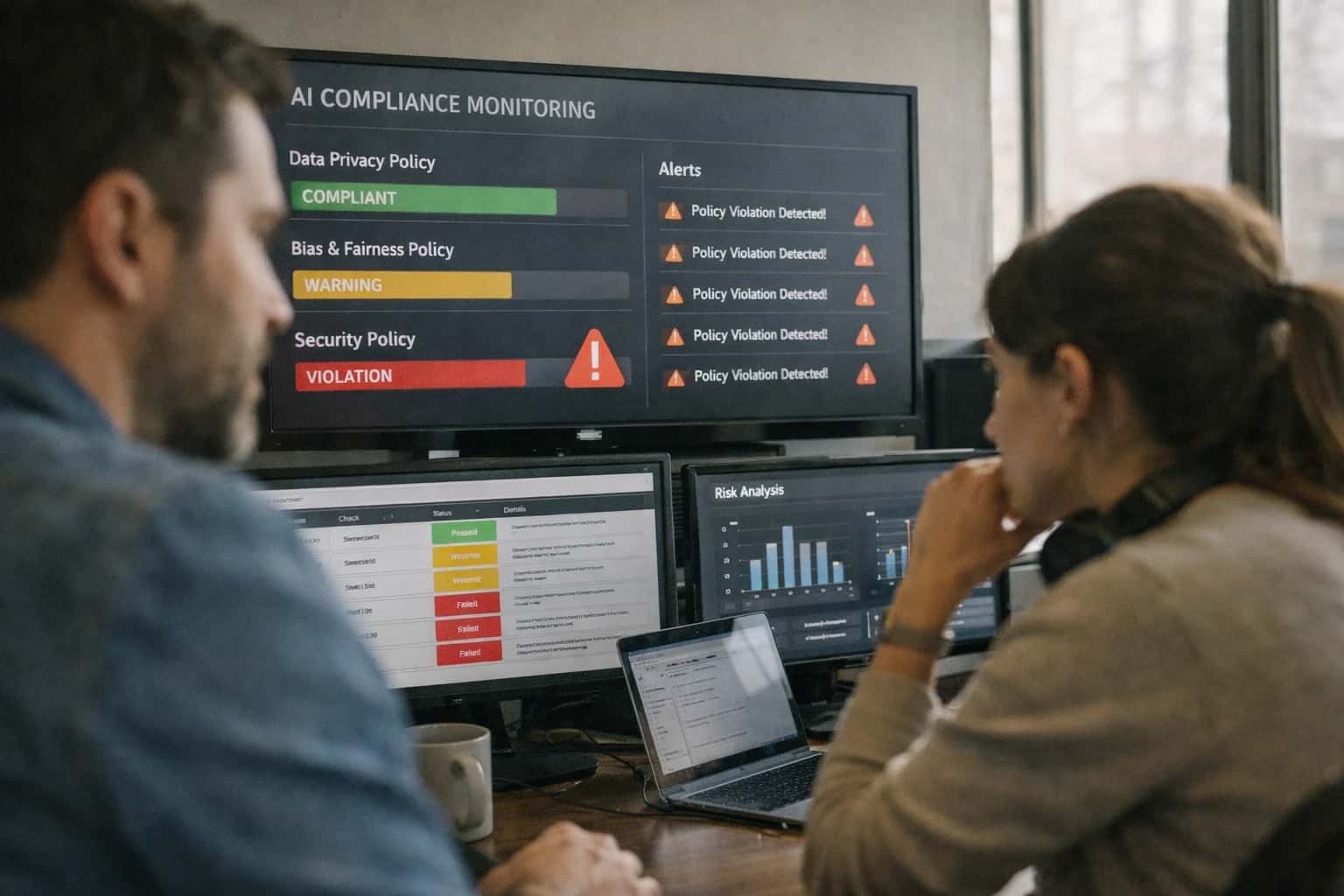
THE VISIBILITY GAP
The Illusion of Control in AI Security
Security dashboards that monitor AI usage are useless if they cannot see how sensitive data is transformed within black-box models.
Standard monitoring tools create a false sense of control. Platforms that track token usage and cost dashboards, like those from LangChain or LlamaIndex, cannot audit data-in-use. You see the input and output, but the critical computation within proprietary models like Google Gemini is an opaque black box.
This visibility gap creates unmanaged compliance risk. Without PETs like confidential computing, you cannot prove data residency or enforce the EU AI Act. Your security platform has a blind spot across third-party AI applications, turning your governance dashboard into a compliance liability.
Evidence: A 2024 study by the AI Security Alliance found that over 70% of enterprises with AI monitoring tools could not trace a PII data element through a single inference call in a model from Hugging Face, demonstrating the fundamental governance paradox of modern AI.
SECURITY THEATER
Three Trends Exposing Conventional AI Security
Logging and monitoring are useless if you cannot see how sensitive data is being used and transformed within black-box AI models.
01
The Black-Box Inference Problem
Conventional security tools see API calls to models like OpenAI GPT-4 or Anthropic Claude, but not the data transformations inside. This creates a critical blind spot where Personally Identifiable Information (PII) can be ingested, memorized, and potentially leaked via model inversion attacks.
- Risk: Inability to audit how sensitive data influences model outputs or is reconstructed by adversaries.
- Solution: Confidential Computing with Trusted Execution Environments (TEEs) ensures data remains encrypted during processing, providing true visibility into 'data-in-use'.
0%
Internal Model Visibility
100%
API Call Logging
02
The Third-Party Integration Blind Spot
Enterprises use multiple external AI services (e.g., Google Gemini, Hugging Face), but security platforms lack governance over cross-application data flows. This creates unmanaged risk where data exits your controlled environment.
- Risk: Data Residency violations and non-compliance with regulations like the EU AI Act.
- Solution: Policy-Aware Connectors that act as a first line of defense, automatically redacting PII and enforcing geo-fencing before data reaches a third-party LLM.
50+
Common AI APIs
1
Centralized PET Dashboard
03
The Compliance Liability of Data Lineage
Without Privacy-Enhancing Technology (PET)-instrumented lineage tracking, you cannot prove where sensitive data flowed through training, fine-tuning, and inference pipelines. This creates massive audit liabilities.
- Risk: Inability to demonstrate compliance for GDPR or provide Explainable AI (XAI) for model decisions.
- Solution: PET-First Architecture that bakes privacy into the MLOps lifecycle, enabling continuous validation and immutable audit trails from data source to model output.
$10M+
Potential GDPR Fine
0
Provable Data Paths
AI SECURITY VISIBILITY
The Visibility Gap: Conventional vs. PET-Enabled Security
This table compares the capabilities of conventional AI security monitoring against a Privacy-Enhancing Technology (PET)-enabled approach, demonstrating why traditional methods are insufficient for protecting sensitive data within AI models.
| Security & Visibility Capability | Conventional AI Security | PET-Enabled AI Security |
|---|---|---|
Observes raw PII entering LLM prompts (e.g., OpenAI, Anthropic Claude) | ||
Tracks sensitive data transformations inside model inference | ||
Provides verifiable data lineage for compliance audits (GDPR, EU AI Act) | Manual, incomplete logs | Automated, cryptographically attested |
Prevents data exfiltration via model inversion attacks | ||
Enforces data residency policies at the API connector level | ||
Redacts PII automatically before model ingestion | ||
Centralizes governance across third-party AI applications | ||
Enables confidential multi-party training without sharing raw data |
THE VISIBILITY GAP
How PET Architectures Enable True Data Lineage
Privacy-Enhancing Technologies provide the forensic audit trail needed to prove how sensitive data is transformed within AI models, closing the critical visibility gap.
PET architectures create immutable lineage by instrumenting every data transformation with cryptographic proofs, turning black-box AI inference into a transparent, auditable process. Without this, logging is just security theater.
Visibility without PET is an illusion. Standard monitoring tools like Datadog or Splunk log API calls but cannot see inside a model's latent space. They track that data entered an OpenAI GPT-4 or Anthropic Claude API, but not how PII was embedded, combined, or influenced the output.
True lineage requires cryptographic binding. Techniques like secure multi-party computation (SMPC) and runtime attestation in Trusted Execution Environments (TEEs) generate verifiable records of each computation step. This creates a chain of custody from raw data in a Snowflake warehouse to a vector in Pinecone to a final model prediction.
This forensic capability is non-negotiable for compliance. Regulations like the EU AI Act demand explainability for high-risk systems. A PET-instrumented lineage log proves a credit decision was based on anonymized aggregates, not prohibited factors, directly addressing AI TRiSM requirements.
Evidence: A 2023 study by the Confidential Computing Consortium found that organizations using PET-enabled lineage reduced audit preparation time by 70% and could definitively answer data sovereignty queries in minutes, not weeks.
VISIBILITY WITHOUT PROTECTION
The Real-World Costs of Security Theater
Logging and monitoring are useless if you cannot see how sensitive data is being used and transformed within black-box AI models.
01
The Problem: Black-Box Data Exfiltration
Standard AI security tools log API calls but cannot track how PII is transformed inside models like OpenAI GPT-4 or Anthropic Claude. This creates a false sense of control.\n- Model inversion attacks can reconstruct training data from model outputs.\n- Membership inference reveals if specific customer data was in the training set.\n- Without PET, your monitoring dashboard is a liability log, not a control plane.
~70%
Of AI Breaches
0%
Internal Visibility
02
The Solution: Policy-Aware Connectors
Intelligent data connectors enforce privacy policies before data reaches a third-party LLM. They are the first line of defense in a PET-first architecture.\n- Automated PII redaction using NLP to preserve context.\n- Geo-fencing & residency enforcement for regulations like GDPR and the EU AI Act.\n- Centralized governance across APIs from OpenAI, Google Gemini, and Hugging Face.
-99%
PII Exposure
~500ms
Added Latency
03
The Problem: The $10M Compliance Facade
Investing in AI security platforms without PET creates massive audit liabilities. You cannot prove data lineage or compliance with evolving regulations.\n- Fines under GDPR can reach 4% of global revenue.\n- Shadow AI usage by employees bypasses all centralized logging.\n- Your SOC 2 report is a fiction for AI workloads.
$10M+
Potential Fines
100%
Audit Failure
04
The Solution: PET-Instrumented MLOps
Bake privacy-enhancing technologies directly into the ModelOps lifecycle. This enables continuous compliance and trustworthy AI.\n- Confidential data versioning in platforms like Weights & Biases.\n- Secure model deployment with encrypted inference using vLLM in TEEs.\n- End-to-end confidential pipelines that protect data-in-use, not just at-rest.
10x
Faster Audits
Zero-Trust
Data Processing
05
The Problem: The Third-PAPI Blind Spot
Most AI security platforms cannot govern data flows to external model APIs. This creates unmanaged risk and negates internal security investments.\n- Data sovereignty violations when PII leaves a jurisdiction.\n- No control over how vendors process or retain your data.\n- Your AI security platform is blind to its largest attack surface.
80%
Of AI Use
0%
Platform Coverage
06
The Solution: Centralized PET Dashboard
A unified control plane for Confidential Computing and Privacy-Enhancing Tech (PET) provides true cross-application visibility and governance.\n- Real-time PET validation of privacy controls across all AI workloads.\n- Unified lineage tracking for sensitive data flows, even to third parties.\n- Defense-in-depth combining hardware TEEs, software guards, and runtime attestation.
360°
Visibility
-50%
OpSec Overhead
THE DATA
The PET Performance Overhead Myth (And Why It's Wrong)
Modern Privacy-Enhancing Technologies (PET) deliver enterprise-grade security with minimal latency, debunking the primary objection to their adoption.
PET performance overhead is negligible for modern AI inference. The pervasive myth that encryption cripples speed stems from outdated benchmarks of early-stage technologies like fully homomorphic encryption (FHE). Today's production-ready PET, such as trusted execution environments (TEEs) in Intel SGX or AMD SEV and runtime memory encryption, add single-digit millisecond latency. This is imperceptible in most enterprise RAG or agentic workflows using models from OpenAI or Anthropic Claude.
The real cost is unsecured data. The computational 'overhead' of a data breach or GDPR non-compliance fine dwarfs any microsecond delay from PET. Without PET, your AI security visibility is security theater; you see logs but cannot prevent sensitive data exfiltration from within black-box models. Platforms like Microsoft Azure Confidential Computing demonstrate that secure enclaves operate at near-native speed for inference tasks.
PET enables faster, compliant innovation. By eliminating the data privacy bottleneck, engineering teams can safely use real production data for fine-tuning and testing, accelerating development cycles. Integrating policy-aware connectors and PII redaction as code into your MLOps pipeline with tools like Weights & Biases or vLLM removes manual governance drag. This creates a confidential AI foundation that supports scaling into sensitive domains like healthcare and finance.
Evidence from hybrid architectures. Leading AI platforms report that using hardware-backed TEEs for sensitive data processing, while offloading non-sensitive tasks to standard GPU clusters, results in less than a 5% end-to-end performance impact. This hybrid approach, central to a PET-first architecture, is the standard for achieving both speed and true AI security visibility.
THE REALITY CHECK
Key Takeaways: Moving Beyond the Theater
Logging and monitoring are useless if you cannot see how sensitive data is being used and transformed within black-box AI models.
01
The Problem: Black-Box Inference
Standard monitoring tools provide visibility into API calls and latency, but offer zero insight into how Personally Identifiable Information (PII) is being processed within the model's internal layers. This creates a critical blind spot for compliance and security teams.
- Blind Data Flows: You cannot audit what happens to customer data between input prompt and model output.
- Compliance Theater: Logs show a call to OpenAI's API, but not that a Social Security Number was embedded into a vector and processed.
- Undetectable Exfiltration: Model inversion or membership inference attacks can reconstruct training data without triggering any security alerts.
0%
Internal Visibility
100%
Compliance Risk
02
The Solution: Policy-Aware Connectors
Intelligent data connectors act as the first line of defense, enforcing privacy policies at the point of ingestion before data ever reaches a third-party model like Anthropic Claude or Google Gemini.
- Proactive Redaction: Automatically strip PII, PHI, and financial data using NLP-based detection before the API call.
- Geo-Fencing Enforcement: Programmatically enforce data residency rules required by the EU AI Act or GDPR.
- Immutable Audit Trail: Create a PET-instrumented data lineage, proving where redacted data flowed for compliance audits.
-90%
PII Exposure
~50ms
Added Latency
03
The Problem: Siloed Security Tools
Most AI security platforms cannot govern data flows across the fragmented third-party model ecosystem. This creates unmanaged risk as data moves between OpenAI, Hugging Face, and internal vLLM deployments.
- Fragmented Governance: Separate dashboards for model performance, API security, and data loss prevention.
- Unmanaged Third-Party Risk: No centralized control over what data is sent to external AI providers.
- Reactive Posture: Security is an afterthought, applied after the model has already ingested sensitive data.
3-5x
Tool Overhead
+300%
Attack Surface
04
The Solution: Centralized PET Dashboard
A unified control plane provides cross-application visibility and governance, treating privacy as a first-class metric alongside model accuracy and latency. This is the core of a mature AI TRiSM program.
- Holistic Visibility: Single pane for data flows across all LLMs, vector databases, and embedding models.
- Real-Time Policy Validation: Continuously monitor for policy violations, moving beyond static compliance checks.
- Integrated MLOps: Bake PET controls directly into the ModelOps lifecycle within platforms like Weights & Biases.
10x
Faster Audits
1
Source of Truth
05
The Problem: Data Lineage Nightmares
Without PET-instrumented tracking, you cannot prove where sensitive data flowed through complex AI pipelines involving fine-tuning, Retrieval-Augmented Generation (RAG), and inference. This creates massive liability.
- Unprovable Compliance: Inability to demonstrate data handling to regulators under strict laws.
- Hidden Breach Vectors: Data exfiltration can occur during pre-processing, embedding, or inference without a trace.
- Broken Governance: The 'Governance Paradox' where you deploy agentic AI but lack the models to oversee its data usage.
$4M+
Potential Fine
0
Audit Trail
06
The Solution: PET-as-Code Pipelines
Treat data anonymization and confidential computing controls as immutable, version-controlled infrastructure. This enables agile development while ensuring continuous compliance.
- Infrastructure as Code: Define redaction rules and Trusted Execution Environment (TEE) configurations in Terraform or Git.
- Automated Enforcement: Privacy policies are executed consistently in every CI/CD pipeline run, eliminating human error.
- End-to-End Confidential Pipelines: Extend protection beyond isolated enclaves to cover data-in-use throughout the entire AI workflow, a concept explored in our pillar on Confidential Computing and Privacy-Enhancing Tech (PET).
-75%
Manual Effort
100%
Policy Coverage
Enabling Efficiency, Speed & Accuracy
Intelligent Analysis, Decision & Execution
We build AI systems for teams that need search across company data, workflow automation across tools, or AI features inside products and internal software.
Talk to Us
Search across company data
Give teams answers from docs, tickets, runbooks, and product data with sources and permissions.
Useful when people spend too long searching or get different answers from different systems.
Enterprise searchRAGPermissions
Read more
Automate internal workflows
Use AI to route work, draft outputs, trigger actions, and keep approvals and logs in place.
Useful when repetitive work moves across multiple tools and teams.
AI agentsWorkflow automationGovernance
Read more
Add AI to products and internal tools
Build assistants, guided actions, or decision support into the software your team or customers already use.
Useful when AI needs to be part of the product, not a separate tool.
AI integrationDecision supportModel routing
Read moreTHE VISIBILITY GAP
Architect for Trust, Not Just Compliance
Logging and monitoring are useless if you cannot see how sensitive data is being used and transformed within black-box AI models.
AI security visibility without PET is security theater. It creates the illusion of control while sensitive data flows unprotected through opaque models like OpenAI GPT-4 or Anthropic Claude, rendering compliance checklists meaningless.
Traditional monitoring tools are blind to data-in-use. SIEM platforms and API gateways log access but cannot track how PII is transformed inside a model's latent space, creating an ungovernable data exfiltration risk.
Compliance does not equal trust. Passing a SOC 2 audit verifies process, not protection. Stakeholder trust requires provable data security throughout the AI lifecycle, which demands PET-first architecture.
Evidence: A 2024 Gartner survey found that 45% of organizations experienced an AI privacy breach, with 80% of those breaches involving data processed during model inference, not storage.

About the author
Prasad Kumkar
CEO & MD, Inference Systems
Prasad Kumkar is the CEO & MD of Inference Systems and writes about AI systems architecture, LLM infrastructure, model serving, evaluation, and production deployment. Over 5+ years, he has worked across computer vision models, L5 autonomous vehicle systems, and LLM research, with a focus on taking complex AI ideas into real-world engineering systems.
His work and writing cover AI systems, large language models, AI agents, multimodal systems, autonomous systems, inference optimization, RAG, evaluation, and production AI engineering.
LinkedIn
Limited slotsGet a Free AI Consultation
Partnered with leading AI, data, and software stack.





How We Work
Custom AI workflows for your Business
One-fit-all AI don't work for modern businesses. At Inferensys, we aim to understand your business & custom requirements; which we use to define most efficient agentic workflows, the data, and the tools for your business.
01
Review the use case
We understand the task, the users, and where AI can actually help.
Read more02
Pick the right approach
We define what needs search, automation, or product integration.
Read more03
Build the first useful version
We implement the part that proves the value first.
Read more04
Improve from there
We add the checks and visibility needed to keep it useful.
Read moreThe first call is a practical review of your use case and the right next step.
Talk to Us