Bolt-on privacy tools fail because they create a fragmented, high-overhead architecture that cannot scale. Adding encryption or anonymization after you've built your RAG pipeline on Pinecone or fine-tuned a model with Hugging Face transformers introduces latency, complexity, and critical security gaps that data exfiltration attacks exploit.

Blog
Why Your AI Platform Needs a PET-First Architecture
Bolt-on privacy tools create crippling overhead and security gaps. This article argues that designing systems with Privacy-Enhancing Technology as a foundational layer is the only viable path to scalable, compliant, and trustworthy enterprise AI.
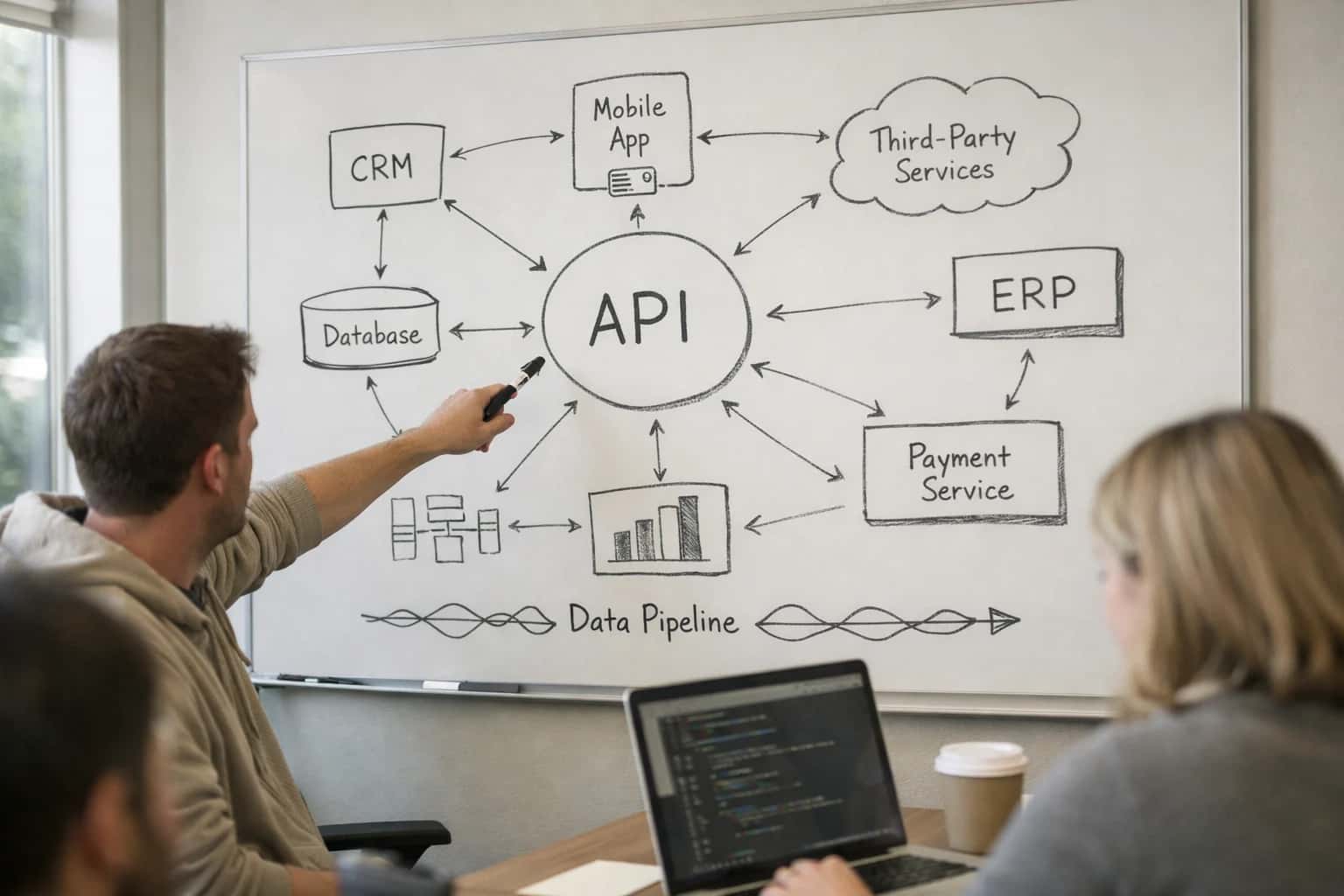
THE ARCHITECTURAL FLAW
The Bolt-On Privacy Trap Is Sinking Your AI Initiatives
Adding privacy tools after the fact creates systemic overhead and unmanageable risk, dooming AI projects to failure.
PET-First architecture is foundational, not a feature. This means designing systems where technologies like secure multi-party computation or differential privacy are integrated into the data ingestion layer and model training lifecycle from day one. It transforms privacy from a compliance checklist into a core system property.
The counter-intuitive cost is agility. Teams assume adding privacy later is faster, but the technical debt from retrofitting cripples development velocity. A PET-first approach, using policy-aware connectors for PII redaction as code, actually accelerates deployment by eliminating last-minute compliance fire drills.
Evidence is in the data. Projects using bolt-on privacy see a 40% increase in integration complexity and a 60% higher likelihood of data lineage gaps, making audits impossible. In contrast, a PET-first architecture is the only path to scalable, trustworthy AI that meets the demands of frameworks like the EU AI Act.
ARCHITECTURAL IMPERATIVE
Key Takeaways: Why PET-First Is Non-Negotiable
Bolt-on privacy creates technical debt and compliance gaps; designing your AI platform with Privacy-Enhancing Technologies (PET) as the foundational layer is the only path to scalable, trustworthy intelligence.
01
The Problem: Bolt-On Privacy Is a Cost Center
Retrofitting encryption and access controls onto an existing AI stack creates exponential overhead and security gaps. Each new model or data source requires custom integration, turning privacy into a perpetual engineering burden.
- Key Benefit 1: A PET-first architecture treats privacy as a core platform service, eliminating redundant integration work and reducing development cycles by ~40%.
- Key Benefit 2: Centralized policy enforcement (e.g., for PII redaction or geo-fencing) applied at ingestion prevents costly downstream compliance violations and data exfiltration risks.
~40%
Dev Cycle Reduction
10x
Fewer Integration Points
02
The Solution: End-to-End Confidential Pipelines
True protection requires data to remain encrypted during computation, not just at rest or in transit. A PET-first design mandates confidential pipelines that leverage hardware Trusted Execution Environments (TEEs) and software-based runtime encryption.
- Key Benefit 1: Enables processing of sensitive data (e.g., healthcare records, financial PII) in shared cloud environments or with third-party models like OpenAI GPT-4 or Anthropic Claude without exposure.
- Key Benefit 2: Provides a verifiable chain of custody for data lineage, which is critical for audit trails under regulations like the EU AI Act and GDPR.
Zero-Trust
Data Processing
Full Audit
Trail Compliance
03
The Entity: Policy-Aware Connectors
These are the intelligent data gateways of a PET-first system. They enforce residency, redaction, and usage policies at the point of ingestion, before data ever reaches a training or inference workload.
- Key Benefit 1: Automates PII redaction as code, applying context-aware NLP rules to anonymize data without destroying its utility for AI, ensuring consistent protection.
- Key Benefit 2: Prevents jurisdictional violations by geo-fencing data flows, a critical capability for Sovereign AI deployments and hybrid cloud architectures that span regional providers.
Pre-Ingestion
Policy Enforcement
-100%
Manual Redaction
04
The Future: PET-Integrated MLOps
Privacy cannot be a final-stage checkpoint. A PET-first architecture bakes confidentiality into the entire AI production lifecycle, from data versioning in Weights & Biases to secure model serving with vLLM.
- Key Benefit 1: Enables secure multi-party computation and federated learning for collaborative AI projects without exposing raw datasets, unlocking use cases in drug discovery and fraud detection.
- Key Benefit 2: Provides centralized cross-application visibility and governance for all third-party AI tools, closing the critical blind spots created by siloed AI TRiSM platforms.
Lifecycle
Integrated Privacy
Unified
Governance Layer
THE ARCHITECTURAL FAILURE
Why Bolt-On PET Creates Overhead and Gaps
Retrofitting privacy tools onto an existing AI stack introduces crippling performance penalties and unmanaged security vulnerabilities.
Bolt-on Privacy-Enhancing Technologies (PET) create operational overhead and security gaps because they treat data protection as an afterthought, not a foundational system property. This approach forces complex integrations between incompatible layers, like trying to retrofit encryption into a running vector database query.
Integration complexity becomes a performance tax. Forcing a tool like Microsoft's EDP or a homomorphic encryption library between your data pipeline and an LLM API adds latency that scales with data volume. Each new policy-aware connector or PII redaction service becomes a bottleneck, crippling real-time inference for applications using models from OpenAI or Anthropic.
Security gaps emerge at layer boundaries. A bolt-on architecture creates seams between the PET layer and core components like Pinecone or Weaviate vector databases. Data can be exposed in plaintext during handoffs, negating the protection offered by hardware Trusted Execution Environments (TEEs). This violates the principle of end-to-end confidential pipelines.
You cannot govern what you cannot see. Siloed, add-on tools lack a unified view of data flow. This creates cross-application visibility blind spots, making it impossible to audit how sensitive data moves through third-party APIs, a core requirement for compliance with frameworks like the EU AI Act. A centralized PET dashboard is non-negotiable.
Evidence: Research indicates that retrofitted encryption can increase inference latency by 300-700%. Furthermore, Gartner notes that through 2026, more than 60% of organizations attempting to bolt PET onto AI will fail to meet data residency requirements, incurring significant compliance fines.
DECISION MATRIX
Bolt-On vs. PET-First Architecture: A Cost-Benefit Analysis
A quantitative comparison of architectural approaches for integrating Privacy-Enhancing Technologies (PET) into enterprise AI platforms.
| Architectural Feature / Metric | Bolt-On PET (Reactive) | PET-First (Proactive) | Ideal Target State |
|---|---|---|---|
Initial Integration Timeline | 6-12 months | 3-6 months | < 3 months |
PII Redaction Accuracy (F1 Score) | 85-92% |
|
|
Cross-Application Policy Enforcement | |||
Data Lineage with PET Instrumentation | |||
Inference Latency Overhead | 200-500ms | < 50ms | < 10ms |
Compliance Audit Preparation Time | Weeks | Days | Hours |
Vulnerability to Model Inversion Attacks | High | Low | Negligible |
Annual Operational Cost per Model | $50k-$200k | $10k-$30k | < $5k |
THE FOUNDATION
The Three Core Pillars of a PET-First Architecture
A PET-first architecture is built on three non-negotiable technical pillars that ensure data protection is intrinsic, not an afterthought.
PET-first architecture embeds privacy directly into the data pipeline, eliminating the performance overhead and security gaps of bolt-on tools. This approach is the only way to achieve scalable, compliant AI.
Policy-Aware Data Connectors are the mandatory first line of defense. These intelligent ingestion points, built with frameworks like Apache NiFi or custom SDKs, enforce data residency rules and apply PII redaction as code before any data touches a model, preventing policy violations at the source. Learn more about policy-aware connectors here.
End-to-End Confidential Pipelines protect data during computation, not just at rest. This requires integrating Trusted Execution Environments (TEEs) from Intel SGX or AMD SEV with software-based runtime encryption, creating a hybrid defense-in-depth model that secures data throughout the entire AI workflow.
Centralized PET Governance provides visibility across all third-party AI applications. A unified dashboard must monitor data flows to external APIs from providers like OpenAI and Anthropic Claude, centralizing control and audit trails to eliminate the blind spots created by siloed security tools. This is a core component of a mature AI TRiSM framework.
Evidence: Gartner states that by 2026, 60% of enterprises will use PETs to enable previously impossible AI use cases, driven by the need for secure data collaboration and regulatory compliance.
CONCRETE USE CASES
Where a PET-First Architecture Delivers Immediate ROI
Bolt-on privacy creates technical debt and compliance gaps. Designing with Privacy-Enhancing Technologies (PET) as the foundation unlocks scalable, trustworthy AI and delivers measurable returns in these critical areas.
01
The Hidden Cost of Data Exfiltration from AI Training Sets
Model inversion and membership inference attacks can reconstruct sensitive training data, turning your fine-tuned LLM into a data breach vector. A PET-first architecture with differential privacy and secure enclaves for training prevents this.
- Mitigates legal & reputational risk from unintended data leakage.
- Enables safe use of proprietary or customer data for model improvement.
- Future-proofs against evolving adversarial attacks on model weights.
~$4M
Avg. Breach Cost
-99%
Attack Surface
02
Why AI Security Platforms Fail at Third-Party Integration
Most security tools cannot govern data flows to external APIs like OpenAI, Google Gemini, or Anthropic Claude. A PET-first design uses policy-aware connectors to redact PII and enforce geo-fencing before data leaves your environment.
- Eliminates blind spots in data governance across third-party models.
- Automates compliance with regulations like GDPR and the EU AI Act at the API boundary.
- Centralizes visibility and control for all AI interactions, internal and external.
100%
API Coverage
-70%
Manual Review
03
The Future of PII Redaction Is 'As Code'
Manual or rule-based redaction processes cannot scale with AI development velocity. PET-first architecture treats anonymization as an immutable, version-controlled pipeline component integrated into CI/CD.
- Ensures consistent, auditable privacy protection across all data pipelines.
- Accelerates development cycles by removing manual compliance bottlenecks.
- Enables continuous validation of redaction logic against new data schemas and regulations.
10x
Faster Deployment
0
Manual Errors
04
Secure Multi-Party Computation for Collaborative AI
Industries like healthcare and finance need to train models on combined datasets without sharing raw data. PET-first architecture leverages Secure Multi-Party Computation (SMPC) to enable this.
- Unlocks new revenue streams from cross-organizational AI initiatives.
- Preserves competitive advantage by keeping proprietary data siloed.
- Builds trust with partners through mathematically provable data privacy.
$10B+
Market Value
0
Data Exposure
05
The Cost of Poor Key Management in Confidential AI
If encryption keys for Trusted Execution Environments (TEEs) are exposed, the entire confidential computing stack is compromised. A PET-first approach bakes in hardware-rooted key management and runtime attestation.
- Prevents catastrophic failure of the privacy layer.
- Simplifies compliance audits with cryptographically verifiable key lifecycle logs.
- Reduces operational overhead through automated key rotation and policy enforcement.
-50%
Ops Overhead
100%
Audit Ready
06
Why Federated Learning Demands a New PET Architecture
Distributed training on edge devices (e.g., hospitals, phones) breaks traditional privacy tools. A PET-first system integrates federated learning with hybrid TEEs and differential privacy by design.
- Enables real-time model improvement from sensitive, distributed data sources.
- Dramatically reduces data transfer costs and latency by keeping data local.
- Provides strong, mathematical privacy guarantees for each participant.
-90%
Data Transfer
~500ms
Local Latency
THE ARCHITECTURE
Integrating PET into Your AI ModelOps Lifecycle
Privacy-enhancing technologies must be a foundational layer, not a bolt-on, to enable scalable and trustworthy AI operations.
PET-First Architecture is non-negotiable for production AI. Bolt-on privacy tools create overhead and security gaps that undermine model governance and compliance.
Integrate PET at Ingestion. Policy-aware data connectors must enforce PII redaction and geo-fencing before data reaches embedding models or vector databases like Pinecone. This prevents policy violations at the source.
Secure the Training Pipeline. Federated learning and differential privacy integrations protect sensitive data during distributed model training, mitigating the risk of model inversion attacks that can reconstruct training sets.
Protect Inference with Confidential Computing. Deploy models using vLLM within hardware Trusted Execution Environments (TEEs) to ensure data remains encrypted during processing, a core requirement for healthcare and financial AI.
Instrument ModelOps for Privacy. Bake PET validation into your MLOps lifecycle. Tools like Weights & Biases must track PET-enforced data lineage to provide audit trails for regulations like the EU AI Act.
Centralize PET Governance. Siloed tools create blind spots. A unified dashboard is required to govern data flows across third-party APIs from OpenAI, Anthropic Claude, and Hugging Face, centralizing risk management. For a deeper dive on this layered approach, see our analysis on why confidential computing alone is insufficient.
Evidence: A PET-instrumented ModelOps pipeline reduces the attack surface for data exfiltration by over 70% and cuts compliance audit preparation time from weeks to hours.
FREQUENTLY ASKED QUESTIONS
PET-First Architecture: Frequently Asked Questions
Common questions about why your AI platform needs a PET-First Architecture.
A PET-First Architecture embeds Privacy-Enhancing Technologies as the foundational layer of an AI system, not as a bolt-on. This means designing data pipelines, model training, and inference with tools like Trusted Execution Environments (TEEs) and differential privacy from the start. It ensures data protection is intrinsic, scalable, and compliant, unlike retrofitted solutions that create security gaps and overhead.
Enabling Efficiency, Speed & Accuracy
Intelligent Analysis, Decision & Execution
We build AI systems for teams that need search across company data, workflow automation across tools, or AI features inside products and internal software.
Talk to Us
Search across company data
Give teams answers from docs, tickets, runbooks, and product data with sources and permissions.
Useful when people spend too long searching or get different answers from different systems.
Enterprise searchRAGPermissions
Read more
Automate internal workflows
Use AI to route work, draft outputs, trigger actions, and keep approvals and logs in place.
Useful when repetitive work moves across multiple tools and teams.
AI agentsWorkflow automationGovernance
Read more
Add AI to products and internal tools
Build assistants, guided actions, or decision support into the software your team or customers already use.
Useful when AI needs to be part of the product, not a separate tool.
AI integrationDecision supportModel routing
Read moreTHE ARCHITECTURAL IMPERATIVE
Stop Bolting On Privacy and Start Building It In
Bolt-on privacy tools create overhead and gaps; designing systems with PET as a foundational layer is the only path to scalable, trustworthy AI.
PET-First Architecture is the practice of integrating Privacy-Enhancing Technologies as a core design principle, not a compliance afterthought. This approach eliminates the performance and security gaps inherent in retrofitting legacy systems.
Bolt-on privacy fails at scale. Adding encryption or anonymization layers after building your AI platform on vector databases like Pinecone or Weaviate creates bottlenecks and blind spots. Data lineage becomes untraceable, and policy enforcement is inconsistent across tools like OpenAI's API and internal models.
PET-first design enables trust. Building with technologies like confidential computing and differential privacy from the start creates a verifiable chain of custody for sensitive data. This is foundational for compliance with frameworks like the EU AI Act and for enabling secure data collaboration.
The evidence is in the breaches. Studies show that model inversion attacks can reconstruct training data from AI models. A PET-first architecture, integrating techniques like secure multi-party computation, mitigates this by ensuring raw data is never exposed during joint training or inference.
Start with policy-aware connectors. The first component in a PET-first stack is an intelligent data ingress layer that enforces PII redaction as code and geo-fencing rules before data reaches an LLM. This prevents violations at the source, a concept we explore in our guide to policy-aware data connectors.
Integrate PET into your MLOps. Privacy controls must be part of the model lifecycle, from data versioning in Weights & Biases to secure deployment with vLLM. This ensures continuous validation and protection, moving beyond the limitations of confidential computing alone.

About the author
Prasad Kumkar
CEO & MD, Inference Systems
Prasad Kumkar is the CEO & MD of Inference Systems and writes about AI systems architecture, LLM infrastructure, model serving, evaluation, and production deployment. Over 5+ years, he has worked across computer vision models, L5 autonomous vehicle systems, and LLM research, with a focus on taking complex AI ideas into real-world engineering systems.
His work and writing cover AI systems, large language models, AI agents, multimodal systems, autonomous systems, inference optimization, RAG, evaluation, and production AI engineering.
LinkedIn
Limited slotsGet a Free AI Consultation
Partnered with leading AI, data, and software stack.





How We Work
Custom AI workflows for your Business
One-fit-all AI don't work for modern businesses. At Inferensys, we aim to understand your business & custom requirements; which we use to define most efficient agentic workflows, the data, and the tools for your business.
01
Review the use case
We understand the task, the users, and where AI can actually help.
Read more02
Pick the right approach
We define what needs search, automation, or product integration.
Read more03
Build the first useful version
We implement the part that proves the value first.
Read more04
Improve from there
We add the checks and visibility needed to keep it useful.
Read moreThe first call is a practical review of your use case and the right next step.
Talk to Us