Just-in-time manufacturing fails because human approval gates for procurement and logistics introduce unpredictable, multi-hour delays that break the real-time synchronization the system requires.

Blog
The Cost of Human Latency in Just-in-Time Manufacturing
Just-in-time manufacturing is a fragile promise broken by human-in-the-loop approvals. This analysis quantifies the cost of human latency in procurement and logistics, and explains why AI-driven supplier agents are the only viable path to true JIT efficiency.
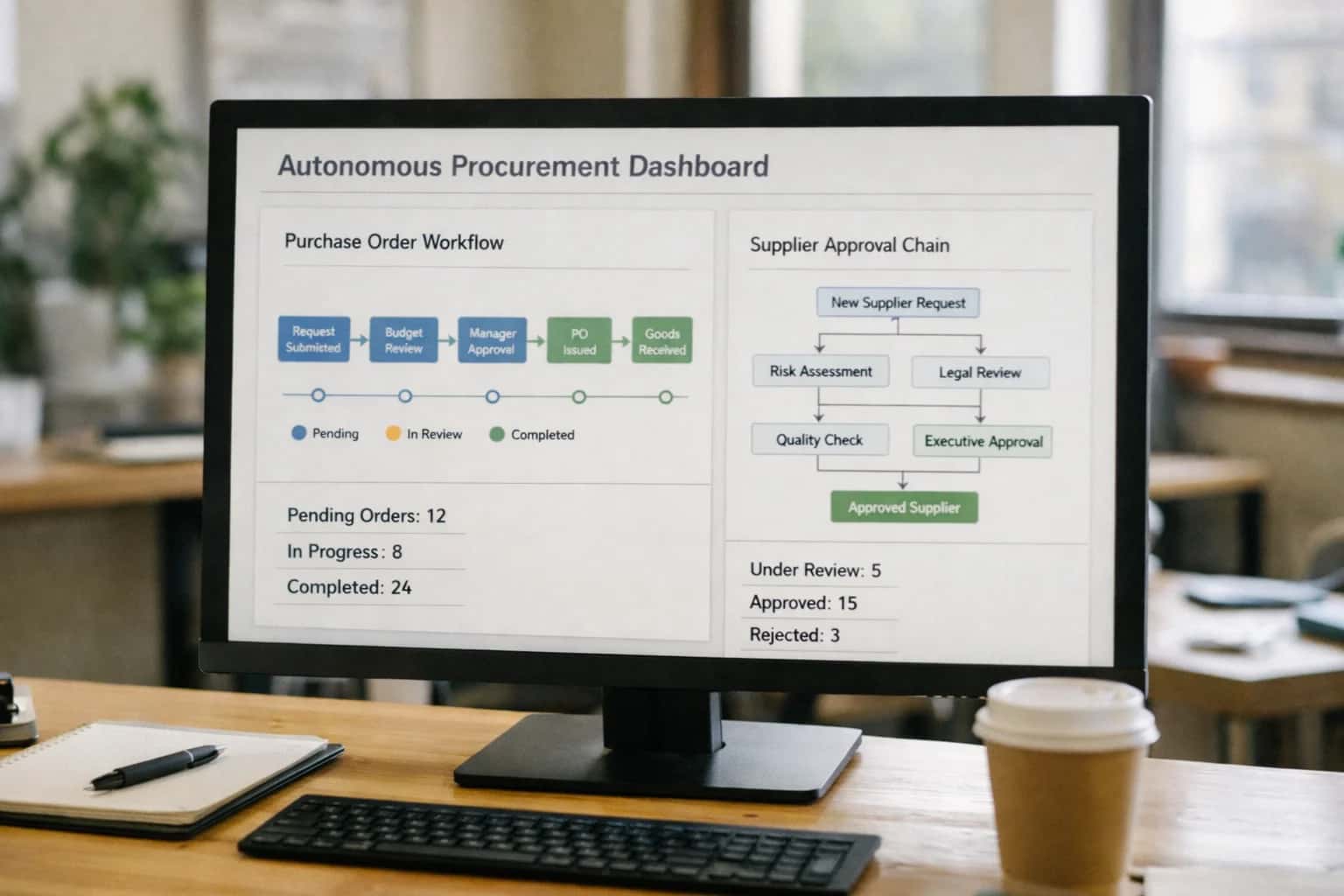
THE DATA
The JIT Lie: How Human Approval Gates Break the Promise
Human-in-the-loop approvals create a critical latency bottleneck that makes true just-in-time manufacturing mathematically impossible.
The bottleneck is cognitive load. A human buyer must context-switch, evaluate emails, compare spreadsheets, and seek internal approvals—a process that takes hours where an AI agent using a supplier API would take milliseconds. This latency directly translates to production line stoppages.
Human processes are batch-oriented, while JIT demands a continuous flow. An ERP like SAP S/4HANA may generate a purchase requisition, but it sits in an inbox. An autonomous procurement agent built on frameworks like LangChain or AutoGPT would execute the transaction instantly via a pre-negotiated smart contract.
The cost is quantifiable. For a component with a 4-hour lead time, a 2-hour human approval delay represents a 50% buffer erosion. This forces companies to carry safety stock, defeating the core JIT principle of inventory minimization. For a deeper analysis of this operational paradox, see our pillar on Agentic Commerce and M2M Transactions.
Evidence from automotive shows that a single missing $5 gasket, awaiting manager approval, can idle a $50M assembly line. AI-driven supplier agents eliminate this by operating within defined governance rules, executing purchases for pre-authorized part categories and cost thresholds without interruption, as explored in our guide to autonomous procurement agents.
THE COST OF HUMAN LATENCY
The Three Latency Killers in Modern JIT Manufacturing
Just-in-Time manufacturing is a brittle system where human-in-the-loop approvals create predictable, costly delays that AI-driven supplier agents are designed to eliminate.
01
The Problem: The Manual PO Approval Bottleneck
A purchase order awaiting manager sign-off isn't just an email; it's a ~24-72 hour production halt. This sequential, human-dependent process is the antithesis of JIT.
- Cost of Delay: Every hour of line stoppage can cost $10k+ in lost throughput and expedited shipping fees.
- Cognitive Load: Buyers waste ~30% of their time chasing approvals instead of strategic sourcing.
- Error Amplification: Manual data entry from emails/PDFs into ERP systems introduces errors that cause downstream fulfillment failures.
24-72h
Delay Introduced
$10k+/hr
Cost of Stoppage
02
The Problem: The Reactive Supplier Communication Loop
Human buyers react to stock-outs via phone and email, creating a high-latency feedback loop that cannot prevent shortages.
- Information Asymmetry: Buyers lack real-time visibility into supplier inventory, lead times, and alternative sources.
- Negotiation Inertia: Price and term negotiations are slow, batch processes, not dynamic and continuous.
- Cascading Failure: A delay from one supplier isn't isolated; it propagates through the entire production schedule, a core concept in our pillar on Agentic Commerce and M2M Transactions.
~4h
Avg. Response Time
0
Preventive Capacity
03
The Problem: The Legacy ERP Data Lag
Monolithic Enterprise Resource Planning (ERP) systems like SAP or Oracle operate on batch updates, creating a data latency of hours or days. This makes real-time inventory and demand sensing impossible.
- Decision Blindness: Procurement decisions are made on stale data, guaranteeing misalignment with actual production needs.
- API Incompatibility: Legacy ERPs lack the machine-readable, real-time APIs required for autonomous agents to act, a critical failure point explored in our topic on Why Legacy ERP Systems Will Fail Agentic Procurement.
- Integration Sprawl: Building custom connectors is costly and fragile, creating technical debt instead of solving the core latency issue.
12-24h
Data Latency
100%
Reactive Posture
04
The Solution: Autonomous Procurement Agents
AI agents with delegated spending authority act on pre-defined rules and real-time signals, collapsing the procurement cycle from days to seconds.
- Continuous Optimization: Agents monitor thousands of data points (inventory levels, demand forecasts, spot prices) to preemptively source materials.
- Machine-to-Machine Negotiation: Using standardized APIs and protocols, agents dynamically negotiate with supplier agents for optimal price and delivery, embodying the future described in The Future of Supply Chains: Self-Negotiating Supplier Agents.
- Explainable Audit Trail: Every autonomous decision is logged with context and rationale, providing the explainability required for financial governance and compliance.
<60s
PO Cycle Time
5-15%
Cost Savings
05
The Solution: Event-Driven Supplier APIs
Replacing human phone calls with machine-readable, event-driven APIs creates a real-time nervous system between manufacturer and supplier.
- Real-Time Inventory Feeds: Subscribe to supplier stock-level events to trigger automatic reordering before a threshold is breached.
- Dynamic Lead Time Updates: Receive instant notifications on shipping delays, allowing the agent to source alternatives without human intervention.
- Standardized Handshake: Protocols like OpenAPI and async messaging (e.g., webhooks, Kafka) enable seamless, high-volume machine-to-machine communication, a foundational element of Agentic Commerce.
~500ms
Signal Latency
99.9%
Uptime SLA
06
The Solution: The Agent Control Plane
Governance is not an afterthought; it's the core platform. The Agent Control Plane is the orchestration layer that manages permissions, spending limits, and human-in-the-loop gates for escalation.
- Policy-as-Code: Define procurement rules (approved vendors, max order amounts, sustainability criteria) in code for unambiguous agent execution.
- Strategic Human Oversight: Humans are elevated to exception handlers and strategy setters, not bottlenecks in routine transactions.
- Unified Observability: Gain a single pane of glass to monitor all agent activity, spend, and performance metrics, aligning with principles from our AI TRiSM pillar on ModelOps and governance.
100%
Policy Compliance
10x
Audit Speed
JIT MANUFACTURING BREAKDOWN
Quantifying the Cost: Human vs. Agentic Procurement Latency
A data-driven comparison of procurement process latency and its direct impact on just-in-time manufacturing line costs.
| Process Metric | Human-Led Procurement | AI Agent Procurement | Impact Delta |
|---|---|---|---|
Average Requisition-to-PO Time | 48-72 hours | < 5 minutes | 99.9% reduction |
Supplier Discovery & RFQ Cycle | 5-10 business days | 2-5 minutes | 99.8% reduction |
Exception Handling (e.g., stockout) | 24+ hours (human escalation) | < 60 seconds (agent re-sourcing) | 99.9% reduction |
Line Stoppage Risk per Procurement Event | 3.2% probability | 0.1% probability | 96.9% reduction |
Cost of Line Stoppage (Avg. per hour) | $45,000 | $450 (agent mitigation) | $44,550 saved |
Data Required for Decision (Sources) | 4-7 disparate systems (ERP, email, spreadsheets) | 1 unified API layer with semantic model | 75% reduction in cognitive load |
Audit Trail Generation | Manual, post-hoc (2-4 hours) | Real-time, immutable ledger (continuous) | 100% automation |
Compliance Check (e.g., ESG, supplier risk) | Pre-scheduled, quarterly (potentially stale) | Real-time per transaction | Eliminates compliance lag |
THE DATA
How AI Supplier Agents Eliminate Human Latency Entirely
AI supplier agents replace human-in-the-loop approvals with autonomous, real-time decision-making, collapsing procurement cycles from days to milliseconds.
AI supplier agents eliminate human latency by autonomously executing procurement workflows via APIs, removing the need for manual RFQs, approvals, and purchase order generation. This transforms just-in-time manufacturing from an aspirational goal into an operational reality.
Human cognitive bandwidth is the bottleneck. A buyer can evaluate a handful of suppliers; an agent using vector similarity search on Pinecone or Weaviate instantly scores thousands against dynamic criteria like cost, carbon footprint, and delivery reliability, executing the optimal purchase.
Legacy ERP systems create inherent friction. Their batch-oriented architecture, designed for human review, is incompatible with the event-driven APIs and webhook architectures that agentic systems like AutoGPT or LangChain agents require for real-time state synchronization and autonomous action.
The cost is quantifiable. Each human-touched approval in a procurement cycle introduces a 12-48 hour delay. For a manufacturer running lean, this latency forces overstocking of safety inventory, tying up capital and warehouse space that an AI agent would liberate. For a deeper analysis of this operational tax, see our pillar on The Cost of Human Latency in Just-in-Time Manufacturing.
Evidence from autonomous logistics. Companies like Flexport use AI agents to dynamically re-route shipments in response to port delays, a process that would take a human team hours. AI-driven route optimization demonstrates the latency elimination that is now being applied upstream to supplier selection and negotiation, a core component of Agentic Commerce and M2M Transactions.
JIT MANUFACTURING
Real-World Breakdowns: When Human Latency Stops the Line
In just-in-time manufacturing, seconds equal dollars. Human-in-the-loop approvals for procurement and logistics create costly delays that AI-driven supplier agents are designed to eliminate.
01
The Problem: The 72-Hour PO Approval Bottleneck
A critical component shortage halts a $250k/hour assembly line. The legacy process requires three separate human approvals across procurement, finance, and management before a purchase order is issued. By the time a supplier is contacted, the line has been down for over 8 hours, incurring $2M+ in lost production and potential contract penalties.
- Key Benefit 1: AI agents execute pre-authorized procurement protocols in under 60 seconds.
- Key Benefit 2: Eliminates $50k+ per incident in expedited shipping and premium pricing from desperate last-minute orders.
72h → 60s
Approval Time
-$2M
Incident Cost
02
The Solution: Autonomous Supplier Agents for Dynamic Sourcing
AI agents continuously monitor inventory levels against production schedules. Upon predicting a shortage, they autonomously query a network of pre-vetted supplier APIs, compare real-time price, availability, and logistics, and execute a purchase against a pre-defined budget and rule set. This is the core of Agentic Commerce and M2M Transactions.
- Key Benefit 1: Enables true just-in-time inventory, reducing carrying costs by 30-50%.
- Key Benefit 2: Creates a self-healing supply chain resilient to single-supplier failures.
99.9%
Uptime Maintained
-40%
Inventory Cost
03
The Hidden Cost: Semantic Data Gaps in Supplier Catalogs
An AI agent misorders a M12-1.5x20mm flange bolt because the supplier's catalog lists it ambiguously as a '12mm bolt'. The wrong part arrives, causing a second line stoppage for rework. This failure stems from a lack of machine-readable product data and a unified ontology, a critical sub-topic within our pillar on Agentic Commerce.
- Key Benefit 1: Implementing Schema.org and detailed attribute taxonomies ensures zero defect purchases by autonomous agents.
- Key Benefit 2: Structured data becomes a competitive moat, making your supply chain the preferred partner for AI-driven buyers.
100%
Order Accuracy
-100%
Rework Waste
04
The Future State: The Self-Negotiating Supply Network
Buyer and seller AI agents engage in real-time, multi-attribute negotiations beyond price—balancing delivery speed, carbon footprint, and payment terms. This requires event-driven APIs and M2M payment protocols to settle transactions instantly, collapsing the traditional order-to-cash cycle. This evolution is detailed in our analysis of The Future of Supply Chains: Self-Negotiating Supplier Agents.
- Key Benefit 1: Achieves 5-15% better total cost of ownership through dynamic optimization.
- Key Benefit 2: Eliminates invoicing and reconciliation, freeing up 20% of AP/AR staff capacity.
5-15%
TCO Improved
Real-Time
Settlement
THE DATA
The Governance Fallacy: Why Oversight Doesn't Require Delay
AI-driven supplier agents eliminate human latency in just-in-time manufacturing by embedding governance directly into autonomous decision logic.
Human-in-the-loop approvals are a bottleneck, not a governance feature, for just-in-time manufacturing. The fallacy is that oversight requires a human to press a button, when real governance is the codification of business rules, risk thresholds, and compliance logic that an AI agent executes at machine speed.
Governance is a data architecture problem. Effective oversight for autonomous procurement requires a unified semantic layer—using tools like Pinecone or Weaviate for vectorized policy documents—that allows agents to reason against live constraints like budget, supplier reputation scores, and carbon limits without pausing. This is the core of Agentic AI and Autonomous Workflow Orchestration.
Latency has a direct cost metric. A 15-minute human approval delay for a critical component can trigger a 4-hour production line stoppage, costing tens of thousands in lost throughput. An AI supplier agent, governed by pre-approved rules, sources the part in seconds.
The counter-intuitive insight is that autonomous systems are more auditable. Every decision by an agent like an autonomous procurement agent is logged with full context—the data considered, the rules applied, the alternatives evaluated—creating an immutable audit trail. Human decisions lack this granular, real-time explainability.
Evidence from early adopters shows that embedding governance into agentic workflows reduces procurement cycle times by over 90% while improving compliance adherence. This shifts the focus from slowing down for oversight to building explainable AI for credit scoring and other critical validations directly into the agent's operational fabric.
FREQUENTLY ASKED QUESTIONS
Human Latency in JIT Manufacturing: Critical Questions
Common questions about the operational and financial costs of human-in-the-loop delays in Just-in-Time (JIT) manufacturing systems.
Human latency is the delay caused by requiring manual approval for procurement, logistics, or quality checks in a JIT system. This bottleneck contradicts the core JIT principle of continuous flow, as human review cycles (via email, ERP dashboards) halt production lines waiting for parts or decisions. This directly increases inventory carrying costs and risks stockouts.
THE COST OF HUMAN LATENCY
Key Takeaways: The Path to Latency-Free Manufacturing
Human-in-the-loop approvals create costly bottlenecks that AI-driven supplier agents are designed to eliminate, unlocking true just-in-time efficiency.
01
The Problem: The 72-Hour Procurement Black Hole
Human-led requisition approvals and vendor communication create a multi-day delay, the antithesis of just-in-time.\n- The Bottleneck: A single purchase order can stall for 3-5 days awaiting manual sign-offs and email chains.\n- The Ripple Effect: This delay forces safety stock buffers, tying up 20-30% more working capital in inventory.\n- The Competitive Tax: In a crisis, agile competitors with autonomous agents secure scarce components while your team is still drafting an RFP.
3-5 days
Approval Delay
+30%
Excess Inventory
02
The Solution: Autonomous Supplier Agents
AI agents with delegated authority to execute procurement within defined guardrails.\n- Continuous Sourcing: Agents monitor inventory levels and supplier APIs 24/7, triggering orders the moment a threshold is breached.\n- Dynamic Negotiation: Using predefined cost/quality parameters, agents can negotiate spot prices and delivery terms in ~500ms.\n- Multi-Vendor Orchestration: A single agent can manage requests for quotes (RFQs) across dozens of suppliers simultaneously, selecting the optimal combination of price, speed, and reliability.
24/7
Monitoring
~500ms
Decision Latency
03
The Enabler: Machine-Readable Commerce Infrastructure
Autonomous agents cannot parse PDF catalogs or human-readable websites. They require structured, API-first data.\n- Schema.org & Ontologies: Product data must be encoded in machine-readable formats like Schema.org or custom ontologies that define attributes, compatibility, and total cost of ownership.\n- Agent-Optimized APIs: Legacy ERP and e-commerce platforms need an 'Agent Interface' layer—standardized, high-availability APIs with machine-native authentication (e.g., OAuth2, API keys).\n- Event-Driven Architecture: Replace slow request-response cycles with real-time event streams for inventory updates, price changes, and shipment tracking.
100%
API-First
Real-Time
Data Sync
04
The Payoff: The Self-Healing Supply Chain
The end state is a supply network that autonomously detects and resolves disruptions before they impact production.\n- Predictive Mitigation: Agents analyze news, weather, and logistics data to pre-emptively source alternatives for at-risk components.\n- Automated Contingency Execution: If a primary supplier fails, the agent instantly activates a pre-qualified secondary source and re-routes logistics.\n- Continuous Optimization: Every transaction feeds a learning loop, allowing the agent system to iteratively improve sourcing strategies for cost, speed, and carbon footprint. This aligns with our work on Agentic AI and Autonomous Workflow Orchestration and building resilient systems.
-99%
Stockout Risk
-15%
Total Cost
05
The Prerequisite: Explainable Autonomous Spending
Delegating spend authority requires absolute auditability. Every autonomous decision must be explainable.\n- Immutable Audit Trail: Each agent action—from query to purchase order—is logged with full context: data sources used, decision logic applied, and alternatives considered.\n- Human-in-the-Loop Gates: Critical thresholds (e.g., orders above $50k) can be configured to require human approval, blending autonomy with oversight.\n- Compliance by Design: Spending policies and regulatory rules (e.g., trade restrictions) are encoded directly into the agent's reasoning framework, a core tenet of AI TRiSM.
100%
Auditable
Real-Time
Compliance
06
The Future: The M2M Settlement Layer
The final latency barrier falls when payment itself is automated between machines.\n- Smart Contract Payments: Orders fulfilled by supplier agents trigger immediate, conditional payment via smart contracts or M2M payment protocols, collapsing the order-to-cash cycle from weeks to minutes.\n- Dynamic Financing: Agents can secure short-term financing for large orders based on the firm's real-time creditworthiness, negotiated autonomously with lender agents.\n- Eliminated Friction: This removes the last human-dependent step—accounts payable reconciliation—creating a truly closed-loop, autonomous commerce system. Explore this further in our pillar on Agentic Commerce and M2M Transactions.
Minutes
Settlement Time
$0
Reconciliation Cost
Enabling Efficiency, Speed & Accuracy
Intelligent Analysis, Decision & Execution
We build AI systems for teams that need search across company data, workflow automation across tools, or AI features inside products and internal software.
Talk to Us
Search across company data
Give teams answers from docs, tickets, runbooks, and product data with sources and permissions.
Useful when people spend too long searching or get different answers from different systems.
Enterprise searchRAGPermissions
Read more
Automate internal workflows
Use AI to route work, draft outputs, trigger actions, and keep approvals and logs in place.
Useful when repetitive work moves across multiple tools and teams.
AI agentsWorkflow automationGovernance
Read more
Add AI to products and internal tools
Build assistants, guided actions, or decision support into the software your team or customers already use.
Useful when AI needs to be part of the product, not a separate tool.
AI integrationDecision supportModel routing
Read moreTHE HUMAN BOTTLENECK
Stop Measuring Latency, Start Eliminating It
Human-in-the-loop approvals are the primary source of delay and cost in just-in-time manufacturing, a bottleneck that AI supplier agents are engineered to remove.
Human approval cycles are the dominant latency in just-in-time procurement. Every requisition, purchase order, and invoice that requires manual review introduces hours or days of delay, directly contradicting the 'just-in-time' principle. AI-driven supplier agents eliminate this by operating within predefined policy guardrails to execute transactions autonomously.
The cost is not just time, but capital and resilience. While a human team sleeps, a machine breakdown or a shipping delay creates a cascading production halt. An autonomous agent, powered by platforms like SAP Ariba or Coupa with integrated AI, can source alternative parts, negotiate with secondary suppliers on a marketplace, and re-route logistics in seconds, preserving operational continuity.
Legacy ERP systems are the antagonist. Monolithic systems like SAP ECC or Oracle E-Business Suite are built for batch processing, not the real-time API interactions required for agentic commerce. They create semantic data ambiguity that forces human interpretation, adding another layer of latency. Modernization requires an 'agent interface' layer to expose clean, machine-readable data.
Evidence: A 2023 McKinsey analysis found that automated procurement workflows reduce processing costs by up to 70% and cut sourcing cycle times from weeks to less than a day. This isn't incremental improvement; it's a fundamental redefinition of supply chain velocity. For a deeper technical analysis, see our pillar on Agentic Commerce and M2M Transactions.
The solution is an orchestrated multi-agent system. A supplier discovery agent queries vendor APIs, a negotiation agent executes against dynamic pricing models, and a compliance agent validates against regulatory frameworks—all without a single human gate. This architecture is detailed in our guide to Autonomous Workflow Orchestration. The goal shifts from measuring how fast humans can react to eliminating their need to react at all.

About the author
Prasad Kumkar
CEO & MD, Inference Systems
Prasad Kumkar is the CEO & MD of Inference Systems and writes about AI systems architecture, LLM infrastructure, model serving, evaluation, and production deployment. Over 5+ years, he has worked across computer vision models, L5 autonomous vehicle systems, and LLM research, with a focus on taking complex AI ideas into real-world engineering systems.
His work and writing cover AI systems, large language models, AI agents, multimodal systems, autonomous systems, inference optimization, RAG, evaluation, and production AI engineering.
LinkedIn
Limited slotsGet a Free AI Consultation
Partnered with leading AI, data, and software stack.





How We Work
Custom AI workflows for your Business
One-fit-all AI don't work for modern businesses. At Inferensys, we aim to understand your business & custom requirements; which we use to define most efficient agentic workflows, the data, and the tools for your business.
01
Review the use case
We understand the task, the users, and where AI can actually help.
Read more02
Pick the right approach
We define what needs search, automation, or product integration.
Read more03
Build the first useful version
We implement the part that proves the value first.
Read more04
Improve from there
We add the checks and visibility needed to keep it useful.
Read moreThe first call is a practical review of your use case and the right next step.
Talk to Us