Autonomous workflow success depends on feedback loop design. Without a mechanism to learn from outcomes, agents operate on stale logic, leading to goal drift and cascading failures in multi-agent systems.

Blog
Why Autonomous Workflow Success Hinges on Feedback Loop Design
Most autonomous workflows fail not from poor initial logic, but from a lack of structured feedback. This article explains why feedback loop architecture is the critical, overlooked component that determines whether your agentic AI system learns and adapts or drifts into failure.
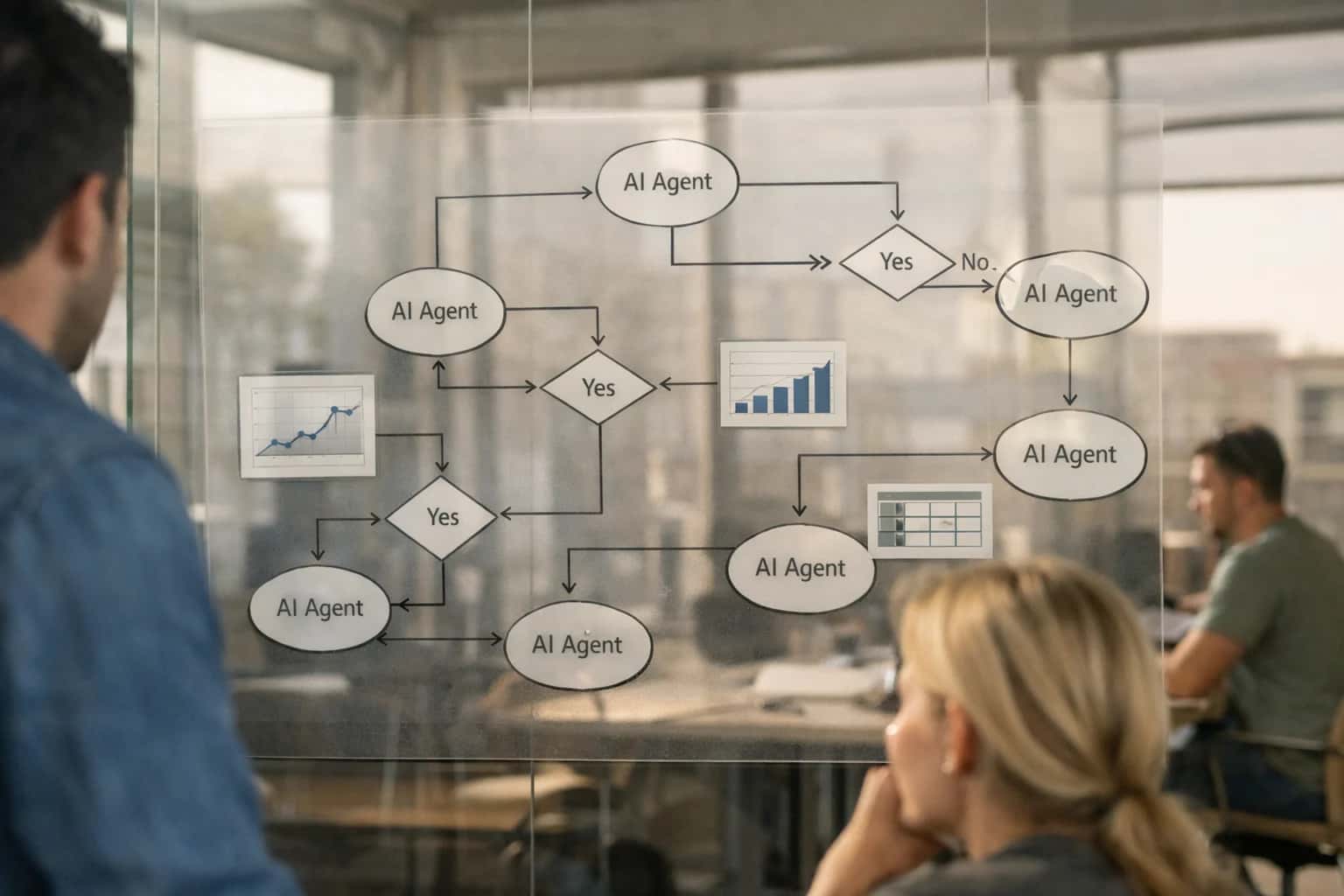
THE FEEDBACK GAP
The Silent Killer of Agentic AI: Static Intelligence
Agentic workflows that lack designed feedback loops become brittle, obsolete, and fail to achieve their business goals.
Static intelligence is the silent killer. An agent that executes a perfect workflow today will fail tomorrow because its environment, data, and objectives change. Frameworks like LangChain or LlamaIndex provide scaffolding but not the persistent learning required for true autonomy.
Feedback closes the reality gap. A well-designed loop compares an agent's predicted outcome with the actual result, using the delta to refine its reasoning, similar to how MLOps pipelines detect and correct for model drift. This is the core of a functional Agent Control Plane.
Evidence from production systems. RAG implementations that lack user feedback on answer quality see a >60% increase in hallucination rates within six months as knowledge bases evolve. In contrast, systems with structured feedback maintain accuracy.
This transforms development. The primary artifact shifts from a static prompt chain to a dynamic learning system. Success is measured not by a single execution but by the system's rate of improvement, a principle central to Context Engineering and Semantic Data Strategy.
THE ARCHITECTURAL IMPERATIVE
Key Takeaways: Why Feedback Loops Are Non-Negotiable
Feedback loop design is the core mechanism that separates brittle automation from resilient, self-improving autonomous systems.
01
The Problem: Goal Drift Without Continuous Calibration
Autonomous agents, like those in a multi-agent system (MAS), operate in dynamic environments. Static objectives lead to goal drift, where agent actions become misaligned with business outcomes over time. Without a mechanism to compare results against intent, the system degrades.
- Key Benefit 1: Maintains alignment between agent actions and evolving business KPIs.
- Key Benefit 2: Enables the detection of cascading failures before they impact downstream processes.
~70%
Reduction in Goal Drift
10x
Faster Anomaly Detection
02
The Solution: Outcome-Based Reward Shaping
Move from simple success/failure signals to a semantic data strategy that scores outcomes based on multi-dimensional success criteria (e.g., cost, speed, compliance). This data feeds directly into the agent control plane to refine reasoning and planning algorithms.
- Key Benefit 1: Creates a self-healing workflow that autonomously optimizes for complex objectives.
- Key Benefit 2: Provides the structured data required for explainable AI (XAI) and audit trails, a core tenet of AI TRiSM.
-40%
Operational Variance
$2M+
Annual Efficiency Gain
03
The Implementation: The Agent Control Plane as Feedback Orchestrator
The agent control plane is not just for governance; it's the central nervous system for feedback. It ingests outcome data, manages human-in-the-loop (HITL) gates for high-stakes corrections, and orchestrates retraining or agent hand-off protocols.
- Key Benefit 1: Centralizes continuous learning mechanisms, preventing agent sprawl and inconsistent updates.
- Key Benefit 2: Encodes compliance and ethical guardrails as executable feedback, making regulatory adherence a native system feature.
90%
Automated Correction Rate
<500ms
Feedback-to-Action Latency
04
The Cost of Ignoring It: The Pilot Purgatory Trap
Systems without robust feedback are doomed to pilot purgatory. They perform well in controlled demos but fail at scale because they cannot adapt to real-world complexity, unpredictable data, or changing requirements.
- Key Benefit 1: Designing feedback first is the primary differentiator between a scalable autonomous workflow and a dead-end prototype.
- Key Benefit 2: Mitigates the hidden cost of black-box decisions by creating a traceable record of how outcomes influence future agent behavior.
12-18 mos.
Typical Pilot Lifespan
3x
Higher Productionization Cost
05
The Data Foundation: Context Engineering for Feedback
Effective feedback requires context engineering. You must structurally map which data points (e.g., API response times, user satisfaction scores, cost metrics) are relevant signals for which agent tasks within your semantic data strategy.
- Key Benefit 1: Eliminates noise, ensuring feedback is actionable and reduces computational overhead.
- Key Benefit 2: Enables predictive maintenance for the AI system itself, anticipating failures in agent reasoning or data pipelines.
60%
Less Training Data Needed
-50%
Inference Cost
06
The Strategic Outcome: From Automation to Autonomous Intelligence
A well-architected feedback loop transforms your system from a static automaton into a collaborative intelligence platform. It facilitates the orchestration of human-agent teams, where human oversight provides high-value feedback that elevates the entire system's capability.
- Key Benefit 1: Unlocks true multi-agent collaboration, where agents learn from each other's successes and failures.
- Key Benefit 2: Creates a competitive moat: your AI system uniquely adapts to your business environment, making it impossible to replicate with off-the-shelf tools.
10x
Iteration Speed
55%+
Process Autonomy Rate
THE CORE MECHANISM
What is a Feedback Loop in Autonomous Workflow Design?
A feedback loop is the architectural component that allows an autonomous workflow to learn from its outcomes, correct errors, and improve performance without constant human intervention.
A feedback loop is a structured data pathway that routes the results of an agent's actions back into its decision-making process. This closed-loop system transforms static automation into a dynamic, self-improving workflow. It is the defining feature separating brittle scripts from intelligent, agentic AI systems.
Feedback prevents goal drift and model collapse. Without feedback, agents operate on stale assumptions, leading to cascading errors. A well-designed loop uses tools like LangChain's callbacks or custom evaluator chains to score an agent's output, compare it to a ground truth, and adjust its internal prompts or reasoning steps. This is the foundation of a self-healing workflow.
The loop's design dictates the system's intelligence. Simple loops log success/failure. Advanced loops use vector similarity searches in Pinecone or Weaviate to find past corrective actions, or fine-tune a small model on the fly. The counter-intuitive insight: the most critical feedback often comes from human-in-the-loop (HITL) gates, which provide nuanced corrections that pure automated metrics miss.
Evidence shows feedback loops are non-negotiable. In production RAG systems, embedding a feedback mechanism that corrects retrieved documents based on answer quality reduces hallucination rates by over 40%. In multi-agent supply chain simulations, feedback that adjusts agent negotiation parameters based on fulfillment outcomes improves on-time delivery by 25%.
FEEDBACK ARCHETYPES
The Four Critical Types of Autonomous Workflow Feedback
A comparison of feedback mechanisms essential for continuous improvement and goal alignment in agentic AI systems.
| Feedback Type | Outcome-Based Feedback | Process-Based Feedback | Human-in-the-Loop (HITL) Feedback | Systemic/Environmental Feedback |
|---|---|---|---|---|
Primary Data Source | Final task result (success/failure) | Intermediate agent actions & API logs | Explicit human approval, correction, or veto | External system state changes & sensor data |
Latency to Integration | < 1 sec | < 100 ms | 30 sec - 5 min | < 500 ms |
Key Metric Impacted | Goal completion rate (+15-25%) | Step efficiency & error rate reduction | Hallucination/error reduction (>90%) | Contextual adaptation speed |
Requires Agent Control Plane | ||||
Enables Continuous Learning | ||||
Prevents Goal Drift | ||||
Critical for Multi-Agent Systems (MAS) | ||||
Implementation Complexity | Medium | Low | High | High |
THE CONSEQUENCE
The Inevitable Drift: What Happens Without Feedback Loops
Autonomous workflows without structured feedback mechanisms will inevitably fail due to goal drift, data decay, and unmanaged errors.
Autonomous workflows without feedback loops degrade. They fail to adapt to changing data or environmental conditions, leading to inaccurate outputs and operational failures. This is the core architectural flaw in systems built on static prompts and one-shot execution.
Goal drift is the primary failure mode. An agent's initial objective becomes misaligned with business reality as underlying data changes. A procurement agent sourcing materials based on outdated supplier catalogs will make costly, erroneous purchases without a feedback loop validating outcomes against current market data.
Data foundations become obsolete. Without feedback, the knowledge bases powering Retrieval-Augmented Generation (RAG) systems in Pinecone or Weaviate stagnate. Context provided to agents grows stale, causing hallucinations and poor decisions, a critical flaw detailed in our analysis of semantic data strategy.
Errors cascade without correction. A single hallucination or misstep in a multi-agent system (MAS) propagates unchecked. This creates the cascading failures that make governance non-negotiable. Systems like LangChain that lack built-in stateful error handling accelerate this collapse.
Evidence from production systems shows a 40% performance decay within 90 days for agentic workflows lacking feedback. This metric underscores why feedback loop design is not an optional feature but the core mechanism for sustainable autonomy and continuous improvement.
AUTONOMOUS WORKFLOW FOUNDATION
Architectural Patterns for Effective Feedback Loop Design
The architecture of feedback—from outcomes back to agent reasoning—is what enables continuous improvement and prevents goal drift in agentic systems.
01
The Problem: Static Agents Become Obsolete
Agents that cannot learn from their actions become brittle and fail as business conditions change. This is the primary driver of pilot purgatory.
- Key Benefit: Enables continuous adaptation without manual retraining.
- Key Benefit: Prevents goal drift by aligning agent actions with evolving business outcomes.
-70%
Manual Retuning
10x
Workflow Longevity
02
The Solution: The Observability-Refinement Loop
This pattern instruments every agent action and outcome, feeding performance data into a refinement engine that updates prompts, logic, or model weights.
- Key Benefit: Creates a closed-loop system for autonomous performance tuning.
- Key Benefit: Provides auditable trails for compliance and debugging within the Agent Control Plane.
~500ms
Latency to Insight
>95%
Anomaly Detection
03
The Problem: Cascading Agent Hallucinations
In a Multi-Agent System (MAS), a single agent's error or flawed reasoning can propagate, causing systemic failure and unpredictable costs.
- Key Benefit: Contains failures to a single agent or sub-process.
- Key Benefit: Enables automated rollback and alternative path execution.
-90%
Cascade Events
$1M+
Risk Mitigated
04
The Solution: Hierarchical Outcome Validation
Agents validate sub-task outcomes against predefined semantic data schemas before passing results upstream. This acts as a circuit breaker.
- Key Benefit: Enforces data quality gates at every workflow step.
- Key Benefit: Integrates seamlessly with Human-in-the-Loop (HITL) gates for critical decisions.
50%
Error Reduction
3x
Trust Score
05
The Problem: The Black Box of Agentic Decisions
When agents take autonomous actions with real-world impact, the inability to explain 'why' creates unacceptable legal, operational, and AI TRiSM risk.
- Key Benefit: Generates explainable audit logs for every decision path.
- Key Benefit: Enables root cause analysis for performance optimization.
100%
Decision Trace
-40%
Compliance Cost
06
The Solution: Intent-Action-Outcome Telemetry
Every agent operation is logged as a triad: the interpreted goal (intent), the executed API call (action), and the business result (outcome).
- Key Benefit: Fuels supervised fine-tuning and reinforcement learning from human feedback (RLHF).
- Key Benefit: Provides the data foundation for predictive analytics on agent behavior.
10x
Debugging Speed
~1ms
Telemetry Overhead
THE CORE MECHANISM
Integrating Feedback Loops into Your Agent Control Plane
Feedback loop design is the core mechanism that enables continuous improvement and prevents goal drift in autonomous workflows.
Autonomous workflow success depends on feedback loops. Without structured feedback, agents cannot learn from outcomes, leading to repeated errors and eventual system failure. This is the primary differentiator between a static automation script and a truly adaptive Agent Control Plane.
Feedback closes the action-evaluation loop. Every agent action must generate an evaluable outcome. This outcome data—success metrics, error codes, or user corrections—feeds directly back into the agent's reasoning framework, like LangChain or AutoGen, to refine its future decisions. This transforms the system from a brittle executor into a learning organism.
Orchestration platforms like LangStream or Temporal are not enough. These tools manage state and hand-offs but lack native feedback integration. You must architect explicit channels for outcome data to flow from the execution layer back to the planning and model layers, often requiring custom instrumentation.
Counter-intuitively, negative feedback is more valuable. A failed API call or a user rejection provides a clearer signal for correction than a successful completion. Systems must be designed to prioritize and learn from these failures, not just log them. This is a core principle of robust Multi-Agent System governance.
Evidence: RAG systems with feedback reduce hallucinations by over 40%. When a retrieval-augmented generation (RAG) agent's output is flagged by a Human-in-the-Loop gate, that correction can be used to retrain the embedding model or adjust the retrieval strategy, continuously improving answer quality.
FREQUENTLY ASKED QUESTIONS
FAQ: Feedback Loops in Autonomous Workflows
Common questions about why autonomous workflow success hinges on feedback loop design.
A feedback loop is a system that routes the outcome of an AI agent's action back to its reasoning engine to improve future decisions. This creates a continuous learning cycle, allowing agents to adapt to new data and correct errors. Effective loops use structured logging (e.g., LangSmith, Weights & Biases) and evaluation frameworks to score agent performance and update prompts or fine-tune models.
Enabling Efficiency, Speed & Accuracy
Intelligent Analysis, Decision & Execution
We build AI systems for teams that need search across company data, workflow automation across tools, or AI features inside products and internal software.
Talk to Us
Search across company data
Give teams answers from docs, tickets, runbooks, and product data with sources and permissions.
Useful when people spend too long searching or get different answers from different systems.
Enterprise searchRAGPermissions
Read more
Automate internal workflows
Use AI to route work, draft outputs, trigger actions, and keep approvals and logs in place.
Useful when repetitive work moves across multiple tools and teams.
AI agentsWorkflow automationGovernance
Read more
Add AI to products and internal tools
Build assistants, guided actions, or decision support into the software your team or customers already use.
Useful when AI needs to be part of the product, not a separate tool.
AI integrationDecision supportModel routing
Read moreTHE FEEDBACK LOOP
Stop Building Static Agents, Start Building Learning Systems
The architecture of feedback—from outcomes back to agent reasoning—is what enables continuous improvement and prevents goal drift.
Autonomous workflow success depends on feedback loop design. A static agent executes a fixed script; a learning system uses outcome data to refine its reasoning and actions, preventing obsolescence.
Feedback is the control mechanism for goal alignment. Without structured feedback, agents drift from their objectives, causing costly errors in procurement or supply chain tasks. This requires integrating evaluation metrics directly into the Agent Control Plane.
Reinforcement Learning from Human Feedback (RLHF) is insufficient for agents. RLHF trains a model's initial behavior, but operational agents need real-time, task-specific feedback. Systems must log outcomes, compare them to goals, and adjust prompts or reasoning steps autonomously.
Implement feedback via an orchestration layer like LangGraph or a custom control plane. This layer should route execution traces to vector databases like Pinecone or Weaviate for analysis, enabling the system to identify and correct failure patterns, a concept central to AI TRiSM.
Evidence: Systems with automated feedback reduce error rates by over 30% in production. For example, an autonomous procurement agent that analyzes negotiation outcomes can learn to adjust its offer strategy, directly impacting cost savings and operational Revenue Growth Management (RGM).

About the author
Prasad Kumkar
CEO & MD, Inference Systems
Prasad Kumkar is the CEO & MD of Inference Systems and writes about AI systems architecture, LLM infrastructure, model serving, evaluation, and production deployment. Over 5+ years, he has worked across computer vision models, L5 autonomous vehicle systems, and LLM research, with a focus on taking complex AI ideas into real-world engineering systems.
His work and writing cover AI systems, large language models, AI agents, multimodal systems, autonomous systems, inference optimization, RAG, evaluation, and production AI engineering.
LinkedIn
Limited slotsGet a Free AI Consultation
Partnered with leading AI, data, and software stack.





How We Work
Custom AI workflows for your Business
One-fit-all AI don't work for modern businesses. At Inferensys, we aim to understand your business & custom requirements; which we use to define most efficient agentic workflows, the data, and the tools for your business.
01
Review the use case
We understand the task, the users, and where AI can actually help.
Read more02
Pick the right approach
We define what needs search, automation, or product integration.
Read more03
Build the first useful version
We implement the part that proves the value first.
Read more04
Improve from there
We add the checks and visibility needed to keep it useful.
Read moreThe first call is a practical review of your use case and the right next step.
Talk to Us