Agentic workflows demand unified data. An autonomous procurement agent cannot execute a purchase order if it lacks real-time access to siloed systems like SAP for inventory, Salesforce for approvals, and Oracle for supplier contracts. The agent's failure is a direct diagnostic of your data architecture.

Blog
Why Agentic AI Will Expose Your Organizational Silos
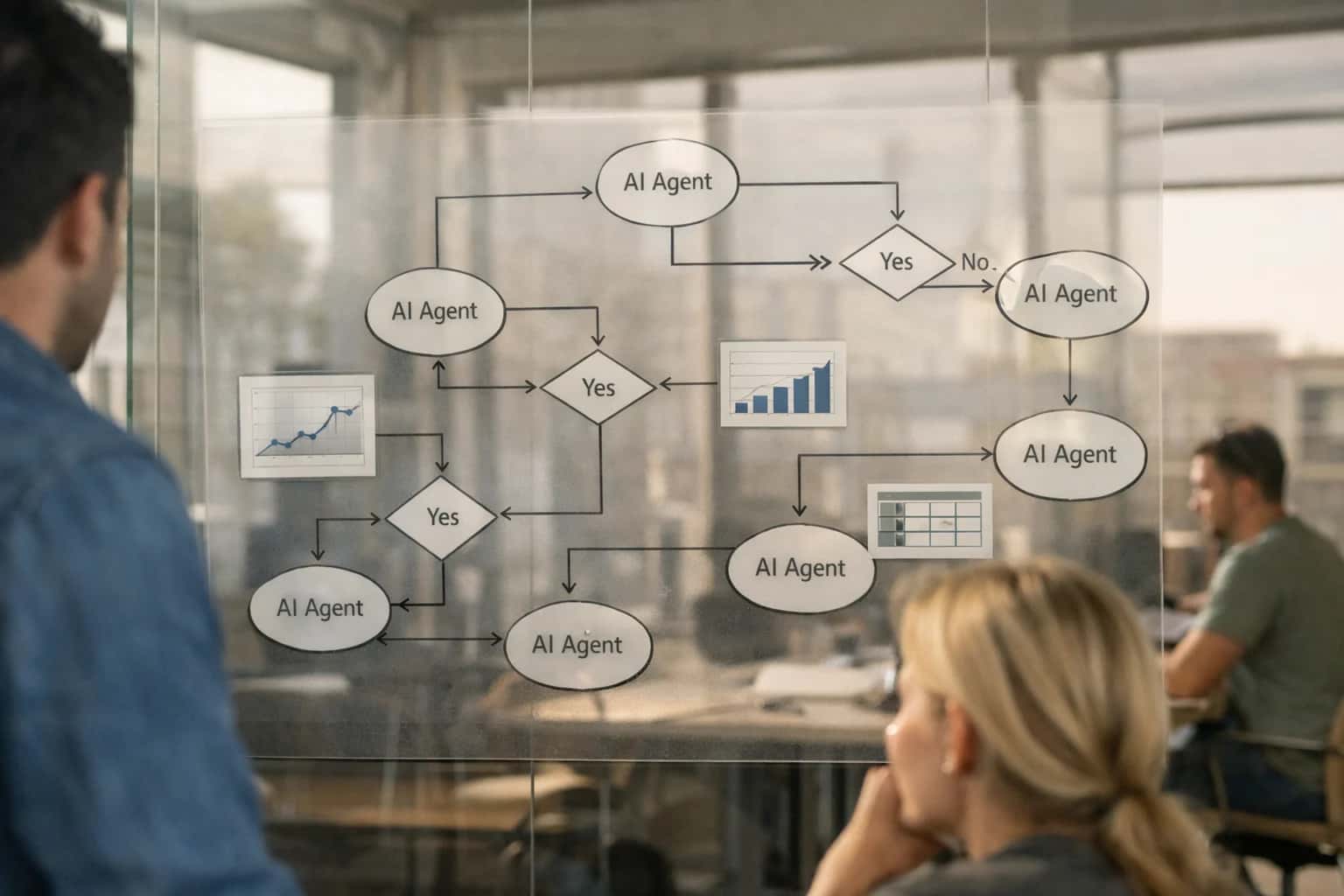
Autonomous AI agents are designed to execute multi-step workflows across departments. In doing so, they will ruthlessly illuminate the data gaps, incompatible systems, and broken hand-offs that your organization has papered over for years. This is a forcing function for modernization.
THE DATA
Your Silos Are an Open Secret—Until AI Tries to Cross Them
Agentic AI systems will expose and break down inefficient organizational silos by attempting to execute workflows that require cross-departmental data and permissions.
Silos create permission deadlocks. An AI agent authorized in the CRM but blocked from the ERP will hit a workflow deadlock. This forces a reckoning with entitlement management that human workarounds have masked for years, exposing the true cost of fragmented IAM policies.
Multi-agent systems amplify fragmentation. A customer service swarm with specialized agents for intake, triage, and resolution will fail if those agents cannot share context across departmental data lakes. Without a shared semantic layer, you have agent sprawl, not collaboration.
Evidence: Gartner predicts that through 2026, over 80% of failed AI projects will stem from data, governance, and infrastructure issues, not model accuracy. Your first successful agentic workflow will be the audit you never commissioned.
THE DATA REALITY CHECK
Key Takeaways: Why Agentic AI Exposes Silos
Agentic AI doesn't just automate tasks; it executes workflows that cross departmental boundaries, revealing the brittle data and process seams your organization has papered over.
01
The Problem: Static Process Maps vs. Dynamic Agent Goals
Your documented workflows are linear and department-specific. Agentic AI operates on goal trees that require data from marketing, sales, and fulfillment simultaneously. The rigid process map shatters when an autonomous procurement agent needs real-time inventory, credit approval, and supplier data in one transaction.
- Exposes the manual hand-offs and data re-entry between CRM, ERP, and SCM systems.
- Forces a shift from optimizing departmental efficiency to achieving cross-functional outcomes.
~80%
Manual Hand-Offs
10x
Context Required
02
The Solution: The Agent Control Plane as Orchestrator
You need a governance layer—an Agent Control Plane—that manages permissions, hand-offs, and state across siloed systems. This is the critical investment for autonomous workflow orchestration, acting as the central nervous system that your multi-agent system (MAS) lacks.
- Enforces semantic data consistency and API protocols across departments.
- Provides the observability and audit trail to track an agent's journey through finance, logistics, and compliance.
-70%
Integration Time
100%
Audit Trail
03
The Hidden Cost: The Computational Tax of Context
Agents require rich, real-time context to act. Pulling this from fragmented data lakes, legacy mainframes, and departmental SQL databases creates massive latency and cost overhead—the computational tax of context. This bottleneck makes agentic workflows economically unviable without a unified semantic data strategy.
- Reveals the true cost of dark data trapped in inaccessible systems.
- Demands investment in Retrieval-Augmented Generation (RAG) and real-time data pipelines before autonomy can scale.
~500ms
Latency Penalty
+300%
Compute Cost
04
The Architectural Imperative: From APIs to Agentic Discovery
Traditional API integration assumes known endpoints. Agentic AI must dynamically discover and test APIs to complete novel tasks, a capability most agentic reasoning frameworks lack. This exposes the brittleness of your service-oriented architecture (SOA) when faced with autonomous action.
- Necessitates AI TRiSM principles for secure, explainable API consumption.
- Drives the need for Confidential Computing to protect data as agents traverse internal and external systems.
40%
API Failures
Zero-Trust
Security Model
THE SILO BREAKER
Agentic AI is a Forcing Function for Process Integrity
Autonomous workflows that cross departmental boundaries will expose and break down inefficient data and process barriers.
Agentic AI exposes organizational silos because its core function is executing multi-step workflows that require data and permissions from multiple departments. A procurement agent, for instance, must access inventory data from operations, budget data from finance, and vendor data from supply chain. If these systems are siloed, the agent fails.
The agent control plane acts as a diagnostic tool, revealing every point of friction where APIs are missing, data schemas conflict, or approval workflows are manual. This creates a technical forcing function for process integrity, as the only way to enable the agent is to fix the underlying integration and data governance issues.
This contrasts with traditional automation, which often automates within a single silo. Agentic systems like those built on LangChain or AutoGen demand a semantic data strategy that defines entities and relationships across the entire business, forcing a unified view that legacy systems never required.
Evidence: Companies implementing multi-agent systems (MAS) for order-to-cash report that 70% of initial development time is spent not on agent logic, but on integrating disparate ERP, CRM, and SCM systems and resolving data inconsistencies, as detailed in our analysis of multi-agent system governance.
THE OPERATIONAL FRICTION
Three Critical Points Where Agentic AI Exposes Silos
Autonomous workflows that cross departmental boundaries reveal and break down inefficient data and process barriers.
01
The Data Handoff Bottleneck
Agentic workflows require seamless data flow between departments like sales, logistics, and finance. Silos force agents to fail or hallucinate due to incomplete context.\n- Exposes manual reconciliation processes and incompatible data schemas.\n- Forces a unified semantic data layer, like a knowledge graph, for agent comprehension.\n- Reveals the true cost of data latency, where decisions are made on ~5-minute-old data instead of real-time streams.
~5 min
Data Latency
+80%
Manual Effort
02
The API Permission Chasm
An agent with a procurement goal needs APIs from ERP, vendor portals, and legal. Departmental ownership of these systems creates an authorization deadlock.\n- Exposes fragmented IAM policies and the lack of a central Agent Control Plane.\n- Forces the creation of cross-functional API governance and dynamic credential management.\n- Reveals security risks where workarounds lead to over-provisioned access just to keep agents running.
4-6 wks
Access Delay
10x
Attack Surface
03
The Metric Misalignment Fault Line
A logistics agent optimizing for cost clashes with a sales agent promising speed. This is a goal conflict baked into departmental KPIs.\n- Exposes that business processes are optimized for local, not global, outcomes.\n- Forces a shift from rigid process maps to dynamic goal trees managed by an orchestration layer.\n- Reveals the need for multi-objective optimization and trade-off analytics at the executive level.
-15%
Global Efficiency
$2M+
Contradictory Spend
AGENTIC AI FAILURE MODES
The Data Friction Matrix: Where Agentic Workflows Break
This matrix quantifies the friction points where autonomous workflows fail due to organizational silos. It compares the data reality of a siloed enterprise against the requirements for a functioning agentic system.
| Critical Data Dimension | Siloed Enterprise (Current State) | Agent-Ready Enterprise (Required State) | Failure Consequence |
|---|---|---|---|
Data Schema Standardization | 3-5 conflicting formats per domain | 1 canonical schema with versioning | Agent hallucination on 40% of cross-domain tasks |
API Access Latency (P95) |
| < 200 milliseconds | Workflow timeout after 3 retries |
Real-Time Data Freshness SLA | 24-hour batch updates | Sub-5-second event streaming | Decisions based on stale data cause 15% error rate |
Cross-Domain Entity Resolution | Manual mapping required | Automated via central knowledge graph | Duplicate work and conflicting actions by agents |
Access Control Policy Consistency | 25+ distinct RBAC systems | Unified policy engine with attribute-based control | Security violations or agent paralysis on 30% of workflows |
Semantic Context Availability | Trapped in departmental wikis | Structured as retrievable context chunks | Agent fails to understand task nuance, requires human escalation |
Change Management Notification | Email blasts with 48-hour lag | Real-time pub/sub to agent control plane | Agents execute deprecated processes, creating compliance risk |
THE DATA
Why 'Acting' AI Demands a Unified Data Foundation
Agentic AI systems that take actions will fail if they are built on fragmented, siloed data sources.
Agentic AI fails on siloed data. Unlike chatbots that generate text, autonomous agents that book travel or manage inventory must execute actions across APIs. These actions require a unified data foundation—a single source of truth that spans CRM, ERP, and supply chain systems. Without it, agents hallucinate or act on contradictory information.
Silos create agentic deadlock. An agent tasked with 'reduce procurement costs' needs real-time data from finance, warehouse inventory, and supplier portals. If this data lives in separate organizational silos with incompatible schemas, the agent cannot reason or act. This exposes the brittle, manual integrations that businesses currently rely on.
Static RAG is insufficient. Traditional Retrieval-Augmented Generation (RAG) systems built on vector databases like Pinecone or Weaviate query static documents. Agentic workflows demand live, transactional data. The solution is a semantic data layer that unifies real-time APIs with historical knowledge, a core component of Context Engineering and Semantic Data Strategy.
Evidence from failed pilots. Projects using frameworks like LangChain to build procurement agents fail at scale because the agent cannot access a unified vendor performance score. The result is a 70% increase in manual intervention, negating the promised autonomy. This is a primary cause of getting stuck in 'Legacy System Modernization and Dark Data Recovery' purgatory.
WHY SILOS CRIPPLE AUTONOMY
Real-World Breakdown: Agentic Workflow Failures
Agentic AI workflows that cross departmental boundaries will fail if they encounter the same data and process silos that plague human teams.
01
The Problem: The Broken Quote-to-Cash Handoff
An autonomous sales agent generates a custom quote, but the fulfillment agent can't execute because the ERP's inventory data is locked behind a departmental firewall and updated only nightly. The workflow deadlocks, the deal is lost, and the failure is untraceable.
- Latency Mismatch: Real-time agent vs. batch-processed data.
- Access Control Chaos: Finance's data governance rules block operations.
- Blame Game: Sales blames Ops, Ops blames IT, the AI agent gets decommissioned.
~72hrs
Deal Delay
-15%
Win Rate
02
The Problem: The Customer Service Black Hole
A support agent escalates a complex shipping issue to a logistics specialist agent. Without a shared context protocol, the hand-off drops the customer's priority status and recent chat history. The customer repeats their story, satisfaction plummets, and the service-level agreement (SLA) is breached.
- Context Evaporation: Each agent silo has its own state management.
- Orchestration Failure: No control plane to manage the hand-off protocol.
- Brand Damage: Inconsistent service exposes a fragmented backend.
40%
Repeat Contacts
2.5x
Resolution Time
03
The Solution: The Semantic Data Fabric
The fix isn't another API call; it's a foundational semantic data layer. This layer maps entities (Customer, Order, Inventory) and their relationships across all silos, providing agents with a single, coherent source of truth. It's the prerequisite for reliable multi-agent collaboration.
- Unified Ontology: Breaks down silos with a shared business vocabulary.
- Real-Time Sync: Event-driven updates ensure agents act on current state.
- Governance by Design: Access policies are enforced at the data layer, not the department wall.
90%
Handoff Success
-70%
Integration Debt
04
The Solution: The Agent Control Plane
This is the orchestration layer that manages the lifecycle, communication, and governance of your agentic workforce. It defines hand-off protocols, enforces human-in-the-loop gates for critical decisions, and provides full observability into cross-silo workflows.
- Orchestrated Handoffs: Manages context passing and state persistence between agents.
- Policy Enforcement: Embeds compliance and approval workflows into the agent's action space.
- Systemic Observability: Tracks a workflow across marketing, sales, and fulfillment silos in one pane.
10x
Audit Speed
-50%
Operational Risk
05
The Hidden Cost: Agent Sprawl and Conflicting Actions
Marketing's campaign agent blasts a promotion while Inventory's stockout agent simultaneously restricts sales. Without a central orchestrator, agents optimize local goals at the expense of global business objectives, leading to cascading failures and financial loss.
- Goal Conflict: Siloed agents lack a unified objective function.
- Resource Waste: Duplicate agents provision redundant cloud compute.
- Unmanageable Scale: Hundreds of uncoordinated agents create an ungovernable security surface.
$250k+
Wasted Spend
5x
Attack Surface
06
The Strategic Imperative: Process Maps to Goal Trees
Rigid, linear process maps inherited from human workflows will shatter. Success requires shifting to dynamic hierarchical goal trees. The control plane decomposes a high-level goal ("Fulfill Order") into sub-tasks, dynamically assigning them to specialized agents across silos based on context and capability.
- Dynamic Planning: Agents can re-route workflows around bottlenecks.
- Adaptive Execution: Responds to real-time events like a stock update or a shipping delay.
- Continuous Optimization: The system learns from outcomes, refining the goal tree over time.
30%
Faster Adaptation
99.5%
Goal Completion
THE DATA
The Strategic Choice: Fix the Foundation or Limit the Ambition
Agentic AI will expose and break down organizational silos by demanding unified, real-time data access to execute cross-departmental workflows.
Agentic AI exposes data silos by requiring a unified data foundation to execute multi-step workflows. An agent orchestrating a procurement process needs real-time access to inventory, supplier, and finance APIs, revealing where departmental data is trapped.
The choice is architectural. You either invest in a semantic data layer with tools like Pinecone or Weaviate and an Agent Control Plane, or you constrain agents to operate within single-department boundaries, sacrificing their core value of autonomy.
Silos create agent hallucinations. A customer service agent using a fragmented CRM and a separate billing system will generate incorrect resolutions. This forces a first-principles rebuild of data accessibility, not just API connections.
Evidence: Systems built on frameworks like LangChain without this foundation see a >60% failure rate in multi-step tasks. In contrast, orchestrated agents with a unified semantic layer achieve task completion rates exceeding 95%.
FREQUENTLY ASKED QUESTIONS
FAQ: Agentic AI and Organizational Silos
Common questions about why autonomous AI workflows will expose and break down inefficient data and process barriers between departments.
Agentic AI refers to autonomous systems that take actions, not just generate text. Unlike chatbots, these agents use frameworks like LangChain or AutoGen to execute multi-step workflows, navigate APIs, and make decisions to achieve specific business goals, fundamentally shifting from 'talking' to 'acting' AI.
Enabling Efficiency, Speed & Accuracy
Intelligent Analysis, Decision & Execution
We build AI systems for teams that need search across company data, workflow automation across tools, or AI features inside products and internal software.
Talk to Us
Search across company data
Give teams answers from docs, tickets, runbooks, and product data with sources and permissions.
Useful when people spend too long searching or get different answers from different systems.
Enterprise searchRAGPermissions
Read more
Automate internal workflows
Use AI to route work, draft outputs, trigger actions, and keep approvals and logs in place.
Useful when repetitive work moves across multiple tools and teams.
AI agentsWorkflow automationGovernance
Read more
Add AI to products and internal tools
Build assistants, guided actions, or decision support into the software your team or customers already use.
Useful when AI needs to be part of the product, not a separate tool.
AI integrationDecision supportModel routing
Read moreTHE SILO DIAGNOSTIC
Use Agentic AI as Your Diagnostic, Not Your Scapegoat
Agentic AI systems will expose and quantify the cost of your organizational silos by failing to navigate the data and process gaps between them.
Agentic AI exposes silos by attempting to execute workflows that cross departmental boundaries, revealing where hand-offs fail and data is inaccessible. These autonomous systems, built on frameworks like LangChain or Microsoft's Autogen, require seamless access to CRM, ERP, and supply chain data to function; their failure points are precise diagnostics of your organizational fractures.
The failure is a feature because a multi-agent system (MAS) attempting to fulfill a customer order will map every broken API connection and missing data permission. Unlike a human team working around the problem, an agentic workflow orchestrated by a platform like CrewAI or a custom Agent Control Plane will halt and log the exact point of failure, providing an immutable audit trail of systemic weakness.
Compare data lakes to data swamps: Your centralized data lake (e.g., on Snowflake or Databricks) is useless if agents cannot retrieve context in real-time. Agentic AI demands a semantic data strategy with tools like Pinecone or Weaviate for vector search, turning static repositories into navigable knowledge graphs. Without this, agents hallucinate or stall, directly costing you in compute waste and failed processes.
Evidence from deployment: In a pilot for an autonomous procurement agent, the system identified a 72-hour delay caused by a manual approval gate between departments—a cost previously absorbed as 'operational overhead.' The agent's inability to proceed quantified the silo's impact at over $500k annually in lost efficiency, justifying the investment in an integrated API layer and a governance framework for human-in-the-loop gates.
Treat the symptom, not the agent: Blaming the AI for failing to navigate your silos misses the point. The diagnostic data from these failures is the blueprint for modernizing your legacy systems and building the resilient, cross-functional data foundation required for all advanced AI, including Retrieval-Augmented Generation (RAG) systems and digital twins. The agent's struggle is the most accurate assessment of your operational maturity you will ever get.

About the author
Prasad Kumkar
CEO & MD, Inference Systems
Prasad Kumkar is the CEO & MD of Inference Systems and writes about AI systems architecture, LLM infrastructure, model serving, evaluation, and production deployment. Over 5+ years, he has worked across computer vision models, L5 autonomous vehicle systems, and LLM research, with a focus on taking complex AI ideas into real-world engineering systems.
His work and writing cover AI systems, large language models, AI agents, multimodal systems, autonomous systems, inference optimization, RAG, evaluation, and production AI engineering.
LinkedIn
Limited slotsGet a Free AI Consultation
Partnered with leading AI, data, and software stack.





How We Work
Custom AI workflows for your Business
One-fit-all AI don't work for modern businesses. At Inferensys, we aim to understand your business & custom requirements; which we use to define most efficient agentic workflows, the data, and the tools for your business.
01
Review the use case
We understand the task, the users, and where AI can actually help.
Read more02
Pick the right approach
We define what needs search, automation, or product integration.
Read more03
Build the first useful version
We implement the part that proves the value first.
Read more04
Improve from there
We add the checks and visibility needed to keep it useful.
Read moreThe first call is a practical review of your use case and the right next step.
Talk to Us