Edge AI demands a decentralized architecture. The cloud-native paradigm of centralized compute, elastic scaling, and constant connectivity is fundamentally incompatible with the edge's physical reality of intermittent networks, strict latency budgets, and constrained power. Success requires a shift from stateless microservices to stateful, autonomous units of intelligence.

Blog
Why Edge AI Requires a Fundamental Rethink of Software Architecture
Monolithic cloud-native architectures are fundamentally incompatible with edge AI constraints. This article deconstructs why microservices, containerization, and orchestration must be reimagined for resource-constrained, latency-sensitive, and privacy-critical edge deployments.
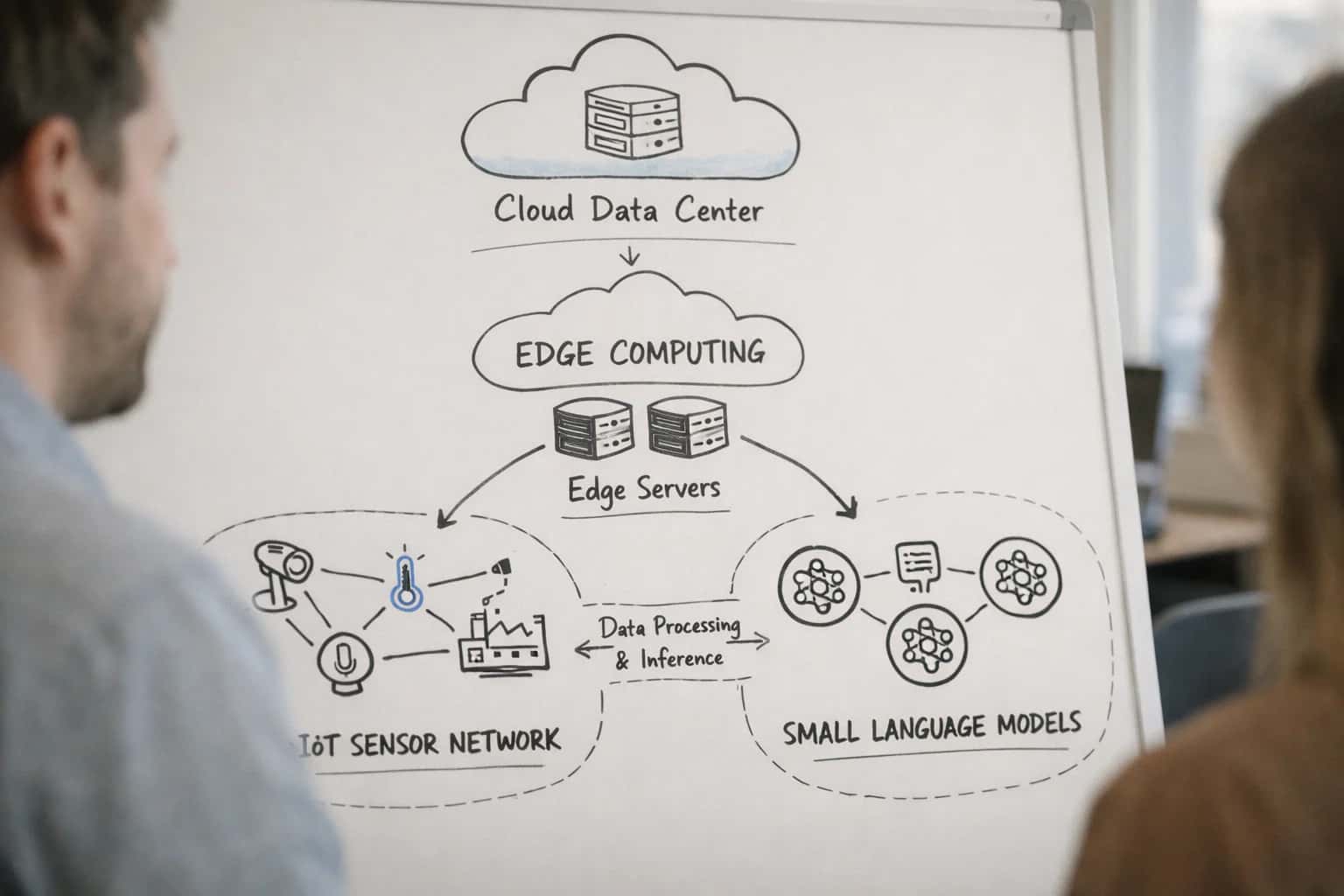
THE ARCHITECTURE
The Cloud-Native Fallacy at the Edge
Edge AI fails when built on cloud-native principles due to fundamental constraints in latency, connectivity, and resource scarcity.
Kubernetes and Docker fail at the edge. Orchestrating containers across thousands of heterogeneous, resource-constrained devices is a different problem than managing virtual machines in a data center. Frameworks like K3s and MicroK8s attempt to address this, but the core challenge is the operating model, not just the tooling. The control plane must tolerate constant network partitions.
The unit of deployment is the model, not the service. In cloud AI, you deploy a model as part of a scalable API endpoint. At the edge, you deploy a compressed, quantized model—often using TensorFlow Lite or ONNX Runtime—directly onto a device's memory, alongside its inference engine and local data pipeline. This bundle must be self-contained and capable of offline operation.
Evidence: A real-time video analytics system streaming raw footage to the cloud requires ~4 Mbps per camera. Processing 100 cameras demands 400 Mbps of sustained bandwidth, a cost-prohibitive and latency-inducing proposition. On-camera inference with a model like YOLO-NAS reduces bandwidth to kilobytes of metadata, enabling scale.
State management moves to the device. Cloud applications are often stateless, relying on centralized databases like Redis. Edge applications must manage state locally using embedded databases like SQLite or in-memory stores, syncing only essential summaries. This is critical for applications like predictive maintenance where continuous sensor data is analyzed on-device.
Failure is the default network condition. Architectures must assume partition tolerance as a first-class concern, not an edge case. This requires designing for eventual consistency and local decision-making, a core principle of federated learning systems. The system cannot stall waiting for a cloud handshake.
WHY EDGE AI BREAKS CLOUD ARCHITECTURE
Key Takeaways
Deploying AI at the edge is not a simple lift-and-shift; it demands a fundamental re-architecture of software, infrastructure, and operations.
01
The Problem: Unacceptable Cloud Round-Trip Latency
Cloud-native architectures introduce ~100-500ms latency for data transit, which is catastrophic for real-time systems. This delay is the difference between a successful autonomous maneuver and a collision.
- Key Benefit: On-device inference reduces latency to <10ms, enabling true real-time response.
- Key Benefit: Eliminates dependency on unreliable or non-existent network connectivity.
<10ms
Edge Latency
~500ms
Cloud Latency
02
The Solution: Microservices & Containerization for Constraint
Monolithic applications fail under edge resource constraints. Success requires decomposing AI workloads into lightweight, independently deployable microservices packaged as containers (e.g., Docker) or unikernels.
- Key Benefit: Enables granular deployment of only the necessary model components to each device type.
- Key Benefit: Facilitates A/B testing and canary rollouts of new models across thousands of heterogeneous edge nodes.
~100MB
Container Footprint
-70%
Memory Use
03
The Problem: The Silent Drift of Deployed Models
Edge models degrade in the field due to changing data distributions (concept drift), but traditional cloud MLOps cannot monitor thousands of offline devices. This creates a massive, hidden operational debt.
- Key Benefit: Implementing edge-native MLOps with federated learning allows for continuous model improvement without centralizing raw data.
- Key Benefit: Proactive detection of performance decay triggers retraining pipelines before service quality collapses.
30-90 days
Typical Drift Cycle
>50%
Unmonitored Models
04
The Solution: Orchestration for the Heterogeneous Fleet
Managing deployments across a mix of hardware (NVIDIA Jetson, Qualcomm Snapdragon, Intel Movidius) is a scaling nightmare. Kubernetes derivatives like K3s and KubeEdge are essential for declarative orchestration at scale.
- Key Benefit: Automated rollbacks and health checks maintain fleet integrity without manual intervention.
- Key Benefit: Unified control plane for deploying to ARM, x86, and RISC-V architectures simultaneously.
10k+ nodes
Orchestration Scale
-80%
Ops Overhead
05
The Problem: The Bandwidth Tax of Raw Data
Streaming high-fidelity sensor data (e.g., video, lidar) to the cloud for analysis is economically and technically infeasible, costing millions in bandwidth and storage.
- Key Benefit: On-sensor analytics processes data at the source, sending only metadata or alerts.
- Key Benefit: Enables use cases like real-time video analytics in bandwidth-constrained environments.
$1M+/year
Bandwidth Cost Saved
>90%
Data Reduced
06
The Solution: Privacy as a First-Class Architecture Feature
Edge AI transforms data privacy from a compliance burden into a core architectural advantage. By processing data locally, it inherently aligns with regulations like GDPR and the EU AI Act.
- Key Benefit: Data never leaves the device, eliminating the risk of breaches in transit or at rest in the cloud.
- Key Benefit: Builds customer trust and enables sensitive use cases in healthcare, finance, and defense that are impossible with cloud-offloading.
0%
Data Egress
100%
On-Device
THE CONSTRAINT
Edge AI Architecture Is Defined by Constraint
Edge AI architecture is not a scaled-down version of cloud AI; it is a fundamentally different paradigm built around severe computational, power, and latency limitations.
Edge AI architecture is a discipline of scarcity, not abundance. It requires designing systems where every millijoule of energy and every millisecond of latency is a first-class constraint, not an afterthought. This forces a complete departure from the resource-lavish paradigms of cloud-native AI.
Monolithic cloud applications fail at the edge because they assume infinite compute and persistent connectivity. Edge success requires a microservices-based, containerized architecture using tools like Docker and orchestrated by Kubernetes (K3s) to decompose monolithic models into discrete, lightweight inference tasks that can be scheduled across constrained hardware.
The cloud-offload model is broken for real-time decisioning. A round-trip to AWS or Azure for inference introduces 100-300ms of latency, which is catastrophic for autonomous vehicles or AR glasses. The architecture must prioritize on-device inference engines like TensorFlow Lite or ONNX Runtime to guarantee sub-10ms response times.
Hardware dictates software design. You cannot deploy the same PyTorch model on an NVIDIA Jetson, a Qualcomm Snapdragon wearable, and a Raspberry Pi. Architecture must be hardware-aware, involving aggressive model quantization (via TensorRT or OpenVINO), pruning, and knowledge distillation to fit within specific memory and thermal envelopes.
Evidence: Deploying a standard ResNet-50 model on a cloud GPU costs ~$0.0001 per inference with 50ms latency. Running an optimized, quantized version on an edge TPU costs ~$0.000001 per inference with 2ms latency, but required 30% more engineering effort for model compression and hardware-software co-design.
Data pipelines must be inverted. Instead of streaming raw sensor data (e.g., video feeds) to a central cloud for processing, edge architecture embeds filtering and feature extraction at the source. This reduces bandwidth costs by over 90% and is the only viable approach for real-time video analytics.
Orchestration shifts from pods to proofs. In the cloud, Kubernetes manages the health of software containers. At the edge, orchestration platforms like AWS IoT Greengrass or Azure IoT Edge must manage the health, security, and update integrity of thousands of physically remote, potentially offline devices—a problem of distributed systems consensus.
ARCHITECTURAL DECISION
Cloud vs. Edge: The Architectural Chasm
A quantitative comparison of core architectural paradigms for deploying AI, highlighting why edge AI demands a fundamental rethink of software design, as detailed in our pillar on Edge AI and Real-Time Decisioning Systems.
| Architectural Feature | Cloud-Native Monolith | Edge-Native Microservices | Hybrid Orchestration |
|---|---|---|---|
Primary Latency Source | Network Round-Trip (100-500ms) | On-Device Compute (< 10ms) | Variable (10-200ms) |
Data Sovereignty Guarantee | Conditional | ||
Operational Bandwidth Cost | $10-50/TB egress | < $1/TB (local) | $5-30/TB (selective) |
Model Update Deployment Time | Minutes (centralized) | Hours-Days (OTA to fleet) | Minutes-Hours (orchestrated) |
Failure Mode on Network Loss | Total Service Disruption | Local Autonomy Preserved | Degraded Functionality |
Typical Hardware Heterogeneity | Low (x86 clusters) | Extreme (ARM, RISC-V, GPU) | High (mix of cloud & edge) |
Inference Economics (Cost/1M inferences) | $2-10 | $0.10-0.50 | $1-5 |
Required Orchestration Complexity | Medium (Kubernetes) | High (K3s, OpenYurt, Akri) | Very High (Hybrid K8s fleets) |
WHY CLOUD-NATIVE FAILS
Three Pillars of Edge-Native Architecture
Monolithic cloud-native architectures crumble under the constraints of the edge. Success demands a fundamental redesign around three core principles.
01
The Problem: Cloud Round-Trip Latency
A ~500ms round-trip to the cloud is a non-starter for autonomous systems. This delay is catastrophic for real-time decisioning in autonomous vehicles, industrial robotics, and health monitors.
- Key Benefit: Enables sub-10ms inference for life-critical alerts and control loops.
- Key Benefit: Eliminates the single point of failure and bandwidth cost of constant cloud streaming.
~500ms
Cloud Latency
<10ms
Edge Target
02
The Problem: The Data Sovereignty Mandate
Regulations like GDPR and the EU AI Act prohibit sensitive data (e.g., biometrics, video) from leaving a geographic region. Centralized cloud processing creates compliance and privacy nightmares.
- Key Benefit: Ensures data never leaves the device or local edge node, building inherent trust.
- Key Benefit: Enables use cases in defense, healthcare, and smart cities that are otherwise legally impossible.
0%
Data Egress
GDPR
Compliant by Design
03
The Solution: Federated Learning & Heterogeneous Orchestration
Managing thousands of unique devices—from NVIDIA Jetson to ARM MCUs—requires a new MLOps paradigm. Federated Learning allows model improvement across a fleet without centralizing raw data.
- Key Benefit: Continuous model refinement from distributed edge data while preserving privacy.
- Key Benefit: Orchestrates model deployment across diverse hardware (x86, ARM, RISC-V), solving the scaling challenge.
1000s
Devices Managed
-80%
Data Transfer
THE ARCHITECTURE
From Microservices to Nano-Functions: The Granularity Imperative
Edge AI demands a shift from cloud-native microservices to ultra-granular, stateless nano-functions to meet strict latency and resource constraints.
Edge AI fails on cloud architecture. The microservices pattern, designed for scalable cloud data centers, introduces fatal latency and bandwidth overhead at the edge where every millisecond and megabyte counts.
Nano-functions replace microservices. These are single-purpose, stateless units of inference—like a tiny model for object detection or anomaly classification—deployed directly on a device. They eliminate the inter-service communication tax that cripples real-time systems.
Orchestration shifts from Kubernetes to lighter frameworks. Managing thousands of nano-functions across heterogeneous hardware requires edge-native orchestrators like AWS IoT Greengrass or Azure IoT Edge, not container-centric platforms designed for data centers.
State management becomes the critical bottleneck. Unlike cloud services with shared databases, edge nano-functions must pass context via ultra-efficient protocols like MQTT or use embedded vector databases like SQLite with HNSW indexes, as detailed in our guide on Edge AI and Real-Time Decisioning Systems.
Evidence: A cloud round-trip for a microservice call adds 100-300ms of latency; an on-device nano-function executes in <10ms. For an autonomous vehicle, this difference is non-negotiable.
FROM CLOUD-NATIVE TO EDGE-FIRST
Edge Architecture in Practice: Use Case Breakdown
Monolithic cloud-native architectures fail at the edge; success requires a fundamental redesign for resource constraints, latency, and autonomy.
01
The Problem: Cloud Round-Trip Latency
Autonomous systems like vehicles and drones cannot tolerate the ~500ms latency of a cloud round-trip. A delayed decision is a failed decision, making cloud reliance a non-starter for real-time control.
- Key Benefit 1: Enables sub-10ms decision loops for safety-critical operations.
- Key Benefit 2: Eliminates dependency on unreliable or non-existent network connectivity.
~500ms
Cloud Latency
<10ms
Edge Target
02
The Solution: Microservices & Containerization
Monolithic apps are too heavy and brittle for the edge. The architecture must decompose into lightweight, independently deployable microservices packaged as containers (e.g., Docker) or unikernels.
- Key Benefit 1: Allows granular updates (e.g., just a new CV model) without full device reboots.
- Key Benefit 2: Enables heterogeneous hardware support via hardware-agnostic container orchestration.
90%
Smaller Updates
ARM/x86/RISC-V
Hardware Agnostic
03
The Problem: The Bandwidth Tax
Streaming raw sensor data (e.g., 4K video, LIDAR point clouds) to the cloud for analysis is economically and technically infeasible, consuming terabytes of bandwidth daily.
- Key Benefit 1: Reduces upstream bandwidth costs by over 95% through on-device filtering.
- Key Benefit 2: Transforms cameras and sensors from dumb data pipes into intelligent perception nodes.
>95%
Bandwidth Saved
TB/day
Data Avoided
04
The Solution: Orchestration for the Wilderness
Managing thousands of remote, heterogeneous devices requires a new breed of orchestration (e.g., K3s, OpenYurt) that operates with intermittent connectivity and minimal overhead.
- Key Benefit 1: Enables zero-touch provisioning and fleet-wide model updates from a central control plane.
- Key Benefit 2: Provides health monitoring and automated rollback for failed deployments in the field.
10k+
Nodes Managed
Offline-First
Operational Mode
05
The Problem: Silent Model Degradation
Edge models degrade silently in the field due to data drift (changing environments). Traditional cloud-centric MLOps cannot monitor or retrain these isolated models.
- Key Benefit 1: Implements continuous validation using on-device metrics and canary inference patterns.
- Key Benefit 2: Leverages Federated Learning to aggregate learnings across devices without exporting raw data, a core technique for privacy-preserving AI.
Silent
Failure Mode
Federated
Learning Path
06
The Solution: Privacy as a Default
On-device processing isn't just for latency; it's a business advantage. By never exporting sensitive data (e.g., health metrics, video feeds), you build inherent trust and comply with regulations like GDPR and the EU AI Act.
- Key Benefit 1: Turns data privacy from a compliance cost into a competitive moat and customer trust signal.
- Key Benefit 2: Enables use cases in regulated industries (healthcare, defense) that are impossible with cloud-offloading.
Zero-Export
Data Policy
GDPR/EU AI Act
Compliance Built-In
THE ARCHITECTURAL SHIFT
The Rise of the Edge-Native Stack
Edge AI demands a fundamental shift from cloud-native to edge-native software architecture, built for constrained, distributed environments.
Edge AI requires a new software stack. Cloud-native architectures, built on assumptions of abundant bandwidth and centralized compute, fail at the edge where latency, privacy, and intermittent connectivity are primary constraints. Success demands an edge-native stack designed from first principles for distributed, resource-constrained environments.
The unit of deployment is the containerized microservice. Monolithic applications are untenable for edge updates and scaling. The edge-native stack relies on lightweight, containerized microservices orchestrated by platforms like K3s or AWS IoT Greengrass. This enables independent deployment, scaling, and failure isolation for individual AI inference tasks.
State management moves to the edge. Cloud-centric databases like PostgreSQL or MongoDB introduce unacceptable latency. The edge-native stack integrates embedded databases like SQLite or Redis for local state and uses eventual consistency models, syncing only essential data to the cloud. This is a core principle of our approach to Edge AI and Real-Time Decisioning Systems.
Orchestration is federated, not centralized. Kubernetes, designed for data centers, is too heavy for the edge. Edge-native orchestration uses lightweight agents that manage local workloads and coordinate with a central control plane only for policy and updates, not real-time control. This mirrors the distributed intelligence needed for Physical AI and Embodied Intelligence.
Evidence: A connected vehicle generates 4TB of data daily. Streaming this to the cloud is economically impossible. An edge-native stack processes 99% of this data on-vehicle, sending only critical insights, reducing bandwidth costs by orders of magnitude and enabling real-time collision avoidance.
FREQUENTLY ASKED QUESTIONS
Edge AI Architecture FAQ
Common questions about why Edge AI requires a fundamental rethink of software architecture.
Cloud-native architectures assume abundant bandwidth and compute, which don't exist at the edge. Edge devices have constrained resources, intermittent connectivity, and strict latency requirements. This demands a shift from monolithic applications to lightweight, containerized microservices orchestrated by tools like Kubernetes K3s or Azure IoT Edge.
Enabling Efficiency, Speed & Accuracy
Intelligent Analysis, Decision & Execution
We build AI systems for teams that need search across company data, workflow automation across tools, or AI features inside products and internal software.
Talk to Us
Search across company data
Give teams answers from docs, tickets, runbooks, and product data with sources and permissions.
Useful when people spend too long searching or get different answers from different systems.
Enterprise searchRAGPermissions
Read more
Automate internal workflows
Use AI to route work, draft outputs, trigger actions, and keep approvals and logs in place.
Useful when repetitive work moves across multiple tools and teams.
AI agentsWorkflow automationGovernance
Read more
Add AI to products and internal tools
Build assistants, guided actions, or decision support into the software your team or customers already use.
Useful when AI needs to be part of the product, not a separate tool.
AI integrationDecision supportModel routing
Read moreTHE ARCHITECTURAL SHIFT
Stop Porting, Start Architecting
Edge AI demands a fundamental shift from cloud-native monoliths to distributed, resource-aware architectures.
Edge AI is not cloud computing. Porting a monolithic cloud application to a Raspberry Pi or NVIDIA Jetson device fails because the core architectural assumptions of infinite compute, bandwidth, and persistent connectivity are invalid at the edge.
Success requires microservices and containerization. You must decompose applications into discrete, lightweight services packaged with tools like Docker and orchestrated by Kubernetes (K3s) or AWS IoT Greengrass. This enables independent deployment, scaling, and updating of individual AI inference modules across a heterogeneous fleet.
The orchestration layer is the new control plane. Managing thousands of remote deployments demands an edge-native orchestration strategy, fundamentally different from cloud-centric tools. This is the true test of an organization's MLOps maturity.
Resource constraints dictate design. Every architectural decision—from model selection in PyTorch or TensorFlow Lite to the choice of a vector database like ChromaDB—is governed by strict limits on memory, power, and CPU cycles. You architect for the device first, not the data center.

About the author
Prasad Kumkar
CEO & MD, Inference Systems
Prasad Kumkar is the CEO & MD of Inference Systems and writes about AI systems architecture, LLM infrastructure, model serving, evaluation, and production deployment. Over 5+ years, he has worked across computer vision models, L5 autonomous vehicle systems, and LLM research, with a focus on taking complex AI ideas into real-world engineering systems.
His work and writing cover AI systems, large language models, AI agents, multimodal systems, autonomous systems, inference optimization, RAG, evaluation, and production AI engineering.
LinkedIn
Limited slotsGet a Free AI Consultation
Partnered with leading AI, data, and software stack.





How We Work
Custom AI workflows for your Business
One-fit-all AI don't work for modern businesses. At Inferensys, we aim to understand your business & custom requirements; which we use to define most efficient agentic workflows, the data, and the tools for your business.
01
Review the use case
We understand the task, the users, and where AI can actually help.
Read more02
Pick the right approach
We define what needs search, automation, or product integration.
Read more03
Build the first useful version
We implement the part that proves the value first.
Read more04
Improve from there
We add the checks and visibility needed to keep it useful.
Read moreThe first call is a practical review of your use case and the right next step.
Talk to Us