Edge inference directly trades model performance for battery life. Every watt-hour consumed by an AI model on a device like a smartwatch or drone reduces its operational window, making energy efficiency the primary design constraint.

Blog
The Hidden Cost of Energy Consumption in Edge Inference
Battery-powered edge devices force a brutal trade-off between model accuracy and operational lifespan. This deep dive explains how energy consumption dictates model compression, quantization strategies, and hardware-software co-design, revealing the true cost of on-device intelligence.
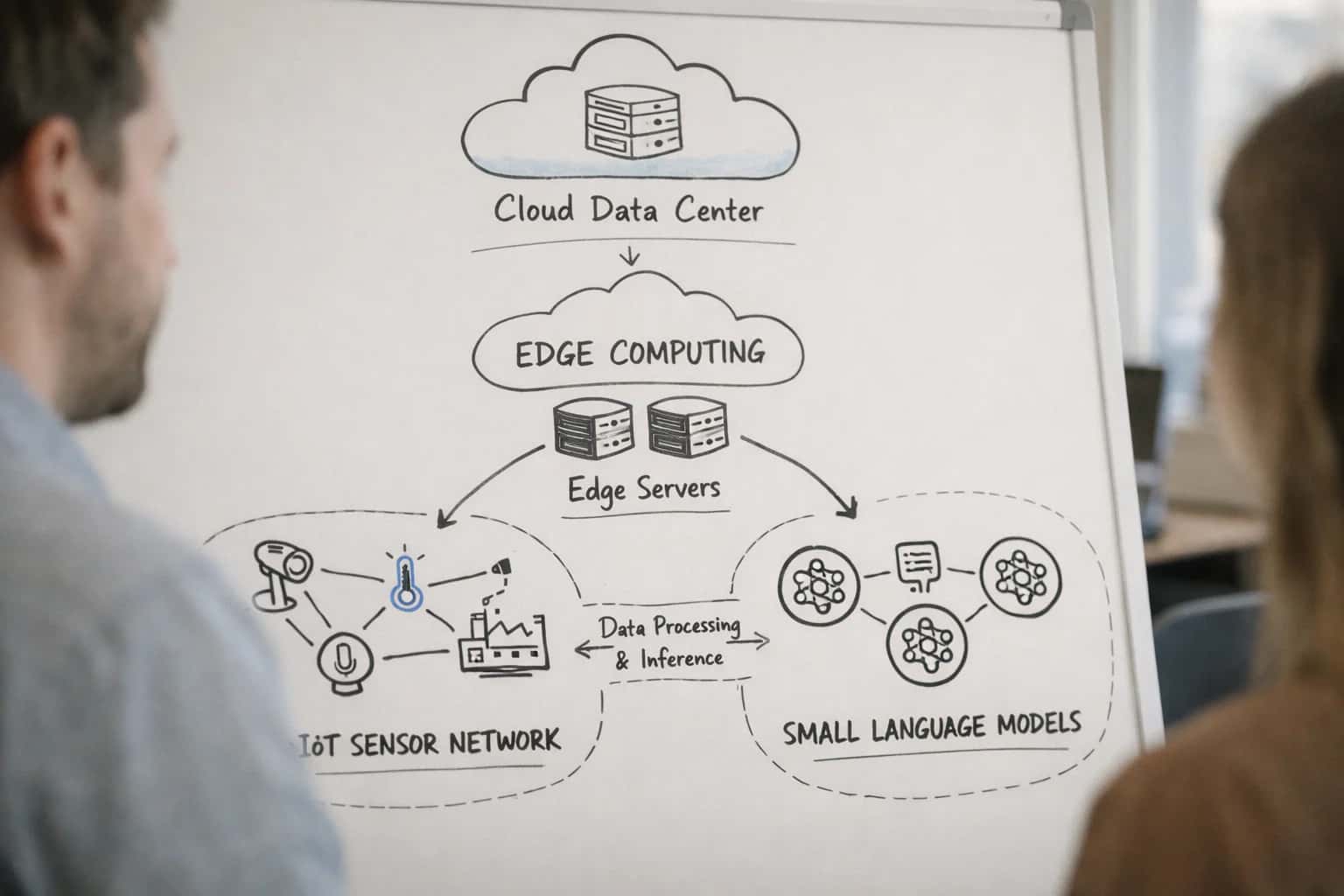
THE HARDWARE CONSTRAINT
The Battery Life Bottleneck
Battery-powered devices force a brutal trade-off between model accuracy and operational lifespan, dictating model compression and quantization strategies.
Model quantization is the first line of defense. Converting 32-bit floating-point weights to 8-bit integers (INT8) or lower via frameworks like TensorFlow Lite or ONNX Runtime slashes compute and memory energy by 4x, but introduces a quantifiable accuracy loss that must be managed.
Pruning and knowledge distillation create ultra-lean architectures. Techniques like neural architecture search (NAS) and iterative pruning remove redundant neurons, while distillation trains a small 'student' model to mimic a large 'teacher', achieving similar accuracy with a fraction of the computational graph.
Hardware dictates the software strategy. An algorithm optimized for the Google Coral Edge TPU will fail on a Qualcomm Snapdragon CPU; successful deployment requires co-designing the model, framework, and target silicon from the start, a core principle of our Edge AI services.
The real cost is measured in milliwatts per inference. For a health monitor running a TensorFlow Lite Micro model continuously, a 10mW reduction extends battery life from days to weeks, transforming the product's viability and user adherence, a critical factor in wearable health systems.
THE HIDDEN COST
Key Takeaways: The Energy Reality of Edge AI
Battery-powered devices force a brutal trade-off between model accuracy and operational lifespan, dictating model compression and quantization strategies.
01
The Problem: The Battery Life Cliff
Running a modern vision transformer on a smartphone can drain its battery in under 2 hours. This isn't a hardware failure; it's a fundamental mismatch between model architecture and power-constrained silicon. The result is either uselessly short device uptime or a fallback to cloud dependency, defeating the purpose of edge deployment.
- Exponential Cost: Every additional FLOP consumes linearly more energy, but the returns in accuracy diminish.
- Thermal Throttling: Sustained high inference causes heat buildup, forcing chips to slow down, creating unpredictable latency.
- Operational Burden: Frequent recharging or battery replacement makes large-scale deployments economically unviable.
<2h
Battery Life
~70%
Thermal Throttle
02
The Solution: Hardware-Software Co-Design
You cannot software your way out of a hardware problem. Effective edge AI requires selecting or designing silicon—like ARM's Ethos NPUs or Google's Edge TPU—that accelerates specific, quantized operations. The software stack, from compiler to runtime, must be built for that silicon to eliminate overhead.
- Quantization-Aware Training: Models are trained with simulated 8-bit or 4-bit precision, recovering accuracy lost in post-training quantization.
- Compiler Optimization: Frameworks like Apache TVM or vendor-specific SDKs map model graphs to the most energy-efficient execution paths on the target hardware.
- Dynamic Voltage/Frequency Scaling: The system adjusts chip power in real-time based on inference workload, a technique central to platforms like NVIDIA Jetson.
10-100x
Efficiency Gain
4-8 bit
Precision
03
The Tactic: Strategic Model Compression
Throwing a 500M parameter model at an edge device is architectural malpractice. The goal is the smallest model that achieves the required performance. This involves a multi-pronged attack:
- Pruning: Removing redundant neurons or channels that contribute little to output. Sparse models can be ~60% smaller with minimal accuracy loss.
- Knowledge Distillation: Training a small 'student' model to mimic the behavior of a large, accurate 'teacher' model.
- Architecture Search: Using automated tools to find neural network structures optimized for a target device's power profile, a process known as Neural Architecture Search (NAS).
60-90%
Size Reduction
<2%
Accuracy Drop
04
The Trade-Off: Accuracy vs. Joule
Edge AI is the art of managed degradation. A 99.9% accurate cloud model is a liability if it consumes 10 watts. You must define the minimum viable accuracy for the application—often 95-98% is sufficient for real-world detection—and work backward to the most efficient model architecture.
- Inference Economics: The metric is inferences per joule, not pure FLOPS. This shifts the optimization target fundamentally.
- Context-Aware Inference: Use simpler models for easy cases (e.g., empty scene) and trigger complex models only when needed, a pattern used in always-on sensors.
- Federated Learning: Enables model improvement using distributed device data without the energy cost of constant cloud uploads, a key technique for privacy-preserving AI.
95-98%
Target Accuracy
Inf/J
Key Metric
05
The Architecture: Hybrid and Hierarchical Inference
The most efficient system uses the right compute for the right task. A lightweight model runs perpetually on a low-power microcontroller (MCU) core. Only when a high-confidence event is detected does it wake up a more powerful NPU or CPU cluster for detailed analysis. This tiered approach is critical for wearable health monitors and smart sensors.
- Wake-on-Event: Ultra-low-power MCU domain handles sensor sampling and basic thresholding.
- Orchestration Layer: Manages model hand-off and power state transitions between different compute units.
- Edge-Cloud Fallback: For ambiguous cases, the device can request a cloud 'second opinion,' but this is the exception, not the rule.
µW-mW
MCU Power
>90%
Uptime
06
The Imperative: Lifecycle Energy Accounting
The energy cost isn't just inference; it's the entire lifecycle. Training a massive model in the cloud has a carbon footprint. Pushing frequent OTA model updates to a million devices consumes network energy. The sustainable edge system minimizes total energy expenditure.
- Update Efficiency: Use delta updates and efficient compression to reduce the energy cost of model deployment, a core concern of mature MLOps practices.
- Carbon-Aware Training: Consider the embodied carbon of the training process when selecting a model architecture.
- Hardware Refresh Cycles: Energy-optimized new silicon may justify device replacement, factoring in the total cost of ownership. This connects to broader strategies in Carbon Accounting and Climate Tech AI.
CO2e
Full Lifecycle
TCO
Driving Metric
THE PHYSICAL CONSTRAINT
Energy Consumption Dictates Everything
Battery life is the ultimate bottleneck for edge AI, forcing a brutal trade-off between model accuracy and operational lifespan.
Energy consumption dictates the entire edge AI stack, from silicon selection to model architecture. Every milliwatt-hour spent on inference directly reduces device uptime, making power efficiency the primary design constraint.
Model compression and quantization are not optional optimizations; they are survival tactics. Techniques like pruning with TensorFlow Lite or quantization-aware training in PyTorch Mobile strip out computational fat, trading marginal accuracy for exponential gains in battery life.
The cloud-edge comparison is misleading. A cloud-based BERT model might achieve 92% accuracy, but its edge-optimized counterpart, like a MobileBERT variant distilled for an ARM Cortex-M core, will use 100x less energy for a 5-8% accuracy drop that is acceptable for on-device tasks.
Evidence: Deploying a standard ResNet-50 model on a NVIDIA Jetson Nano for continuous video inference drains a 10,000mAh battery in under 4 hours. Switching to a MobileNetV3 architecture extends that to over 24 hours, making the application viable.
FEATURED SNIPPETS
The Brutal Math of Edge Inference Energy
A direct comparison of energy consumption, operational lifespan, and cost for common edge AI deployment strategies.
| Metric / Feature | Cloud Offloading | Standard Edge Inference | Optimized Edge Inference |
|---|---|---|---|
Inference Energy per Query |
| 2-5 Wh | < 0.5 Wh |
Battery Life Impact (vs. idle) | Hours | Days | Weeks |
Model Compression Required | None | Pruning & Quantization (INT8) | Extreme Quantization (INT4/Binary) |
Peak Power Draw | N/A | 5-15W | < 2W |
Supports Always-On Sensing | |||
Operational Cost per 1M Queries | $50-100 | $10-20 | < $5 |
Latency (End-to-End) | 100-500ms | 10-50ms | 1-10ms |
Data Sovereignty Guarantee |
THE TRADE-OFF
Model Compression: Trading Accuracy for Watts
Battery-powered edge devices force a brutal optimization between model performance and operational lifespan, dictating aggressive compression and quantization strategies.
Model compression is a non-negotiable requirement for edge AI. The energy cost of running a large, unoptimized model on a battery-powered device renders the application impractical. Techniques like pruning, quantization, and knowledge distillation directly reduce computational load and power draw.
Quantization is the most impactful lever. Converting model weights from 32-bit floating-point to 8-bit integers (FP32 to INT8) via frameworks like TensorFlow Lite or ONNX Runtime can reduce memory footprint by 75% and accelerate inference by 3-4x with a minimal accuracy drop.
The trade-off curve is non-linear. A 1% drop in Top-5 accuracy on a dataset like ImageNet can yield a 30-40% reduction in power consumption. This makes principled accuracy-for-efficiency testing with tools like NVIDIA TAO Toolkit or OpenVINO essential for finding the optimal operating point.
Evidence: Deploying a MobileNetV3 model quantized with PyTorch Mobile on a smartphone uses ~300mW, compared to ~3W for a full ResNet-50, extending continuous inference time from hours to days on a single charge. For a deeper dive into the economics of edge deployment, see our analysis on Inference Economics.
The hidden cost is operational complexity. Managing a fleet of compressed models, each tailored for different hardware (ARM Cortex, NVIDIA Jetson, Qualcomm Snapdragon), creates a model ops burden that traditional MLOps platforms fail to address. This necessitates specialized Edge AI MLOps toolchains.
THE HIDDEN COST OF ENERGY CONSUMPTION IN EDGE INFERENCE
Energy Cost in Real-World Edge Systems
Battery-powered devices force a brutal trade-off between model accuracy and operational lifespan, dictating model compression and quantization strategies.
01
The Problem: Battery Life Dictates Model Architecture
The primary constraint for edge AI isn't compute, it's joules per inference. A complex vision model can drain a device's battery in hours, not days, making continuous operation impossible. This forces a fundamental redesign of the AI stack.
- Key Metric: A 1-watt reduction in average power can extend a device's operational life by ~30%.
- Key Constraint: Model size and complexity are directly traded for battery capacity, limiting achievable accuracy.
~30%
Life Extension
Hours
Runtime Penalty
02
The Solution: Hardware-Aware Neural Architecture Search (HW-NAS)
Manually designing efficient models is obsolete. HW-NAS automates the search for optimal model architectures that maximize performance-per-watt for a specific chipset, like the NVIDIA Jetson or Qualcomm Snapdragon.
- Key Benefit: Automatically discovers models that are 2-5x more energy-efficient than hand-tuned benchmarks.
- Key Benefit: Co-optimizes for latency, memory footprint, and thermal constraints, not just FLOPs.
2-5x
Efficiency Gain
Chip-Specific
Optimization
03
The Problem: Quantization's Accuracy-Energy Trade-Off
Converting models from 32-bit to 8-bit (INT8) or lower precision saves energy but introduces quantization noise, degrading model accuracy on complex tasks. The loss is non-linear and unpredictable.
- Key Metric: INT8 inference can reduce energy consumption by ~75% but may cause a >5% drop in mAP for object detection.
- Key Constraint: Aggressive quantization can break model functionality entirely, requiring extensive retraining and calibration.
-75%
Energy Use
>5%
Accuracy Drop
04
The Solution: Dynamic Voltage and Frequency Scaling (DVFS) for Inference
Running the processor at full clock speed for every inference wastes energy. DVFS algorithms dynamically adjust chip voltage and frequency based on the real-time computational load of the AI task.
- Key Benefit: Achieves ~40% energy savings for bursty, intermittent inference workloads common in sensors and wearables.
- Key Benefit: Maintains peak performance for latency-critical inferences while idling efficiently during downtime.
-40%
Energy Saved
Dynamic
Performance
05
The Problem: The Thermal Wall and Performance Throttling
Sustained AI computation generates heat. Passive-cooled edge devices quickly hit a thermal ceiling, forcing the system to throttle CPU/GPU performance to avoid damage, crashing inference latency.
- Key Metric: A 10°C increase in junction temperature can trigger throttling that doubles inference time.
- Key Constraint: Thermal design limits the sustainable throughput of an edge AI system more than raw TOPS (Tera Operations Per Second).
10°C
Throttle Trigger
2x
Latency Penalty
06
The Solution: Spatio-Temporal Model Gating and Early Exit
Not every sensor input requires a full model pass. Gating networks and early-exit architectures allow simple inputs to bypass most layers, and complex ones to use the full model, slashing average energy use.
- Key Benefit: Reduces average compute cost per inference by 60-80% on real-world data streams.
- Key Benefit: Enables always-on sensing with battery life measured in weeks, not hours, critical for wearable health monitors.
-80%
Avg. Compute
Weeks
Battery Life
THE ENERGY TRAP
The Cloud Fallacy: Why Offloading Isn't a Panacea
The perceived efficiency of cloud offloading is a dangerous illusion for edge inference, where the energy cost of data transmission often exceeds the cost of local computation.
Offloading inference to the cloud is not an energy panacea. The energy required to transmit high-bandwidth sensor data (e.g., video streams) over a cellular network often exceeds the energy cost of running a quantized model locally on an edge device.
The fundamental trade-off is joules per inference. A cloud round-trip consumes energy for sensor activation, data encoding, wireless transmission, network hops, and cloud compute. An optimized edge model, quantized via TensorFlow Lite or PyTorch Mobile, executes the inference in a single, localized energy burst.
Battery life dictates model architecture. This energy calculus forces a brutal optimization: simpler, pruned models running on efficient hardware like the NVIDIA Jetson Orin or Qualcomm Snapdragon platforms. The goal is not peak FLOPs but minimal millijoules per correct prediction.
Evidence: Studies show transmitting one megabyte of data over 4G can consume ~5-10 joules, while performing a lightweight image classification inference on a modern edge TPU may consume <0.1 joule. For continuous video analytics, cloud offloading drains device batteries 10-100x faster.
FREQUENTLY ASKED QUESTIONS
Edge Inference Energy: Critical Questions Answered
Common questions about the hidden costs and trade-offs of energy consumption in edge AI inference.
Energy consumption dictates the operational lifespan and feasibility of battery-powered edge devices. High-power models drain batteries rapidly, forcing a brutal trade-off between model accuracy and device uptime. This makes techniques like quantization with TensorFlow Lite and pruning essential for deployment.
Enabling Efficiency, Speed & Accuracy
Intelligent Analysis, Decision & Execution
We build AI systems for teams that need search across company data, workflow automation across tools, or AI features inside products and internal software.
Talk to Us
Search across company data
Give teams answers from docs, tickets, runbooks, and product data with sources and permissions.
Useful when people spend too long searching or get different answers from different systems.
Enterprise searchRAGPermissions
Read more
Automate internal workflows
Use AI to route work, draft outputs, trigger actions, and keep approvals and logs in place.
Useful when repetitive work moves across multiple tools and teams.
AI agentsWorkflow automationGovernance
Read more
Add AI to products and internal tools
Build assistants, guided actions, or decision support into the software your team or customers already use.
Useful when AI needs to be part of the product, not a separate tool.
AI integrationDecision supportModel routing
Read moreTHE ENERGY CONSTRAINT
Beyond Compression: The Next Frontier in Efficient Inference
Model compression is insufficient; the true bottleneck for edge AI is the physics of energy consumption in battery-powered devices.
Energy consumption dictates edge viability. The primary constraint for deploying AI on drones, wearables, or industrial sensors is not model size, but the joules-per-inference that directly translates to device operational lifespan. Quantization and pruning reduce compute, but they ignore the static power draw of memory access and idle silicon, which dominates total energy use in intermittent workloads.
Hardware dictates software strategy. Frameworks like TensorFlow Lite and ONNX Runtime must be paired with platform-specific optimizations for Qualcomm's Hexagon DSP or the NVIDIA Jetson platform to achieve true efficiency. A model optimized for an ARM CPU will waste energy on an AI accelerator due to inefficient data movement and kernel scheduling.
Inference economics supersede accuracy. The trade-off is not just accuracy versus model size, but accuracy versus total cost of ownership. A 1% accuracy gain that doubles energy consumption is a net loss for a fleet of 10,000 battery-powered sensors. The optimal model is the one that delivers the required business outcome within the hard energy budget.
Evidence: Running a standard MobileNetV2 image classification model on a common microcontroller consumes ~280 mJ per inference. For a device with a 10,000 J battery, this limits operations to ~35,000 inferences before depletion, making continuous real-time vision impossible without a fundamental architectural shift. For a deeper analysis of these trade-offs, see our guide on Edge AI hardware-software co-design.
The next frontier is energy-aware ML. Research into spiking neural networks (SNNs) and in-memory computing architectures aims to mimic the brain's extreme efficiency by processing data only on event-driven triggers, potentially reducing energy use by orders of magnitude. This moves beyond compressing existing models to inventing new computational paradigms fit for the edge's physical reality.

About the author
Prasad Kumkar
CEO & MD, Inference Systems
Prasad Kumkar is the CEO & MD of Inference Systems and writes about AI systems architecture, LLM infrastructure, model serving, evaluation, and production deployment. Over 5+ years, he has worked across computer vision models, L5 autonomous vehicle systems, and LLM research, with a focus on taking complex AI ideas into real-world engineering systems.
His work and writing cover AI systems, large language models, AI agents, multimodal systems, autonomous systems, inference optimization, RAG, evaluation, and production AI engineering.
LinkedIn
Limited slotsGet a Free AI Consultation
Partnered with leading AI, data, and software stack.





How We Work
Custom AI workflows for your Business
One-fit-all AI don't work for modern businesses. At Inferensys, we aim to understand your business & custom requirements; which we use to define most efficient agentic workflows, the data, and the tools for your business.
01
Review the use case
We understand the task, the users, and where AI can actually help.
Read more02
Pick the right approach
We define what needs search, automation, or product integration.
Read more03
Build the first useful version
We implement the part that proves the value first.
Read more04
Improve from there
We add the checks and visibility needed to keep it useful.
Read moreThe first call is a practical review of your use case and the right next step.
Talk to Us