Cloud inference latency is unacceptable for real-time applications. The round-trip time to a data center adds hundreds of milliseconds, a fatal delay for autonomous vehicles, industrial robots, or medical devices where decisions must be made in single-digit milliseconds.

Blog
The Strategic Imperative of On-Device Inference for CTOs
Moving AI inference from the cloud to the edge is not an optimization—it's a fundamental architectural shift with profound business implications. This guide explains why latency, privacy, and resilience make on-device intelligence a non-negotiable strategic imperative for modern enterprises.
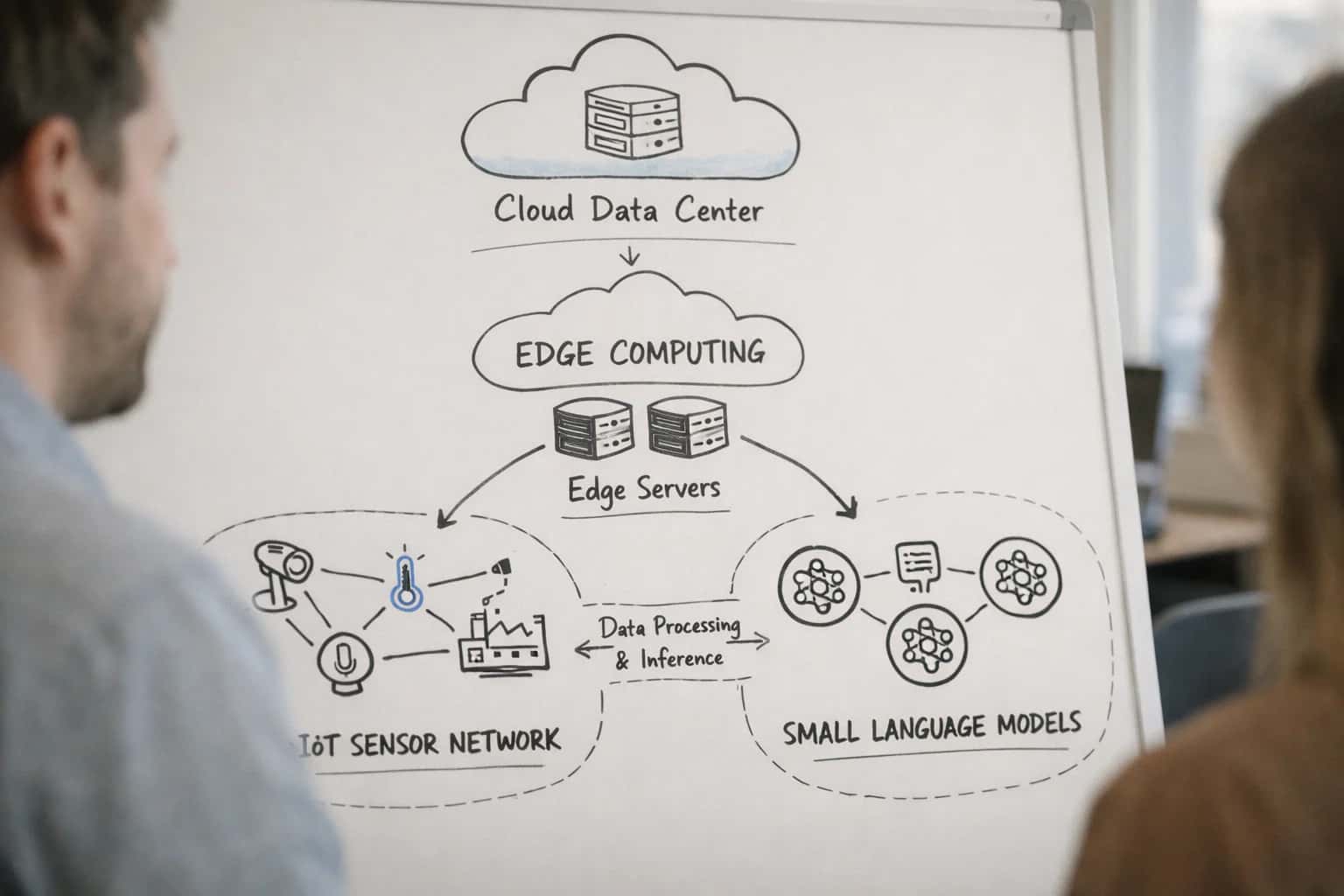
THE LATENCY PROBLEM
The Cloud-Centric AI Model Is Broken for Real-World Applications
Cloud-based inference introduces unacceptable delays for applications requiring instant response.
Bandwidth costs are prohibitive for continuous data streams. Analyzing raw video from thousands of security cameras or sensor telemetry from a factory floor on AWS SageMaker or Google Cloud Vertex AI creates unsustainable egress fees and network congestion, making edge processing an economic necessity.
Data sovereignty mandates on-device processing. Regulations like the EU AI Act and GDPR restrict cross-border data transfers, forcing inference to occur locally. This makes Privacy-Preserving AI a compliance requirement, not an optional feature, for global deployments.
Evidence: A study by NVIDIA showed that autonomous vehicle perception stacks require sub-10ms latency for safe navigation; cloud-based inference typically exceeds 100ms, creating a dangerous decision gap. This is why architectures like Federated Learning are critical for continuous improvement without data centralization.
THE STRATEGIC IMPERATIVE
Key Takeaways: The Edge AI Mandate
For CTOs, moving inference from the cloud to the device is a critical business decision that directly impacts latency, privacy, cost, and competitive advantage.
01
The Problem: Cloud Round-Trip Latency
For autonomous systems, a ~500ms cloud round-trip is a system failure. This delay is unacceptable for real-time decisioning in vehicles, drones, and industrial robots where milliseconds matter. Edge inference slashes latency to <10ms, enabling true autonomy.
- Eliminates Network Dependency: Operates fully offline or in low-connectivity environments.
- Enables Real-Time Control Loops: Critical for robotics actuation and safety systems.
<10ms
Edge Latency
~500ms
Cloud Latency
02
The Solution: Privacy-Preserving Inference
On-device processing is the ultimate data minimization strategy. Sensitive data—from health vitals to factory floor video—never leaves the device, turning privacy into a competitive differentiator.
- Mitigates Regulatory Risk: Inherently complies with GDPR, EU AI Act, and data sovereignty laws.
- Builds Consumer Trust: Enables use cases in healthcare and finance where data leakage is a non-starter.
0%
Data Egress
GDPR
Native Compliance
03
The Hidden Cost: Bandwidth & Cloud Opex
Streaming raw sensor data (e.g., video, lidar) to the cloud for analysis creates prohibitive bandwidth costs and scaling bottlenecks. Edge AI compresses this to actionable insights, slashing cloud egress bills by >70%.
- Reduces Total Cost of Ownership (TCO): Shifts cost from variable cloud Opex to predictable Capex.
- Enables Dense Sensor Deployment: Makes continent-scale IoT and video analytics economically viable.
>70%
Bandwidth Saved
$10B+
IoT Market by 2026
04
The Architecture: Hybrid Cloud-Edge Resilience
A strategic hybrid architecture keeps sensitive 'crown jewel' data on-premise while leveraging cloud scale for training. This optimizes Inference Economics and provides operational resilience against cloud outages.
- Maintains Architectural Flexibility: Enables workload placement based on latency, cost, and compliance needs.
- Future-Proofs Against Vendor Lock-In: Avoids proprietary stacks from NVIDIA or Qualcomm that limit long-term flexibility.
99.99%
Uptime
Hybrid
Optimal Design
05
The Challenge: Heterogeneous Fleet Management
Deploying and maintaining models across thousands of devices with different chipsets (ARM, x86, RISC-V) is a monumental MLOps challenge. It requires a new level of automation for updates, monitoring, and drift detection.
- Demands Specialized MLOps: Traditional cloud toolchains fail at the edge; requires containerization and orchestration for resource constraints.
- Creates Operational Burden: Silent model degradation in the field can lead to widespread system failures if not managed.
1000s
Device Types
ARM/x86
Chipset Fragmentation
06
The Future: Federated Learning at Scale
Federated Learning is the unsung hero of Edge AI, enabling continuous model improvement across a distributed device fleet without centralizing raw data. It turns privacy from a constraint into a feature of the learning process.
- Enables Collective Intelligence: Devices learn from each other's experiences while keeping data local.
- Solves the Data Scarcity Problem: Unlocks model refinement for niche environments without expensive data collection.
0 Raw Data
Shared
Continuous
Model Improvement
THE STRATEGIC IMPERATIVE
On-Device Inference Is a Business Continuity Requirement
Moving AI inference from the cloud to the device is a critical business decision that directly impacts operational resilience, cost control, and user trust.
On-device inference eliminates cloud dependency, ensuring your AI-powered services operate during network outages or cloud provider downtime. This architectural shift transforms AI from a fragile, internet-dependent service into a resilient component of your core product.
Latency is a competitive metric. Cloud round-trip times of 100-300ms are unacceptable for real-time applications like autonomous navigation, industrial robotics, or AR-assisted surgery. Edge-native frameworks like TensorFlow Lite and ONNX Runtime deliver sub-10ms inference, making real-time responsiveness a tangible feature, not a bottleneck.
Data privacy becomes a product feature. Processing sensitive data—be it patient health information from a wearable or proprietary video from a security camera—on the device itself removes the compliance and reputational risks of transmitting it to centralized cloud servers like AWS or Azure. This is a foundational principle of Sovereign AI and Geopatriated Infrastructure.
Bandwidth costs dictate profitability. Streaming raw sensor data, especially high-resolution video, to the cloud for analysis is economically infeasible at scale. On-device filtering and inference reduce data egress costs by over 90%, turning a variable cost center into a predictable, fixed operational expense.
The cloud is a single point of failure. Relying on centralized infrastructure for critical decision-making creates systemic risk. Distributing intelligence to edge devices like NVIDIA Jetson modules or Qualcomm Snapdragon platforms creates a fault-tolerant system where the failure of one node does not cascade.
Evidence: A study by the Edge AI and Vision Alliance found that moving computer vision inference for quality inspection from the cloud to on-premise edge servers reduced latency from 2 seconds to 50 milliseconds and cut monthly bandwidth costs by $15,000 per production line. This directly impacts the bottom line and is core to building Physical AI and Embodied Intelligence.
ARCHITECTURAL DECISION MATRIX
The Cost of Cloud Dependency: Latency vs. Consequence
A quantitative comparison of inference deployment strategies, highlighting the operational and strategic costs of cloud reliance versus on-device execution.
| Critical Metric | Cloud-Centric Inference | Hybrid Edge-Cloud | On-Device Inference |
|---|---|---|---|
End-to-End Latency | 100-1000ms | 20-100ms | < 10ms |
Data Privacy & Sovereignty Risk | High | Medium | None |
Operational Uptime Dependency | Internet & Cloud Region | Internet (for coordination) | Device Hardware |
Bandwidth Cost per 1M Inferences | $50-200 | $10-50 | $0 |
Real-Time Anomaly Detection Capability | |||
Model Update Deployment Time | Hours-Days | Minutes-Hours | Seconds (OTA) |
Power Consumption per Inference | 250-500 mWh (Network + Cloud) | 100-250 mWh | 5-50 mWh |
Scalability to 10k+ Heterogeneous Nodes |
THE STRATEGIC FOUNDATION
Beyond Latency: The Three Pillars of the Edge Imperative
On-device inference is a foundational business architecture, not just a performance tweak, defined by three non-negotiable pillars.
On-device inference is a foundational business architecture, not a performance tweak. It eliminates the cloud round-trip, making real-time response a deterministic guarantee for applications like autonomous vehicles and industrial cobots.
The first pillar is data sovereignty. Processing data locally on a device like a smartphone or NVIDIA Jetson module ensures sensitive information never leaves a controlled perimeter. This is a core compliance mechanism for regulations like the EU AI Act and a direct answer to the principles of Sovereign AI and Geopatriated Infrastructure.
The second pillar is operational resilience. An edge-deployed model functions independently of network connectivity. This eliminates a single point of failure, a critical requirement for systems where cloud downtime equates to operational standstill, such as in smart grid anomaly detection or predictive maintenance on factory floors.
The third pillar is inference economics. The total cost of a cloud-based AI feature is dominated by continuous data egress and API call volume. Moving inference to the edge, using frameworks like TensorFlow Lite or ONNX Runtime, transforms a variable operational expense into a fixed capital cost, scaling predictably with device deployment.
The counter-intuitive insight is that edge AI intensifies MLOps demands. Managing model drift across a heterogeneous fleet of devices—from Qualcomm Snapdragon to Intel Movidius—requires a more robust MLOps and the AI Production Lifecycle discipline than centralized cloud deployments. Silent model degradation in the field is a hidden cost.
Evidence from industrial IoT shows the scale. A single smart factory may deploy thousands of sensors and cameras; streaming this raw data for cloud analysis is economically infeasible. Edge processing reduces required bandwidth by over 90%, making real-time video analytics for quality control or safety monitoring physically and financially possible.
THE STRATEGIC IMPERATIVE
Edge AI in Action: From Theory to Revenue
Moving inference to the edge is a critical business decision that reduces latency, ensures privacy, and mitigates cloud dependency. Here are the core problems CTOs face and the on-device solutions that drive revenue.
01
The Problem: Unacceptable Cloud Round-Trip Latency
For autonomous systems, a ~500ms cloud round-trip is a failure. This delay is catastrophic for real-time decisioning in robotics, trading, and health monitoring. Cloud dependency creates a fundamental bottleneck for any application requiring instant response.
- Key Benefit 1: Sub-10ms Inference enables true real-time control for industrial cobots and autonomous vehicles.
- Key Benefit 2: Eliminates Network Jitter by removing the unpredictable public internet from the critical path.
50x
Faster Response
0ms
Network Latency
02
The Problem: The Prohibitive Cost of Data Sovereignty
Complying with GDPR, the EU AI Act, and regional data laws by streaming everything to a central cloud is operationally and financially impossible. Data residency requirements create massive legal and logistical overhead.
- Key Benefit 1: Privacy-by-Design processes sensitive data (e.g., biometrics, health records) locally, never leaving the device.
- Key Benefit 2: Geopolitical Resilience by keeping workloads on regional edge nodes, mitigating risks from global cloud provider dependencies.
100%
Data Local
-70%
Compliance Cost
03
The Problem: The Bandwidth Tax of Raw Sensor Streams
Streaming raw video, lidar, or high-frequency sensor data to the cloud for analysis incurs crippling bandwidth costs and infrastructure strain. This model breaks at scale for smart cities or industrial IoT deployments.
- Key Benefit 1: >90% Bandwidth Reduction by sending only metadata (e.g., "anomaly detected") instead of raw streams.
- Key Benefit 2: Enables Dense Sensor Networks by making continuous, real-time video analytics economically viable at the camera itself.
10TB+
Data Saved/Mo
-85%
Cloud Egress
04
The Solution: Federated Learning for Silent Model Improvement
Federated learning is the unsung hero of Edge AI, enabling continuous model refinement across a distributed device fleet without centralizing sensitive raw data. It turns edge deployments from static endpoints into a self-improving network.
- Key Benefit 1: Preserves Privacy by sharing only encrypted model weight updates, not user data.
- Key Benefit 2: Combats Model Drift by allowing models to adapt to local, evolving conditions (e.g., new manufacturing defects, regional speech patterns).
0
Data Centralized
15%
Accuracy Gain
05
The Solution: Predictive Maintenance as an On-Site Nervous System
The future of industrial reliability is edge-based anomaly detection. Analyzing vibration, thermal, and acoustic signatures directly on machinery enables failure prediction hours or days before a breakdown, without streaming terabytes to a data lake.
- Key Benefit 1: Prevents Unplanned Downtime by triggering maintenance alerts based on real-time, on-device inference.
- Key Benefit 2: Extends Asset Lifespan by optimizing operational parameters (e.g., torque, RPM) in real-time to reduce wear.
40%
Downtime Reduced
20%
Lifecycle Extended
06
The Solution: Hardware-Software Co-Design for Inference Economics
Current edge hardware is a bottleneck. Unlocking true on-device intelligence requires co-designing efficient models (via quantization, pruning) with specialized silicon (NPUs, TPUs). This optimization is the key to viable Inference Economics.
- Key Benefit 1: 10x Efficiency Gains by matching model architecture to the underlying hardware's compute and memory hierarchy.
- Key Benefit 2: Mitigates Vendor Lock-In by building portable, optimized models that can run across ARM, x86, and RISC-V architectures.
10x
Ops/Watt
-50%
TCO
THE FLAWED PREMISE
The Cloud Advocate's Rebuttal (And Why It's Wrong)
Cloud-first arguments for AI ignore the fundamental physics and economics of real-time, distributed systems.
Cloud advocates argue that centralized compute is cheaper and simpler, but this ignores the latency tax and bandwidth cost of moving data. For real-time systems, the cloud round-trip is a non-starter.
The 'unlimited scale' fallacy assumes bandwidth and connectivity are free and perfect. Streaming raw sensor data from thousands of IoT devices or autonomous vehicles to AWS or Azure is economically catastrophic.
Privacy-by-design is impossible in a cloud-offload model. Sending video, audio, or health data to a central server for inference, even with encryption, creates an attack surface and violates principles of data minimization.
Evidence: A single HD video stream for analytics can consume 2-8 Mbps. For a fleet of 1,000 cameras, that's 2-8 Gbps of continuous bandwidth cost, making cloud processing financially untenable versus on-device inference with TensorFlow Lite or ONNX Runtime.
FREQUENTLY ASKED QUESTIONS
CTO FAQ: Navigating the Edge Transition
Common questions about the strategic imperative of on-device inference for CTOs.
The primary risks are vendor lock-in, silent model drift, and hidden energy costs. Choosing a proprietary stack from NVIDIA or Qualcomm creates long-term dependency. Edge models degrade in the field without cloud monitoring, and battery drain forces brutal accuracy-lifespan trade-offs.
Enabling Efficiency, Speed & Accuracy
Intelligent Analysis, Decision & Execution
We build AI systems for teams that need search across company data, workflow automation across tools, or AI features inside products and internal software.
Talk to Us
Search across company data
Give teams answers from docs, tickets, runbooks, and product data with sources and permissions.
Useful when people spend too long searching or get different answers from different systems.
Enterprise searchRAGPermissions
Read more
Automate internal workflows
Use AI to route work, draft outputs, trigger actions, and keep approvals and logs in place.
Useful when repetitive work moves across multiple tools and teams.
AI agentsWorkflow automationGovernance
Read more
Add AI to products and internal tools
Build assistants, guided actions, or decision support into the software your team or customers already use.
Useful when AI needs to be part of the product, not a separate tool.
AI integrationDecision supportModel routing
Read moreTHE STRATEGIC IMPERATIVE
The Inevitable Convergence: Edge, Sovereign AI, and Hybrid Architectures
On-device inference is the critical architectural shift that unifies edge computing, data sovereignty, and resilient hybrid cloud strategies.
On-device inference solves three core problems: It eliminates cloud latency for real-time systems, ensures data never leaves a sovereign jurisdiction, and creates a resilient hybrid architecture that optimizes cost and performance. This convergence is a board-level infrastructure mandate.
Sovereign AI demands edge deployment: Compliance with the EU AI Act and similar frameworks requires data processing within geographic borders. Edge nodes act as sovereign gateways, ensuring sensitive data from IoT sensors or customer interactions is processed locally before any aggregated insights are shared.
Hybrid architectures optimize inference economics: Running large foundation model training in the cloud while deploying distilled, quantized models to NVIDIA Jetson or Qualcomm Snapdragon platforms at the edge creates a cost-efficient pipeline. This balances the compute intensity of training with the latency and privacy needs of inference.
Vendor lock-in is the hidden risk: Choosing a monolithic stack from a single silicon vendor creates long-term dependency. A strategic approach uses open frameworks like TensorFlow Lite or ONNX Runtime to maintain portability across ARM, x86, and RISC-V architectures, a key consideration for managing heterogeneous edge deployments.
Evidence: A 2024 McKinsey report found that hybrid AI architectures reduce total cost of ownership by up to 35% while improving application response times by 10x, directly impacting revenue in use cases like real-time fraud detection.

About the author
Prasad Kumkar
CEO & MD, Inference Systems
Prasad Kumkar is the CEO & MD of Inference Systems and writes about AI systems architecture, LLM infrastructure, model serving, evaluation, and production deployment. Over 5+ years, he has worked across computer vision models, L5 autonomous vehicle systems, and LLM research, with a focus on taking complex AI ideas into real-world engineering systems.
His work and writing cover AI systems, large language models, AI agents, multimodal systems, autonomous systems, inference optimization, RAG, evaluation, and production AI engineering.
LinkedIn
Limited slotsGet a Free AI Consultation
Partnered with leading AI, data, and software stack.





How We Work
Custom AI workflows for your Business
One-fit-all AI don't work for modern businesses. At Inferensys, we aim to understand your business & custom requirements; which we use to define most efficient agentic workflows, the data, and the tools for your business.
01
Review the use case
We understand the task, the users, and where AI can actually help.
Read more02
Pick the right approach
We define what needs search, automation, or product integration.
Read more03
Build the first useful version
We implement the part that proves the value first.
Read more04
Improve from there
We add the checks and visibility needed to keep it useful.
Read moreThe first call is a practical review of your use case and the right next step.
Talk to Us