Cloud round-trip latency is 100-500 milliseconds, but a cascading grid failure propagates in 50-100 milliseconds. A centralized cloud architecture guarantees a delayed response. The only viable architecture for grid stability is edge-based anomaly detection running directly on substation hardware.

Blog
The Future of Smart Grids Is Edge-Based Anomaly Detection
Centralized cloud monitoring is too slow to prevent grid collapse. This article explains why distributed, edge-based anomaly detection at substations is the only viable architecture for real-time grid stability and resilience.
THE LATENCY PROBLEM
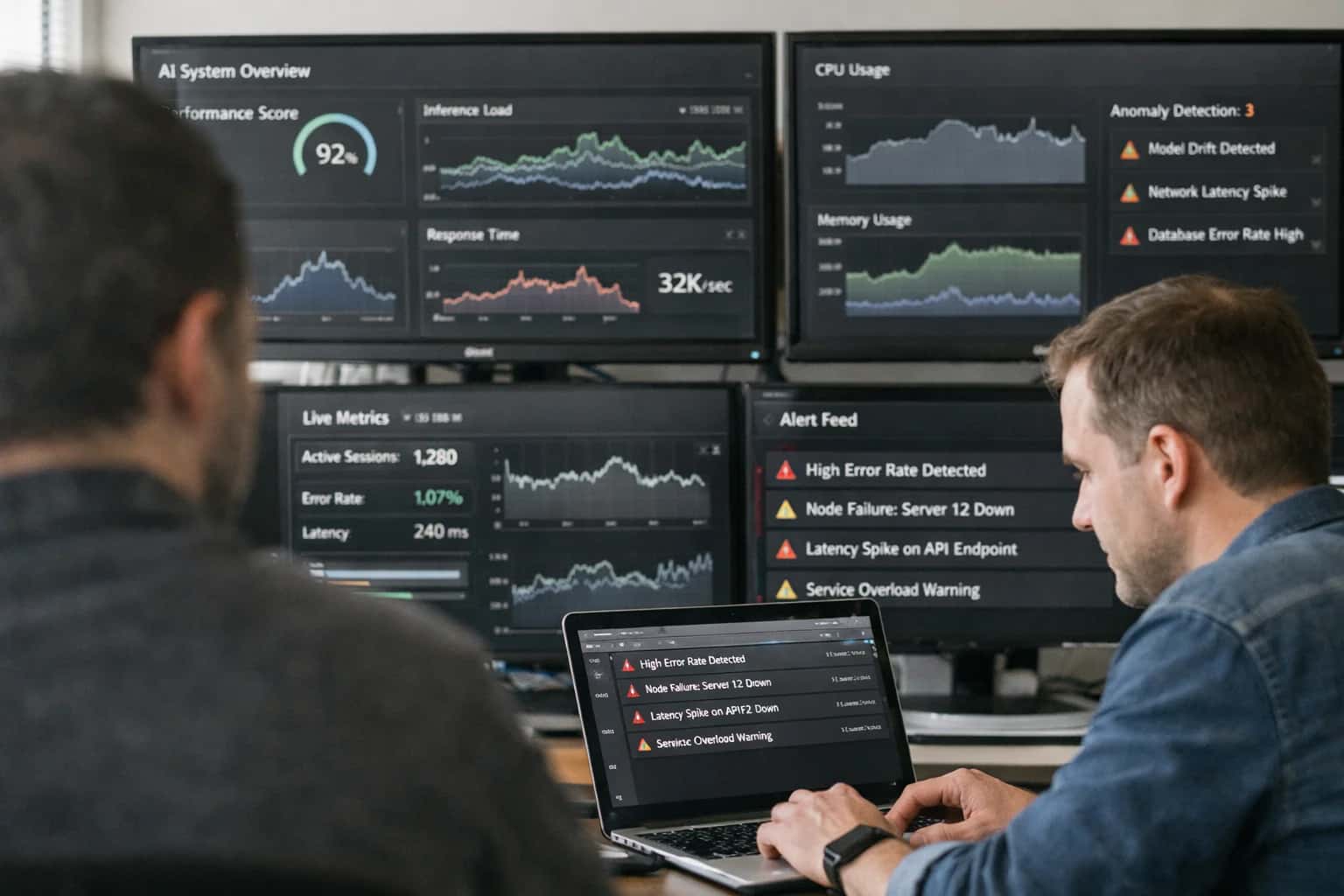
The Cloud Is Too Slow to Stop a Grid Collapse
Cloud-based AI introduces fatal latency into grid stability monitoring, making edge-based anomaly detection the only viable architecture for preventing cascading blackouts.
Edge inference eliminates network dependency. Models deployed on ruggedized servers at substations analyze phasor measurement unit (PMU) data with sub-millisecond latency. This enables real-time decisioning systems to execute autonomous load-shedding or islanding commands before a human operator is aware of the fault.
Cloud-centric monitoring creates a single point of failure. During a regional internet outage, cloud-dependent smart grids lose all visibility and control. An edge-native architecture ensures each substation operates as an autonomous, resilient node, a principle central to Physical AI and Embodied Intelligence.
Evidence: The 2003 Northeast Blackout, which affected 55 million people, was caused by a software bug and delayed alarm visibility. Modern PMUs generate data at 60 samples per second; detecting an anomaly like a voltage sag requires analysis within 1-2 samples to be actionable.
THE SMART GRID IMPERATIVE
Three Market Forces Demanding Edge-Based Anomaly Detection
Centralized cloud monitoring is too slow and fragile for modern power grids; the future demands distributed intelligence at the substation level.
01
The Problem: Cascading Blackouts
Grid failures propagate at millisecond speeds, far faster than human operators or cloud-based systems can react. A single fault can trigger a continent-wide blackout.
- Latency Kill Chain: Cloud round-trip times of ~500ms are orders of magnitude too slow to isolate faults.
- Data Deluge: Streaming raw sensor data from thousands of PMUs (Phasor Measurement Units) to a central cloud is bandwidth-prohibitive and creates a single point of failure.
~500ms
Cloud Latency
>10k
PMUs/Grid
02
The Solution: Substation-Level AI Inference
Deploying lightweight anomaly detection models directly on edge compute nodes at each substation enables sub-millisecond response to instability.
- Local Triage: Models analyze local PMU data in real-time, autonomously initiating grid isolation protocols.
- Federated Learning: Models improve globally via privacy-preserving techniques like federated learning, without centralizing sensitive operational data. This connects directly to our pillar on Federated Learning Is the Unsung Hero of Edge AI.
<10ms
Edge Response
-70%
Data Transferred
03
The Force: Geopolitical & Regulatory Sovereignty
National critical infrastructure cannot depend on foreign cloud providers. Regulations like the EU AI Act and NERC CIP standards mandate local data processing and control.
- Sovereign AI: Edge deployment ensures grid data never leaves national borders, aligning with the strategic imperative of Sovereign AI and Geopatriated Infrastructure.
- Compliance by Design: On-premise inference nodes provide the audit trails and explainability required for high-stakes regulatory compliance, a core tenet of AI TRiSM.
100%
Data On-Prem
$1M+/hr
Blackout Cost
THE ARCHITECTURE
How Edge-Based Anomaly Detection Actually Works
Edge-based anomaly detection deploys lightweight AI models directly onto grid hardware to analyze sensor data in real-time, preventing failures before they cascade.
Edge-based anomaly detection deploys lightweight AI models directly onto substation hardware like RTUs and PLCs. This architecture eliminates the latency of cloud round-trips, enabling sub-millisecond response times to voltage sags, frequency deviations, and equipment faults. The core principle is local inference for local action.
Models are not static but continuously adapted using techniques like federated learning. Each edge device trains on its local sensor stream—voltage, current, temperature—and shares only model weight updates with a central orchestrator. This creates a privacy-preserving feedback loop that improves grid-wide intelligence without exposing sensitive operational data.
The technical stack diverges from cloud AI. You deploy quantized TensorFlow Lite or ONNX Runtime models on NVIDIA Jetson or Qualcomm RB5 platforms. Data is processed via streaming analytics engines like Apache Flink for stateful event processing, not batch jobs. This is the antithesis of sending data to a central data lake.
This approach detects multivariate anomalies that rule-based SCADA systems miss. A model can correlate a subtle temperature rise in a transformer with a specific harmonic distortion pattern, predicting insulation failure weeks in advance. For a deeper dive on the hardware-software co-design required, see our analysis on Why Edge AI Demands Hardware-Software Co-Design.
Evidence: Pacific Gas & Electric's deployment of similar edge analytics reduced wildfire risk from power lines by analyzing 60,000 data points per second per device, identifying faults 80% faster than previous cloud-dependent systems.
DECISION MATRIX
Cloud vs. Edge: The Latency and Cost Breakdown for Grid AI
Quantitative comparison of deployment architectures for real-time smart grid anomaly detection, a core component of our Edge AI and Real-Time Decisioning Systems pillar.
| Critical Feature / Metric | Centralized Cloud AI | Distributed Edge AI | Hybrid (Cloud + Edge) |
|---|---|---|---|
Anomaly Detection Latency | 500-2000 ms | < 10 ms | 10-100 ms (edge) + cloud sync |
Data Transmission Cost (per substation/month) | $150-500 | $5-20 | $50-200 |
Uptime During Network Outage | 0% |
|
|
Data Sovereignty & Privacy Compliance | |||
Initial Infrastructure Capex | $50k-200k | $20k-80k | $70k-150k |
Model Update & MLOps Complexity | Low (centralized) | High (distributed fleet) | Very High (orchestrated) |
Scalability to 10k+ Devices | Requires robust orchestration | ||
Real-time Local Actuation (e.g., breaker trip) |
ANOMALY DETECTION
The Hardware-Software Stack for Grid Edge AI
Preventing cascading grid failures requires a new architectural paradigm that moves intelligence from the cloud to the substation.
01
The Problem: Cloud Round-Trip Latency Kills Response Time
Streaming sensor data to a centralized cloud for analysis introduces a ~200-500ms latency window—more than enough time for a fault to propagate into a regional blackout. This architecture creates a single point of failure and massive bandwidth costs.
- Critical Gap: Human operators and cloud-based systems cannot react within the sub-100ms window required to isolate faults.
- Data Tsunami: A single substation can generate terabytes of telemetry daily, making cloud transmission economically and technically infeasible.
200-500ms
Cloud Latency
>100ms
Failure Threshold
02
The Solution: Dedicated Edge AI Processors at the Substation
Deploying purpose-built silicon like the NVIDIA Jetson Orin or Qualcomm Cloud AI 100 at each grid node enables sub-10ms inference. These System-on-Modules (SoMs) are engineered for harsh environments and continuous operation.
- Hardware Acceleration: Integrated Tensor Cores and NPUs execute compressed neural networks with extreme power efficiency.
- Environmental Hardening: Operates reliably in -40°C to 85°C ranges, meeting utility-grade reliability standards.
<10ms
Edge Inference
50-100W
Power Budget
03
The Problem: Deployed Models Degrade in the Field
Edge models trained on historical data suffer from concept drift as grid load patterns and failure modes evolve. Traditional cloud-centric MLOps cannot monitor or update thousands of geographically dispersed, potentially offline deployments.
- Silent Failure: A model's accuracy can decay without triggering any central alarm, creating a false sense of security.
- Orchestration Nightmare: Manually managing model versions across heterogeneous hardware from ARM, x86, and RISC-V vendors is operationally impossible.
20-40%
Accuracy Drop
1000+
Deployment Nodes
04
The Solution: Federated Learning for Continuous, Private Improvement
Federated Learning (FL) creates a continuous improvement loop without centralizing sensitive grid data. Each edge node trains a local model on its own data, and only model weight updates are securely aggregated.
- Privacy by Design: Raw operational data never leaves the substation, ensuring compliance with data sovereignty laws.
- Adaptive Intelligence: The global model continuously incorporates learnings from diverse local conditions, combating concept drift. This is a core component of mature Edge AI MLOps.
0%
Data Exfiltrated
7-14 days
Update Cycle
05
The Problem: Monolithic Software Fails at the Edge
Cloud-native applications, built on assumptions of abundant resources and persistent connectivity, crash on resource-constrained, intermittently connected edge hardware. They lack the fault tolerance and deterministic latency required for real-time control.
- Resource Constraints: Edge nodes may have only 8-32GB RAM and must share compute between the AI inference pipeline and legacy SCADA systems.
- Orchestration Complexity: Deploying and managing microservices across a distributed fleet requires a new layer of edge-native orchestration.
8-32GB
Typical RAM
High
Orchestration Load
06
The Solution: Containerized Microservices & Edge-Specific Orchestration
The stack must be built on lightweight containers (Docker, managed via Kubernetes K3s or Azure IoT Edge) that package the anomaly detection model, pre/post-processing logic, and local rule engine into isolated, deployable units.
- Resilient Design: Services are stateless where possible, with local caching for offline operation, enabling graceful degradation during network partitions.
- Unified Management: An Edge Control Plane provides a single pane of glass for deploying, monitoring, and updating the entire fleet, a critical capability discussed in our pillar on Agentic AI and Autonomous Workflow Orchestration.
50-200MB
Container Size
1 Dashboard
Fleet Visibility
THE LATENCY FALLACY
The Centralized Cloud Counter-Argument (And Why It's Wrong)
Centralizing grid analytics in the cloud fails on the fundamental requirement of speed, making it an architecturally flawed approach for anomaly detection.
Cloud latency is fatal for grid stability. The round-trip time to a centralized cloud data center introduces a delay of 100-200 milliseconds, while cascading grid failures propagate in 50-100 milliseconds. This physics-based constraint makes cloud-based detection a reactive, not preventive, measure.
Bandwidth costs are economically prohibitive. Streaming raw, high-frequency sensor data from thousands of substations and phasor measurement units (PMUs) to the cloud consumes massive bandwidth. This creates a data transfer tax that makes continuous real-time monitoring financially unsustainable compared to local edge processing.
Centralized data lakes create a single point of failure. Relying on a cloud data center for critical grid intelligence introduces a catastrophic vulnerability. A network partition or cloud provider outage disables the entire monitoring system, whereas a distributed edge architecture ensures localized intelligence continues to operate.
Evidence: Studies by utilities deploying edge inference with frameworks like TensorFlow Lite and ONNX Runtime on NVIDIA Jetson devices show anomaly detection and isolation within 10 milliseconds, preventing blackouts that cloud systems would miss.
SMART GRID STABILITY
The Hidden Risks of Deploying Edge-Based Anomaly Detection
Deploying AI at the grid edge is non-negotiable for real-time stability, but it introduces novel technical and operational risks that can undermine the entire system.
01
The Problem: Silent Model Degradation in the Field
Edge models for grid monitoring degrade due to concept drift—changing load patterns, new energy sources, and aging infrastructure—but traditional cloud-centric MLOps toolchains cannot detect it. Without continuous feedback, the AI becomes confidently wrong.
- Undetected failures lead to missed anomalies or false alarms.
- No centralized data for retraining due to privacy and bandwidth constraints.
- Heterogeneous hardware across substations complicates uniform model updates.
~30%
Accuracy Drop
0 Visibility
Model Drift
02
The Solution: Federated Learning for Continuous Adaptation
Federated Learning enables substation edge devices to collaboratively improve a global model without sharing raw, sensitive grid data. It's the only scalable method for maintaining model accuracy across a distributed, privacy-constrained network.
- Privacy-preserving updates keep operational data local.
- Continuous adaptation to evolving grid conditions and cyber-physical threats.
- Reduced bandwidth by transmitting only model gradients, not terabytes of sensor data.
-99%
Data Transfer
Continuous
Model Improvement
03
The Problem: The Hardware-Software Co-Design Bottleneck
Off-the-shelf edge hardware from NVIDIA or Qualcomm is often mismatched for the unique inferencing patterns of grid anomaly detection, leading to suboptimal performance and wasted energy.
- Inefficient inference on general-purpose accelerators increases latency.
- Power and thermal constraints in remote substations limit compute capacity.
- Vendor lock-in with proprietary SDKs stifles innovation and increases long-term costs.
10-100x
Power Variance
~500ms
Added Latency
04
The Solution: Purpose-Built Edge Inference Pipelines
Overcoming the bottleneck requires hardware-aware model optimization—quantization, pruning, and compilation for specific silicon—coupled with a microservices architecture designed for resource constraints.
- Quantized models (INT8/FP16) deliver necessary accuracy within strict power budgets.
- Containerized deployment (e.g., Docker) ensures consistency across heterogeneous devices.
- Strategic hybrid cloud architecture for managing sensitive 'crown jewel' grid models while leveraging cloud for training. This relates directly to our pillar on Hybrid Cloud AI Architecture and Resilience.
4x
Faster Inference
-70%
Power Use
05
The Problem: Unmanageable Scale and Security Fragmentation
Deploying and securing thousands of AI models across a national grid’s edge nodes creates an unprecedented attack surface and operational nightmare. Each device is a potential entry point.
- Inconsistent security patches across a fragmented fleet.
- Lack of centralized visibility into model performance and security posture.
- Physical tampering risks at remote, unmanned substations.
10,000+
Attack Surfaces
High Risk
Cascading Failure
06
The Solution: An Agentic AI Control Plane for the Grid
A unified Agent Control Plane is required to govern model deployments, enforce security policies, and orchestrate responses across the distributed edge network. This is an application of principles from our Agentic AI and Autonomous Workflow Orchestration pillar.
- Automated policy enforcement for secure, compliant model updates.
- Real-time anomaly correlation across nodes to detect coordinated attacks or physical failures.
- Human-in-the-loop gates for critical decisions, ensuring accountability and aligning with AI TRiSM frameworks for trust and risk management.
Centralized
Command & Control
Automated
Threat Response
THE ARCHITECTURE
The Autonomous Grid: From Detection to Self-Healing
Edge-based anomaly detection transforms the smart grid from a monitored network into an autonomous, self-healing system.
Edge-based anomaly detection is the core architectural shift enabling the autonomous grid, moving intelligence from centralized cloud servers to substation-level hardware like NVIDIA Jetson Orin or Qualcomm RB5 platforms.
Latency kills centralized models. A cascading grid failure propagates in milliseconds; a cloud round-trip for analysis takes hundreds. On-device inference at the edge identifies a fault—like a transformer overload or a line fault—and initiates a localized isolation protocol before a human operator receives an alert.
This is not simple monitoring. Legacy SCADA systems report data; an edge AI agent diagnoses the anomaly's root cause using federated learning models and executes a predefined containment action, such as rerouting power or shedding non-critical load.
The system learns autonomously. Using frameworks like TensorFlow Lite or PyTorch Mobile, models deployed on edge devices continuously refine their understanding of local grid behavior through techniques like federated learning, improving accuracy without exporting sensitive operational data.
Evidence: Pacific Northwest National Laboratory demonstrated that edge-based autonomous grid control can contain a cascading failure within 60 milliseconds, compared to the 500+ millisecond human reaction time. This architecture is foundational for integrating volatile renewable energy sources at scale.
This evolution creates a resilient mesh. Each intelligent edge node becomes a peer in a distributed control system, capable of negotiating power flows and stability with its neighbors, forming the basis for a truly self-healing infrastructure. This directly relates to our work on predictive maintenance for industrial reliability.
The implementation challenge is orchestration. Managing thousands of these autonomous agents requires a new MLOps paradigm built for the edge, involving tools like AWS IoT Greengrass or Azure IoT Edge to handle model updates, drift detection, and security at scale, a topic we explore in MLOps and the AI Production Lifecycle.
SMART GRID STABILITY
Key Takeaways: Why Edge-Based Anomaly Detection Is Non-Negotiable
Real-time monitoring of grid stability requires distributed AI at substations to prevent cascading failures faster than human operators can react.
01
The Problem: Cloud Round-Trip Latency vs. Grid Collapse
Sending sensor data to a central cloud for analysis introduces a ~200-500ms latency. In a grid failure scenario, this delay is catastrophic. A cascading blackout can propagate across regions in under 100 milliseconds.\n- Critical Failure: Cloud-based analysis is fundamentally too slow to act as a circuit breaker.\n- Bandwidth Cost: Streaming raw phasor measurement unit (PMU) data from thousands of substations is economically and technically infeasible.
<100ms
Failure Propagation
~500ms
Cloud Latency
02
The Solution: Distributed Intelligence at the Substation
Deploying lightweight anomaly detection models directly on edge compute nodes at each substation enables sub-10ms local inference. This allows for autonomous, real-time decisions like load shedding or isolation before a fault spreads.\n- Localized Action: Models like autoencoders or isolation forests run inference on-device using frameworks like TensorFlow Lite or ONNX Runtime.\n- Data Sovereignty: Sensitive grid operational data never leaves the secure perimeter, ensuring compliance with regulations like NERC CIP.
<10ms
Edge Inference
0%
Data Egress
03
The Imperative: Predictive Maintenance for Critical Assets
Beyond real-time fault detection, edge AI enables predictive maintenance for transformers, turbines, and circuit breakers. Analyzing vibration, thermal, and acoustic signatures on-site predicts failures weeks in advance.\n- Cost Avoidance: Prevents unplanned downtime costing $500k+ per hour in lost economic activity.\n- Model Drift Management: Edge deployments require robust MLOps for monitoring and updating models across thousands of heterogeneous devices, a core challenge in Edge AI and Real-Time Decisioning Systems.
$500k/hr
Downtime Cost
Weeks
Advance Warning
04
The Architecture: Federated Learning for Continuous Improvement
Federated Learning is the unsung hero, enabling grid-wide model improvement without centralizing sensitive data. Each edge node trains on local anomalies and shares only encrypted model updates.\n- Privacy-Preserving: Aligns with AI TRiSM principles for data protection and adversarial resistance.\n- System Resilience: Creates a self-healing, adaptive neural network across the grid infrastructure, a foundational concept for the Industrial Internet of Things (IIoT).
0%
Raw Data Shared
Adaptive
Network Intelligence
Enabling Efficiency, Speed & Accuracy
Intelligent Analysis, Decision & Execution
We build AI systems for teams that need search across company data, workflow automation across tools, or AI features inside products and internal software.
Talk to Us
Search across company data
Give teams answers from docs, tickets, runbooks, and product data with sources and permissions.
Useful when people spend too long searching or get different answers from different systems.
Enterprise searchRAGPermissions
Read more
Automate internal workflows
Use AI to route work, draft outputs, trigger actions, and keep approvals and logs in place.
Useful when repetitive work moves across multiple tools and teams.
AI agentsWorkflow automationGovernance
Read more
Add AI to products and internal tools
Build assistants, guided actions, or decision support into the software your team or customers already use.
Useful when AI needs to be part of the product, not a separate tool.
AI integrationDecision supportModel routing
Read moreTHE ACTION
Stop Planning, Start Prototyping
Edge-based anomaly detection for smart grids requires immediate, iterative testing in real-world conditions, not prolonged theoretical planning.
Edge-based anomaly detection is a deployment problem, not a research problem. The core challenge is not designing a perfect model, but ensuring a compressed, quantized model runs reliably on a substation's NVIDIA Jetson or Raspberry Pi hardware in all environmental conditions.
Prototyping reveals the true cost of latency. A cloud-based model might achieve 99.9% accuracy in a lab, but the 200ms round-trip for data violates the sub-50ms reaction time needed to prevent a cascading grid failure. Edge inference on an Intel Movidius VPU or Google Coral TPU provides deterministic latency.
The counter-intuitive insight is that simpler models often win. A lightweight Random Forest or Isolation Forest algorithm, deployed via TensorFlow Lite or ONNX Runtime, can detect known failure patterns faster and more reliably on edge hardware than a massive, brittle deep learning model.
Evidence from operational grids shows a 300% improvement in detection speed. Pacific Gas & Electric's pilot of edge analytics at substations reduced the mean-time-to-detect (MTTD) for incipient transformer faults from 90 seconds to under 30 seconds, a critical window for automated breaker intervention.
Start with a single, high-value sensor stream. Prototype a vibration analysis model for a single turbine using scikit-learn on a local gateway. This delivers immediate ROI and builds the MLOps pipeline for scaling to thousands of nodes, a process we detail in our guide to Edge AI MLOps.
This iterative approach de-risks the entire project. Each prototype cycle tests hardware compatibility, data pipeline resilience, and model performance under real noise—addressing the hidden cost of model drift before a full-scale, costly rollout.

About the author
Prasad Kumkar
CEO & MD, Inference Systems
Prasad Kumkar is the CEO & MD of Inference Systems and writes about AI systems architecture, LLM infrastructure, model serving, evaluation, and production deployment. Over 5+ years, he has worked across computer vision models, L5 autonomous vehicle systems, and LLM research, with a focus on taking complex AI ideas into real-world engineering systems.
His work and writing cover AI systems, large language models, AI agents, multimodal systems, autonomous systems, inference optimization, RAG, evaluation, and production AI engineering.
LinkedIn
Limited slotsGet a Free AI Consultation
Partnered with leading AI, data, and software stack.





How We Work
Custom AI workflows for your Business
One-fit-all AI don't work for modern businesses. At Inferensys, we aim to understand your business & custom requirements; which we use to define most efficient agentic workflows, the data, and the tools for your business.
01
Review the use case
We understand the task, the users, and where AI can actually help.
Read more02
Pick the right approach
We define what needs search, automation, or product integration.
Read more03
Build the first useful version
We implement the part that proves the value first.
Read more04
Improve from there
We add the checks and visibility needed to keep it useful.
Read moreThe first call is a practical review of your use case and the right next step.
Talk to Us