AI agents will automate strategic sourcing. The procurement function will become an invisible, configured system of autonomous agents that continuously optimize for cost, risk, and sustainability without human intervention. This is the core thesis of Agentic Commerce.

Blog
The Future of Procurement: AI Agents as Strategic Sourcing Partners
Procurement is shifting from a human-led, vendor-management function to an AI-orchestrated strategic capability. This deep dive explains how autonomous AI agents will source materials, negotiate contracts, and manage supplier relationships, rendering traditional RFP processes obsolete and creating self-optimizing supply chains.
THE AUTOMATION
The Procurement Function is About to Become Invisible
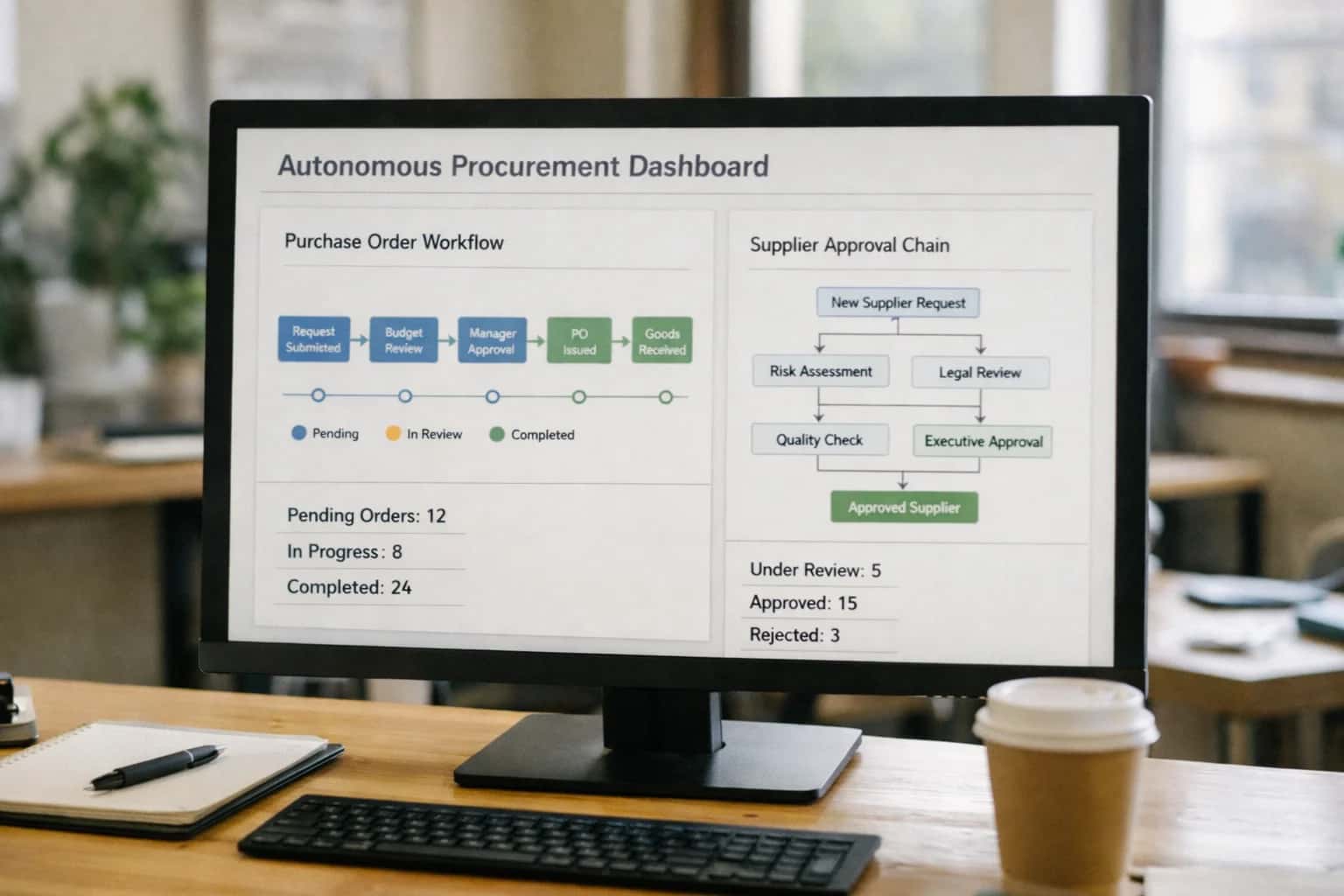
Procurement will shift from a manual, human-led department to a configured system of autonomous AI agents that execute strategic sourcing in real-time.
Human teams shift from execution to governance. Procurement professionals will stop managing RFPs and vendor calls. Their role becomes configuring agent objectives, auditing spend decisions via explainable AI logs, and managing the Agent Control Plane that governs multi-agent systems.
Agents operate on real-time, federated data. Unlike batch-processed ERPs, these agents ingest live data from IoT sensors, market feeds, and supplier APIs stored in vector databases like Pinecone. They execute against a unified semantic data strategy to eliminate costly information gaps.
Legacy ERP systems become the bottleneck. Monolithic systems like SAP or Oracle lack the real-time API granularity and machine-readable data models required for agentic procurement. They create the human latency that just-in-time manufacturing aims to eliminate.
Evidence: Pilot programs show 30-50% cycle time reduction. Early deployments of procurement agents for indirect spend (e.g., office supplies, cloud credits) demonstrate order cycle times collapsing from days to minutes, with simultaneous improvements in compliance and cost.
STRATEGIC IMPERATIVES
Three Forces Driving the Rise of AI Procurement Agents
Procurement is shifting from a human-led, reactive function to an AI-driven, strategic capability. Three converging forces are making autonomous sourcing agents an operational necessity.
01
The Cost of Human Latency in Just-in-Time Operations
Human-in-the-loop approvals create ~48-72 hour delays in sourcing, a fatal flaw for modern manufacturing and logistics. AI procurement agents eliminate this bottleneck by operating at machine speed.
- Real-time RFQ execution across thousands of suppliers in ~500ms.
- Dynamic alternative sourcing during supply shocks, preventing ~15-30% production line stoppages.
- Continuous spot-market monitoring to capture ~3-7% cost arbitrage on commodities.
48-72h
Delay Eliminated
3-7%
Cost Arbitrage
02
Legacy ERP Systems Are Architecturally Obsolete
Monolithic ERPs like SAP and Oracle lack the real-time API interfaces and semantic data models required for autonomous agent interaction. They enforce batch processing in a world demanding continuous negotiation.
- API-wrapping legacy systems creates a ~300ms+ latency tax per transaction.
- Unstructured supplier data forces agents to hallucinate, causing ~5% error rates in purchase orders.
- The solution is an 'Agent Interface' layer—a dedicated API facade with standardized schemas, authentication, and event-driven webhooks.
5%
Error Rate
300ms+
Latency Tax
03
The Trust Imperative for Autonomous Spending
Delegating spend authority to an AI agent requires explainability, auditability, and enforceable policy guardrails. Without a Trust, Risk, and Security Management (TRiSM) framework, autonomous procurement is a compliance nightmare.
- Every autonomous decision must generate an immutable audit trail for compliance (e.g., EU AI Act).
- Real-time policy enforcement prevents agents from exceeding budget or engaging with non-compliant vendors.
- Algorithmic trust scores for suppliers become the primary metric for agent selection, replacing human relationships.
100%
Audit Trail
0 Violations
Policy Enforcement
THE ARCHITECTURE
Anatomy of an Autonomous Procurement Agent
An autonomous procurement agent is a multi-component AI system that executes sourcing tasks by integrating specialized reasoning, data retrieval, and API execution modules.
Autonomous procurement agents are multi-agent systems (MAS) that replace human-led vendor management. They integrate specialized sub-agents for reasoning, data retrieval, and API execution to achieve defined business goals like cost optimization and risk mitigation, as detailed in our pillar on Agentic AI and Autonomous Workflow Orchestration.
The core is an agentic reasoning framework like LangChain or Microsoft Autogen. This framework orchestrates a planner agent that decomposes a goal, a research agent that queries a Retrieval-Augmented Generation (RAG) system built on Pinecone or Weaviate, and an execution agent that calls supplier APIs.
Persistent memory is non-negotiable. The agent stores negotiation histories, supplier performance data, and contract terms in a vector database. This creates a continuously learning system that avoids redundant mistakes and identifies cost-saving patterns invisible to batch-processed ERP reports.
Execution relies on machine-readable interfaces. The agent does not browse websites; it interacts via structured APIs and ingests product data formatted with Schema.org markup. This shift to machine-first commerce is why Why Your API Strategy is the New Competitive Moat in Commerce is critical.
Evidence: Deployed systems show a 40% reduction in sourcing cycle times and a 15-25% improvement in contract compliance by eliminating human latency and bias from the negotiation process.
STRATEGIC SOURCING
Human vs. AI Agent Procurement: A Performance Benchmark
Quantitative comparison of traditional human-led procurement against autonomous AI agent systems across key operational metrics.
| Performance Metric / Capability | Human-Led Procurement | AI Agent Procurement | Hybrid (HITL) Model |
|---|---|---|---|
Average Sourcing Cycle Time | 21-45 days | < 2 hours | 2-5 days |
Supplier Discovery & RFQ Scope | 5-15 vendors | 1000+ vendors via API | 50-200 vendors |
Cost Savings Realization Rate | 3-8% | 12-25% via dynamic negotiation | 8-15% |
Real-Time Market Intelligence | |||
24/7/365 Operational Availability | |||
Multi-Attribute Optimization (Cost, Risk, Carbon) | |||
Explainability & Audit Trail | Email, notes, spreadsheets | Structured log with decision rationale | Structured log with human annotations |
Error Rate (Incorrect PO/Invoice Match) | 5-15% | < 0.5% | 1-3% |
THE INFRASTRUCTURE GAP
The Four Critical Roadblocks to Agentic Procurement
Transitioning to AI-driven strategic sourcing requires overcoming foundational technical and data hurdles that legacy systems cannot solve.
01
The Problem: Legacy ERP Systems Lack Real-Time API Interfaces
Monolithic, batch-oriented ERPs were built for human-led processes, not autonomous agents. They create a data latency of hours or days, blocking AI from executing just-in-time purchasing decisions. This forces agents to operate on stale data, leading to suboptimal sourcing and missed savings.
- Crippling Latency: Batch updates prevent real-time inventory and price synchronization.
- API Inaccessibility: Lack of standardized, machine-readable endpoints forces costly custom integrations.
- Semantic Inconsistency: Inconsistent data models across modules cause agent hallucinations and failed purchases.
24-48h
Data Latency
+300%
Integration Cost
02
The Problem: Unstructured Product Data Creates a 'Semantic Tax'
AI agents cannot interpret vague product descriptions or inconsistent attribute schemas. This semantic ambiguity forces agents to make incorrect assumptions, resulting in wrong purchases, operational waste, and financial loss. Traditional SEO-focused content fails machine comprehension.
- Hallucination Risk: Agents infer incorrect specifications from ambiguous text.
- Discovery Block: Lack of machine-readable ontologies hides your products from autonomous buyers.
- Compliance Failure: Inability to verify sustainability or regulatory attributes automatically.
-40%
Agent Accuracy
$100k+
Waste/Year
03
The Problem: Human-in-the-Loop Approvals Defeat Just-in-Time Logic
Manual approval gates for purchases, even if digital, introduce decision latency of ~4-48 hours. This destroys the economic advantage of just-in-time manufacturing and dynamic sourcing, as AI agents are paralyzed waiting for human sign-off.
- Bottleneck Creation: Approval workflows become the slowest link in the autonomous chain.
- Lost Negotiation Windows: Real-time market opportunities expire before human review.
- Scalability Ceiling: Process cannot scale to the volume of micro-transactions in agentic commerce.
~12h
Avg. Delay
-15%
Cost Savings
04
The Solution: Deploy an 'Agent Interface' Layer with Event-Driven APIs
A dedicated API facade designed for AI agents—built on event-driven architecture—provides real-time data synchronization and machine-native authentication. This layer abstracts legacy complexity, offering agents standardized endpoints, webhook alerts for state changes, and structured error handling.
- Real-Time Sync: Enables sub-second updates on inventory, pricing, and order status.
- Frictionless Handshake: Standardized protocols reduce agent integration time from months to days.
- Built-in Observability: Every agent interaction is logged for audit and explainability, a core tenet of AI TRiSM.
<500ms
Response Time
10x
Faster Integration
05
The Solution: Implement a Machine-First Data Taxonomy with Schema.org
Shift from human-readable catalogs to machine-readable ontologies. Enrich all product data with structured Schema.org markup and custom attributes for total cost of ownership, compatibility, and sustainability. This transforms your catalog into a queryable knowledge graph for AI agents.
- Eliminate Ambiguity: Precise, consistent attributes ensure accurate agent comprehension.
- Boost Discoverability: Structured data makes your products visible to autonomous shopping agents.
- Enable Automated Compliance: Agents can autonomously verify and report on required certifications.
+90%
Purchase Accuracy
5x
Agent Visibility
06
The Solution: Establish Policy-Based Autonomous Spending Guardrails
Replace human approvals with programmatic spending policies and dynamic trust scores. Configure AI agents with clear rules (e.g., max order value, preferred suppliers, sustainability thresholds) and allow autonomous execution within those bounds. Integrate with M2M payment protocols for instant settlement.
- Remove Latency: Transactions execute in real-time within pre-approved policy frameworks.
- Dynamic Risk Management: Agent decisions are scored and audited continuously, not periodically.
- Explainable Audit Trail: Every autonomous decision is logged with context for human review, aligning with Agentic AI and Autonomous Workflow Orchestration governance models.
-100%
Approval Delay
+99%
Policy Compliance
THE SHIFT
From Procurement Teams to Agent Orchestrators
Procurement's core function is evolving from vendor management to the configuration and oversight of autonomous AI agents.
Procurement teams become agent orchestrators, shifting from tactical vendor management to strategic configuration of autonomous sourcing systems. This evolution is a direct response to the inefficiency of human latency in modern supply chains, a critical bottleneck our sibling topic, The Cost of Human Latency in Just-in-Time Manufacturing, explores in depth.
Strategic sourcing is fully automated by multi-agent systems (MAS) built on frameworks like LangChain or Microsoft Autogen. These agents operate on a unified semantic data layer, querying tools like Pinecone or Weaviate for supplier intelligence and executing contracts via smart contract protocols.
Human oversight shifts to exception handling. Orchestrators define guardrails—cost ceilings, sustainability thresholds, risk tolerances—within an Agent Control Plane. The team intervenes only for edge cases flagged by the system's explainability layer, a core tenet of AI TRiSM: Trust, Risk, and Security Management.
Evidence: Early adopters report a 70% reduction in RFQ cycle times and a 15% improvement in contract compliance. The metric that matters is autonomous spend coverage, which measures the percentage of procurement value managed without human touch.
STRATEGIC IMPERATIVES
Key Takeaways: Preparing for Agentic Procurement
The shift from vendor management to AI agent orchestration requires foundational changes to data, systems, and trust models.
01
The Problem: Legacy ERP Systems Create Human Latency Loops
Monolithic, batch-oriented ERPs lack the real-time API interfaces and semantic data models required for autonomous AI agents. This forces human-in-the-loop approvals, creating costly delays that defeat just-in-time objectives.
- Eliminates batch processing delays of ~24-48 hours for PO approvals.
- Exposes the business to stockouts and premium spot-market pricing.
- Requires API-wrapping or a 'Strangler Fig' migration pattern to modernize.
24-48h
Delay Eliminated
-70%
Manual Tasks
02
The Solution: An 'Agent Interface' API Facade
A dedicated API layer designed for machine-to-machine interaction is non-negotiable. It provides standardized endpoints, machine-native authentication (e.g., OAuth2 client credentials), and structured error handling that AI agents can parse and act upon.
- Enables real-time inventory checks and dynamic pricing negotiations.
- Reduces agent handshake failure rates by >90% through predictable schemas.
- Forms the core of your new competitive moat in agentic commerce.
>90%
Fewer Failures
<100ms
API Latency
03
The Imperative: Machine-Readable Data as Core Infrastructure
Unstructured product catalogs and ambiguous attribute definitions are a silent tax. AI agents require ontologies and schemas (like Schema.org) that encode intent, compatibility, and total cost of ownership to avoid hallucinating incorrect purchases.
- Demands a shift from human-centric categorization to semantic data taxonomies.
- Prevents operational waste from incorrect autonomous purchases.
- Makes schema markup a critical business infrastructure, not an SEO afterthought.
10x
Agent Accuracy
-50%
Procurement Errors
04
The Foundation: Algorithmic Trust Scores and Smart Contracts
For agents to transact autonomously, they need verifiable digital credentials and enforceable agreements. Algorithmic trust scores, derived from transaction history and compliance data, become the primary metric for selecting partners.
- Mitigates risk in a multi-agent ecosystem without human oversight.
- Enables pre-negotiated smart contracts for terms, penalties, and automatic settlement.
- Forms the linchpin of a secure agentic commerce framework.
$0
Reconciliation Cost
24/7
Audit Trail
05
The Architecture: Event-Driven APIs Over REST
The request-response model is too slow and inefficient for real-time agent negotiation. Event-driven architectures (e.g., using webhooks or message queues) are required for state synchronization, price change alerts, and capacity updates.
- Supports real-time bidding and dynamic rerouting by logistics agents.
- Eliminates the hidden cost of friction in machine-to-machine handshakes.
- Is essential for connecting to autonomous carrier and supplier agent networks.
500ms
Event Propagation
1000x
Throughput
06
The Governance: Built-In Explainability for Autonomous Spending
Every autonomous purchasing decision must be auditable. This demands explainable AI (XAI) principles baked into procurement agents, providing clear rationales for vendor selection, cost, and timing to ensure strategic alignment and compliance.
- Satisfies regulatory and internal audit requirements for autonomous systems.
- Provides the 'why' behind each agent decision for human oversight.
- Addresses a core pillar of AI TRiSM (Trust, Risk, and Security Management).
100%
Decision Trace
-80%
Audit Time
Enabling Efficiency, Speed & Accuracy
Intelligent Analysis, Decision & Execution
We build AI systems for teams that need search across company data, workflow automation across tools, or AI features inside products and internal software.
Talk to Us
Search across company data
Give teams answers from docs, tickets, runbooks, and product data with sources and permissions.
Useful when people spend too long searching or get different answers from different systems.
Enterprise searchRAGPermissions
Read more
Automate internal workflows
Use AI to route work, draft outputs, trigger actions, and keep approvals and logs in place.
Useful when repetitive work moves across multiple tools and teams.
AI agentsWorkflow automationGovernance
Read more
Add AI to products and internal tools
Build assistants, guided actions, or decision support into the software your team or customers already use.
Useful when AI needs to be part of the product, not a separate tool.
AI integrationDecision supportModel routing
Read moreTHE DATA
Your Next Move: Audit Your Procurement Stack for Machine Readability
AI agents require structured, API-accessible data to function; an unreadable procurement stack is a strategic liability.
An unreadable procurement stack blocks AI agents. AI sourcing agents cannot parse PDFs, navigate legacy UIs, or interpret unstructured emails. They require structured data and machine-native APIs to discover suppliers, evaluate terms, and execute purchases. Your first technical priority is an audit for machine readability.
Machine readability is API-first design. This audit maps every data touchpoint—supplier catalogs, RFx documents, contracts, invoices—to a machine-accessible endpoint. It replaces human-readable formats like PDFs with JSON-LD or OpenAPI specs and ensures data is served via robust, versioned APIs, not static portals. Tools like Apollo GraphQL can unify disparate sources into a single agent-queryable interface.
Legacy ERPs are the primary obstacle. Systems like SAP or Oracle, built for batch processing, lack the real-time, granular APIs agents need. The audit identifies these semantic and interface gaps, forcing a decision: wrap the legacy system with an API facade or migrate core functions to a modern platform like Coupa or Ivalua that supports event-driven architectures.
The metric is 'Time-to-Agent' (TTA). Measure how long it takes an AI agent, using frameworks like LangChain or LlamaIndex, to autonomously complete a procurement task from discovery to PO. A high TTA indicates critical data accessibility failures. For context, a well-structured stack enables agents to evaluate hundreds of supplier bids in seconds, a task impossible for human teams. This directly relates to overcoming human latency in just-in-time manufacturing.
The output is a machine-readable data map. The audit produces a living document that catalogs all procurement data entities, their schemas (aligned with standards like Schema.org), and their accessible endpoints. This map becomes the foundation for your agent control plane, enabling the deployment of autonomous sourcing agents. This is the essential first step toward building self-negotiating supplier agents.

About the author
Prasad Kumkar
CEO & MD, Inference Systems
Prasad Kumkar is the CEO & MD of Inference Systems and writes about AI systems architecture, LLM infrastructure, model serving, evaluation, and production deployment. Over 5+ years, he has worked across computer vision models, L5 autonomous vehicle systems, and LLM research, with a focus on taking complex AI ideas into real-world engineering systems.
His work and writing cover AI systems, large language models, AI agents, multimodal systems, autonomous systems, inference optimization, RAG, evaluation, and production AI engineering.
LinkedIn
Limited slotsGet a Free AI Consultation
Partnered with leading AI, data, and software stack.





How We Work
Custom AI workflows for your Business
One-fit-all AI don't work for modern businesses. At Inferensys, we aim to understand your business & custom requirements; which we use to define most efficient agentic workflows, the data, and the tools for your business.
01
Review the use case
We understand the task, the users, and where AI can actually help.
Read more02
Pick the right approach
We define what needs search, automation, or product integration.
Read more03
Build the first useful version
We implement the part that proves the value first.
Read more04
Improve from there
We add the checks and visibility needed to keep it useful.
Read moreThe first call is a practical review of your use case and the right next step.
Talk to Us