Anthropic's Model Context Protocol (MCP) excels at standardizing tool integration by providing a universal interface—like 'USB-C for AI'—between an LLM and any data source or application. It abstracts away API complexities, allowing a single agent to dynamically discover and use hundreds of tools from CRM, ERP, and database systems. For example, an MCP server for Salesforce can expose standardized search_accounts or update_opportunity tools, which any MCP-compliant client like Claude Desktop can immediately use without custom code. This focus on client-server tool discovery makes MCP ideal for rapidly augmenting a central, powerful AI with enterprise context, a pattern central to many MCP implementations.

Comparison
Anthropic's MCP vs Google's A2A Protocol
A technical comparison of two leading protocols for connecting and coordinating AI agents. Evaluates design philosophy, security models, and practical implementation for enterprise agentic workflows.
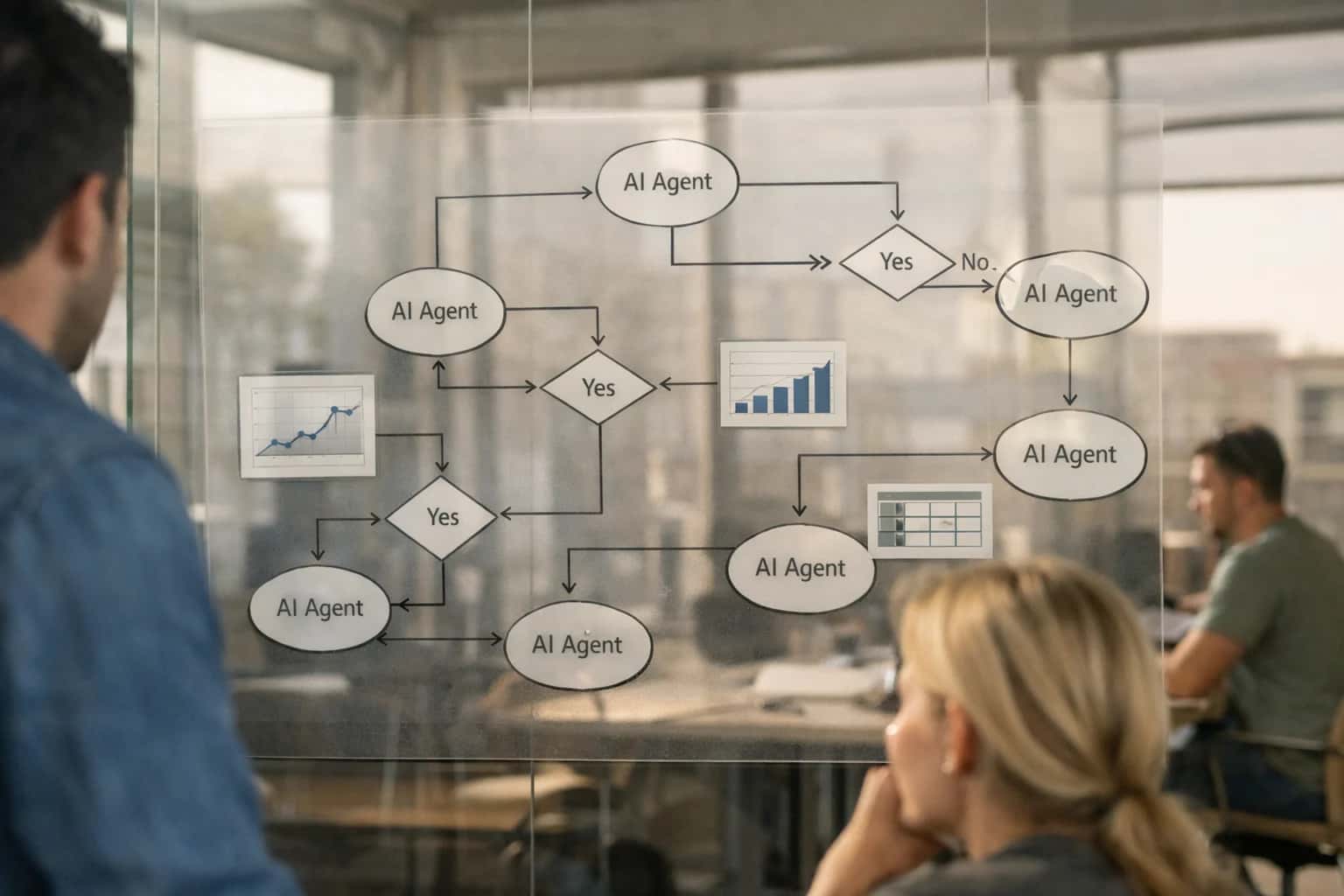
THE ANALYSIS
Introduction: The Protocol Battle for the Agent Internet
A head-to-head evaluation of Anthropic's Model Context Protocol (MCP) and Google's Agent-to-Agent (A2A) protocol for building the interconnected, multi-agent systems of the future.
Google's Agent-to-Agent (A2A) Protocol takes a fundamentally different approach by focusing on peer-to-peer coordination between specialized agents. Instead of a central LLM calling tools, A2A is designed for a network of autonomous agents—a coding agent, a research agent, a validation agent—to discover each other, negotiate, delegate tasks, and share results securely. This results in a trade-off of complexity for scalability. Building an A2A system requires designing agent roles, communication contracts, and consensus mechanisms, but it enables the creation of resilient, decentralized workflows that align with the vision of a true 'Agent Internet' explored in frameworks for Multi-Agent Coordination Protocols.
The key architectural divergence is that MCP optimizes for vertical integration (AI-to-tool), while A2A optimizes for horizontal integration (agent-to-agent). MCP's strength is its growing ecosystem of servers for popular SaaS tools, reducing integration time from weeks to hours. A2A's strength is its foundational design for secure delegation and state management across long-running, collaborative tasks, which is critical for complex Agentic Workflow Orchestration.
The key trade-off: If your priority is empowering a single, sophisticated AI assistant with deep, real-time access to your company's tools and data, choose Anthropic's MCP. Its standardized, tool-centric model offers faster time-to-value for most enterprise integration scenarios. If you prioritize orchestrating a team of specialized, autonomous agents that must collaborate on complex, multi-step problems with minimal human intervention, choose Google's A2A Protocol. Its native support for multi-agent communication and task lifecycle management is better suited for building the next generation of autonomous systems.
HEAD-TO-HEAD COMPARISON
MCP vs A2A Protocol: Feature Comparison
Direct comparison of Anthropic's Model Context Protocol (MCP) and Google's Agent-to-Agent (A2A) protocol for multi-agent coordination and tool integration.
| Metric / Feature | Anthropic MCP | Google A2A Protocol |
|---|---|---|
Primary Design Goal | Universal tool integration (USB-C for AI) | Multi-agent coordination & delegation |
Core Security Model | OAuth2, API Keys, scoped permissions | Capability-based, verifiable credentials |
Protocol Transport | SSE or WebSockets (JSON-RPC) | gRPC with Protobuf |
Ecosystem Maturity (Servers) | 100+ official & community | Early access, Google-first |
Interoperability Focus | AI-to-tool (CRM, ERP, DB) | Agent-to-agent (cross-vendor teams) |
Real-time Task Lifecycle | ||
Enterprise Adoption (2026) | High (Financial Services, Tech) | Medium (Early Adopters, Google Cloud) |
Anthropic's MCP vs Google's A2A Protocol
TL;DR: Key Differentiators
A head-to-head breakdown of the two leading protocols for connecting AI agents to tools and coordinating multi-agent systems. Choose based on your primary architectural goal.
03
MCP's Strength: Ecosystem & Tool Discovery
Rapid tool integration growth: A vibrant ecosystem of open-source MCP servers (e.g., for GitHub, PostgreSQL, Notion) allows developers to add new capabilities in hours, not weeks. The protocol includes a built-in tool discovery mechanism, letting agents dynamically understand available functions. This matters for accelerating development velocity and maintaining a future-proof integration layer.
100+
Open-Source Servers
04
A2A's Strength: Secure Delegation & Audit
Cryptographically verifiable delegation: A2A provides a robust security model for agent interactions, including verifiable credentials and audit trails for task hand-offs. This matters for regulated industries or high-stakes workflows where the provenance of every decision and the chain of command between agents must be traceable and secure.
05
MCP's Trade-off: Orchestration Overhead
Requires an external orchestrator: MCP defines the 'how' of tool access but not the 'when' or 'why.' You need a separate framework like LangGraph or a custom scheduler to manage multi-agent workflows. This matters if your primary challenge is agent coordination logic, not tool connectivity.
06
A2A's Trade-off: Tool Integration Complexity
Lower-level protocol focus: A2A excels at agent messaging but doesn't standardize tool interfaces. Connecting agents to external APIs (like a CRM) still requires building custom adapters or layering MCP on top. This matters for projects that need deep tool integration out-of-the-box, as it adds development complexity.
CHOOSE YOUR PRIORITY
When to Choose MCP vs A2A
Google's A2A Protocol for Multi-Agent Systems
Verdict: The superior choice for orchestrating autonomous, stateful agents. Strengths: A2A is purpose-built for agent-to-agent communication, featuring native support for secure delegation, real-time task lifecycle management, and structured message passing. Its architecture excels in scenarios requiring complex coordination, like a supply chain where a sourcing agent negotiates with a logistics agent. It provides a formal framework for agent discovery and capability advertising, which is critical for dynamic, heterogeneous agent teams.
Anthropic's MCP for Multi-Agent Systems
Verdict: A capable but secondary option, better suited as a tool-access layer for individual agents. Strengths: MCP standardizes how a single agent accesses external tools and data (e.g., CRM, database). While multiple agents can use MCP independently, it lacks A2A's native primitives for direct inter-agent negotiation and state sharing. Its strength here is providing a unified, secure tool interface that any agent in a system can leverage, simplifying the integration of enterprise systems into a broader A2A-based orchestration framework like LangGraph. For more on orchestrating such systems, see our guide on Agentic Workflow Orchestration Frameworks.
Enabling Efficiency, Speed & Accuracy
Intelligent Analysis, Decision & Execution
We build AI systems for teams that need search across company data, workflow automation across tools, or AI features inside products and internal software.
Talk to Us
Search across company data
Give teams answers from docs, tickets, runbooks, and product data with sources and permissions.
Useful when people spend too long searching or get different answers from different systems.
Enterprise searchRAGPermissions
Read more
Automate internal workflows
Use AI to route work, draft outputs, trigger actions, and keep approvals and logs in place.
Useful when repetitive work moves across multiple tools and teams.
AI agentsWorkflow automationGovernance
Read more
Add AI to products and internal tools
Build assistants, guided actions, or decision support into the software your team or customers already use.
Useful when AI needs to be part of the product, not a separate tool.
AI integrationDecision supportModel routing
Read moreTHE ANALYSIS
Verdict and Final Recommendation
Choosing between MCP and A2A hinges on your primary goal: universal tool integration or sophisticated multi-agent coordination.
Anthropic's Model Context Protocol (MCP) excels at creating a universal, standardized bridge between AI models and enterprise data sources. Its strength lies in its singular focus on tool integration, offering a vendor-agnostic specification that simplifies connecting an LLM to hundreds of systems like Salesforce, Jira, or Snowflake. For example, an MCP server can provide a Claude 4.5 Sonnet agent with real-time CRM data through a single, type-safe interface, drastically reducing the custom connector code needed for each tool. This makes MCP the superior choice for teams prioritizing rapid, secure, and maintainable AI-to-tool connectivity over complex inter-agent logic.
Google's Agent-to-Agent (A2A) Protocol takes a fundamentally different approach by focusing on the orchestration layer between AI agents. Its strategy is to enable secure delegation, state sharing, and complex task handoffs within a team of specialized agents. This results in a trade-off: while A2A provides a powerful framework for building sophisticated multi-agent systems (e.g., a research agent delegating analysis to a coding agent), it does not directly solve the tool integration problem. Implementing A2A effectively often still requires underlying tools to be exposed via protocols like MCP or custom APIs, adding architectural complexity.
The key trade-off is between ecosystem breadth and coordination depth. MCP boasts a rapidly growing ecosystem of open-source servers and client support in platforms like Claude Desktop and Cursor IDE, making it the pragmatic choice for most enterprise tool integration projects today. In contrast, A2A is a more nascent protocol specifically designed for the emerging 'Agent Internet,' where the primary challenge is managing conversations and state between autonomous agents, not connecting to a database. Your decision should be guided by whether you are building an AI assistant (use MCP) or an AI team (consider A2A).
Consider Anthropic's MCP if your priority is operationalizing a single, powerful AI agent with broad, secure access to your company's existing software stack. It is the definitive choice for implementing Retrieval-Augmented Generation (RAG) pipelines, live dashboard queries, and automated CRM updates. Its design as a 'USB-C for AI' ensures long-term maintainability and reduces vendor lock-in, a critical factor for CTOs. For related analysis on MCP's technical implementation, see our comparisons of MCP over SSE vs MCP over WebSockets and MCP Server Deployment: Docker vs Serverless Functions.
Choose Google's A2A Protocol when your core challenge is orchestrating a swarm of specialized AI agents that must collaborate on long-running, multi-step workflows. It is the better fit for advanced Agentic Workflow Orchestration where tasks like 'analyze market data, draft a report, and schedule a briefing' require secure handoffs between distinct agent 'roles.' However, be prepared to pair it with a robust tool-access layer like MCP. For a deeper dive into orchestrating such systems, explore our pillar on Agentic Workflow Orchestration Frameworks.
Final Recommendation: For the majority of enterprises in 2026, the immediate need is connecting foundational models to proprietary data and tools. Therefore, adopt Anthropic's MCP as your standard for AI tool integration. It delivers tangible ROI faster and establishes a clean, governed interface for all AI interactions. Reserve evaluation of Google's A2A for when your architecture evolves beyond a single assistant into a true multi-agent system, at which point MCP and A2A can become complementary layers in your AI stack.

About the author
Prasad Kumkar
CEO & MD, Inference Systems
Prasad Kumkar is the CEO & MD of Inference Systems and writes about AI systems architecture, LLM infrastructure, model serving, evaluation, and production deployment. Over 5+ years, he has worked across computer vision models, L5 autonomous vehicle systems, and LLM research, with a focus on taking complex AI ideas into real-world engineering systems.
His work and writing cover AI systems, large language models, AI agents, multimodal systems, autonomous systems, inference optimization, RAG, evaluation, and production AI engineering.
LinkedIn
Limited slotsGet a Free AI Consultation
Partnered with leading AI, data, and software stack.





How We Work
Custom AI workflows for your Business
One-fit-all AI don't work for modern businesses. At Inferensys, we aim to understand your business & custom requirements; which we use to define most efficient agentic workflows, the data, and the tools for your business.
01
Review the use case
We understand the task, the users, and where AI can actually help.
Read more02
Pick the right approach
We define what needs search, automation, or product integration.
Read more03
Build the first useful version
We implement the part that proves the value first.
Read more04
Improve from there
We add the checks and visibility needed to keep it useful.
Read moreThe first call is a practical review of your use case and the right next step.
Talk to Us