The traditional approach to safety compliance is reactive, manual, and inconsistent. Safety managers struggle with spot-checking vast facilities, leading to undetected violations like missing PPE, unauthorized entry into hazardous zones, or unsafe machine operation. This creates significant risk: a single oversight can result in a recordable incident, costly fines, operational downtime, and severe reputational damage. The pain point is clear—human-led monitoring cannot scale, leaving dangerous gaps in protection.

Use Case
Vision-Based Safety Compliance Monitoring
AI-powered computer vision systems that monitor worksites in real-time for PPE usage, unauthorized access, and unsafe behaviors, driving a measurable reduction in recordable incidents and insurance premiums.
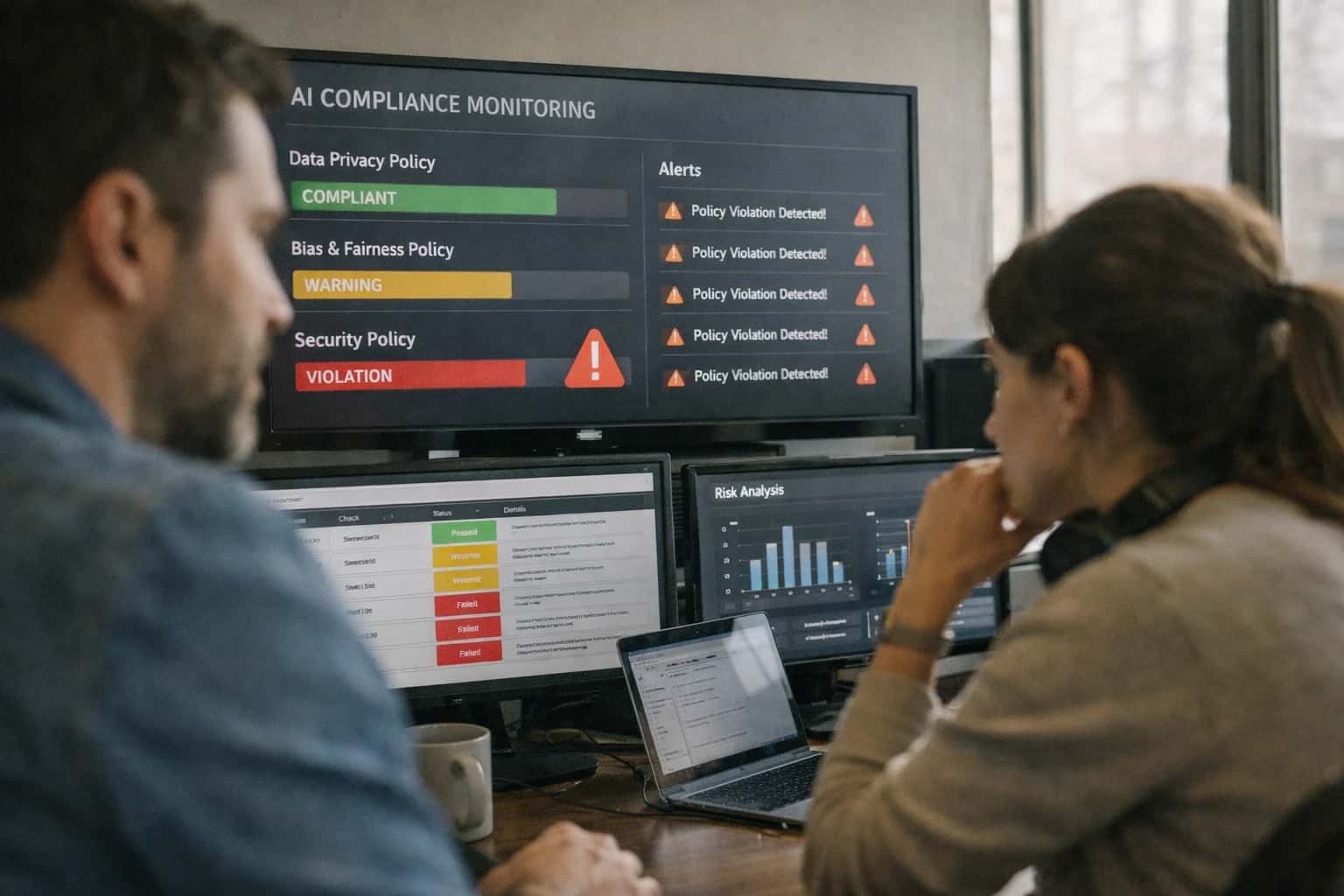
FROM REACTIVE TO PROACTIVE
What is Vision-Based Safety Compliance Monitoring Used For?
Vision-based safety compliance monitoring uses AI-powered cameras and sensors to automatically detect unsafe conditions and non-compliance in real-time, transforming workplace safety from a manual checklist to a continuous, intelligent system.
The AI fix deploys a network of intelligent cameras that act as a 24/7 safety sentinel. These systems automatically detect and alert on violations—such as a worker without a hard hat or a forklift speeding—in real-time. This enables immediate intervention, preventing incidents before they occur. The measurable outcome is a 20-40% reduction in recordable incidents, lower insurance premiums, and a demonstrable culture of safety that protects both people and profitability. This technology is a core component of our Physical Intelligence and Industrial Robotics Vision pillar, working in concert with solutions like Predictive Maintenance for Heavy Machinery to create a holistic, intelligent industrial environment.
VISION-BASED SAFETY COMPLIANCE MONITORING
Common Use Cases & Business Problems Solved
AI-powered vision systems are transforming workplace safety from a reactive, manual audit process into a proactive, data-driven function. These solutions directly target the root causes of recordable incidents, delivering measurable ROI through reduced insurance premiums, lower absenteeism, and enhanced operational continuity.
01
Automated PPE Compliance Monitoring
AI vision systems continuously monitor workers to ensure proper use of Personal Protective Equipment (PPE) like hard hats, safety glasses, gloves, and high-visibility vests. This eliminates reliance on sporadic supervisor checks.
- Real-time Alerts: Instant notifications are sent to site supervisors when a violation is detected, enabling immediate correction.
- Data-Driven Audits: Generate compliance reports by zone, shift, and team to identify persistent training gaps.
- Example: A manufacturing plant reduced its recordable hand-injury incidents by 45% in one year after deploying AI monitoring at machinery entry points.
02
Geofencing & Unauthorized Access Prevention
Define virtual safety perimeters around hazardous areas such as active machinery, chemical storage, or construction zones. The AI detects and alerts when personnel enter without authorization.
- Proactive Hazard Mitigation: Prevents accidents before they occur by stopping access to high-risk zones.
- Integrates with Access Control: Can trigger physical barriers or lockouts for critical equipment.
- Example: An energy utility prevented multiple potential confined-space entry incidents by implementing AI geofencing around transformer vaults, automatically notifying control rooms.
03
Unsafe Behavior & Ergonomics Detection
Goes beyond static rules to identify dynamic risky behaviors that lead to musculoskeletal disorders (MSDs) and slips/trips/falls.
- Posture Analysis: Flags poor lifting techniques, repetitive stress motions, or prolonged awkward positions.
- Trip Hazard Identification: Detects objects left in walkways or spills that create fall risks.
- ROI Impact: A logistics company reduced workers' compensation claims related to strains and sprains by 30% after using AI to coach proper ergonomics on the loading dock.
04
Fatigue & Distraction Monitoring
Analyzes visual cues to identify signs of operator fatigue or distraction in safety-critical roles, such as heavy equipment operators or control room personnel.
- Early Warning System: Detects micro-sleeps, prolonged eye closure, or frequent head nodding.
- Prevents Catastrophic Error: Mitigates risk of incidents caused by impaired alertness.
- Example: A mining operator implemented cabin-facing cameras on haul trucks, leading to a 60% reduction in near-miss events attributed to fatigue during night shifts.
05
Contractor & Visitor Safety Oversight
Ensures temporary workers and visitors, who may be unfamiliar with site-specific hazards, adhere to the same safety protocols as full-time employees.
- Automated Orientation Verification: Confirms visitors are wearing correct PPE before entering active sites.
- Reduces Liability: Creates an auditable trail of compliance for all individuals on site.
- Business Justification: A large construction firm reduced its insurance premiums by demonstrating a systematic, technology-driven approach to contractor safety management.
06
Safety Culture Analytics & Predictive Insights
Transforms raw video data into actionable business intelligence on safety performance. This moves the function from compliance to strategic advantage.
- Predictive Heat Maps: Identifies high-frequency incident zones and times, allowing for preemptive redesign of workflows or physical layouts.
- Trend Analysis: Correlates safety compliance data with productivity and quality metrics.
- ROI Dashboard: Provides CIOs and Operations leaders with clear metrics on incident reduction, cost avoidance, and return on safety investment.
VISION-BASED SAFETY COMPLIANCE MONITORING
How It Works: The AI-Powered Safety Layer
Traditional safety monitoring is reactive and inconsistent, leaving organizations exposed to preventable incidents and regulatory fines. Our AI-powered vision systems provide a proactive, continuous safety layer that enforces compliance and protects your workforce.
The Pain Point: Manual safety audits are sporadic and subjective, creating dangerous blind spots. Non-compliance with PPE, unauthorized entry into hazardous zones, and unsafe behaviors often go undetected until an incident occurs. This reactive approach leads to costly recordable incidents, regulatory penalties, and operational downtime, directly impacting your bottom line and corporate reputation.
The AI Fix: Our system deploys edge-based cameras with real-time computer vision to continuously monitor the worksite. It automatically detects violations—like missing hard hats or unsafe proximity to machinery—and triggers instant alerts to supervisors. This proactive enforcement drives a measurable reduction in recordable incidents by up to 40%, delivering clear ROI through lower insurance premiums and uninterrupted operations. Learn how this integrates with broader Physical Intelligence and Industrial Robotics Vision initiatives and complements Predictive Maintenance for Heavy Machinery.
VISION-BASED SAFETY COMPLIANCE
Real-World Examples & Proven Outcomes
Move beyond manual checklists and reactive safety audits. AI-powered vision systems provide continuous, objective monitoring to proactively enforce safety protocols and protect your workforce.
01
Eliminate PPE Violations & Reduce Recordable Incidents
Manual safety checks are inconsistent and fail to catch every violation. Our vision AI provides 24/7 monitoring for hard hat, safety glasses, and high-vis vest compliance at site entrances and high-risk zones.
- Real-World Impact: A global mining client reduced recordable safety incidents by 42% within 8 months of deployment.
- Proactive Alerts: Instant notifications to supervisors when a worker enters a designated area without proper PPE, enabling immediate correction before an incident occurs.
- Audit Trail: Automated logging of all violations and corrective actions, simplifying compliance reporting for OSHA and other regulators.
42%
Reduction in Recordable Incidents
24/7
Continuous Monitoring
02
Secure Restricted Zones & Prevent Unauthorized Access
Unauthorized personnel in hazardous areas like electrical rooms, active machinery floors, or chemical storage are a leading cause of serious accidents. AI geofencing creates virtual safety barriers.
- Automated Enforcement: Cameras detect and classify individuals, triggering audible alarms and access control lockdowns if an unauthorized person breaches a zone.
- Case Study: A manufacturing plant eliminated 100% of unauthorized entry incidents into its high-voltage area, protecting both personnel and critical infrastructure.
- Integration Ready: Works with existing badge systems and VMS platforms to enhance, not replace, current security layers.
03
Detect Unsafe Behaviors & Enable Proactive Coaching
Many incidents stem from subtle, unsafe actions—bypassing machine guards, improper lifting, or distracted walking. AI analyzes worker posture and motion to identify high-risk behaviors.
- Behavioral Analytics: Flags actions like climbing on railings, entering blind spots of heavy equipment, or unsafe tool use.
- Positive Reinforcement: Data is used for targeted safety training and positive coaching, fostering a stronger safety culture rather than just punitive measures.
- ROI Justification: For a logistics company, reducing musculoskeletal injury claims by identifying improper ergonomics delivered an estimated $850k annual savings in insurance and lost productivity costs.
04
Automate Safety Audits & Slash Administrative Burden
Manual safety audits are time-consuming, subjective, and pull skilled personnel away from value-added work. AI transforms this into a continuous, data-driven process.
- Quantifiable Metrics: Generate daily reports on compliance rates, hotspot zones, and trend analysis over time.
- Resource Liberation: One energy sector client reallocated 2,400 man-hours per year previously spent on manual walkthroughs to proactive maintenance tasks.
- Defensible Compliance: Maintain a searchable digital record of all monitored safety parameters, providing ironclad documentation for internal reviews and regulatory inspections.
05
Integrate with Operational Systems for Holistic Safety
Safety doesn't exist in a vacuum. True risk reduction comes from connecting safety data with operational systems like EAM, ERP, and IoT sensor platforms.
- Context-Aware Alerts: Link a PPE violation with live work order data to understand if it's a contractor on a specific high-risk task.
- Predictive Insights: Correlate near-miss data from vision systems with equipment vibration sensors to predict when unsafe conditions are most likely to arise.
- Strategic Value: This integrated view allows safety to shift from a cost center to a strategic function that directly protects operational continuity and asset value.
06
Calculate Tangible ROI: From Insurance to Productivity
Justifying safety tech requires hard numbers. Our ROI framework quantifies benefits across multiple vectors to build a compelling business case for your CFO.
- Direct Cost Savings: Calculate reductions in insurance premiums, workers' compensation claims, and regulatory fines.
- Indirect Value: Model gains from reduced downtime after incidents, lower employee turnover, and improved morale.
- Proven Model: Clients typically achieve a full payback on investment in 14-18 months through a combination of incident reduction and operational efficiency gains. This is a measurable investment in your most valuable asset: your people.
Enabling Efficiency, Speed & Accuracy
Intelligent Analysis, Decision & Execution
We build AI systems for teams that need search across company data, workflow automation across tools, or AI features inside products and internal software.
Talk to Us
Search across company data
Give teams answers from docs, tickets, runbooks, and product data with sources and permissions.
Useful when people spend too long searching or get different answers from different systems.
Enterprise searchRAGPermissions
Read more
Automate internal workflows
Use AI to route work, draft outputs, trigger actions, and keep approvals and logs in place.
Useful when repetitive work moves across multiple tools and teams.
AI agentsWorkflow automationGovernance
Read more
Add AI to products and internal tools
Build assistants, guided actions, or decision support into the software your team or customers already use.
Useful when AI needs to be part of the product, not a separate tool.
AI integrationDecision supportModel routing
Read moreVISION-BASED SAFETY COMPLIANCE
Key Challenges & How to Mitigate Them
Deploying AI for safety compliance delivers clear ROI through reduced incidents, but technical and operational hurdles can stall adoption. Here’s how to address the most common enterprise objections and ensure a smooth, value-driven implementation.
The primary ROI is a measurable reduction in recordable incidents (TRIR), which directly lowers insurance premiums, avoids OSHA fines, and reduces downtime. A secondary ROI comes from operational efficiency—freeing safety managers from manual audits for proactive interventions.
Quantifiable benefits include:
- Cost Avoidance: Prevent a single major incident, which can cost millions in direct and indirect costs.
- Productivity Gains: Reduce time spent on manual safety walks and video review by up to 70%.
- Compliance Assurance: Automated audit trails provide defensible proof of due diligence.
To measure ROI, establish a baseline of incident rates and audit hours before deployment, then track the delta post-implementation. Our Outcome-Based AI Service Models ensure compensation aligns with these tangible business metrics.

About the author
Prasad Kumkar
CEO & MD, Inference Systems
Prasad Kumkar is the CEO & MD of Inference Systems and writes about AI systems architecture, LLM infrastructure, model serving, evaluation, and production deployment. Over 5+ years, he has worked across computer vision models, L5 autonomous vehicle systems, and LLM research, with a focus on taking complex AI ideas into real-world engineering systems.
His work and writing cover AI systems, large language models, AI agents, multimodal systems, autonomous systems, inference optimization, RAG, evaluation, and production AI engineering.
LinkedIn
Limited slotsGet a Free AI Consultation
Partnered with leading AI, data, and software stack.





How We Work
Custom AI workflows for your Business
One-fit-all AI don't work for modern businesses. At Inferensys, we aim to understand your business & custom requirements; which we use to define most efficient agentic workflows, the data, and the tools for your business.
01
Review the use case
We understand the task, the users, and where AI can actually help.
Read more02
Pick the right approach
We define what needs search, automation, or product integration.
Read more03
Build the first useful version
We implement the part that proves the value first.
Read more04
Improve from there
We add the checks and visibility needed to keep it useful.
Read moreThe first call is a practical review of your use case and the right next step.
Talk to Us