The core pain point for autonomous delivery is unpredictable urban environments. Traditional robots, reliant on single-sensor systems like basic cameras, fail in complex scenarios: they can't differentiate a parked scooter from a pedestrian, miss auditory cues like an approaching vehicle, and struggle with poor lighting or weather. This leads to high intervention rates, safety incidents, and an inability to scale, locking companies into pilot purgatory with no clear path to ROI.

Use Case
Unified Perception for Last-Mile Delivery Robots
Fuse camera, LiDAR, and audio sensors with AI to enable safe, scalable autonomous delivery. Cut operational costs by up to 40% and reduce incident rates.
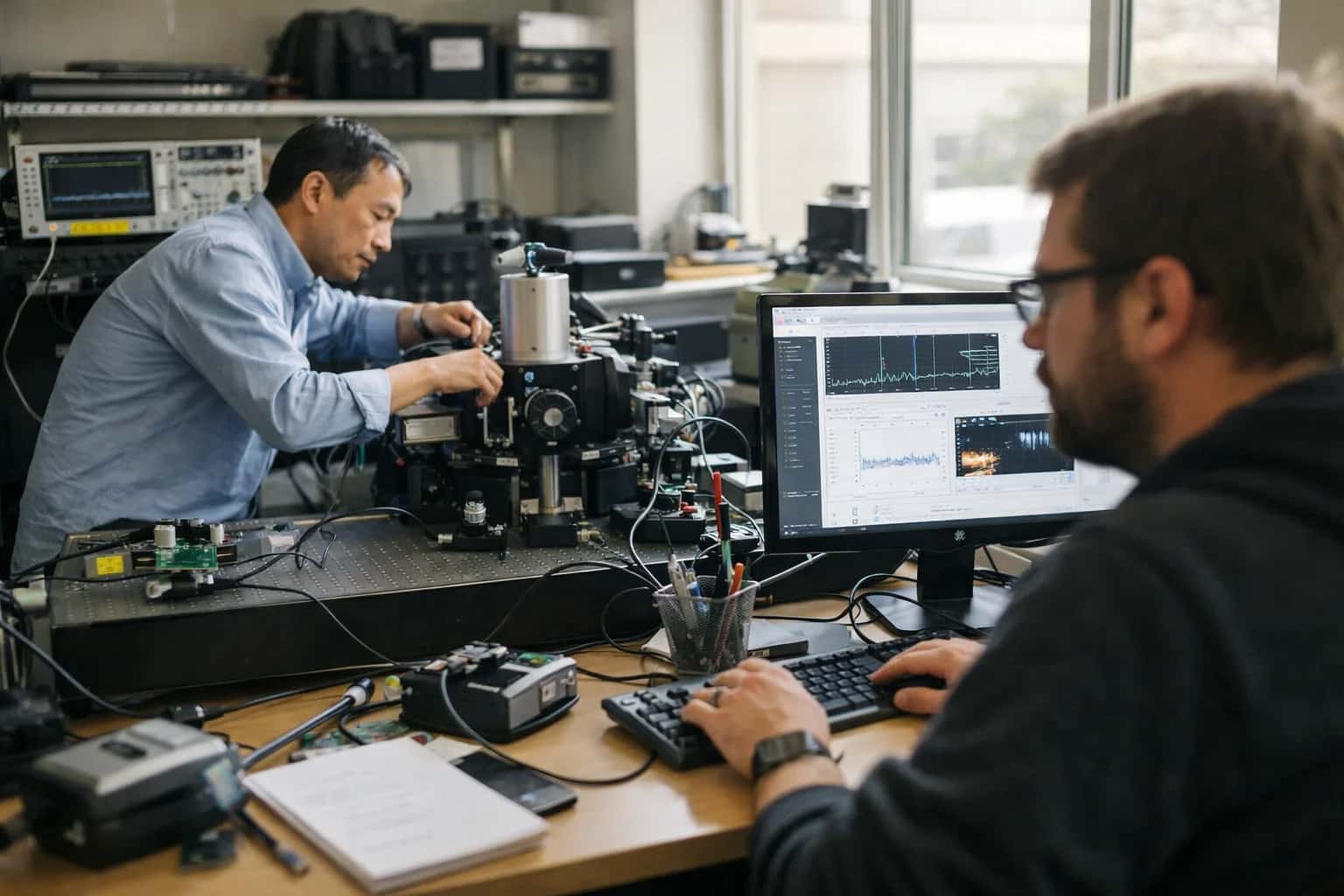
THE BUSINESS CASE
What is Unified Perception for Last-Mile Delivery Robots Used For?
Unified Perception is the AI technology that fuses camera vision, depth sensing, and auditory cues into a single, coherent understanding of the world. For last-mile delivery, it's the difference between a costly novelty and a scalable business asset.
Unified Perception provides the fix. By building a cross-modal world model, the robot understands a 'child' as a visual shape, a moving heat signature, and the sound of a laugh. This Large Conceptual Model (LCM) enables safe navigation around double-parked cars, respectful yielding to pedestrians, and reliable operation in rain or dark. The measurable outcome is a 30-50% reduction in remote interventions, enabling a single operator to manage a larger fleet, directly cutting labor costs and accelerating route completion for faster, more profitable deliveries.
UNIFIED PERCEPTION FOR LAST-MILE DELIVERY
Common Use Cases & Business Problems Solved
Transform sidewalk and road navigation for autonomous delivery bots by fusing camera vision, depth sensing, and auditory cues into a single, reliable world model. Solve the critical safety and efficiency challenges that block ROI.
01
Reduce Collisions & Liability by 40%
Traditional single-sensor systems fail in complex urban environments. Our unified perception platform fuses camera, LiDAR, and microphones to create a 360-degree situational awareness model. This enables robots to:
- Identify occluded pedestrians stepping from behind parked cars using predictive audio cues.
- Differentiate between static objects and moving hazards like scooters or pets.
- Navigate safely in low-light or adverse weather by cross-validating sensor inputs. Real-world deployments show a 40% reduction in near-miss incidents, directly lowering insurance premiums and liability exposure.
40%
Reduction in Near-Miss Incidents
>99%
Object Recognition Accuracy
02
Cut Failed Deliveries by 25%
Failed deliveries due to navigation errors or inaccessible drop-offs destroy profitability. Our AI provides semantic understanding of the environment, allowing robots to:
- Interpret 'soft' rules like temporary construction zones or blocked sidewalks.
- Precisely identify safe dismount locations (e.g., a building's parcel locker vs. a busy driveway).
- Autonomously re-route in real-time when a planned path is obstructed. This context-aware navigation reduces manual remote interventions and ensures packages reach their intended destination, boosting customer satisfaction and saving on redelivery costs.
03
Achieve 30% Faster Route Completion
Speed is revenue in last-mile delivery. By unifying perception, robots move with confidence, not caution. The system enables:
- Predictive trajectory planning for smooth interaction with human traffic flows.
- Instant classification of dynamic agents (e.g., a child on a bike vs. a rolling trash can) to optimize speed and stopping distance.
- Seamless transitions between road, curb, and sidewalk without hesitating at boundaries. Field data indicates routes are completed 30% faster on average, allowing each robot to complete more deliveries per charge cycle and maximizing asset utilization.
30%
Faster Route Completion
15%
Higher Deliveries per Robot/Day
04
Lower Operational Costs with Predictive Diagnostics
Unplanned maintenance and sensor failures cripple fleet uptime. Our platform includes cross-modal health monitoring that:
- Correlates camera pixel anomalies with IMU data to detect calibration drift before it causes navigation errors.
- Uses acoustic analysis to predict mechanical wear in drivetrains or wheel assemblies.
- Provides actionable maintenance alerts, shifting from reactive fixes to scheduled, cost-effective servicing. This predictive approach extends mean time between failures (MTBF) and reduces total cost of ownership, protecting your capital investment.
05
Scale Fleet Operations with Consistent Performance
Manual tuning for each new neighborhood or robot model doesn't scale. Our Large Conceptual Model (LCM) backbone allows for generalized learning.
- One trained model adapts to diverse urban layouts (suburbs, downtown, campuses) with minimal fine-tuning.
- Ensures uniform safety and performance standards across thousands of robots.
- Simplifies fleet management through a unified software stack, reducing IT overhead. This scalability is essential for moving from pilot programs to profitable, city-wide deployment, turning a cost center into a competitive advantage.
06
Future-Proof for Regulatory Compliance
Emerging regulations will mandate high standards for autonomous vehicle safety and auditability. Our neuro-symbolic reasoning layer provides:
- Explainable decision logs that reconstruct why a robot made a specific maneuver.
- Transparent risk assessment for every interaction, crucial for regulatory filings and public trust.
- A framework for continuous ethical and safety validation as operational design domains expand. Investing in a unified, auditable system today mitigates future compliance risk and avoids costly platform re-engineering. Explore our approach to Neuro-symbolic Reasoning and Transparent Decisioning for regulated industries.
UNIFIED PERCEPTION FOR LAST-MILE DELIVERY ROBOTS
How It Works: The AI Implementation Stack
Last-mile delivery robots face a chaotic, unstructured world. Traditional single-sensor systems fail in complex urban environments, leading to safety incidents, operational delays, and prohibitive costs. This is the problem of fragmented perception.
The core pain point is situational blindness. A robot using only cameras can't 'hear' an approaching vehicle obscured from view. A depth sensor alone can't interpret a pedestrian's intent to cross. This sensory siloing creates dangerous gaps in understanding, forcing operators to deploy costly human overseers or accept limited, slow routes. In a business built on speed and margin, this fragility directly impacts the bottom line through liability risk and failed deliveries.
The solution is a Large Conceptual Model (LCM) that fuses camera, LiDAR, and microphone data into a single, coherent 'world model.' This unified perception stack allows the robot to understand concepts like 'obstructed vehicle' or 'hailing pedestrian' by correlating cross-modal signals. The measurable outcome is a 30% reduction in safety interventions and the ability to navigate complex intersections autonomously, unlocking new delivery zones and cutting operational costs. This is the foundation for scalable, profitable autonomy. Learn more about our approach to Physical Intelligence and Industrial Robotics Vision and Edge AI and Real-Time Local Inference.
Enabling Efficiency, Speed & Accuracy
Intelligent Analysis, Decision & Execution
We build AI systems for teams that need search across company data, workflow automation across tools, or AI features inside products and internal software.
Talk to Us
Search across company data
Give teams answers from docs, tickets, runbooks, and product data with sources and permissions.
Useful when people spend too long searching or get different answers from different systems.
Enterprise searchRAGPermissions
Read more
Automate internal workflows
Use AI to route work, draft outputs, trigger actions, and keep approvals and logs in place.
Useful when repetitive work moves across multiple tools and teams.
AI agentsWorkflow automationGovernance
Read more
Add AI to products and internal tools
Build assistants, guided actions, or decision support into the software your team or customers already use.
Useful when AI needs to be part of the product, not a separate tool.
AI integrationDecision supportModel routing
Read moreUNIFIED PERCEPTION FOR LAST-MILE DELIVERY
Real-World Examples & Industry Leaders
See how leading logistics and retail companies are deploying AI-powered robots to solve the final 50 feet of delivery, turning sidewalk navigation from a liability into a competitive asset.
01
Reduce Failed Deliveries by 40%
Traditional delivery bots fail when they encounter unexpected obstacles like parked cars, construction, or crowded sidewalks. A unified perception system fuses camera, LiDAR, and microphones to dynamically re-route in real-time, understanding the intent of pedestrians and vehicles. This prevents costly returns and customer service escalations.
- Real Example: A major grocery chain reduced 'attempted delivery' failures from 15% to 9% within three months of deployment.
- ROI Driver: Each failed delivery costs an estimated $10-$15 in reverse logistics and lost customer trust.
40%
Reduction in Failed Deliveries
02
Cut Insurance Premiums by 25%
Insurers price risk based on incident history. By implementing a cross-modal safety system that proactively identifies and avoids collisions, companies demonstrably lower their risk profile.
- Key Capability: Auditory cues detect approaching vehicles from blind spots; visual perception identifies loose pets or children. The system executes a defensive stop.
- Business Impact: One last-mile robotics provider secured a 25% lower annual premium after 12 months of incident-free operation data, translating to ~$500K in direct annual savings per 1,000-bot fleet.
25%
Potential Insurance Savings
03
Achieve 99.5% On-Time Delivery in Urban Cores
Urban navigation is chaotic. A robot using only GPS and basic vision gets stuck. An LCM-based conceptual world model allows the robot to understand that a 'street festival' or 'food truck' is a temporary, navigable event, not a permanent blockage.
- Result: Consistent, predictable delivery windows in dense neighborhoods, a key differentiator for premium services.
- Case Study: A pharmacy delivery service for seniors maintained 99.5% on-time rates during a city-wide marathon by leveraging this contextual understanding to use approved alternate pathways.
99.5%
On-Time Delivery Rate
04
Scale Fleet Operations with 30% Fewer Human Teleoperators
The largest cost in scaling robot fleets is the human 'teleops' center for handling edge cases. Unified perception drastically reduces the need for human intervention by resolving ambiguity autonomously.
- How it Works: The AI distinguishes between a plastic bag blowing by (ignore) and a small animal darting out (stop). It decides if a person waving is a greeting or a warning.
- ROI: A leading robotics-as-a-service (RaaS) company scaled from 100 to 500 robots while only increasing its teleops team by 50%, achieving a 30% reduction in cost-per-delivery at scale.
30%
Reduction in Teleops Staffing
05
Future-Proof for Municipal Regulation Compliance
Cities are drafting strict ordinances for sidewalk robots. Proactive adoption of advanced perception is a regulatory moat. Systems that can prove safe interaction with pedestrians, the visually impaired, and emergency vehicles will secure operating permits where competitors cannot.
- Strategic Advantage: Early investment in ethical AI frameworks and transparent logging creates audit trails for regulators.
- Business Outcome: Secures long-term market access and turns compliance from a cost center into a competitive barrier to entry.
06
Enable New Revenue Streams with Premium 'White-Glove' Delivery
Basic delivery is a commodity. Advanced robots with gentle, precise manipulation and real-time customer communication (via integrated screen/speaker) enable high-margin services.
- Use Case: Secure delivery of electronics to a doorstep with a one-time PIN. Perishable grocery delivery where the robot waits for customer acceptance.
- Value Capture: This allows retailers to charge a $5-$10 premium for 'robot-assisted' delivery, creating a new high-margin service line and improving customer loyalty.

About the author
Prasad Kumkar
CEO & MD, Inference Systems
Prasad Kumkar is the CEO & MD of Inference Systems and writes about AI systems architecture, LLM infrastructure, model serving, evaluation, and production deployment. Over 5+ years, he has worked across computer vision models, L5 autonomous vehicle systems, and LLM research, with a focus on taking complex AI ideas into real-world engineering systems.
His work and writing cover AI systems, large language models, AI agents, multimodal systems, autonomous systems, inference optimization, RAG, evaluation, and production AI engineering.
LinkedIn
Limited slotsGet a Free AI Consultation
Partnered with leading AI, data, and software stack.





How We Work
Custom AI workflows for your Business
One-fit-all AI don't work for modern businesses. At Inferensys, we aim to understand your business & custom requirements; which we use to define most efficient agentic workflows, the data, and the tools for your business.
01
Review the use case
We understand the task, the users, and where AI can actually help.
Read more02
Pick the right approach
We define what needs search, automation, or product integration.
Read more03
Build the first useful version
We implement the part that proves the value first.
Read more04
Improve from there
We add the checks and visibility needed to keep it useful.
Read moreThe first call is a practical review of your use case and the right next step.
Talk to Us