CIOs face a critical pain point: unpredictable and spiraling cloud compute costs for AI. Training large models or running high-volume inference can lead to massive, variable bills as workloads sit on expensive, underutilized resources. A static, single-cloud deployment locks you into one provider's pricing, missing opportunities for savings and creating a critical business liability in terms of cost control and resilience. This financial unpredictability directly threatens ROI and slows AI adoption.

Use Case
Dynamic AI Workload Migration for Cost Optimization
Automatically shift AI training and inference jobs across cloud providers to leverage spot pricing and reduce compute spend by up to 40%. A core strategy for enterprise AI FinOps.
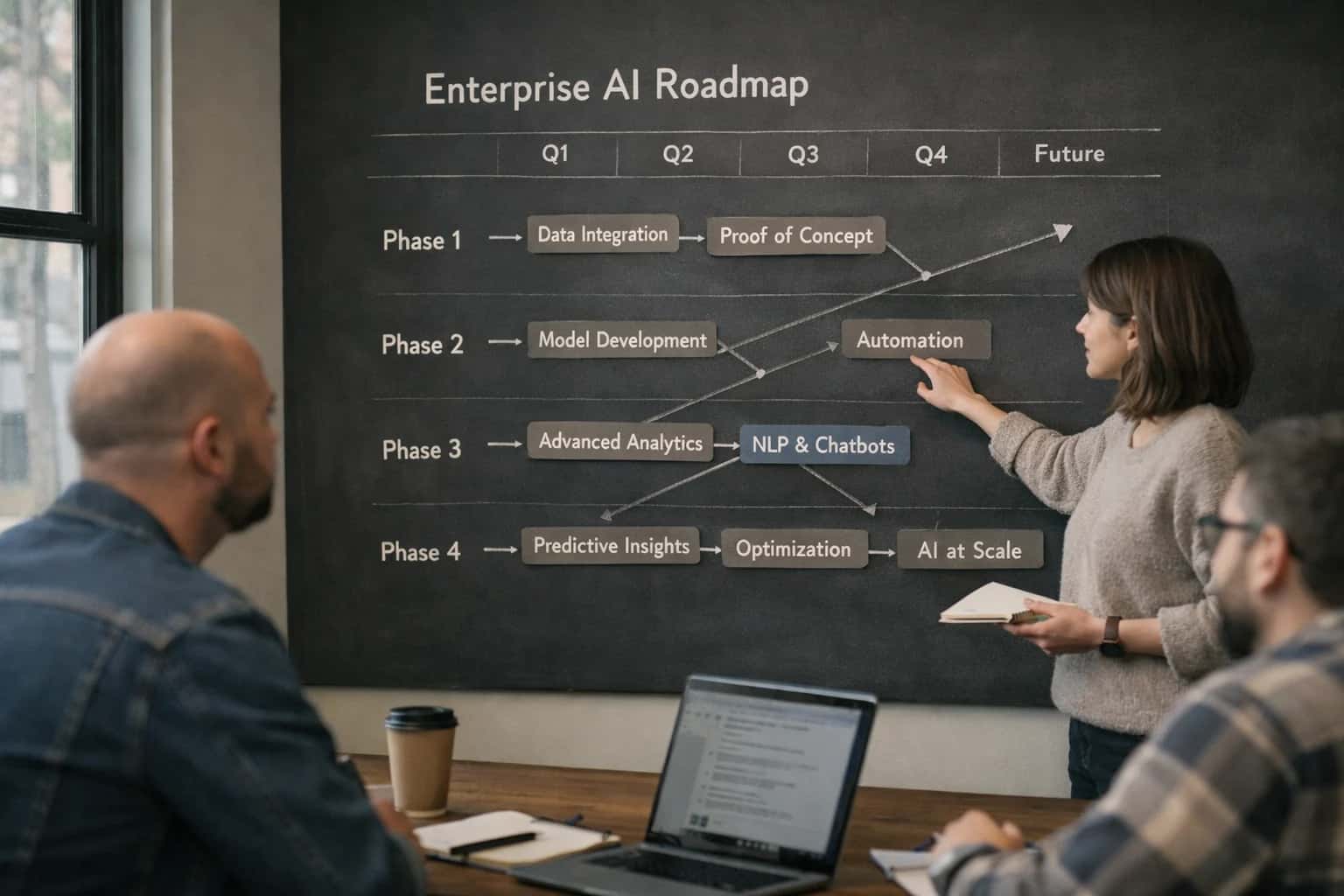
AI FINOPS IN ACTION
What is Dynamic AI Workload Migration for Cost Optimization Used For?
Dynamic AI Workload Migration is a strategic capability that automatically shifts AI training and inference jobs across cloud providers and instance types in real-time to capitalize on the most cost-effective compute resources available.
The solution is an intelligent orchestration layer that treats multi-cloud as a single, fluid resource pool. By continuously monitoring spot instance pricing, regional capacity, and performance SLAs, the system can automatically migrate workloads to the optimal environment. This delivers measurable outcomes: reducing compute spend by up to 40%, accelerating time-to-model by leveraging burst capacity, and building inherent resilience. It turns cloud flexibility into a direct competitive advantage, as detailed in our guide on Cross-Cloud AI Governance and Cost Control.
AI COST OPTIMIZATION
Common Use Cases: Where to Apply Dynamic Migration
Dynamic AI workload migration is a strategic lever for CIOs, moving beyond static cloud commitments to achieve significant, measurable ROI. These real-world applications demonstrate how to turn cloud flexibility into a direct competitive advantage.
01
Batch AI Training with Spot Instance Arbitrage
The Pain Point: Training large foundation models or running nightly batch predictions incurs massive, predictable compute costs. Committing to on-demand or reserved instances locks in high rates.
The AI Fix: Deploy an intelligent scheduler that dynamically submits training jobs to the cloud provider (or region) with the deepest spot instance discounts at that moment. The system monitors for preemption and checkpoints progress, ensuring jobs complete reliably at a fraction of the cost.
- Real Example: A financial services firm reduced its model retraining costs by 65% by migrating nightly risk analysis jobs across AWS, Azure, and GCP spot markets.
- ROI Justification: Quantify savings by comparing projected on-demand costs against actual spot spend, factoring in minimal engineering overhead for checkpointing.
02
Global Inference Load Balancing for Latency & Cost
The Pain Point: Serving AI inference to a global user base from a single region leads to high latency for distant users and prevents capitalizing on regional price variations.
The AI Fix: Implement a real-time performance and cost router at the DNS or API gateway level. It directs each user request to the cloud region offering the optimal blend of sub-second latency and lowest inference cost at that precise moment, based on live pricing APIs and performance telemetry.
- Real Example: An e-commerce platform cut its peak-hour inference costs by 30% while improving 95th percentile latency for APAC users by 200ms, directly boosting conversion rates.
- ROI Justification: Calculate savings from reduced inter-region data transfer fees and lower-cost instance regions, plus revenue impact of improved latency.
03
Predictive Scaling for Seasonal Demand Spikes
The Pain Point: Retail, travel, and media companies experience extreme, seasonal spikes in AI demand (e.g., recommendation engines, fraud detection). Over-provisioning for the peak wastes millions; under-provisioning loses sales.
The AI Fix: Use predictive analytics to forecast demand curves. The system automatically provisions burst capacity in the most cost-effective cloud environment ahead of the spike, and scales it down post-event. This moves beyond reactive auto-scaling to proactive, cost-aware scaling.
- Real Example: A streaming service handles holiday traffic surges by bursting training workloads to a secondary cloud, avoiding a 40% over-provisioning penalty on its primary cloud commitment.
- ROI Justification: Model the cost difference between maintaining year-round peak capacity versus dynamically bursting, including reserved instance optimization on the base load.
04
Hybrid Bursting from Private AI Clusters
The Pain Point: On-premises or colocation GPU clusters are capital-intensive but necessary for data sovereignty. However, they lack the elasticity for unexpected project surges, causing model development delays.
The AI Fix: Establish a seamless hybrid pipeline where workloads default to the private cluster. When queues form or specialized hardware (e.g., the latest H100s) is needed, jobs automatically burst to a public cloud, with data staged securely. Workloads repatriate once private capacity frees up.
- Real Example: A healthcare research institute keeps sensitive genomic data on-prem but uses dynamic bursting to public cloud for computationally intensive simulation phases, accelerating time-to-insight by 50%.
- ROI Justification: Justify the private cluster investment by showing its high utilization for base loads, while demonstrating that burst costs are only incurred when directly tied to accelerating revenue-generating projects.
05
AI Dev/Test Environment Cost Governance
The Pain Point: Data science teams spin up powerful GPU instances for development and testing, often forgetting to turn them off, leading to rampant 'resource sprawl' and wasted spend.
The AI Fix: Implement policy-based dynamic migration for non-production environments. After periods of inactivity, workloads are automatically migrated to lower-cost compute (e.g., from a GPU to a CPU instance, or to a cheaper cloud region) or hibernated. Teams can restore full performance with one click when needed.
- Real Example: A Fortune 500 company reduced its monthly AI dev/test spend by over $120,000 by enforcing automated downsizing of idle notebooks and training environments after 4 hours.
- ROI Justification: This is pure cost avoidance. Track the 'waste' from orphaned instances before implementation and show direct savings post-deployment.
06
Multi-Cloud Resilience as a Cost Driver
The Pain Point: Vendor lock-in with a single cloud provider eliminates negotiating leverage and exposes the business to regional outages that halt critical AI services.
The AI Fix: Design actively-active deployments across clouds. By running live, load-balanced inference endpoints on at least two providers, you not only guarantee 99.99%+ uptime but also create a competitive pricing floor. The dynamic migration system can shift load for cost reasons, proving you can leave, which strengthens negotiation positions.
- Real Example: A fintech startup used its multi-cloud inference architecture as leverage in contract renewals, securing a 22% discount from its primary cloud vendor by demonstrating easy portability.
- ROI Justification: Combine the hard savings from negotiated discounts with the soft ROI of avoided business disruption during outages, quantifying the value of continuous AI service availability.
IMPLEMENTATION BLUEPRINT
Dynamic AI Workload Migration for Cost Optimization
A strategic guide to automating the movement of AI compute across cloud environments to capture spot pricing and reserved capacity discounts, directly reducing infrastructure spend.
The primary pain point is unpredictable and spiraling cloud compute costs for AI training and inference. Workloads are often statically pinned to a single provider or region, missing fleeting opportunities for massive discounts—like AWS Spot or Azure Low-Priority VMs—which can be 60-90% cheaper. This static deployment locks in overspend and creates a significant barrier to scaling AI initiatives profitably, turning innovation into a financial burden.
The solution is an intelligent orchestration layer that continuously monitors global cloud pricing, performance, and capacity. It automatically migrates non-critical batch training jobs or shifts inference traffic to the most cost-effective region or provider in real-time. This dynamic approach can reduce overall AI compute spend by 30-40%, transforming cloud costs from a fixed overhead into a variable, optimized expense. For a deeper dive, explore our framework for Cross-Cloud AI Governance and Cost Control and learn how to implement Predictive Scaling for AI Compute Resources.
Enabling Efficiency, Speed & Accuracy
Intelligent Analysis, Decision & Execution
We build AI systems for teams that need search across company data, workflow automation across tools, or AI features inside products and internal software.
Talk to Us
Search across company data
Give teams answers from docs, tickets, runbooks, and product data with sources and permissions.
Useful when people spend too long searching or get different answers from different systems.
Enterprise searchRAGPermissions
Read more
Automate internal workflows
Use AI to route work, draft outputs, trigger actions, and keep approvals and logs in place.
Useful when repetitive work moves across multiple tools and teams.
AI agentsWorkflow automationGovernance
Read more
Add AI to products and internal tools
Build assistants, guided actions, or decision support into the software your team or customers already use.
Useful when AI needs to be part of the product, not a separate tool.
AI integrationDecision supportModel routing
Read moreDYNAMIC AI WORKLOAD MIGRATION
Implementation Roadmap: From Pilot to Scale
A strategic, phased approach to implementing dynamic AI workload migration, turning cost optimization from a technical concept into a measurable business driver with clear ROI.
01
Phase 1: Pilot & Baseline
Identify a single, non-critical AI workload—such as a batch inference job or a development training pipeline—for the initial pilot. The goal is to establish a cost baseline and prove the technical feasibility of migration.
- Key Activities: Instrument the workload to track compute spend and performance across a primary and secondary cloud region.
- Success Metric: Demonstrate a 15-25% cost reduction on the pilot workload by leveraging spot instances or lower-cost regions during off-peak hours.
- Real-World Example: A media company piloted with its video content moderation model, shifting nightly batch jobs to the most cost-effective cloud, saving $18k monthly and validating the architecture.
02
Phase 2: Standardize & Automate
Package the successful pilot pattern into a reusable, automated framework. This phase focuses on building the orchestration layer that makes migration decisions based on policy.
- Key Activities: Develop policy-driven automation for workload placement (e.g., 'always use spot for training,' 'inference must stay under 200ms latency'). Integrate with cloud billing APIs for real-time cost tracking.
- Success Metric: Achieve 'hands-off' operation for approved workloads, reducing cloud management overhead by 30%.
- Real-World Example: A fintech firm automated its fraud detection model retraining, allowing it to dynamically seek the cheapest available GPU capacity weekly, cutting its annual training budget by 35%.
03
Phase 3: Scale Across Workloads
Apply the standardized framework to a portfolio of AI workloads, starting with the most expensive. This is where enterprise-wide ROI is realized.
- Key Activities: Conduct a workload assessment to prioritize migration based on cost, complexity, and business criticality. Implement centralized governance and guardrails.
- Success Metric: Extend cost optimization to 70% of AI compute spend, achieving an average reduction of 30-40%.
- Real-World Example: A manufacturing scale-up migrated its entire digital twin simulation suite, dynamically running different components across AWS, Azure, and a private cluster, optimizing for both cost and specialized hardware access.
04
Phase 4: Optimize & Innovate
Move from reactive cost-cutting to proactive financial and performance optimization. This phase leverages predictive analytics and integrates with broader business systems.
- Key Activities: Implement AI-driven forecasting for compute demand. Integrate migration policies with business calendars (e.g., avoiding migrations during peak sales periods). Explore cloud bursting for unprecedented scale.
- Success Metric: Transform AI infrastructure from a fixed cost center into a variable, strategic asset that directly contributes to margin improvement.
- Real-World Example: An e-commerce giant uses predictive scaling to handle holiday traffic, automatically provisioning inference capacity across three clouds while staying within a strict compute budget, ensuring zero lost sales due to latency.
05
The CIO's ROI Justification
Presenting the business case requires translating technical gains into boardroom language. Focus on three core value pillars:
- Direct Cost Savings: Quantify the 30-40% reduction in AI compute spend as a direct contribution to the bottom line. For a $5M annual cloud AI bill, that's $1.5M - $2M in annual savings.
- Operational Resilience: Frame multi-cloud migration as de-risking the business. It mitigates vendor lock-in and provides a built-in disaster recovery strategy for critical AI services.
- Strategic Agility: Position the capability as enabling faster experimentation and scaling. Teams can access the best-in-class tools or hardware for each project without lengthy procurement, accelerating time-to-value for new AI initiatives.
06
Common Pitfalls & Mitigations
Acknowledging challenges builds credibility. Here are key hurdles and how to overcome them:
- Data Gravity & Egress Costs: Mitigate by staging data in a central, cloud-agnostic layer like a data lake or using intelligent data synchronization to minimize transfer.
- Model Portability: Avoid vendor-specific AI services. Containerize models using standards like KServe or Triton Inference Server for true portability.
- Governance & Security: Implement a unified identity and access management (IAM) layer and policy engine across clouds to maintain security posture and compliance.
- Cultural Silos: Foster a FinOps culture where AI developers are aware of cost implications, aligning engineering innovation with financial discipline.

About the author
Prasad Kumkar
CEO & MD, Inference Systems
Prasad Kumkar is the CEO & MD of Inference Systems and writes about AI systems architecture, LLM infrastructure, model serving, evaluation, and production deployment. Over 5+ years, he has worked across computer vision models, L5 autonomous vehicle systems, and LLM research, with a focus on taking complex AI ideas into real-world engineering systems.
His work and writing cover AI systems, large language models, AI agents, multimodal systems, autonomous systems, inference optimization, RAG, evaluation, and production AI engineering.
LinkedIn
Limited slotsGet a Free AI Consultation
Partnered with leading AI, data, and software stack.





How We Work
Custom AI workflows for your Business
One-fit-all AI don't work for modern businesses. At Inferensys, we aim to understand your business & custom requirements; which we use to define most efficient agentic workflows, the data, and the tools for your business.
01
Review the use case
We understand the task, the users, and where AI can actually help.
Read more02
Pick the right approach
We define what needs search, automation, or product integration.
Read more03
Build the first useful version
We implement the part that proves the value first.
Read more04
Improve from there
We add the checks and visibility needed to keep it useful.
Read moreThe first call is a practical review of your use case and the right next step.
Talk to Us