CIOs face a stark reality: AI costs are unpredictable, and visibility is fractured. Without centralized control, teams spin up expensive GPU instances across clouds, leading to shadow IT and budget overruns. Security policies become inconsistent, and compliance audits turn into manual nightmares. This lack of governance isn't just an IT headache; it directly threatens the financial viability and security of your AI initiatives, stalling innovation.

Use Case
Cross-Cloud AI Governance and Cost Control
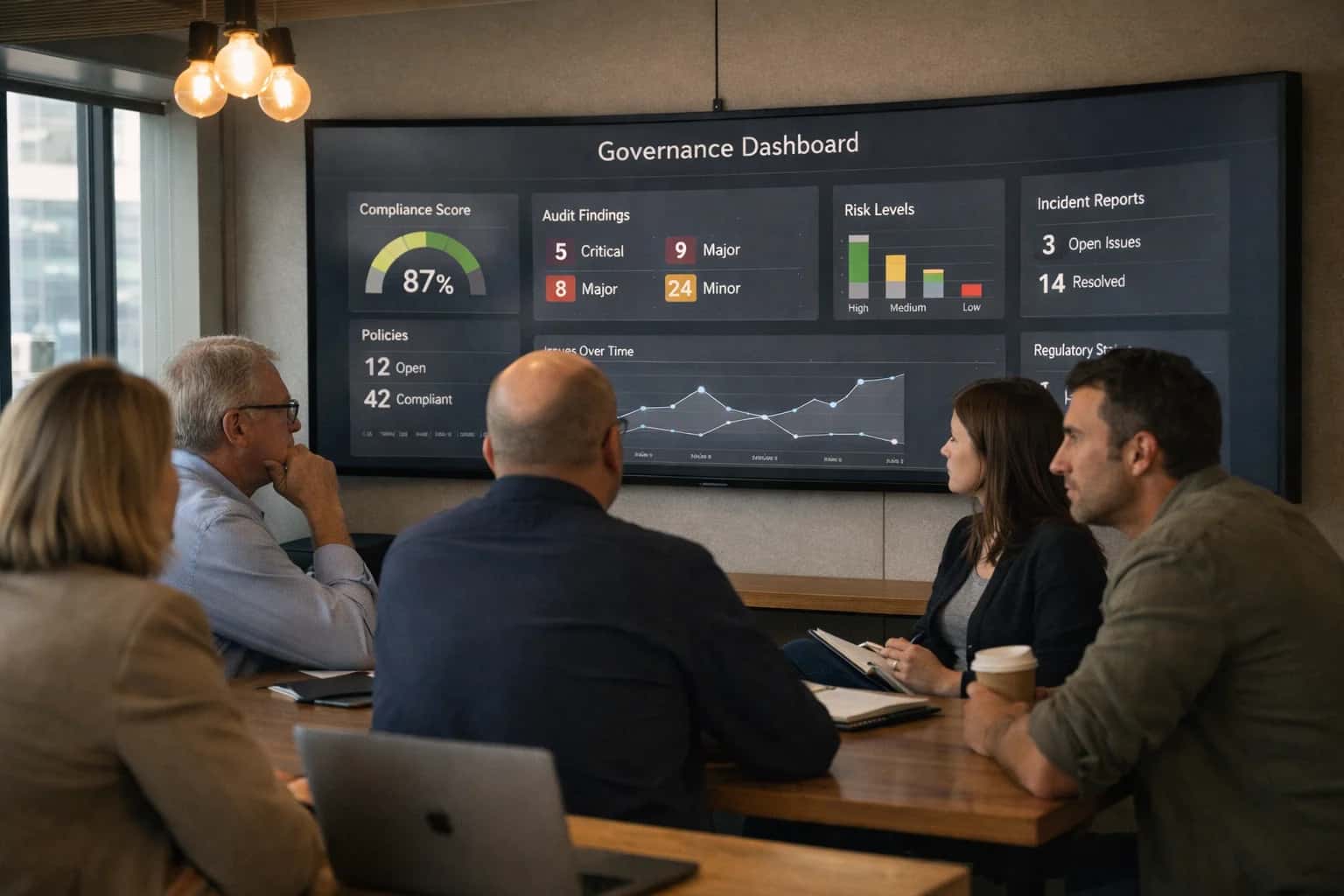
A unified policy engine and dashboard to govern AI spend, resource usage, and security posture across AWS, Azure, and GCP, delivering up to 40% cost reduction and complete financial visibility.
THE BUSINESS IMPERATIVE
What is Cross-Cloud AI Governance and Cost Control Used For?
As enterprises scale AI across AWS, Azure, and GCP, uncontrolled spending and fragmented oversight become critical business risks. This unified approach is the key to predictable ROI and secure operations.
The solution is a unified policy engine and dashboard. This system enforces guardrails—automatically shutting down idle resources and selecting cost-optimal regions—slashing compute spend by 30-40%. It provides a single pane of glass for security posture and generates audit-ready reports for frameworks like GDPR. The outcome is predictable AI expenditure, mitigated risk, and the freedom to scale innovation with confidence. Learn how to build this foundation with our guide on Dynamic AI Workload Migration for Cost Optimization.
CROSS-CLOUD AI GOVERNANCE
Common Use Cases: Solving Specific Business Pains
Unified control over AI spend, security, and performance across AWS, Azure, and GCP is no longer optional—it's a core financial and operational imperative. These use cases demonstrate tangible ROI.
01
Eliminate AI Cost Sprawl
Unpredictable AI compute bills are a primary pain point. A unified governance platform provides real-time visibility into spend across all cloud providers, identifying idle resources and over-provisioned instances.
- Real-World Example: A financial services firm reduced its monthly AI training costs by 35% by automatically rightsizing GPU clusters and leveraging spot instances across clouds based on real-time pricing.
- Key Benefit: Shift from fixed, over-provisioned budgets to dynamic, optimized spend with clear attribution to projects and teams.
02
Automate Compliance & Security Posture
Manually enforcing data sovereignty (GDPR, HIPAA) and security policies across multiple clouds is error-prone and resource-intensive. A centralized policy engine automates guardrails.
- Real-World Example: A global healthcare provider automated checks to ensure patient data for diagnostic AI never left EU-based cloud regions, generating audit trails for regulators and reducing compliance overhead by 60%.
- Key Benefit: Mitigate regulatory risk and avoid hefty fines by ensuring AI workloads are deployed only in compliant environments, with continuous monitoring.
03
Dynamic Workload Migration for Optimal Performance
Cloud performance and pricing fluctuate. Static deployments waste money and slow down results. Intelligent orchestration dynamically routes AI inference and training jobs.
- Real-World Example: An e-commerce company uses policy-based rules to run batch inference during off-peak hours in the lowest-cost region, and shifts to a high-performance region during sales events, maintaining SLA while cutting compute costs by 40%.
- Key Benefit: Achieve the best price-performance ratio for every AI task, translating directly to faster time-to-insight and lower operational expense.
04
Single Pane of Glass for AI Operations
CIOs lack a unified view of model health, resource utilization, and costs across their multi-cloud AI estate. Fragmented dashboards create blind spots. A consolidated operations console provides holistic observability.
- Real-World Example: A manufacturing firm consolidated monitoring for 50+ production AI models across AWS SageMaker and Azure ML, reducing MLOps team firefighting by 50% and improving model uptime to 99.9%.
- Key Benefit: Accelerate root-cause analysis, improve team productivity, and provide executive dashboards that clearly link AI investment to business outcomes.
05
Govern AI Model Lifecycle at Scale
Managing model versions, approvals, and deployments across different cloud MLOps platforms creates inconsistency and risk. A unified model registry and governance workflow standardizes the process.
- Real-World Example: An insurance company implemented a cross-cloud approval chain for new risk models, ensuring only validated, explainable models could be deployed to production, reducing model-related errors by 90%.
- Key Benefit: Enforce standardization, improve model reliability, and accelerate safe deployment of new AI capabilities across the enterprise.
06
Forecast & Right-Size AI Capacity
Over-provisioning leads to wasted spend; under-provisioning cripples innovation. Predictive analytics use historical usage and business forecasts to recommend optimal provisioning.
- Real-World Example: A media company used AI-driven forecasting to plan GPU capacity for its content recommendation engine ahead of a major product launch, avoiding a $2M over-provisioning mistake while ensuring seamless performance.
- Key Benefit: Transform AI infrastructure from a reactive cost center to a strategically managed asset, aligning spend precisely with business demand.
CROSS-CLOUD AI GOVERNANCE AND COST CONTROL
How It Works: The Implementation Blueprint
A unified framework to govern AI spend, resource usage, and security posture across AWS, Azure, and GCP, turning cloud complexity into a competitive advantage.
The pain point is clear: AI initiatives are driving unpredictable, multi-million dollar cloud bills across AWS, Azure, and GCP. Without centralized governance, costs spiral from over-provisioned GPU instances, idle resources, and redundant data egress. This financial opacity makes it impossible to attribute spend to specific projects or calculate true ROI, stalling AI adoption and eroding executive confidence in the program's viability.
The solution is a unified policy engine and dashboard. This system implements tagging standards, automated resource scheduling, and real-time spend alerts. It enforces guardrails—like automatically stopping non-critical training jobs after hours—while providing a single pane of glass for cost attribution. The measurable outcome is a 20-40% reduction in AI compute waste and a clear, auditable trail linking cloud spend directly to business outcomes, enabling strategic reinvestment.
Enabling Efficiency, Speed & Accuracy
Intelligent Analysis, Decision & Execution
We build AI systems for teams that need search across company data, workflow automation across tools, or AI features inside products and internal software.
Talk to Us
Search across company data
Give teams answers from docs, tickets, runbooks, and product data with sources and permissions.
Useful when people spend too long searching or get different answers from different systems.
Enterprise searchRAGPermissions
Read more
Automate internal workflows
Use AI to route work, draft outputs, trigger actions, and keep approvals and logs in place.
Useful when repetitive work moves across multiple tools and teams.
AI agentsWorkflow automationGovernance
Read more
Add AI to products and internal tools
Build assistants, guided actions, or decision support into the software your team or customers already use.
Useful when AI needs to be part of the product, not a separate tool.
AI integrationDecision supportModel routing
Read moreYOUR 90-DAY IMPLEMENTATION ROADMAP
Cross-Cloud AI Governance and Cost Control
Move from fragmented cloud bills and compliance risks to a unified, AI-optimized multi-cloud strategy. This roadmap delivers measurable ROI through centralized control and automated optimization.
01
Weeks 1-4: Establish Unified Financial Control
Deploy a single-pane-of-glass dashboard to aggregate and categorize all AI-related cloud spend (compute, storage, data egress) across AWS, Azure, and GCP. This eliminates invoice shock and identifies immediate waste.
- Real-World Example: A fintech client discovered 35% of their GPU costs were for idle development instances. Automated tagging and shutdown policies saved $1.2M annually.
- Implement showback/chargeback mechanisms to hold business units accountable for their AI resource consumption.
02
Weeks 5-8: Enforce Policy-Based Governance
Implement a centralized policy engine to automate compliance and prevent cost overruns. Policies act as guardrails for your AI factory.
- Automatic Enforcement: Block model training jobs that don't use spot instances, enforce data sovereignty rules by region, and require approval for GPU instance types above a certain cost.
- Quantifiable Benefit: One manufacturing firm reduced compliance audit preparation time from 3 weeks to 3 days by automating evidence collection for SOC2 and GDPR across their multi-cloud AI workloads.
03
Weeks 9-12: Activate Dynamic Cost Optimization
Shift from monitoring to autonomous optimization. Deploy intelligent agents that continuously analyze price-performance across clouds and execute savings actions.
- Key Actions:
- Automated Workload Migration: Move batch inference jobs to the cloud region with the lowest spot pricing at that moment.
- Predictive Right-Sizing: Use historical usage patterns to recommend and implement optimal instance types, avoiding over-provisioning.
- ROI Driver: This phase typically delivers 20-40% reduction in variable AI compute costs by leveraging real-time cloud arbitrage.
04
Ongoing: Institutionalize AI FinOps
Transform cost control from a project into a core business competency. Integrate governance data with enterprise planning and strategic vendor management.
- Strategic Outcomes:
- Use historical optimization data to negotiate better committed-use discounts with cloud providers.
- Align AI project funding with demonstrated ROI, shifting budgets from pure experimentation to scaled production.
- This creates a virtuous cycle where saved costs are reinvested into higher-value AI initiatives, accelerating innovation.
05
The CIO's Business Case
Justify the investment with clear, board-level metrics derived from this roadmap:
- Hard Cost Savings: Target 25-35% reduction in annual AI cloud spend through eliminated waste and dynamic optimization.
- Risk Mitigation: Automated compliance reduces regulatory fines and reputational exposure. Unified monitoring cuts mean-time-to-resolution for AI outages.
- Strategic Agility: Gain the freedom to deploy AI on the best cloud for the task without financial or operational penalty, future-proofing your architecture.

About the author
Prasad Kumkar
CEO & MD, Inference Systems
Prasad Kumkar is the CEO & MD of Inference Systems and writes about AI systems architecture, LLM infrastructure, model serving, evaluation, and production deployment. Over 5+ years, he has worked across computer vision models, L5 autonomous vehicle systems, and LLM research, with a focus on taking complex AI ideas into real-world engineering systems.
His work and writing cover AI systems, large language models, AI agents, multimodal systems, autonomous systems, inference optimization, RAG, evaluation, and production AI engineering.
LinkedIn
Limited slotsGet a Free AI Consultation
Partnered with leading AI, data, and software stack.





How We Work
Custom AI workflows for your Business
One-fit-all AI don't work for modern businesses. At Inferensys, we aim to understand your business & custom requirements; which we use to define most efficient agentic workflows, the data, and the tools for your business.
01
Review the use case
We understand the task, the users, and where AI can actually help.
Read more02
Pick the right approach
We define what needs search, automation, or product integration.
Read more03
Build the first useful version
We implement the part that proves the value first.
Read more04
Improve from there
We add the checks and visibility needed to keep it useful.
Read moreThe first call is a practical review of your use case and the right next step.
Talk to Us