The traditional drug development pipeline is a financial black hole, with over 90% of candidates failing in clinical trials due to poor efficacy or unacceptable toxicity. This process costs billions and takes over a decade, creating immense pressure on R&D budgets and delaying life-saving treatments. The core pain point is the reliance on late-stage, expensive biological experiments to answer fundamental questions: Will this molecule work? and Is it safe?

Use Case
Drug Efficacy and Side Effect Prediction
Use AI to forecast therapeutic potential and adverse reactions before costly clinical trials, reducing R&D risk and accelerating time-to-market.
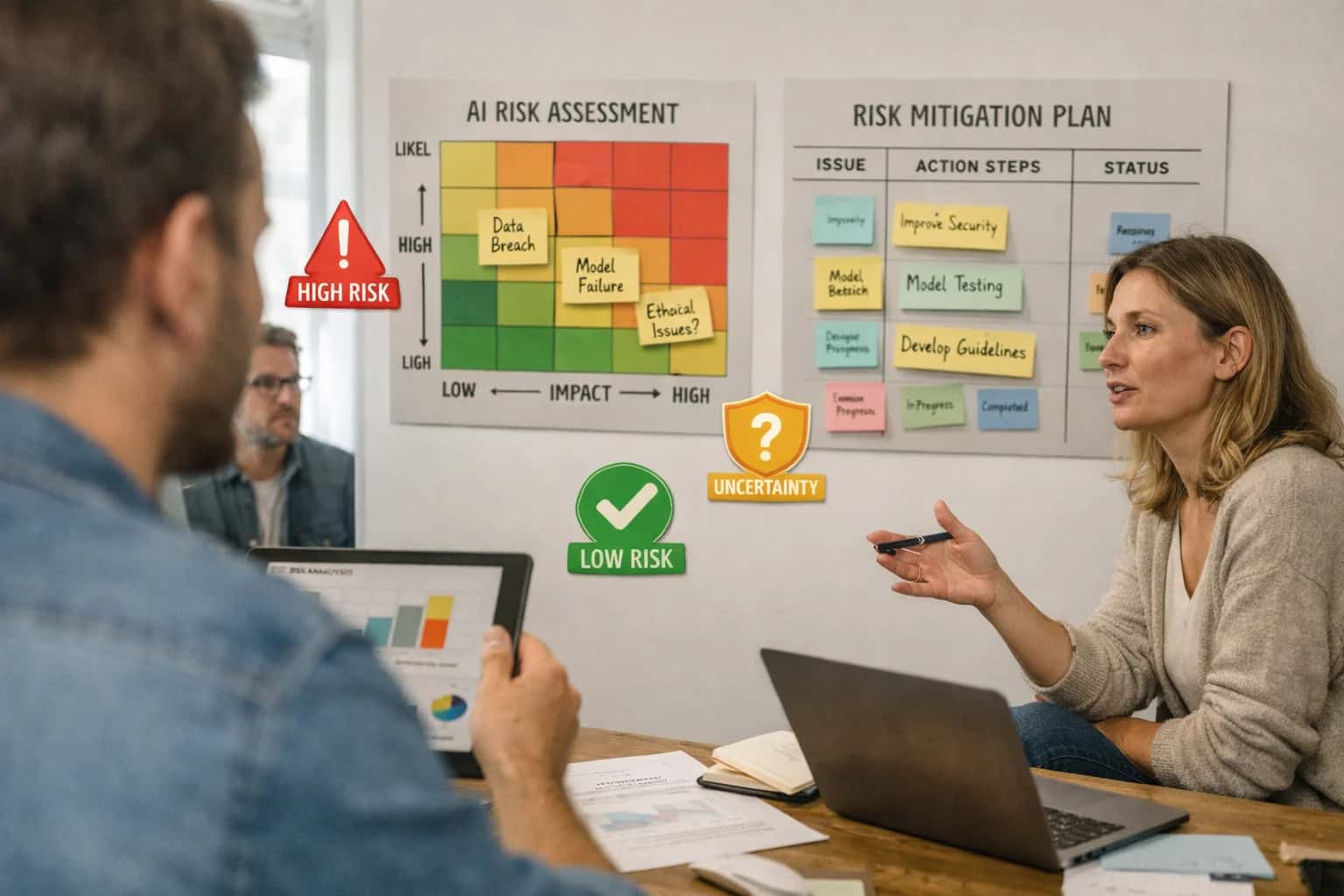
AI IN DRUG DISCOVERY
What is Drug Efficacy and Side Effect Prediction Used For?
This AI use case transforms the high-risk, high-cost process of pharmaceutical R&D by forecasting a drug candidate's performance before human trials.
AI-powered bio-informatics models act as a virtual screening layer. By simulating complex molecular interactions and analyzing vast biomedical datasets, they predict therapeutic potential and adverse reaction profiles with high accuracy. This enables fail-fast, succeed-faster decisioning, de-risking portfolios and redirecting capital to the most promising candidates. The measurable outcome is a dramatic reduction in preclinical timelines and a 10-20% increase in clinical trial success rates, directly boosting ROI. For a deeper dive into the underlying technology, explore our pillar on HealthTech Diagnostics and Bio-Informatics AI.
DRUG DISCOVERY & DEVELOPMENT
Common Use Cases: Where AI Delivers Immediate ROI
AI is transforming pharmaceutical R&D by predicting drug success earlier, de-risking billion-dollar investments and accelerating time-to-market. These applications deliver quantifiable ROI by reducing clinical trial failures and optimizing resource allocation.
01
Predicting Clinical Trial Success
AI models analyze preclinical data, chemical structures, and historical trial outcomes to forecast a candidate's likelihood of success in human trials. This enables portfolio prioritization, shifting resources to the most promising assets and avoiding costly late-stage failures.
- Real Example: Major pharma companies use AI to score pipeline candidates, aiming to reduce Phase III attrition rates, which can save over $100M per failed trial.
- ROI Driver: Direct cost avoidance from terminated non-viable programs and accelerated revenue from successful drugs.
02
Virtual Screening & Lead Optimization
Instead of physically testing millions of compounds, AI performs in-silico screening to simulate how molecules bind to target proteins. It identifies high-potential leads and suggests chemical modifications to improve efficacy and 'drug-likeness'.
- Real Example: AI platforms can screen billions of virtual compounds in weeks, a process that traditionally took years and millions in lab costs.
- ROI Driver: Dramatic reduction in early R&D costs and cycle time, compressing the discovery timeline from 4-5 years to 1-2 years.
03
Adverse Reaction & Toxicity Prediction
AI models predict potential side effects and organ toxicity by analyzing a drug's chemical properties against vast databases of known toxicophores and biological pathways. This enables proactive safety profiling long before human testing.
- Real Example: Models can flag cardiotoxicity (a leading cause of drug withdrawal) with high accuracy, allowing chemists to redesign molecules early.
- ROI Driver: Mitigates the catastrophic financial and reputational risk of a post-market drug recall, which can cost billions.
04
Biomarker & Patient Stratification
AI identifies genetic, proteomic, and clinical biomarkers that predict which patient subgroups will respond best to a therapy. This enables the design of precision medicine trials with higher probability of success.
- Real Example: In oncology, AI helps define biomarker-enriched populations for targeted therapies, leading to stronger clinical results and supporting premium pricing.
- ROI Driver: Increases trial success rates, reduces required patient numbers, and creates a competitive moat for market approval and commercialization.
05
Drug Repurposing & Combination Therapy
AI mines real-world patient data, scientific literature, and molecular databases to discover new therapeutic uses for existing approved drugs or synergistic drug combinations. This unlocks value from existing assets with known safety profiles.
- Real Example: AI identified baricitinib (a rheumatoid arthritis drug) as a potential COVID-19 treatment, leading to rapid clinical validation and emergency use authorization.
- ROI Driver: Creates new revenue streams from old patents, with development costs and timelines a fraction of novel drug discovery.
06
Synthetic Data for Rare Disease Research
AI generates high-fidelity synthetic patient data that mirrors the statistical properties of real, scarce clinical data for rare diseases. This enables robust model training without privacy violations or data scarcity bottlenecks.
- Real Example: Used to simulate patient cohorts for orphan drugs, allowing for more confident go/no-go decisions when recruiting real patients is extremely difficult and expensive.
- ROI Driver: De-risks investment in niche markets by providing evidence for internal funding and partnership discussions, accelerating development for high-need populations.
DRUG DISCOVERY
How It Works: The AI-Powered Prediction Pipeline
Traditional drug development is a high-stakes gamble. AI transforms this by creating a predictive pipeline that simulates biological outcomes before a single molecule is synthesized, de-risking R&D and accelerating time-to-market.
The core pain point is the staggering cost and failure rate of drug development. Billions are spent advancing candidates that ultimately fail in late-stage trials due to unforeseen inefficacy or toxic side effects. This 'valley of death' between discovery and clinical validation represents immense financial waste and delays life-saving treatments. The business risk is not just capital loss but eroded competitive advantage and missed market opportunities.
Our solution deploys neuro-symbolic AI and physics-informed models to create a virtual testing environment. The system simulates a drug candidate's interaction with thousands of biological targets and patient genotypes, predicting both therapeutic potential and adverse reaction profiles with high fidelity. This quantifiable de-risking can reduce late-stage trial failures by up to 30%, compressing R&D timelines and protecting pipeline value. Explore our approach to Neuro-symbolic Reasoning and Transparent Decisioning for regulated industries.
PHARMACEUTICAL R&D INVESTMENT
ROI Calculator: The Business Case
Comparing the financial and operational impact of traditional clinical trial methods versus AI-driven predictive modeling for drug efficacy and safety.
| Key Metric | Traditional Clinical Trial Process | AI-Powered Predictive Modeling (Inference Systems) | Competitive Advantage |
|---|---|---|---|
Average Cost per Failed Phase II/III Trial | $50-100M | $2-5M (simulation cost) | Up to 95% cost avoidance |
Time to Identify High-Risk Side Effects | Months 12-24 (during trials) | Weeks 1-4 (pre-clinical) | Accelerate risk assessment by >90% |
Probability of Late-Stage Attrition (Phase III) | 40-50% | 15-25% (via early de-risking) | Reduce pipeline failure by ~50% |
Computational Throughput (compounds screened/week) | 10-100 | 10,000-100,000 | 1000x increase in candidate evaluation |
Regulatory Submission Readiness | Manual, document-heavy | AI-audited, evidence-traceable | Reduce preparation time by 30% |
Model Explainability / Audit Trail | Critical for FDA/EMA submissions | ||
Integration with Existing Bio-Informatics Platforms | High custom effort | Seamless via APIs (see our MLOps guide) | Faster time-to-insight |
ROI Timeline (Payback Period) | 5-7 years | 1-2 years | Accelerate value realization by 3-5x |
Enabling Efficiency, Speed & Accuracy
Intelligent Analysis, Decision & Execution
We build AI systems for teams that need search across company data, workflow automation across tools, or AI features inside products and internal software.
Talk to Us
Search across company data
Give teams answers from docs, tickets, runbooks, and product data with sources and permissions.
Useful when people spend too long searching or get different answers from different systems.
Enterprise searchRAGPermissions
Read more
Automate internal workflows
Use AI to route work, draft outputs, trigger actions, and keep approvals and logs in place.
Useful when repetitive work moves across multiple tools and teams.
AI agentsWorkflow automationGovernance
Read more
Add AI to products and internal tools
Build assistants, guided actions, or decision support into the software your team or customers already use.
Useful when AI needs to be part of the product, not a separate tool.
AI integrationDecision supportModel routing
Read moreDRUG DISCOVERY AI
Key Implementation Challenges & Mitigations
Implementing AI for drug efficacy and side effect prediction presents unique hurdles. This guide addresses the most common enterprise objections with practical, ROI-focused mitigation strategies.
The 'garbage in, garbage out' principle is critical. AI models require high-quality, structured data from clinical trials, omics (genomics, proteomics), and real-world evidence (RWE). The primary challenge is integrating these siloed, often unstructured datasets.
Mitigation Strategy:
- Implement a unified data lakehouse with strict governance and ontologies to harmonize data.
- Use automated data pipelines with validation rules to ensure consistency.
- Leverage synthetic data generation to augment sparse datasets while preserving privacy, a technique discussed in our guide to Synthetic Data Generation and Privacy-Preserving Analytics.
- Start with a focused proof-of-concept on a single, well-understood data stream to demonstrate value before scaling.

About the author
Prasad Kumkar
CEO & MD, Inference Systems
Prasad Kumkar is the CEO & MD of Inference Systems and writes about AI systems architecture, LLM infrastructure, model serving, evaluation, and production deployment. Over 5+ years, he has worked across computer vision models, L5 autonomous vehicle systems, and LLM research, with a focus on taking complex AI ideas into real-world engineering systems.
His work and writing cover AI systems, large language models, AI agents, multimodal systems, autonomous systems, inference optimization, RAG, evaluation, and production AI engineering.
LinkedIn
Limited slotsGet a Free AI Consultation
Partnered with leading AI, data, and software stack.





How We Work
Custom AI workflows for your Business
One-fit-all AI don't work for modern businesses. At Inferensys, we aim to understand your business & custom requirements; which we use to define most efficient agentic workflows, the data, and the tools for your business.
01
Review the use case
We understand the task, the users, and where AI can actually help.
Read more02
Pick the right approach
We define what needs search, automation, or product integration.
Read more03
Build the first useful version
We implement the part that proves the value first.
Read more04
Improve from there
We add the checks and visibility needed to keep it useful.
Read moreThe first call is a practical review of your use case and the right next step.
Talk to Us