The pain point is contract leakage. Manual monitoring of pricing terms, SLAs, and rebate clauses across thousands of active supplier agreements is impossible. This leads to missed discounts, undetected overcharges, and compliance failures that erode margins and increase vendor risk. For the CIO, this represents a significant unmanaged financial exposure and a drain on legal and procurement resources better spent on strategy.

Use Case
Procurement Contract Compliance Agent
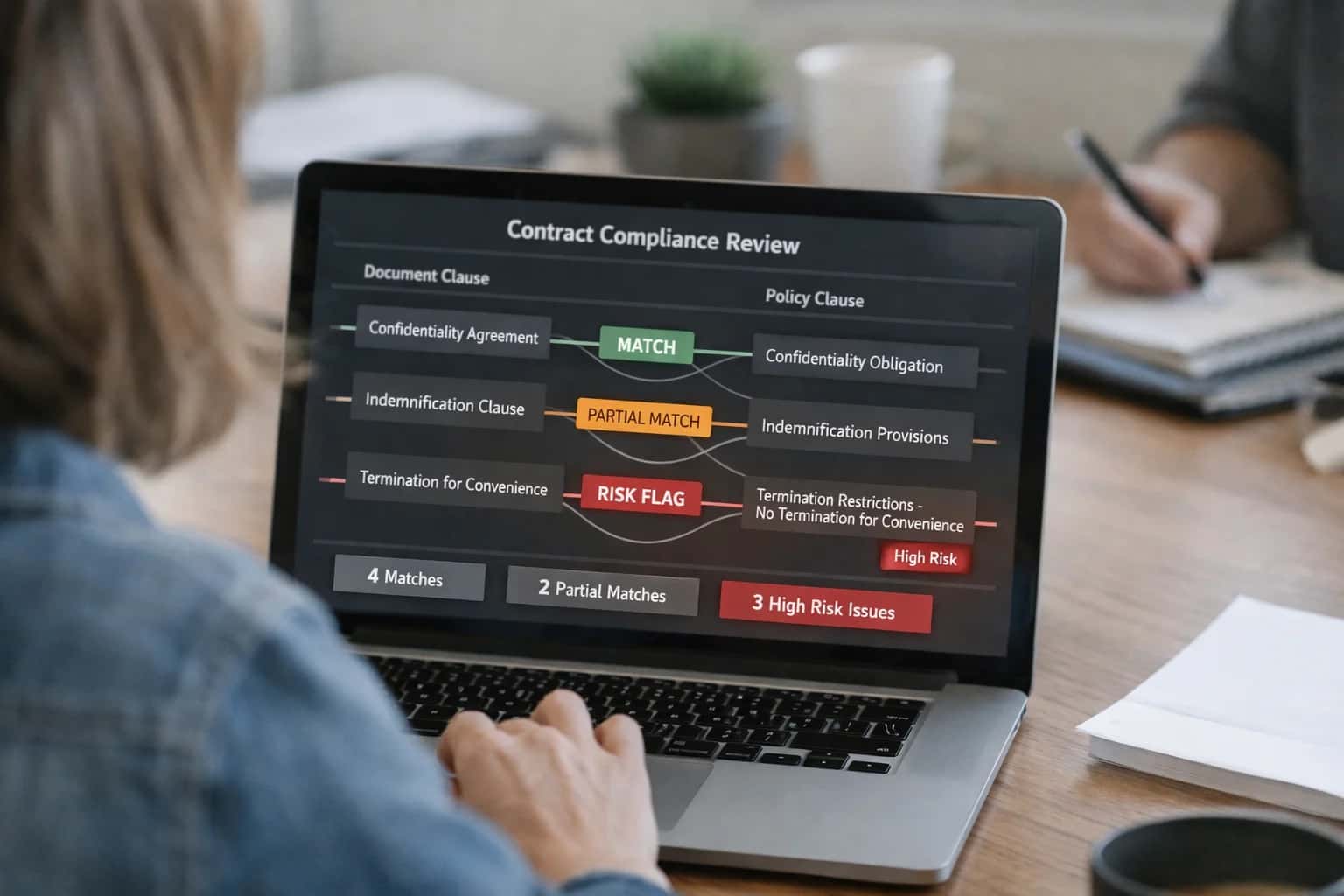
An autonomous AI agent that continuously monitors active contracts for compliance with terms, pricing, and SLAs, automatically flagging deviations and initiating corrective actions to protect revenue and reduce risk.
USE CASES
What is a Procurement Contract Compliance Agent Used For?
Procurement contracts are filled with value, but manual oversight leaves millions in savings and risk mitigation on the table. A Procurement Contract Compliance Agent is an autonomous AI system designed to capture that value continuously.
The AI fix is a virtual compliance officer. This agent uses natural language processing to read contracts, connects to ERP and invoicing systems, and autonomously monitors for deviations. It flags price discrepancies, tracks SLA performance, and can even initiate corrective workflows—like issuing a credit request. The outcome is measurable ROI: typical implementations recover 3-5% of annual spend, eliminate manual audit costs, and strengthen supplier relationships through consistent, data-driven enforcement. Explore our related solution for Autonomous Procurement Orchestration to see how this fits into a broader strategy.
AI ROI FOR THE ENTERPRISE
Common Use Cases: Solving Specific Procurement Pain Points
Move beyond basic automation to autonomous agents that deliver measurable business outcomes. These solutions target the core inefficiencies and risks in procurement, providing clear justification for investment.
01
Eliminate Costly Contract Leakage
Manual contract monitoring misses pricing errors, volume discounts, and SLA breaches, leading to annual leakage of 5-9% of contract value. Our agent acts as a 24/7 virtual auditor, continuously scanning active agreements against invoices and performance data. It autonomously flags deviations—like incorrect freight charges or missed rebates—and initiates corrective workflows, recovering millions in lost value.
- Real Example: A manufacturing client recovered $2.1M annually by automatically enforcing fuel surcharge caps across 300+ carrier contracts.
- ROI Driver: Direct cost recovery and prevention of future leakage.
5-9%
Typical Annual Contract Value Leakage
02
Automate Regulatory & Policy Compliance
Keeping up with evolving regulations (e.g., ESG clauses, conflict minerals, data privacy) and internal procurement policies is a high-risk, manual burden. This agent ingests regulatory updates and policy documents, then proactively scans contracts and supplier documentation for compliance gaps.
- Real Example: A global retailer automated checks for 'Made in USA' claims against supplier documentation, reducing audit prep time by 70% and mitigating false claim risk.
- ROI Driver: Eliminates manual review labor, reduces audit fines and reputational risk.
03
Enforce Supplier Performance & SLAs
Poor supplier performance on delivery, quality, or uptime directly impacts operations, but tracking it is reactive and fragmented. This agent integrates with ERP, IoT, and delivery systems to monitor SLAs in real-time. It generates performance scorecards, triggers remediation conversations, and provides data for negotiation.
- Real Example: A telecom provider used automated SLA tracking to identify a chronic late-delivery pattern from a key vendor, enabling a contract renegotiation that saved 15% on annual spend.
- ROI Driver: Improves operational reliability and strengthens negotiation leverage.
04
Streamline Contract Renewal & Risk Mitigation
Missed renewal dates lead to unfavorable auto-renewals or service lapses. Manual risk assessments are slow and inconsistent. The agent maintains a dynamic contract calendar and autonomously initiates the renewal process 90-120 days out. It performs pre-renewal risk analysis by scanning news, financials, and performance data.
- Real Example: An energy firm avoided a 3-year auto-renewal at above-market rates with a financially unstable supplier, pivoting to a more secure vendor and saving 22%.
- ROI Driver: Prevents value erosion from poor renewals and proactively manages supply chain risk.
05
Centralize Obligation & Deliverable Tracking
Critical obligations (e.g., implementation timelines, training deliverables, IP transfers) are buried in contract text and often missed. This agent extracts all obligations using NLP, creates a centralized register, and assigns owners. It sends automated reminders and escalates overdue items, ensuring nothing falls through the cracks.
- Real Example: A pharmaceutical company ensured 100% on-time delivery of clinical trial data from CROs by automating obligation tracking, accelerating time-to-market.
- ROI Driver: Accelerates project timelines and ensures full value realization from contracts.
06
Generate Audit-Ready Compliance Evidence
Internal and external audits require exhaustive evidence of compliance, a process that consumes hundreds of manual hours. This agent autonomously documents every compliance check, deviation, and corrective action in an immutable ledger. It can produce tailored, audit-ready reports on demand.
- Real Example: A financial services firm reduced its SOX audit preparation for procurement compliance from 6 weeks to 3 days, with zero findings.
- ROI Driver: Drastically cuts audit preparation cost and time while improving audit outcomes.
PROCUREMENT CONTRACT COMPLIANCE AGENT
How It Works: The 4-Step Autonomous Compliance Engine
Manual contract monitoring is a costly, error-prone drain on procurement and legal teams. Our autonomous agent transforms this reactive process into a proactive, self-correcting system.
The pain point is immense: buried in thousands of active contracts, critical terms like pricing discounts, service level agreements (SLAs), and auto-renewal clauses are manually tracked—if at all. This leads to missed savings, compliance breaches, and supplier disputes. Teams waste hundreds of hours on forensic reviews, while the business leaks value through unenforced terms and manual errors. It's a classic case of high operational cost with low strategic return.
The AI fix is our four-step engine: 1. Continuous Ingestion of contract documents and real-time transactional data. 2. Semantic Understanding where a neuro-symbolic AI extracts and maps obligations. 3. Proactive Monitoring against live POs, invoices, and performance data. 4. Autonomous Action, where the agent flags deviations, initiates corrective workflows, and logs a full audit trail. The outcome is 95% faster issue detection and a 70% reduction in manual oversight, directly protecting margin and mitigating risk. Learn more about our approach to Agentic Enterprise Orchestration and related solutions like our Intelligent Invoice-to-Pay Agent.
Enabling Efficiency, Speed & Accuracy
Intelligent Analysis, Decision & Execution
We build AI systems for teams that need search across company data, workflow automation across tools, or AI features inside products and internal software.
Talk to Us
Search across company data
Give teams answers from docs, tickets, runbooks, and product data with sources and permissions.
Useful when people spend too long searching or get different answers from different systems.
Enterprise searchRAGPermissions
Read more
Automate internal workflows
Use AI to route work, draft outputs, trigger actions, and keep approvals and logs in place.
Useful when repetitive work moves across multiple tools and teams.
AI agentsWorkflow automationGovernance
Read more
Add AI to products and internal tools
Build assistants, guided actions, or decision support into the software your team or customers already use.
Useful when AI needs to be part of the product, not a separate tool.
AI integrationDecision supportModel routing
Read morePROCUREMENT CONTRACT COMPLIANCE AGENT
Implementation Roadmap: From Pilot to Scale
A strategic, phased approach to deploying an AI agent that autonomously monitors contracts, flags deviations, and initiates corrective actions—transforming compliance from a cost center into a source of competitive advantage and risk mitigation.
01
Phase 1: Targeted Pilot & ROI Proof
Deploy the agent on a high-value, high-risk contract category (e.g., IT services, cloud infrastructure) to validate core functionality and quantify initial benefits. This controlled pilot focuses on automated clause monitoring and deviation alerting.
- Real-World Example: A manufacturing CIO piloted the agent on 50 critical supplier contracts, identifying $2.1M in annual billing overcharges within the first quarter due to missed volume discount triggers.
- Key Outcome: Establishes a clear, measurable ROI baseline (typically 3-5x on pilot costs) and builds internal stakeholder confidence for broader investment.
02
Phase 2: Process Integration & Workflow Automation
Scale the agent's capabilities by integrating it with core enterprise systems (ERP, CLM, P2P) and automating the initiation of corrective workflows.
- The AI Fix: The agent doesn't just flag issues; it autonomously generates dispute cases in the procurement system, drafts communication to suppliers, and routes exceptions for human review based on pre-defined rules.
- Quantified Benefit: This phase typically reduces manual compliance review time by 70-80%, allowing procurement teams to shift from policing to strategic relationship management. It directly addresses the pain of missed SLA credits and pricing term drift.
03
Phase 3: Enterprise Scale & Predictive Intelligence
Expand coverage to the entire contract portfolio and enhance the agent with predictive analytics to proactively manage risk and opportunity.
- Business Language: The system evolves from monitoring to prescriptive guidance. It analyzes patterns to predict which suppliers are likely to breach SLAs or which contract renewals carry unfavorable terms, enabling pre-emptive renegotiation.
- Competitive Advantage: Provides the CIO with a unified compliance dashboard, turning contract data into a strategic asset for negotiating leverage, optimizing spend, and ensuring regulatory adherence across global operations.
04
Phase 4: Autonomous Ecosystem & Outcome-Based Value
The agent becomes a core component of an agentic enterprise orchestration layer, collaborating with other autonomous agents (e.g., Intelligent Invoice-to-Pay, Dynamic Supply Chain Negotiator) to run end-to-source-to-pay workflows.
- Realistic Vision: This creates a self-correcting procurement ecosystem. A compliance deviation automatically triggers a payment hold, a supplier negotiation, and a contract amendment workflow—all with human oversight, not human execution.
- ROI-Focused Outcome: Shifts the business model from paying for software licenses to paying for guaranteed outcomes, such as % reduction in compliance leakage or % improvement in contract utilization, aligning vendor incentives directly with business performance.
05
Key Justification Metrics for the CIO
To secure budget, frame the investment around these concrete, board-level metrics:
- Cost Avoidance: Reduction in billing errors, missed rebates, and regulatory penalties.
- Efficiency Gains: FTE hours reclaimed from manual contract review and audit preparation.
- Risk Mitigation: Percentage decrease in high-risk contract violations and improved audit readiness scores.
- Strategic Value: Improved supplier performance and enhanced negotiation leverage from data-driven insights.
06
Common Challenges & Mitigation Strategies
Acknowledge and plan for realistic hurdles to ensure a smooth scale-up:
- Data Silos: Start with well-structured contracts; use the pilot phase to develop connectors for disparate systems.
- Change Management: Position the agent as a copilot for procurement teams, eliminating grunt work, not jobs. Provide clear training on exception handling.
- Evolving Regulations: Architect the agent's rule engine for easy updates by legal/compliance teams, ensuring the system adapts to new requirements without full redevelopment.

About the author
Prasad Kumkar
CEO & MD, Inference Systems
Prasad Kumkar is the CEO & MD of Inference Systems and writes about AI systems architecture, LLM infrastructure, model serving, evaluation, and production deployment. Over 5+ years, he has worked across computer vision models, L5 autonomous vehicle systems, and LLM research, with a focus on taking complex AI ideas into real-world engineering systems.
His work and writing cover AI systems, large language models, AI agents, multimodal systems, autonomous systems, inference optimization, RAG, evaluation, and production AI engineering.
LinkedIn
Limited slotsGet a Free AI Consultation
Partnered with leading AI, data, and software stack.





How We Work
Custom AI workflows for your Business
One-fit-all AI don't work for modern businesses. At Inferensys, we aim to understand your business & custom requirements; which we use to define most efficient agentic workflows, the data, and the tools for your business.
01
Review the use case
We understand the task, the users, and where AI can actually help.
Read more02
Pick the right approach
We define what needs search, automation, or product integration.
Read more03
Build the first useful version
We implement the part that proves the value first.
Read more04
Improve from there
We add the checks and visibility needed to keep it useful.
Read moreThe first call is a practical review of your use case and the right next step.
Talk to Us