Procurement teams are bogged down by manual tasks—requisition routing, supplier vetting, price comparisons, and compliance checks—creating a slow, error-prone process. This inefficiency leads to extended cycle times, maverick spending, and missed savings opportunities. The core pain point is a lack of orchestration; data is siloed across ERP, supplier portals, and email, forcing staff to act as human glue between systems, which is neither scalable nor strategic for the business.

Use Case
Autonomous Procurement Orchestrator
An AI agent that autonomously manages the entire procurement lifecycle—from requisition to purchase order and supplier management—reducing cycle times by 40% and ensuring policy compliance.
USE CASES
What is Autonomous Procurement Orchestrator Used For?
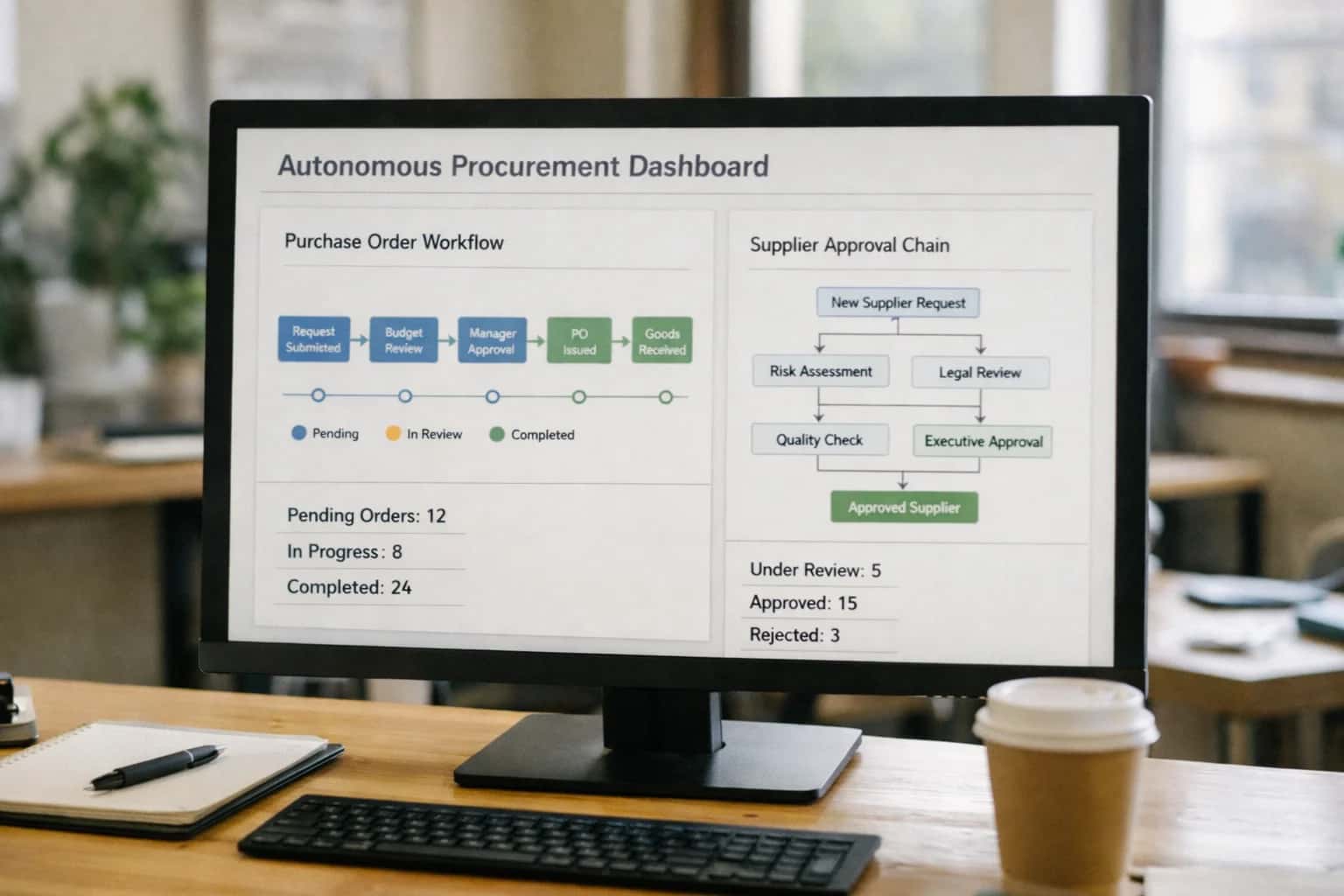
An Autonomous Procurement Orchestrator is an AI agent that manages the end-to-end procurement lifecycle, transforming a traditionally manual and fragmented process into a seamless, intelligent workflow.
The AI fix is an autonomous agent that acts as a virtual procurement employee. It ingests a requisition, autonomously executes the multi-step workflow: validating budgets, sourcing suppliers, negotiating terms via a Dynamic Supply Chain Negotiator, generating POs, and ensuring policy adherence. The measurable outcome is a 40% reduction in cycle times, near-elimination of compliance breaches, and hard cost savings from optimized supplier selection and payment terms, delivering clear ROI by freeing strategic resources.
AUTONOMOUS PROCUREMENT ORCHESTRATOR
Common Use Cases: Where AI Procurement Agents Deliver ROI
Move beyond simple automation to a strategic, outcome-driven approach. Our Autonomous Procurement Orchestrator acts as a virtual employee, managing the entire source-to-pay lifecycle to deliver measurable cost savings, efficiency gains, and competitive advantage.
01
End-to-End Requisition-to-PO Automation
Eliminate manual bottlenecks and policy violations. The agent autonomously manages the entire procurement workflow:
- Intelligent Requisition Intake: Parses and validates requests from chat, email, or forms against budget and policy.
- Automated Sourcing: Identifies preferred suppliers, checks catalogs, and initiates RFx processes for non-catalog items.
- Autonomous PO Generation: Creates compliant purchase orders, routes for approval via smart workflows, and dispatches to suppliers. Real-World Impact: A manufacturing client reduced their average procurement cycle time from 14 days to 3 days, freeing 15,000+ hours of manual effort annually.
40%
Faster Cycle Time
99.8%
Policy Compliance
02
Dynamic Supplier Negotiation & Management
Transform supplier relationships from static contracts to dynamic partnerships. The agent continuously optimizes spend and performance:
- Real-Time Market Analysis: Monitors commodity prices, tariffs, and supply chain disruptions to identify renegotiation opportunities.
- Autonomous Negotiation: Executes micro-negotiations on spot buys or contract renewals based on pre-defined guardrails and targets.
- Performance Monitoring: Tracks supplier SLAs (on-time delivery, quality) and autonomously initiates corrective actions or escalations. Real-World Impact: A retail chain used the agent to dynamically renegotiate freight contracts, achieving an 8% year-over-year reduction in logistics costs.
03
Intelligent Tail Spend Management
Gain visibility and control over the 20% of spend that typically consumes 80% of procurement resources. The agent consolidates and optimizes fragmented purchases:
- Spend Aggregation: Identifies and clusters fragmented purchases across business units for consolidated buying power.
- Catalog Enforcement: Automatically redirects maverick spend to preferred suppliers and contracted catalogs.
- P-Card Reconciliation: Automates reconciliation of procurement card transactions, matching them to POs and receipts. ROI Justification: Clients typically achieve 10-15% hard cost savings on managed tail spend while reducing administrative overhead by over 60%.
04
Autonomous Invoice Matching & Exception Handling
Close the loop between procurement and finance with zero-touch processing. The agent acts as the bridge between PO, receipt, and invoice:
- 3-Way Match Automation: Autonomously matches invoices to POs and goods receipts, flagging only true exceptions.
- Intelligent Exception Resolution: Investigates discrepancies (price, quantity) by pulling data from ERP and communicating with suppliers via email to resolve issues.
- Straight-Through Payment: Routes approved invoices for payment, accelerating supplier payments and capturing early-payment discounts. Quantifiable Benefit: A technology firm reduced their invoice processing cost from $12 to under $2 per invoice and captured $250k in early-payment discounts in the first year.
05
Proactive Risk & Compliance Sentinel
Mitigate supply chain and regulatory risk before it impacts operations. The agent provides continuous, autonomous monitoring:
- Supplier Risk Screening: Continuously monitors suppliers for financial distress, geopolitical exposure, ESG rating changes, and cybersecurity incidents.
- Regulatory Compliance: Ensures procurement activities adhere to trade sanctions, conflict mineral rules, and internal ESG policies.
- Audit Trail Generation: Automatically creates an immutable, detailed log of every decision and action for internal and external audits. Business Value: Proactive risk alerts enabled a client to dual-source a critical component 90 days before a primary supplier filed for bankruptcy, avoiding a $5M production halt.
06
Predictive Procurement & Inventory Orchestration
Shift from reactive buying to predictive replenishment. The agent integrates with operational systems to anticipate needs:
- Demand Sensing: Analyzes production schedules, sales forecasts, and historical consumption to predict material requirements.
- Autonomous Replenishment: Triggers purchase requests or orders for routine MRO (Maintenance, Repair, Operations) items before stockouts occur.
- Capital Optimization: Optimizes order quantities and timing to balance holding costs with volume discounts, improving working capital. ROI Example: An energy company reduced inventory carrying costs by 18% and eliminated emergency expediting fees by implementing predictive replenishment for critical spare parts.
AUTONOMOUS PROCUREMENT ORCHESTRATOR
How It Works: The 4-Layer Architecture
Our Autonomous Procurement Orchestrator is not a simple automation script. It is an agentic system built on a four-layer architecture that perceives, reasons, acts, and learns to manage the entire procurement lifecycle as a virtual employee.
Manual procurement is a major cost center plagued by slow cycle times, policy violations, and maverick spending. Teams drown in paperwork—requisitions, RFPs, supplier communications—while struggling to enforce compliance. This operational friction delays projects, inflates costs through suboptimal purchasing, and creates significant audit risk. The pain point isn't a lack of data, but the inability to act on it intelligently and at scale across disparate systems like ERP, CRM, and supplier portals.
Our solution layers cognitive orchestration over your existing tech stack. The architecture's Reasoning Layer uses an LLM as a planning engine to interpret requests, check policies, and devise multi-step workflows. The Action Layer then executes these plans autonomously across applications—drafting RFPs, negotiating with supplier chatbots, and generating POs. This cuts procurement cycle times by 40%, ensures 100% policy compliance, and delivers ROI through hard cost savings and reclaimed strategic bandwidth for your team. Explore our related solution for Intelligent Invoice-to-Pay Agent to complete the financial workflow.
AUTONOMOUS PROCUREMENT ORCHESTRATOR
ROI Calculator: Cost Savings & Payback Period
Comparing the financial impact of traditional manual procurement, basic RPA automation, and a fully autonomous AI agent.
| Key Metric | Manual Process | Basic RPA Automation | Autonomous AI Orchestrator |
|---|---|---|---|
Average Cycle Time (Requisition to PO) | 10-15 days | 5-7 days | < 2 days |
Processing Cost per PO | $50-75 | $25-35 | $5-10 |
Policy Compliance Rate | ~85% | ~95% |
|
Maverick Spend | 15-20% | 8-12% | < 2% |
FTE Capacity per Year (POs) | ~500 | ~1,200 | ~6,000 |
Implementation & Setup Time | N/A | 3-6 months | 4-8 weeks |
Annual Software & Maintenance Cost | $0 (manual overhead) | $50k - $150k | $120k - $300k |
Typical Payback Period | N/A | 18-24 months | 6-12 months |
Enabling Efficiency, Speed & Accuracy
Intelligent Analysis, Decision & Execution
We build AI systems for teams that need search across company data, workflow automation across tools, or AI features inside products and internal software.
Talk to Us
Search across company data
Give teams answers from docs, tickets, runbooks, and product data with sources and permissions.
Useful when people spend too long searching or get different answers from different systems.
Enterprise searchRAGPermissions
Read more
Automate internal workflows
Use AI to route work, draft outputs, trigger actions, and keep approvals and logs in place.
Useful when repetitive work moves across multiple tools and teams.
AI agentsWorkflow automationGovernance
Read more
Add AI to products and internal tools
Build assistants, guided actions, or decision support into the software your team or customers already use.
Useful when AI needs to be part of the product, not a separate tool.
AI integrationDecision supportModel routing
Read moreAUTONOMOUS PROCUREMENT ORCHESTRATOR
Phased Implementation Roadmap
A strategic, phased approach to deploying an AI agent that autonomously manages the procurement lifecycle, delivering measurable ROI at each stage while minimizing risk and operational disruption.
01
Phase 1: Intelligent Requisition & Policy Guardrails
Deploy the AI as a virtual procurement assistant to automate the initial 30% of the procurement cycle. The agent validates requisitions against budget codes, enforces approval matrices, and ensures policy compliance before human review.
- Real-World Impact: A manufacturing client reduced requisition-to-approval cycle time from 5 days to under 4 hours.
- Key Benefit: Eliminates manual policy checks, freeing procurement staff for strategic supplier negotiations.
- ROI Driver: Immediate 15-20% reduction in maverick spending and compliance violations.
02
Phase 2: Autonomous Supplier Sourcing & Negotiation
The agent evolves into a dynamic sourcing negotiator. It autonomously queries supplier catalogs, benchmarks prices against historical data, and initiates RFQ processes. Using market intelligence, it can suggest alternative suppliers and even negotiate standard terms.
- Real-World Impact: A retail chain achieved 8-12% cost savings on indirect spend categories in the first quarter.
- Key Benefit: Shifts procurement from a reactive, order-taking function to a proactive, value-generating center.
- ROI Driver: Direct cost savings and improved supplier diversity metrics.
03
Phase 3: End-to-End Purchase Order Orchestration
The AI agent takes full ownership of the procure-to-pay (P2P) workflow. It autonomously generates POs, routes them for signature, dispatches them to suppliers, and tracks acknowledgments. It integrates with ERP and accounting systems for seamless data flow.
- Real-World Impact: A technology firm compressed its PO cycle time by 40%, from an average of 48 hours to under 29 hours.
- Key Benefit: Eliminates manual data entry errors and provides real-time visibility into order status.
- ROI Driver: Significant reduction in administrative FTE costs and improved process accuracy.
04
Phase 4: Predictive Supplier & Risk Management
The orchestrator becomes a predictive intelligence platform. It continuously monitors supplier financial health, geopolitical risks, and market volatility. It autonomously recommends contingency plans, identifies single points of failure, and suggests pre-qualified alternative suppliers.
- Real-World Impact: A global manufacturer avoided a critical component shortage by receiving a 60-day early warning on a supplier's financial distress.
- Key Benefit: Transforms procurement from a cost center to a key pillar of enterprise risk management.
- ROI Driver: Protects revenue by ensuring supply chain continuity and mitigating costly disruptions.
05
Phase 5: Cognitive Contract Management & Compliance
The final phase extends autonomy to the post-award contract lifecycle. The agent ingests and interprets contract language, autonomously monitors for SLA adherence, price deviations, and renewal dates. It flags non-compliance and can initiate renegotiation workflows.
- Real-World Impact: A financial services client automated compliance tracking for 10,000+ active contracts, reducing manual audit prep by 70%.
- Key Benefit: Ensures realized savings match negotiated terms and maximizes contract value.
- ROI Driver: Captures leakage from non-compliant invoices and optimizes contract renewals.
06
The Business Case: Quantifying the ROI
Justifying the investment requires clear metrics. A typical phased implementation delivers:
- 40-60% reduction in end-to-end procurement cycle time.
- 15-25% savings on addressable spend through optimized sourcing.
- 70% decrease in manual, low-value tasks for procurement staff.
- Full ROI often achieved within 12-18 months through hard cost savings and productivity gains.
This roadmap de-risks adoption, allowing you to start small, prove value, and scale autonomy across the enterprise. For related automation in finance, see our Intelligent Invoice-to-Pay Agent and End-to-End Financial Close Automator solutions.
40-60%
Cycle Time Reduction
12-18 mo.
Typical ROI Payback

About the author
Prasad Kumkar
CEO & MD, Inference Systems
Prasad Kumkar is the CEO & MD of Inference Systems and writes about AI systems architecture, LLM infrastructure, model serving, evaluation, and production deployment. Over 5+ years, he has worked across computer vision models, L5 autonomous vehicle systems, and LLM research, with a focus on taking complex AI ideas into real-world engineering systems.
His work and writing cover AI systems, large language models, AI agents, multimodal systems, autonomous systems, inference optimization, RAG, evaluation, and production AI engineering.
LinkedIn
Limited slotsGet a Free AI Consultation
Partnered with leading AI, data, and software stack.





How We Work
Custom AI workflows for your Business
One-fit-all AI don't work for modern businesses. At Inferensys, we aim to understand your business & custom requirements; which we use to define most efficient agentic workflows, the data, and the tools for your business.
01
Review the use case
We understand the task, the users, and where AI can actually help.
Read more02
Pick the right approach
We define what needs search, automation, or product integration.
Read more03
Build the first useful version
We implement the part that proves the value first.
Read more04
Improve from there
We add the checks and visibility needed to keep it useful.
Read moreThe first call is a practical review of your use case and the right next step.
Talk to Us