An autonomous compliance gateway is a fail-closed system that acts as mandatory middleware for AI-driven B2B purchases. Its core function is to intercept transaction requests from an AI Buyer and validate them against a dynamic rules engine. This engine checks for export controls, sanctioned entities, internal procurement policies, and budget approvals. Every decision is logged with a complete audit trail, creating an immutable record for regulators and internal auditors. This architecture is a foundational component of robust Human-in-the-Loop (HITL) Governance Systems.

Guide
Launching a Compliance Gateway for Autonomous B2B Purchases
A technical guide to building a middleware layer that validates AI-driven transactions against regulatory and corporate rules before order submission.
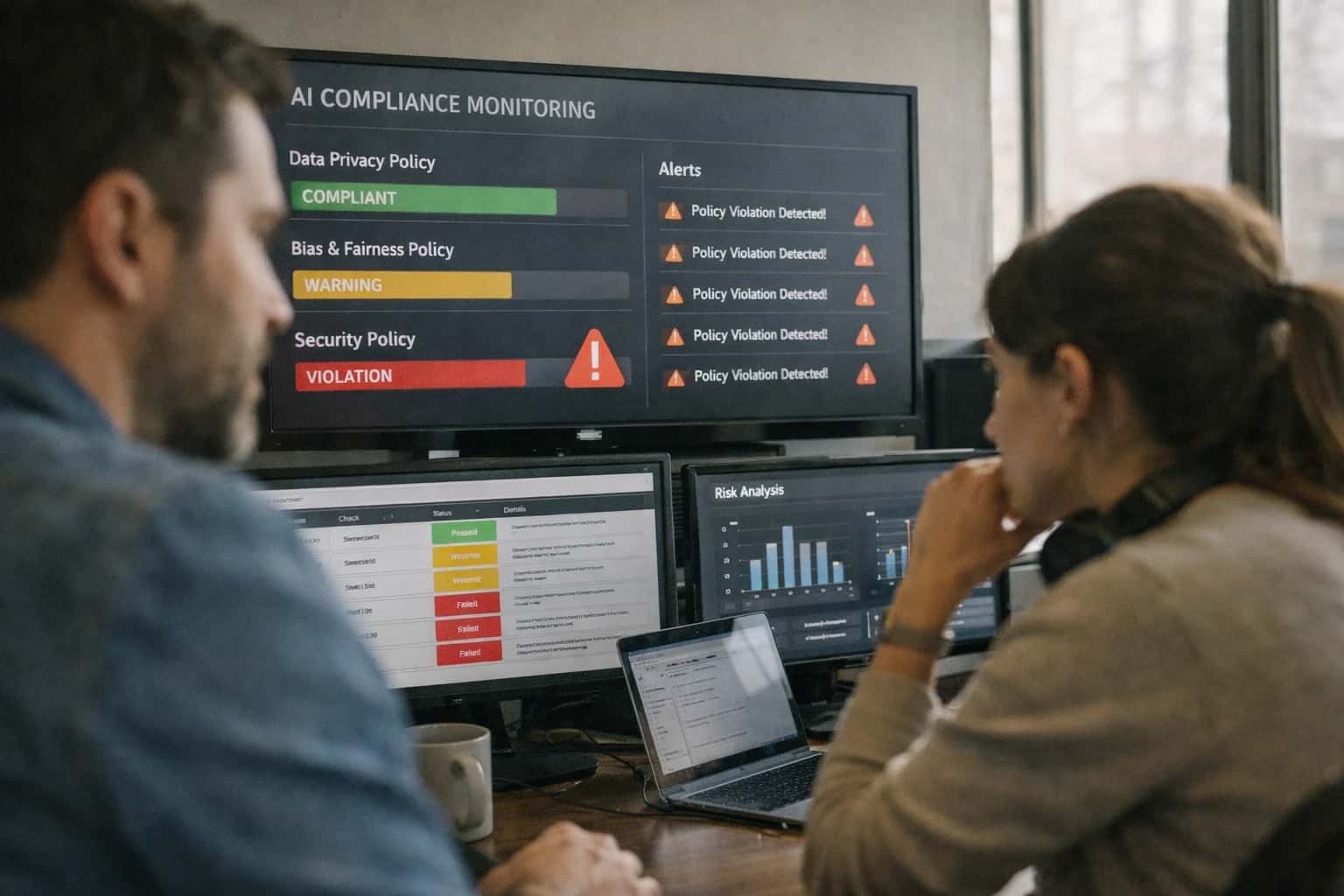
A compliance gateway is the critical middleware that validates autonomous AI transactions against regulatory and corporate rules before order submission.
To build this, you integrate with live compliance databases like OFAC lists and design a rules engine using tools like Drools or a custom DSL. The gateway exposes a simple API: it receives a proposed order payload, executes all compliance checks, and returns a pass/fail decision with reasoning. Key implementation steps include designing idempotent APIs, setting up real-time data feeds, and creating alerting for rogue actions. This ensures autonomous commerce scales without introducing legal or financial risk.
INTEGRATION REQUIREMENTS
Compliance Data Sources and Tools
A comparison of data providers and validation tools essential for building a compliance gateway that checks autonomous transactions against export controls, sanctions lists, and internal policies.
| Data Source / Tool | Official Government Lists | Commercial Aggregators | Internal Policy Engine |
|---|---|---|---|
Primary Use Case | Direct legal authority for sanctions (OFAC, BIS) | Unified API for global watchlists & PEPs | Encode corporate procurement rules |
Update Frequency | Manual or daily (varies by agency) | Real-time or sub-hourly | On-demand via admin UI |
Integration Method | File download (XML/CSV) & manual parsing | REST API with API key | Internal rules engine (e.g., Drools, OPA) |
Coverage Scope | National (e.g., US, EU) jurisdiction only | Global (200+ jurisdictions, adverse media) | Company-specific departments & budgets |
Entity Matching Logic | Exact name & alias matching required | Fuzzy matching & AI-powered disambiguation | Boolean logic on transaction metadata |
Audit Trail Support | None (you must log checks manually) | Built-in query logging & reports | Full decision trace with rule versioning |
Typical Latency | High (batch processing required) | Low (< 100 ms per API call) | Very low (< 10 ms for rule evaluation) |
Cost Model | Free (public data) | Subscription (per API call or tier) | Development & maintenance overhead |
Enabling Efficiency, Speed & Accuracy
Intelligent Analysis, Decision & Execution
We build AI systems for teams that need search across company data, workflow automation across tools, or AI features inside products and internal software.
Talk to Us
Search across company data
Give teams answers from docs, tickets, runbooks, and product data with sources and permissions.
Useful when people spend too long searching or get different answers from different systems.
Enterprise searchRAGPermissions
Read more
Automate internal workflows
Use AI to route work, draft outputs, trigger actions, and keep approvals and logs in place.
Useful when repetitive work moves across multiple tools and teams.
AI agentsWorkflow automationGovernance
Read more
Add AI to products and internal tools
Build assistants, guided actions, or decision support into the software your team or customers already use.
Useful when AI needs to be part of the product, not a separate tool.
AI integrationDecision supportModel routing
Read moreTROUBLESHOOTING
Common Mistakes
Building a compliance gateway for autonomous B2B purchases is a high-stakes engineering challenge. These are the most frequent technical pitfalls developers encounter and how to fix them.
A fail-open design is the most critical mistake, as it defeats the gateway's purpose. This happens when the primary compliance check is wrapped in a try-catch block that defaults to 'approved' on any error.
Fix: Implement a fail-closed architecture. The system must treat any unhandled exception, timeout, or data unavailability as a 'deny' signal. Use a circuit breaker pattern for external API calls (e.g., to sanctions lists). Log the failure reason for audit, but never approve a transaction you cannot validate.
python# BAD - Fail Open try: is_compliant = check_sanctions(order) except Exception: is_compliant = True # Dangerous default! # GOOD - Fail Closed try: is_compliant = check_sanctions(order) except Exception as e: log_audit_event(order, "SANCTION_CHECK_FAILED", str(e)) is_compliant = False # Safe default

About the author
Prasad Kumkar
CEO & MD, Inference Systems
Prasad Kumkar is the CEO & MD of Inference Systems and writes about AI systems architecture, LLM infrastructure, model serving, evaluation, and production deployment. Over 5+ years, he has worked across computer vision models, L5 autonomous vehicle systems, and LLM research, with a focus on taking complex AI ideas into real-world engineering systems.
His work and writing cover AI systems, large language models, AI agents, multimodal systems, autonomous systems, inference optimization, RAG, evaluation, and production AI engineering.
LinkedIn
Limited slotsGet a Free AI Consultation
Partnered with leading AI, data, and software stack.





How We Work
Custom AI workflows for your Business
One-fit-all AI don't work for modern businesses. At Inferensys, we aim to understand your business & custom requirements; which we use to define most efficient agentic workflows, the data, and the tools for your business.
01
Review the use case
We understand the task, the users, and where AI can actually help.
Read more02
Pick the right approach
We define what needs search, automation, or product integration.
Read more03
Build the first useful version
We implement the part that proves the value first.
Read more04
Improve from there
We add the checks and visibility needed to keep it useful.
Read moreThe first call is a practical review of your use case and the right next step.
Talk to Us