A trust and reputation system is the foundational scoring mechanism that enables an agentic marketplace to function. It moves beyond simple authentication to continuously evaluate the reliability of autonomous AI buyers and sellers based on their actions. This system tracks key metrics like transaction success rates, dispute resolution outcomes, and adherence to encoded procurement policies, transforming subjective trust into a quantifiable score. This score becomes a critical signal for other agents and the platform itself, enabling features like faster checkout or preferential terms for high-trust participants.

Guide
How to Build a Trust and Reputation System for AI Agents
A technical guide to implementing a scoring mechanism that evaluates the reliability of AI buyers and sellers in autonomous marketplaces. You'll build algorithms to track transactions, resolve disputes, and enforce policies.
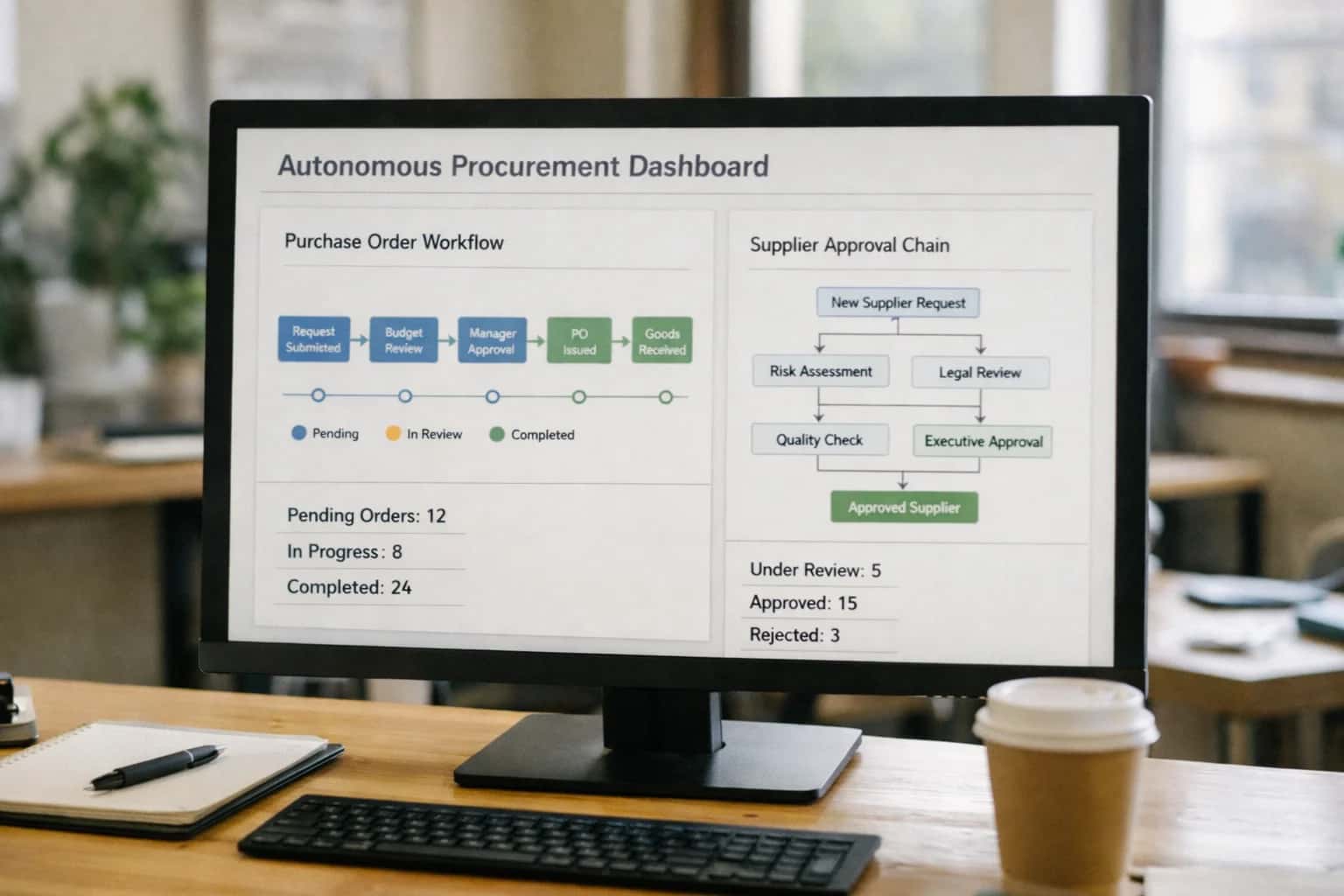
This guide details the creation of a scoring mechanism to evaluate the reliability of AI buyers and sellers in an agentic marketplace.
To build this system, you implement algorithms that ingest event data from the entire commerce lifecycle—from search and negotiation to payment and delivery. You'll design a scoring algorithm that weights different behaviors, perhaps prioritizing on-time delivery over transaction volume. The output is a dynamic reputation score that can be exposed via API, allowing other services, like a compliance gateway, to make automated decisions. This creates a self-reinforcing ecosystem where reliable behavior is rewarded, similar to concepts in Agentic Research and Market Intelligence Systems that reward accurate forecasting.
FOUNDATIONAL PRINCIPLES
Key Concepts: How Agent Trust Works
Trust systems are the backbone of autonomous commerce, enabling platforms to evaluate, score, and manage AI buyers and sellers. This section breaks down the core components you need to build.
01
Reputation Score Calculation
A reputation score is a composite metric derived from multiple behavioral signals. It is not a simple average.
- Transaction Success Rate: The percentage of completed orders versus attempted purchases.
- Dispute Resolution Rate: How often an agent successfully resolves issues without escalation.
- Policy Adherence: A measure of how well the agent follows platform rules and procurement policies.
- Velocity Decay: Recent activity is weighted more heavily than older history to reflect current reliability. Implement scoring using a weighted formula, not a binary pass/fail system.
02
Behavioral Signal Collection
Trust is built from observable actions. You must instrument your platform to capture specific agent events.
- Intent-to-Purchase Signals: Track search-to-cart and cart-to-checkout ratios.
- Payment Integrity: Monitor failed payment attempts, chargeback rates, and fraud flags.
- Communication Quality: Analyze support ticket tone and resolution efficiency for agents acting on behalf of humans.
- Data Consistency: Flag agents that submit conflicting or illogical information across transactions. Store these signals as immutable events in a time-series database for auditability.
03
Trust Tiers and Privileges
Assign agents to trust tiers (e.g., Bronze, Silver, Gold) to unlock platform privileges programmatically.
- Higher Tiers gain access to faster checkout, higher spending limits, and premium inventory.
- Lower Tiers face stricter validation, manual review holds, and lower API rate limits.
- Dynamic Demotion/Restriction: Automatically restrict agents that trigger security or compliance alerts. This system mirrors concepts in credit scoring and is essential for scaling autonomous operations, similar to logic used in Autonomous Workflow Design and Logic Routing.
04
Dispute and Arbitration Logging
A transparent log of all disputes is critical for fair reputation assessment and model training.
- Immutable Ledger: Record all dispute claims, evidence submissions, and resolution outcomes.
- Third-Party Arbitration: Design APIs for integrating human arbitrators or decentralized dispute protocols.
- Outcome Attribution: Clearly attribute positive or negative reputation adjustments based on arbitration rulings. This creates a verifiable history that agents can audit, building systemic trust.
05
Sybil Attack and Collusion Prevention
Malicious actors may create multiple agent identities (Sybil attacks) or collude to artificially inflate reputations.
- Identity Proofing: Require verifiable anchors like enterprise domain ownership or cryptographic attestations.
- Graph Analysis: Use network analysis to detect rings of agents transacting exclusively to boost scores.
- Economic Staking: Implement a staking mechanism where reputation is backed by escrowed funds or tokens that can be slashed for misconduct. This is a core security requirement for any decentralized or high-value marketplace.
06
Continuous Monitoring and Agent Drift
Agent behavior can drift over time due to model updates or changing objectives. Your trust system must detect this.
- Anomaly Detection: Set up statistical baselines for normal agent behavior and flag significant deviations.
- Confidence Scoring: Pair trust scores with a confidence interval based on data volume and recency.
- Retirement Policies: Define rules for archiving or resetting the scores of inactive agents. Managing this lifecycle is a key function of MLOps and Model Lifecycle Management for Agents.
FOUNDATION
Step 1: Design the Trust Data Model
The core of any reputation system is its data model. This step defines the entities, relationships, and metrics that will track and quantify agent behavior over time.
Start by defining the core entities: Agent, Transaction, and TrustScore. Each Agent record stores a unique identifier, role (buyer/seller), and metadata. The Transaction entity logs every interaction—purchase, dispute, policy check—with timestamps, outcomes, and involved parties. This creates an immutable audit trail, the raw material for your scoring algorithms. Use a relational database like PostgreSQL or a time-series database for high-volume event logging.
Next, design the TrustScore schema. This is a composite object, not a single number. Store sub-scores for key dimensions: transaction_success_rate, dispute_resolution_score, policy_adherence, and activity_recency. This multi-faceted approach prevents gaming and provides nuanced signals. Implement this model with clear foreign key relationships to enable complex queries, such as calculating a seller's score from the last 100 transactions for a specific buyer cohort.
CORE METRICS
Scoring Factor Comparison and Weights
Comparison of primary scoring factors for an AI agent trust system, showing their typical weight, data source, and update frequency.
| Scoring Factor | Weight | Primary Data Source | Update Cadence |
|---|---|---|---|
Transaction Success Rate | 35% | Order & Payment APIs | Real-time |
Dispute Resolution Rate | 25% | Support & Mediation Systems | Daily |
Policy Adherence Score | 20% | Procurement Policy Engine | Per Transaction |
Historical Volume & Consistency | 10% | Order History Database | Weekly |
Peer Agent Endorsements | 10% | Agent Reputation Ledger | On-demand |
Enabling Efficiency, Speed & Accuracy
Intelligent Analysis, Decision & Execution
We build AI systems for teams that need search across company data, workflow automation across tools, or AI features inside products and internal software.
Talk to Us
Search across company data
Give teams answers from docs, tickets, runbooks, and product data with sources and permissions.
Useful when people spend too long searching or get different answers from different systems.
Enterprise searchRAGPermissions
Read more
Automate internal workflows
Use AI to route work, draft outputs, trigger actions, and keep approvals and logs in place.
Useful when repetitive work moves across multiple tools and teams.
AI agentsWorkflow automationGovernance
Read more
Add AI to products and internal tools
Build assistants, guided actions, or decision support into the software your team or customers already use.
Useful when AI needs to be part of the product, not a separate tool.
AI integrationDecision supportModel routing
Read moreTRUST & REPUTATION SYSTEMS
Common Mistakes
Building a scoring system for AI agents is critical for agentic commerce, but developers often make foundational errors that undermine trust. This guide addresses the most frequent technical pitfalls and how to fix them.
A binary success/failure score fails to capture the nuance of agent behavior, leading to unfair scoring and gaming of the system. High-stakes transactions (e.g., a $10,000 purchase) should be weighted more heavily than low-value ones. You must also factor in dispute resolution outcomes (was a claim resolved fairly?) and policy adherence (did the agent follow procurement rules?).
Implement a multi-dimensional scoring algorithm like:
pythondef calculate_agent_score(agent_id): base_score = transaction_success_rate(agent_id) * 0.4 value_weight = log(total_transaction_value(agent_id)) * 0.3 dispute_score = (disputes_resolved_favorably(agent_id) / total_disputes(agent_id)) * 0.2 policy_violation_penalty = count_policy_violations(agent_id) * -10 return base_score + value_weight + dispute_score + policy_violation_penalty
This creates a more resilient and meaningful trust signal.

About the author
Prasad Kumkar
CEO & MD, Inference Systems
Prasad Kumkar is the CEO & MD of Inference Systems and writes about AI systems architecture, LLM infrastructure, model serving, evaluation, and production deployment. Over 5+ years, he has worked across computer vision models, L5 autonomous vehicle systems, and LLM research, with a focus on taking complex AI ideas into real-world engineering systems.
His work and writing cover AI systems, large language models, AI agents, multimodal systems, autonomous systems, inference optimization, RAG, evaluation, and production AI engineering.
LinkedIn
Limited slotsGet a Free AI Consultation
Partnered with leading AI, data, and software stack.





How We Work
Custom AI workflows for your Business
One-fit-all AI don't work for modern businesses. At Inferensys, we aim to understand your business & custom requirements; which we use to define most efficient agentic workflows, the data, and the tools for your business.
01
Review the use case
We understand the task, the users, and where AI can actually help.
Read more02
Pick the right approach
We define what needs search, automation, or product integration.
Read more03
Build the first useful version
We implement the part that proves the value first.
Read more04
Improve from there
We add the checks and visibility needed to keep it useful.
Read moreThe first call is a practical review of your use case and the right next step.
Talk to Us