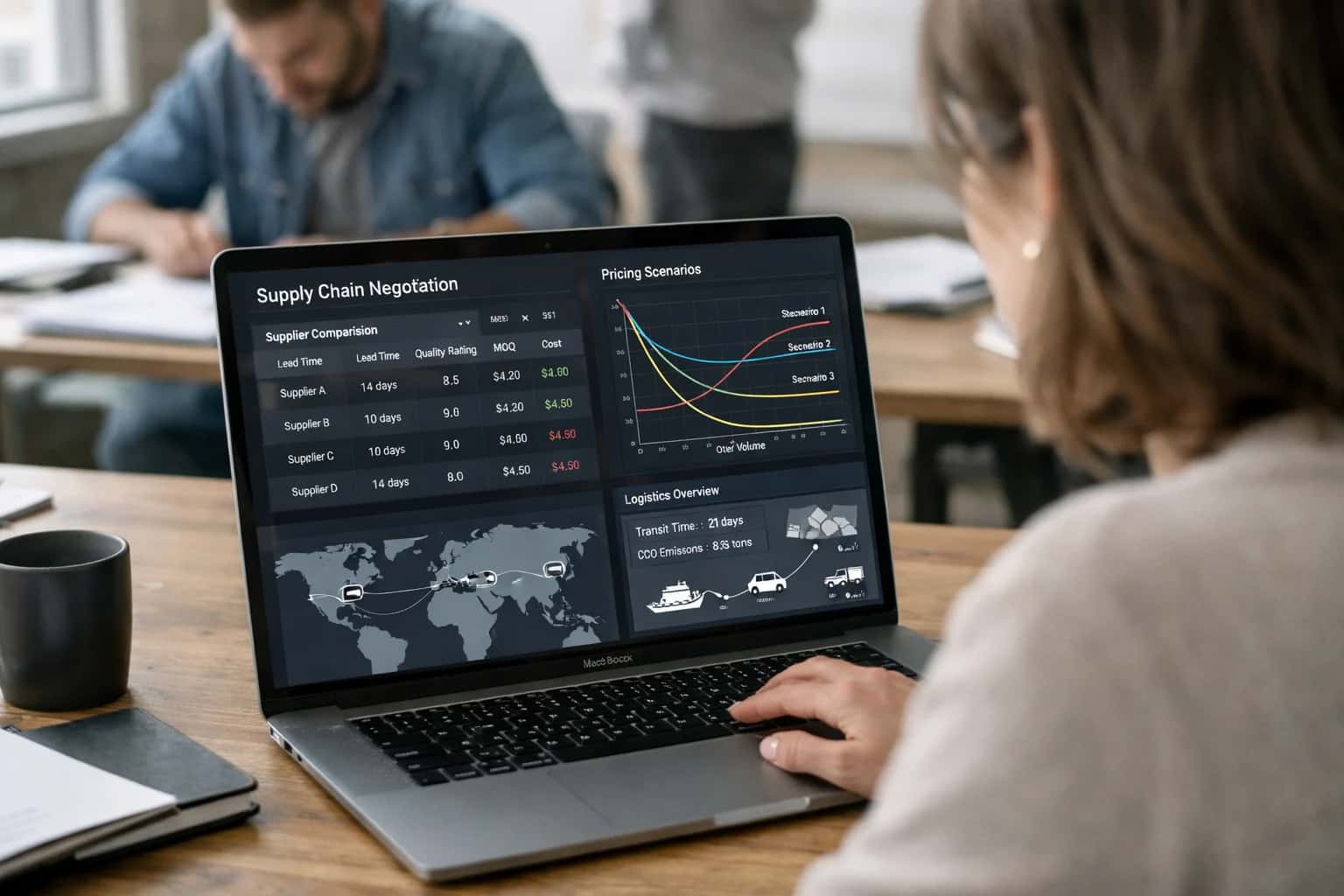
Replace static spreadsheets with dynamic, AI-driven simulations. We engineer custom environments using reinforcement learning to model your end-to-end supply chain, from raw materials to last-mile delivery. Run thousands of parallel 'what-if' scenarios—from port closures and supplier bankruptcies to sudden demand spikes—in hours, not weeks.

Service
Supply Chain Simulation and Scenario Planning
Engineer advanced AI simulation environments to stress-test your supply chain strategies against thousands of 'what-if' scenarios, from natural disasters to supplier bankruptcies, before they impact your operations.
SCENARIO ENGINEERING
Move Beyond Spreadsheet-Based Planning
Engineer AI-powered simulation environments to stress-test your supply chain against thousands of real-world disruptions before they happen.
Identify critical vulnerabilities and optimize strategies with data, not guesswork, reducing potential revenue impact from disruptions by 40-60%.
- Model Complex Interactions: Simulate cascading effects across your multi-tier network, including tariff exposures, logistics bottlenecks, and inventory buffers.
- Quantify Strategic Decisions: Evaluate the ROI of dual-sourcing, nearshoring, or buffer stock policies with probabilistic outcome forecasts.
- Integrate Live Data: Connect simulations to IoT sensors, ERP systems, and market intelligence feeds for continuous, real-time scenario planning.
- Enable Autonomous Response: Use simulation outputs to train agentic AI systems for autonomous replenishment and dynamic rerouting, creating a self-optimizing supply chain.
This capability is foundational for building a resilient Digital Supply Chain Twin. For a complete view of creating a live, AI-powered replica of your operations, explore our Digital Supply Chain Twin Engineering service. To operationalize insights from these simulations, see how we build Autonomous Replenishment Agents.
MEASURABLE IMPACT
Quantifiable Business Outcomes
Our simulation and scenario planning services deliver concrete, data-driven improvements to your supply chain's resilience and efficiency. Move beyond theoretical models to achieve verified operational and financial results.
01
Reduced Scenario Analysis Time
Engineer reinforcement learning environments that stress-test thousands of 'what-if' scenarios—from natural disasters to supplier bankruptcies—in hours, not weeks. This accelerates strategic decision-making and risk mitigation planning.
> 90%
Faster Analysis
1000s
Scenarios Simulated
02
Lower Inventory Carrying Costs
Deploy AI-driven simulations to identify optimal safety stock levels and reorder points across your network. Our models balance service level targets against capital tied up in inventory, directly impacting your working capital.
15-25%
Cost Reduction
99%+
Service Level
04
Improved On-Time In-Full (OTIF) Performance
Simulate end-to-end logistics and production schedules under variable conditions to pinpoint bottlenecks. Optimize routing and buffer times to meet customer delivery promises consistently, protecting revenue and relationships.
10-20%
OTIF Improvement
Real-time
Bottleneck Detection
05
Optimized Total Landed Cost
Integrate dynamic tariff exposure modeling and multi-modal logistics cost analysis into your simulations. Model the true cost impact of sourcing, shipping, and duty decisions to maximize profitability.
5-15%
Cost Savings
Dynamic
Tariff Forecasting
06
Data-Driven Capital Allocation
Use simulation outcomes to justify investments in warehouse automation, new supplier onboarding, or nearshoring initiatives with precise ROI projections. Replace gut-feel decisions with quantifiable financial models.
Quantified ROI
For Capex Decisions
Risk-Adjusted
Investment Planning
From Discovery to Autonomous Operation
Typical Project Phases and Deliverables
A transparent breakdown of our engagement model for building a custom supply chain simulation and scenario planning platform, detailing key outputs and timelines at each phase.
| Phase | Key Activities | Primary Deliverables | Typical Timeline |
|---|---|---|---|
Discovery & Strategy | Requirements workshop, data source audit, KPI definition, simulation scope definition | Project charter, data readiness report, prioritized scenario backlog, technical architecture proposal | 2-3 weeks |
Data Pipeline & Model Engineering | ETL pipeline development, feature engineering, RL environment creation, agent training and validation | Production-ready data pipelines, trained simulation agents, model performance report, validation dashboard | 4-6 weeks |
Simulation Platform Development | Scenario builder UI/API development, results visualization dashboard, integration with planning systems | Deployed simulation web application, comprehensive API documentation, user training materials | 4-8 weeks |
Pilot & Calibration | Run pilot scenarios with historical data, calibrate models against real outcomes, user acceptance testing | Calibrated simulation model, pilot performance report, refined operational playbooks | 2-3 weeks |
Deployment & Handoff | Production deployment, CI/CD pipeline setup, operational monitoring, knowledge transfer sessions | Fully operational platform in your environment, monitoring dashboards, final project documentation | 1-2 weeks |
Ongoing Support & Evolution | Optional SLA for platform enhancements, new scenario modeling, periodic model retraining | Quarterly performance reviews, access to new simulation modules, dedicated technical account manager | Ongoing |
STRATEGIC RESILIENCE
Industry Applications
Our simulation and scenario planning services deliver actionable intelligence for CTOs and supply chain leaders. Move from reactive firefighting to proactive, data-driven strategy.
Enabling Efficiency, Speed & Accuracy
Intelligent Analysis, Decision & Execution
We build AI systems for teams that need search across company data, workflow automation across tools, or AI features inside products and internal software.
Talk to Us
Search across company data
Give teams answers from docs, tickets, runbooks, and product data with sources and permissions.
Useful when people spend too long searching or get different answers from different systems.
Enterprise searchRAGPermissions
Read more
Automate internal workflows
Use AI to route work, draft outputs, trigger actions, and keep approvals and logs in place.
Useful when repetitive work moves across multiple tools and teams.
AI agentsWorkflow automationGovernance
Read more
Add AI to products and internal tools
Build assistants, guided actions, or decision support into the software your team or customers already use.
Useful when AI needs to be part of the product, not a separate tool.
AI integrationDecision supportModel routing
Read moreSupply Chain Simulation & Scenario Planning
Frequently Asked Questions
Common questions about our engineering process, timelines, and outcomes for building AI-driven supply chain simulation environments.
We deliver a production-ready, minimum viable simulation environment in 4-6 weeks. This includes core model integration, a baseline scenario library, and a dashboard for initial analysis. Full-scale deployment with custom scenarios, enterprise system integrations, and user training typically completes in 8-12 weeks.

About the author
Prasad Kumkar
CEO & MD, Inference Systems
Prasad Kumkar is the CEO & MD of Inference Systems and writes about AI systems architecture, LLM infrastructure, model serving, evaluation, and production deployment. Over 5+ years, he has worked across computer vision models, L5 autonomous vehicle systems, and LLM research, with a focus on taking complex AI ideas into real-world engineering systems.
His work and writing cover AI systems, large language models, AI agents, multimodal systems, autonomous systems, inference optimization, RAG, evaluation, and production AI engineering.
LinkedIn
Limited slotsGet a Free AI Consultation
Partnered with leading AI, data, and software stack.





How We Work
Custom AI workflows for your Business
One-fit-all AI don't work for modern businesses. At Inferensys, we aim to understand your business & custom requirements; which we use to define most efficient agentic workflows, the data, and the tools for your business.
01
Review the use case
We understand the task, the users, and where AI can actually help.
Read more02
Pick the right approach
We define what needs search, automation, or product integration.
Read more03
Build the first useful version
We implement the part that proves the value first.
Read more04
Improve from there
We add the checks and visibility needed to keep it useful.
Read moreThe first call is a practical review of your use case and the right next step.
Talk to Us