Replace reactive, labor-intensive inventory management with a proactive, self-correcting AI system. Our autonomous replenishment agents act as your 24/7 digital procurement team.

Service
Autonomous Replenishment Agent Development
Engineering of agentic AI systems that autonomously monitor inventory, predict stockouts, and execute purchase orders by interfacing with supplier APIs and procurement platforms, reducing manual oversight by 80%.
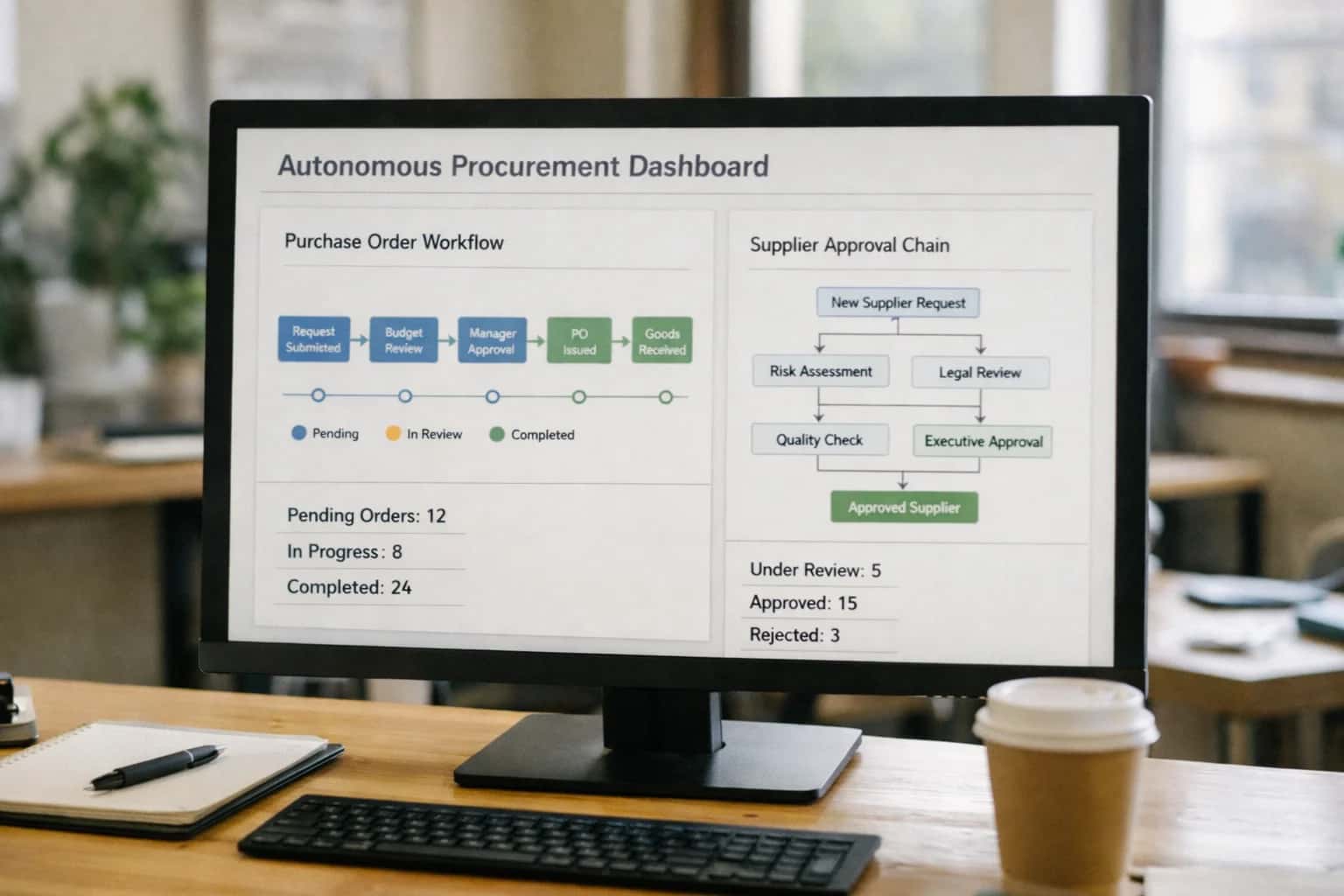
AUTONOMOUS REPLENISHMENT AGENT DEVELOPMENT
Manual Replenishment is Costing You Time and Money
Deploy AI agents that autonomously manage inventory, predict stockouts, and execute procurement, cutting manual oversight by 80%.
- Monitor & Predict: Continuously analyze inventory levels, sales velocity, and lead times using models like
ProphetandLSTMnetworks to forecast stockouts weeks in advance. - Decide & Execute: Agents autonomously generate and place purchase orders via direct supplier API integration (e.g., SAP Ariba, Coupa) or EDI protocols, adhering to predefined business rules.
- Learn & Optimize: Systems use reinforcement learning to refine reorder points and order quantities, reducing carrying costs by 15-30% while maintaining >99% order fill rates.
This is a core component of a broader Intelligent Supply Chain and Autonomous Replenishment strategy. For a complete operational view, explore our Digital Supply Chain Twin Engineering service to simulate outcomes before acting.
Stop letting manual processes dictate your cash flow. Deploy a pilot agent in under 4 weeks to see quantified ROI. For complex, multi-tier networks, our Supply Chain Knowledge Graph Development provides the semantic backbone for advanced agentic reasoning.
DELIVERING TANGIBLE ROI
Measurable Business Outcomes
Our autonomous replenishment agents are engineered to deliver specific, quantifiable improvements to your supply chain operations. We focus on outcomes that directly impact your bottom line.
A Structured, Milestone-Driven Approach
Phased Development and Delivery Timeline
Our proven methodology for Autonomous Replenishment Agent Development delivers incremental value through four distinct phases, ensuring alignment, reducing risk, and providing clear ROI at each stage.
| Phase & Key Deliverables | Timeline | Core Outcomes | Client Involvement |
|---|---|---|---|
Phase 1: Discovery & Architecture | 2-3 weeks | Technical Design Document, Data Pipeline Blueprint, Success Metrics | Stakeholder Workshops, Data Access Provisioning |
Phase 2: Core Agent & Integration | 4-6 weeks | MVP Agent Deployed in Staging, Supplier API Connectors, Basic Forecasting Model | Weekly Review, UAT Environment Setup |
Phase 3: Advanced Logic & Optimization | 3-4 weeks | Multi-Agent Orchestration, Anomaly Detection, Automated PO Execution Workflow | Feedback on Agent Decisions, Business Rule Validation |
Phase 4: Production Deployment & Scaling | 2-3 weeks | Production Deployment, Monitoring Dashboard, Operational Playbook, Team Training | Go/No-Go Approval, Internal Team Handoff |
Post-Launch Support | Ongoing | 99.9% Uptime SLA, Performance Monitoring, Quarterly Optimization Reviews | Optional Retainer for Continuous Improvement |
PROVEN PROCESS
Our Development Methodology
We engineer autonomous replenishment agents through a rigorous, outcome-focused process designed to deliver production-ready systems that reduce manual oversight by 80%.
02
Multi-Agent System Orchestration
For complex supply chains, we deploy specialized, collaborative agents—one for demand sensing, another for supplier risk, a third for procurement—that partition tasks and synthesize results, creating a resilient digital workforce. Learn more about our approach to Multiagent Systems (MAS) Architecture.
EXPLORE
03
Integration with Digital Supply Chain Twins
We connect your autonomous agent to a real-time, AI-powered digital twin of your supply chain. This enables the agent to simulate the upstream and downstream consequences of its replenishment decisions before execution, mitigating risk. Explore our Digital Supply Chain Twin Engineering service.
EXPLORE
04
Proprietary Data Pipeline Engineering
We build robust pipelines that unify and clean data from ERP, WMS, IoT sensors, and external market feeds. This ensures your agent operates on a single source of truth, a critical foundation for accurate predictions. Our expertise in Multimodal AI Data Pipelines ensures all data types are processed.
EXPLORE
05
Continuous Learning & Red Teaming
Post-deployment, we implement feedback loops for continuous model refinement. We also conduct adversarial testing using frameworks like MITRE ATLAS to secure your agent against goal hijacking or manipulation, ensuring operational integrity. Our AI Red Teaming service provides ongoing security.
EXPLORE
06
Enterprise Integration & Governance
We seamlessly integrate the agent into your existing procurement platforms and legacy systems. Concurrently, we implement policy-as-code and audit trails to ensure compliance with internal controls and external regulations like the EU AI Act, managed through our Enterprise AI Governance frameworks.
EXPLORE
Enabling Efficiency, Speed & Accuracy
Intelligent Analysis, Decision & Execution
We build AI systems for teams that need search across company data, workflow automation across tools, or AI features inside products and internal software.
Talk to Us
Search across company data
Give teams answers from docs, tickets, runbooks, and product data with sources and permissions.
Useful when people spend too long searching or get different answers from different systems.
Enterprise searchRAGPermissions
Read more
Automate internal workflows
Use AI to route work, draft outputs, trigger actions, and keep approvals and logs in place.
Useful when repetitive work moves across multiple tools and teams.
AI agentsWorkflow automationGovernance
Read more
Add AI to products and internal tools
Build assistants, guided actions, or decision support into the software your team or customers already use.
Useful when AI needs to be part of the product, not a separate tool.
AI integrationDecision supportModel routing
Read moreTechnical & Commercial Considerations
Frequently Asked Questions on Autonomous Replenishment Agents
Common questions from CTOs and supply chain leaders evaluating AI-driven autonomous replenishment solutions.
Standard deployments take 2-4 weeks for a single SKU category or warehouse node. Complex, multi-node deployments with custom supplier API integrations typically require 6-8 weeks. Our agile methodology includes a 2-week discovery and data pipeline setup, followed by iterative agent development and testing. For context, we recently deployed an agent for a retail client managing 5,000 SKUs across 3 distribution centers in 5 weeks.

About the author
Prasad Kumkar
CEO & MD, Inference Systems
Prasad Kumkar is the CEO & MD of Inference Systems and writes about AI systems architecture, LLM infrastructure, model serving, evaluation, and production deployment. Over 5+ years, he has worked across computer vision models, L5 autonomous vehicle systems, and LLM research, with a focus on taking complex AI ideas into real-world engineering systems.
His work and writing cover AI systems, large language models, AI agents, multimodal systems, autonomous systems, inference optimization, RAG, evaluation, and production AI engineering.
LinkedIn
Limited slotsGet a Free AI Consultation
Partnered with leading AI, data, and software stack.





How We Work
Custom AI workflows for your Business
One-fit-all AI don't work for modern businesses. At Inferensys, we aim to understand your business & custom requirements; which we use to define most efficient agentic workflows, the data, and the tools for your business.
01
Review the use case
We understand the task, the users, and where AI can actually help.
Read more02
Pick the right approach
We define what needs search, automation, or product integration.
Read more03
Build the first useful version
We implement the part that proves the value first.
Read more04
Improve from there
We add the checks and visibility needed to keep it useful.
Read moreThe first call is a practical review of your use case and the right next step.
Talk to Us