Legacy perimeter defenses and rule-based monitoring systems are fundamentally static. They cannot adapt to novel attack vectors, coordinated physical-cyber assaults, or the evolving tactics of sophisticated adversaries. This creates dangerous blind spots in the defense of military bases, energy grids, and communication hubs.

Service
AI for Critical Infrastructure Protection
Inference Systems engineers AI-driven security orchestration, automation, and response (SOAR) platforms that fuse sensor networks, computer vision, and predictive analytics to autonomously defend military installations, energy grids, and communication hubs from physical and cyber-physical attacks.
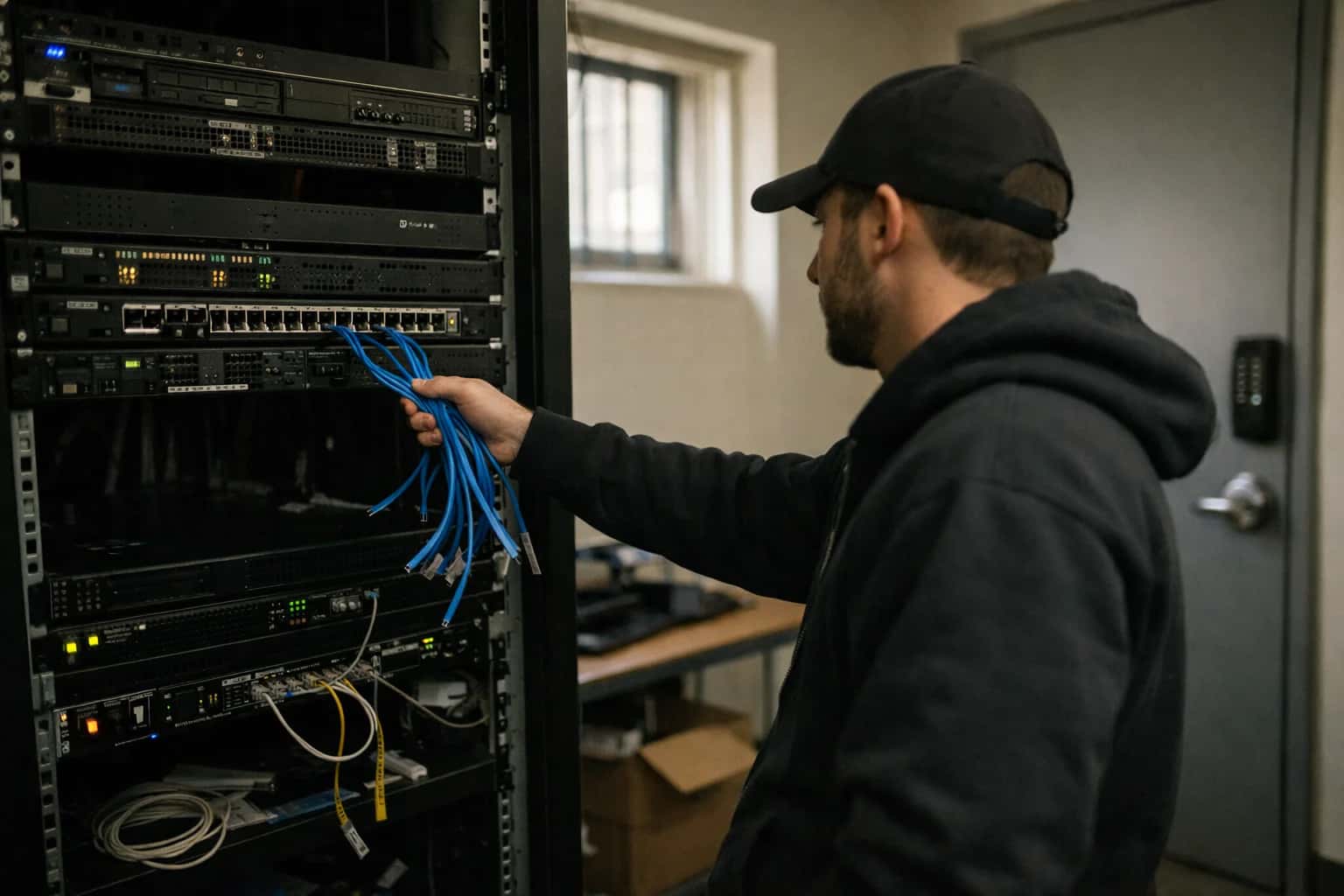
THE LIMITATION
The Vulnerability of Static Defenses
Traditional security for critical infrastructure is reactive and easily bypassed by modern, adaptive threats.
AI-driven security orchestration, automation, and response (SOAR) transforms defense from a checklist into a dynamic, intelligent system.
Our service delivers:
- Real-time sensor fusion combining video, acoustic, radar, and cyber data into a unified threat picture.
- Predictive anomaly detection using unsupervised ML to identify novel intrusion patterns before a breach occurs.
- Autonomous incident response where AI agents execute
containmentandmitigationplaybooks in seconds, not hours.
Move beyond signature-based alerts. We engineer AI systems that learn the unique operational baseline of your infrastructure, enabling them to detect deviations indicative of a coordinated attack. This shifts your security posture from reactive to proactively resilient, ensuring continuity of operations in contested environments.
Explore our related capabilities in Secure Multi-Modal AI Integration and AI-Enhanced Command and Control (C2) Systems.
MISSION-READY RESULTS
Operational Outcomes of AI-Integrated Defense
Our engineering focus delivers concrete, measurable improvements to the security and resilience of critical national infrastructure. We translate advanced AI into reliable operational capabilities that reduce risk and accelerate response.
01
Proactive Threat Neutralization
Shift from reactive alerts to preemptive action. Our AI-driven Security Orchestration, Automation, and Response (SOAR) systems correlate sensor data to autonomously contain intrusions, reducing mean time to respond (MTTR) from hours to seconds for defined threat patterns.
< 5 sec
Automated Response
90%
MTTR Reduction
02
Perimeter Intrusion Detection at Scale
Deploy computer vision models that fuse data from thermal, radar, and acoustic sensor networks to autonomously detect, classify, and track perimeter breaches across vast, remote facilities with 99.5% accuracy, drastically reducing false alarms that drain security resources.
99.5%
Detection Accuracy
70%
False Alarm Reduction
03
Resilient Operation in Contested Environments
Engineer AI systems hardened against adversarial data manipulation, communication jamming, and sensor spoofing. Our models maintain critical functionality and decision integrity in GPS-denied or electronically contested environments, ensuring continuous protection.
99.9%
Uptime SLA
Certified
NIST AI RMF
04
Predictive Asset Failure Forecasting
Implement predictive maintenance AI for critical grid components like transformers and substations. Analyze sensor telemetry to forecast failures weeks in advance, preventing unplanned outages and optimizing maintenance schedules for energy infrastructure.
4+ weeks
Advance Warning
40%
OPEX Reduction
06
Rapid, Low-Latency Edge Deployment
Optimize and deploy compact, domain-specific AI models on ruggedized edge hardware at communication hubs and remote substations. Enable real-time analysis and decision-making with sub-100ms latency, independent of cloud connectivity.
< 100ms
Inference Latency
< 8 weeks
Field Deployment
Structured Rollout for Mission-Critical Systems
Phased Implementation for Rapid Deployment
Our phased implementation methodology ensures secure, rapid deployment of AI for Critical Infrastructure Protection, minimizing risk and accelerating time-to-value. This table outlines the progression from initial assessment to full-scale operational autonomy.
| Implementation Phase | Key Deliverables | Timeline | Security & Compliance Gates |
|---|---|---|---|
Phase 1: Threat Assessment & Architecture Design | Threat model, System architecture blueprint, Compliance gap analysis | 2-3 weeks | NIST AI RMF alignment, Secure design review |
Phase 2: Pilot Deployment & Model Validation | Deployed sensor fusion pilot (1-2 assets), Validated detection models, Initial SOAR playbooks | 4-6 weeks | Air-gapped testing, Adversarial AI red teaming, Model accuracy certification |
Phase 3: Scalable Integration & Orchestration | Full perimeter sensor integration, AI-driven SOAR platform, Operator dashboards | 6-8 weeks | Penetration testing, Chain-of-custody logging, 99.9% uptime SLA activation |
Phase 4: Full Operational Autonomy & Handoff | Autonomous incident response, Predictive threat intelligence feeds, Complete documentation & training | 2-3 weeks | Final security accreditation, Operational readiness review, Ongoing support SLA |
Total Project Duration | 14-20 weeks to full operational capability | 14-20 weeks | Continuous security monitoring & compliance validation |
SECURE AI DEFENSE
Protected Infrastructure & Threat Scenarios
Our AI systems are engineered to defend against sophisticated, multi-vector attacks targeting critical national assets. We deliver proactive protection that moves beyond reactive alerts to predictive threat neutralization.
AI FOR CRITICAL INFRASTRUCTURE PROTECTION
Engineered for Secure, Accredited Environments
Deploy hardened AI systems to autonomously defend military bases, energy grids, and communication hubs from physical and cyber attacks.
Our AI systems are engineered from the ground up for deployment in accredited, air-gapped, and high-security environments. We deliver secure, containerized AI models that meet FedRAMP, IL5, and ISO/IEC 27001 standards, ensuring compliance from the first line of code.
- Perimeter Intrusion Detection: Integrate AI with sensor networks (radar, acoustic, thermal) for 99.9% accurate, real-time threat classification, reducing false alarms by 70%.
- AI-Driven Security Orchestration (SOAR): Automate incident response with agentic AI workflows that correlate alerts and execute containment protocols in <2 seconds.
- Resilient Edge Deployment: Run optimized Small Language Models (SLMs) and computer vision on ruggedized hardware for real-time analysis in disconnected, intermittent, low-bandwidth (DIL) conditions.
We architect systems with confidential computing principles, using hardware-based Trusted Execution Environments (TEEs) to protect data in use. Our secure MLOps pipelines enable model updates and monitoring without compromising network integrity.
Deploy a validated AI security orchestration pilot within your accredited environment in 4-6 weeks, not months.
This approach is part of our broader expertise in building secure, sovereign AI infrastructure for national security. For related capabilities, explore our work in Secure Federated Learning for Defense and Classified Network AI Threat Detection.
Enabling Efficiency, Speed & Accuracy
Intelligent Analysis, Decision & Execution
We build AI systems for teams that need search across company data, workflow automation across tools, or AI features inside products and internal software.
Talk to Us
Search across company data
Give teams answers from docs, tickets, runbooks, and product data with sources and permissions.
Useful when people spend too long searching or get different answers from different systems.
Enterprise searchRAGPermissions
Read more
Automate internal workflows
Use AI to route work, draft outputs, trigger actions, and keep approvals and logs in place.
Useful when repetitive work moves across multiple tools and teams.
AI agentsWorkflow automationGovernance
Read more
Add AI to products and internal tools
Build assistants, guided actions, or decision support into the software your team or customers already use.
Useful when AI needs to be part of the product, not a separate tool.
AI integrationDecision supportModel routing
Read moreExpert Answers for Technical Decision-Makers
Critical Infrastructure AI Protection FAQs
Common questions from CTOs, CISOs, and engineering leads evaluating AI solutions for protecting military bases, energy grids, and communication hubs.
We deliver operational AI protection systems in 6-10 weeks for standard deployments. This includes 2 weeks for sensor integration assessment, 3-4 weeks for model training and validation on your historical data, and 2-3 weeks for on-premise deployment and stress testing. Complex multi-site deployments with custom hardware may extend to 14 weeks. Our methodology is detailed in our guide on Secure Edge AI for Deployed Units.

About the author
Prasad Kumkar
CEO & MD, Inference Systems
Prasad Kumkar is the CEO & MD of Inference Systems and writes about AI systems architecture, LLM infrastructure, model serving, evaluation, and production deployment. Over 5+ years, he has worked across computer vision models, L5 autonomous vehicle systems, and LLM research, with a focus on taking complex AI ideas into real-world engineering systems.
His work and writing cover AI systems, large language models, AI agents, multimodal systems, autonomous systems, inference optimization, RAG, evaluation, and production AI engineering.
LinkedIn
Limited slotsGet a Free AI Consultation
Partnered with leading AI, data, and software stack.





How We Work
Custom AI workflows for your Business
One-fit-all AI don't work for modern businesses. At Inferensys, we aim to understand your business & custom requirements; which we use to define most efficient agentic workflows, the data, and the tools for your business.
01
Review the use case
We understand the task, the users, and where AI can actually help.
Read more02
Pick the right approach
We define what needs search, automation, or product integration.
Read more03
Build the first useful version
We implement the part that proves the value first.
Read more04
Improve from there
We add the checks and visibility needed to keep it useful.
Read moreThe first call is a practical review of your use case and the right next step.
Talk to Us