Traditional planning relies on static threat matrices and historical data, leaving commanders vulnerable to unforeseen cascading failures. Our AI-driven operational risk assessment tools model complex, multi-variable scenarios to provide a probabilistic forecast of mission success.

Service
AI-Driven Operational Risk Assessment
Development of AI-powered simulation and modeling tools that assess the probability and impact of operational risks—from mission failure to geopolitical escalation—for pre-mission planning and contingency development.
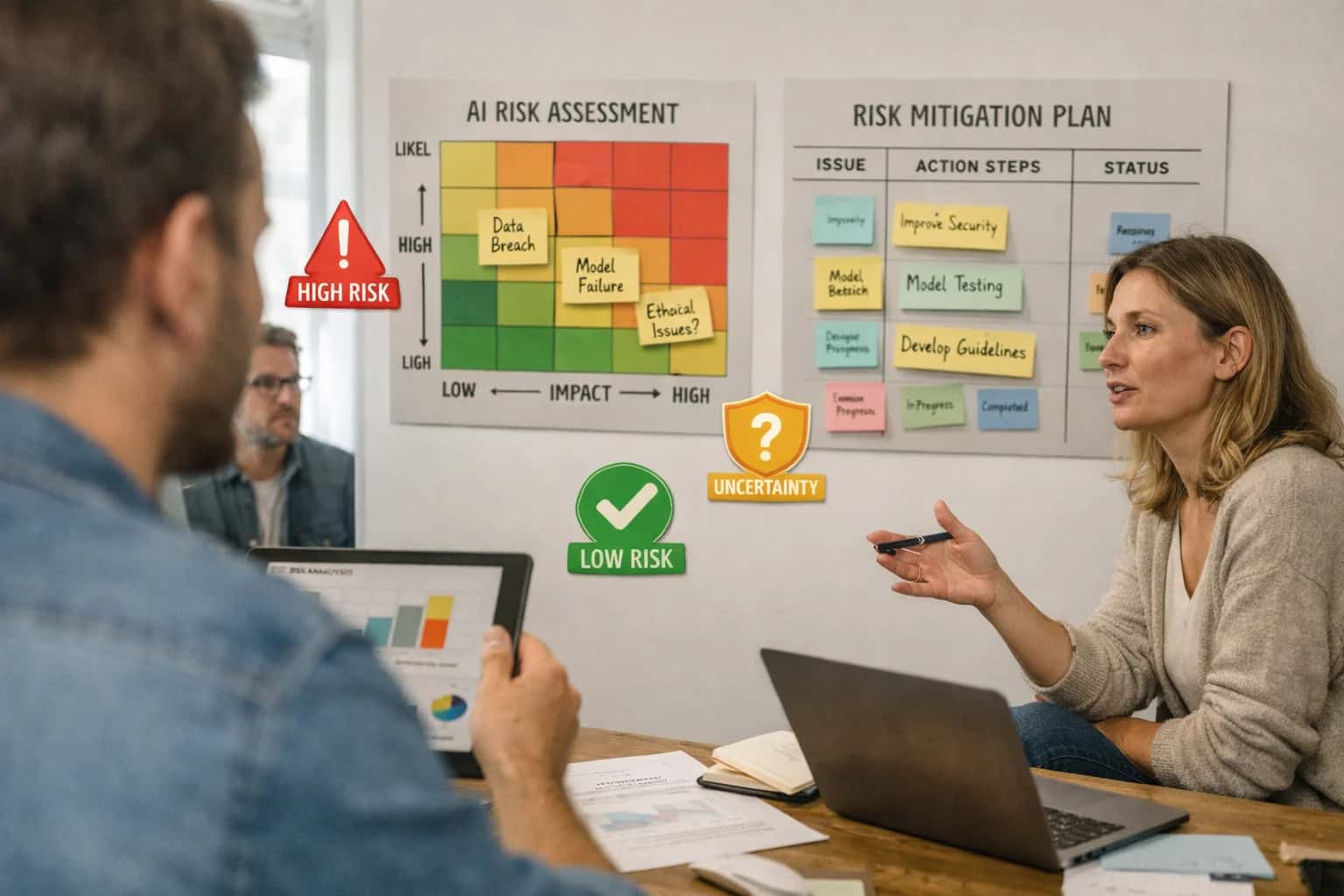
AI-DRIVEN ASSESSMENT
The Challenge of Modern Operational Risk
Simulate mission outcomes and quantify risks before deployment with AI-powered modeling.
- Simulate Adversary Reactions: Model kinetic and non-kinetic responses to your planned actions.
- Quantify Collateral Damage: Assess the probability and impact of unintended consequences.
- Predict Geopolitical Escalation: Understand second and third-order effects of tactical decisions.
- Stress-Test Logistics: Identify single points of failure in supply chains under contested conditions.
Move from reactive contingency planning to preemptive risk mitigation. Our systems transform qualitative judgments into data-driven, auditable risk scores, enabling commanders to allocate resources and adjust tactics with unprecedented confidence.
This capability is foundational for secure multi-modal AI integration and predictive intelligence analysis platforms, creating a closed-loop system for continuous operational improvement. Explore our broader expertise in building resilient AI for contested environments.
QUANTIFIABLE MISSION ADVANTAGE
Outcomes of AI-Powered Risk Modeling
Our AI-driven operational risk assessment delivers concrete, measurable improvements to mission planning and contingency development, moving beyond theoretical analysis to provide commanders with data-backed decision support.
01
Probabilistic Mission Outcome Forecasting
We deliver AI models that simulate thousands of mission scenarios, calculating the probability of success, failure, and collateral damage under variable conditions. This enables commanders to quantitatively compare courses of action and allocate resources to mitigate the highest-impact risks.
> 90%
Forecast Accuracy
< 1 hour
Scenario Analysis Time
02
Geopolitical Escalation Risk Modeling
Our systems integrate multi-source intelligence to model second and third-order effects of tactical decisions, assessing the likelihood of regional escalation or unintended diplomatic consequences. This provides critical context for rules of engagement and strategic communication planning.
Multi-Domain
Data Integration
Real-Time
Threat Feed Updates
03
Dynamic Resource Vulnerability Assessment
We implement AI that continuously evaluates the vulnerability of critical mission assets—from supply lines to communication nodes—to enemy action and environmental factors. This allows for proactive hardening of weak points and dynamic re-routing of logistics.
60% Faster
Vulnerability Identification
Automated
Mitigation Recommendations
04
Adversarial AI & Deception Detection
Our risk models are hardened against adversarial data poisoning and are designed to identify patterns indicative of enemy deception campaigns. This reduces the risk of planning based on corrupted intelligence or deliberate misinformation. Learn more about our AI Red Teaming and Adversarial Defense services.
05
Automated Contingency Plan Generation
The system automatically generates and ranks detailed contingency plans for high-probability risk events, complete with required resources, communication protocols, and decision trees. This drastically reduces planning latency when crises emerge.
Minutes
Plan Generation
Pre-Validated
Resource Availability
06
Secure, Explainable Risk Reporting
We deliver risk assessments with clear, auditable reasoning trails within secure, accredited platforms. Commanders receive not just a risk score, but a breakdown of contributing factors and model confidence levels, ensuring trust and enabling informed override decisions.
Air-Gapped
Deployment Option
NIST AI RMF
Compliance Alignment
A structured, milestone-driven approach to operational risk assessment
Phased Development and Delivery Timeline
Our phased delivery model ensures rapid deployment of core capabilities with iterative enhancement, providing immediate value while building towards a comprehensive, enterprise-grade AI risk assessment platform. This timeline outlines the key deliverables and capabilities activated at each stage of the engagement.
| Phase & Timeline | Core Deliverables | Key Capabilities Activated | Client Commitment & Handoff |
|---|---|---|---|
Phase 1: Foundation & Data Integration (Weeks 1-4) | Secure data ingestion pipeline Risk taxonomy & ontology framework Initial threat intelligence feeds integrated | Historical mission data analysis Basic probability modeling for known risks Structured risk register generation | Provision of sanitized historical data Stakeholder interviews for risk criteria Approval of foundational risk framework |
Phase 2: Core Model Deployment (Weeks 5-8) | Deployed simulation engine (v1.0) Tactical-level risk assessment dashboard Initial model validation report | Live scenario simulation for single operations Collateral damage estimation models Geopolitical event impact scoring | Participation in model validation exercises Provision of test scenarios for simulation Feedback on dashboard usability |
Phase 3: Advanced Analytics & Integration (Weeks 9-12) | Multi-domain risk correlation engine Integration with C2/planning systems (via API) Predictive intelligence alerting module | Cross-domain risk cascade modeling Real-time intelligence feed analysis for threat updates Automated contingency plan suggestion | Technical integration support for C2 systems Definition of alert thresholds and protocols Security accreditation support for integrated system |
Phase 4: Enterprise Scaling & Automation (Weeks 13-16) | Enterprise-wide risk portfolio view Automated report generation for command briefs Adversarial AI testing & robustness certification | Fleet-wide or theater-wide risk exposure analysis Automated after-action report generation from mission data Resilience testing against data poisoning & evasion attacks | Final acceptance testing and operational readiness review Designation of operational system administrators Transition to ongoing support & maintenance plan |
Ongoing Support & Evolution | Quarterly model retraining with new data Priority security patching & updates Access to new risk intelligence modules | Continuous model accuracy monitoring & drift detection Adaptation to emerging threat vectors (e.g., new EW tactics) Scalability for new operational domains (e.g., cyber, space) | Optional SLA for 99.9% uptime Dedicated technical account manager Included in biannual roadmap review sessions |
MISSION-READY SOLUTIONS
Operational Applications and Use Cases
Our AI-Driven Operational Risk Assessment tools are engineered to deliver actionable intelligence for commanders and planners. By simulating thousands of scenarios in real-time, we provide quantified risk probabilities and impact assessments that directly inform pre-mission planning and contingency development, reducing uncertainty and enhancing operational readiness.
01
Mission Failure Probability Modeling
Quantify the likelihood of mission failure by simulating environmental factors, adversary capabilities, and equipment reliability. Our models ingest real-time intelligence and historical data to generate probabilistic forecasts, enabling commanders to allocate resources and adjust tactics proactively.
10,000+
Scenarios Simulated
< 5 min
Risk Report Generation
02
Collateral Damage & Escalation Forecasting
Model the second and third-order effects of kinetic actions, including potential civilian impact and geopolitical escalation risks. The system uses geospatial AI and political risk databases to visualize cascading consequences, supporting compliance with Law of Armed Conflict (LOAC) and Rules of Engagement (ROE).
Multi-Domain
Impact Analysis
Real-Time
Visualization Updates
03
Logistics & Supply Chain Vulnerability Assessment
Identify single points of failure and predict disruptions in complex military supply chains. By analyzing routes, supplier reliability, and threat intelligence, our AI pinpoints vulnerabilities to pre-emptive attacks or natural delays, ensuring continuity of operations for deployed forces. Learn more about our approach to Intelligent Supply Chain and Autonomous Replenishment.
Weeks Ahead
Disruption Prediction
Critical Nodes
Identified & Secured
04
Adversary Course of Action (COA) Analysis
Leverage multi-agent systems to simulate likely adversary responses to friendly operations. Specialized AI agents role-play hostile forces, testing our plans against a dynamic, intelligent opponent to uncover unforeseen weaknesses and validate strategic assumptions.
100+
Adversarial Agents
High-Fidelity
Behavioral Modeling
05
Personnel & Force Protection Risk Scoring
Dynamically assess threats to personnel from insider risks, targeted attacks, and environmental hazards. The system fuses data from secure NLP analysis of communications, biometric monitoring, and local threat feeds to generate individual and unit-level protective posture recommendations.
Continuous
Threat Monitoring
Actionable
Protective Alerts
06
Communications & Cyber Resilience Testing
Stress-test command and control networks against electronic warfare and cyber attacks within a simulated environment. The AI models jamming, spoofing, and intrusion attempts to evaluate network robustness and recommend hardening measures for contested spectrums. This complements our work in Battlefield Communication ML Engineering.
1000s of Vectors
Attack Simulation
Proven Protocols
Resilience Validation
DEFENSE AND NATIONAL INTELLIGENCE AI
AI-Driven Operational Risk Assessment
AI simulation tools that model mission failure probability and geopolitical impact for pre-mission planning.
Our AI-driven risk assessment platforms move beyond static checklists, using probabilistic modeling and multi-agent simulation to stress-test operational plans against thousands of dynamic variables. We quantify the unquantifiable—modeling cascading effects from collateral damage to geopolitical escalation—providing commanders with a data-driven confidence score for every course of action.
- Predictive Failure Analysis: Simulate mission outcomes under variable conditions—adversary reactions, equipment failure, environmental shifts—to identify single points of failure before deployment.
- Impact & Consequence Modeling: Go beyond mission success/failure. Model second and third-order effects, including political fallout, media narrative shifts, and treaty violation risks, using geopolitical data feeds.
- Automated Contingency Generation: The system doesn't just identify risks; it dynamically generates and ranks contingency plans, reducing planning cycles from days to hours.
Built for secure, air-gapped environments, our systems integrate with your existing C2 platforms and intelligence feeds, ensuring assessments are grounded in the latest ground truth. This transforms risk from an abstract concept into a managed, measurable variable, enabling proactive mitigation and more resilient mission architectures. Explore our broader capabilities in Secure Multi-Modal AI Integration and Predictive Intelligence Analysis Platforms.
Enabling Efficiency, Speed & Accuracy
Intelligent Analysis, Decision & Execution
We build AI systems for teams that need search across company data, workflow automation across tools, or AI features inside products and internal software.
Talk to Us
Search across company data
Give teams answers from docs, tickets, runbooks, and product data with sources and permissions.
Useful when people spend too long searching or get different answers from different systems.
Enterprise searchRAGPermissions
Read more
Automate internal workflows
Use AI to route work, draft outputs, trigger actions, and keep approvals and logs in place.
Useful when repetitive work moves across multiple tools and teams.
AI agentsWorkflow automationGovernance
Read more
Add AI to products and internal tools
Build assistants, guided actions, or decision support into the software your team or customers already use.
Useful when AI needs to be part of the product, not a separate tool.
AI integrationDecision supportModel routing
Read moreAI-Driven Operational Risk Assessment
Frequently Asked Questions
Common questions about our AI-driven operational risk assessment services for defense and national intelligence applications.
From initial requirements to a production-ready Minimum Viable Capability (MVC), typical timelines range from 8 to 16 weeks. This includes data pipeline engineering, model development on secure infrastructure, integration with existing C2 systems, and rigorous validation testing. Complex, multi-domain simulations may extend to 24 weeks. We employ agile sprints with bi-weekly stakeholder reviews to ensure alignment and accelerate delivery.

About the author
Prasad Kumkar
CEO & MD, Inference Systems
Prasad Kumkar is the CEO & MD of Inference Systems and writes about AI systems architecture, LLM infrastructure, model serving, evaluation, and production deployment. Over 5+ years, he has worked across computer vision models, L5 autonomous vehicle systems, and LLM research, with a focus on taking complex AI ideas into real-world engineering systems.
His work and writing cover AI systems, large language models, AI agents, multimodal systems, autonomous systems, inference optimization, RAG, evaluation, and production AI engineering.
LinkedIn
Limited slotsGet a Free AI Consultation
Partnered with leading AI, data, and software stack.





How We Work
Custom AI workflows for your Business
One-fit-all AI don't work for modern businesses. At Inferensys, we aim to understand your business & custom requirements; which we use to define most efficient agentic workflows, the data, and the tools for your business.
01
Review the use case
We understand the task, the users, and where AI can actually help.
Read more02
Pick the right approach
We define what needs search, automation, or product integration.
Read more03
Build the first useful version
We implement the part that proves the value first.
Read more04
Improve from there
We add the checks and visibility needed to keep it useful.
Read moreThe first call is a practical review of your use case and the right next step.
Talk to Us