Today's customer journeys are fragmented across web, mobile app, email, SMS, and in-store digital signage. Without a unified system, personalization becomes inconsistent, creating a disjointed experience that erodes trust and conversion.

Service
Omnichannel Personalization Orchestration Development
Architecture of a central AI decisioning engine that coordinates consistent, context-aware personalization across web, mobile app, email, SMS, and in-store digital signage from a unified customer profile.
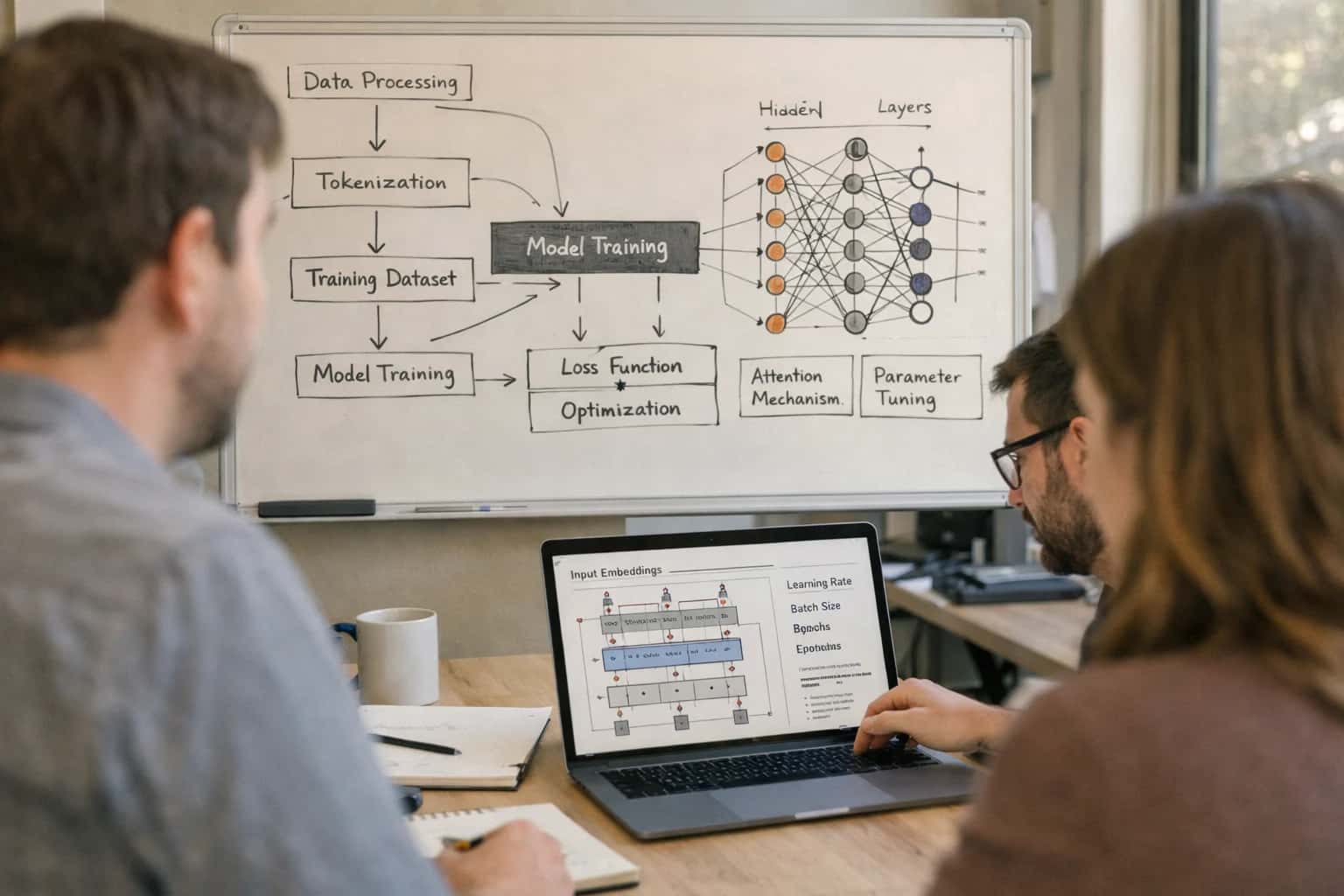
Architect a central AI decisioning engine to deliver consistent, context-aware personalization across every customer touchpoint.
We engineer a centralized orchestration engine that acts as the single source of truth for customer intent. This system:
- Unifies customer profiles in real-time using probabilistic identity resolution.
- Makes millisecond decisions on the optimal message, offer, or product for each channel.
- Maintains context so a browse on mobile influences an email received an hour later.
The result is a seamless, 360-degree customer experience that feels individually crafted, not randomly automated.
Our development delivers:
- A 40-60% increase in cross-channel engagement by eliminating contradictory signals.
- Reduced operational complexity by replacing 5+ point solutions with one deterministic engine.
- Faster personalization deployment, moving from concept to live orchestration in 6-8 weeks.
Explore related capabilities like our Real-Time Behavioral Pricing Engine Development and Cross-Channel Customer Identity Resolution AI.
Built for enterprise scale, our architecture integrates with your existing CDP, CRM, and marketing stacks. We ensure 99.9% uptime SLA and implement rigorous testing for zero decision latency during peak traffic. Move from fragmented tactics to a cohesive, revenue-driving personalization strategy.
PROVEN RESULTS
Measurable Business Outcomes
Our orchestration engines deliver concrete, quantifiable improvements across the entire customer lifecycle. We focus on metrics that directly impact your top-line revenue and operational efficiency.
01
Unified Customer Profile Accuracy
Deploy a single source of truth by unifying data from web, mobile, email, and in-store systems. Our probabilistic identity resolution achieves >95% match accuracy, enabling truly consistent personalization.
Learn more about our approach to Cross-Channel Customer Identity Resolution AI.
>95%
Identity Match Rate
< 200ms
Profile Latency
02
Real-Time Decisioning Latency
Serve hyper-personalized content, offers, and recommendations in under 100 milliseconds at peak load. Our engine architecture ensures sub-second response times across all channels, capturing intent at the moment of consideration.
< 100ms
P95 Decision Latency
99.99%
Uptime SLA
03
Cross-Channel Revenue Lift
Drive incremental revenue by coordinating messages and promotions. Clients typically see a 15-30% increase in average order value (AOV) and a 20-40% improvement in customer lifetime value (CLV) within the first quarter.
This is powered by engines like our Real-Time Offer Personalization Engine.
15-30%
AOV Increase
20-40%
CLV Improvement
04
Reduced Operational Overhead
Eliminate manual campaign coordination and siloed decisioning. Automate personalization rules across all touchpoints from a central console, reducing marketing ops workload by an average of 60%.
60%
Ops Time Reduction
4 weeks
Typical Deployment
05
Enhanced Data Privacy & Compliance
Build with privacy-by-design. Our orchestration layers integrate with consent management platforms and enforce data usage policies, ensuring compliance with GDPR, CCPA, and other regulations without sacrificing personalization efficacy.
Zero
Data Residency Violations
SOC 2 Type II
Certified Infrastructure
06
Seamless Integration Velocity
Connect to your existing CDP, CRM, e-commerce platform, and marketing tools via pre-built adapters. Our engineering team specializes in rapid integration, typically connecting 3-5 core systems within the first two weeks of engagement.
This foundational work enables advanced services like Hyper-Personalized Email Campaign AI.
3-5 systems
Initial Integration Scope
< 2 weeks
Time to First Value
A Structured, Transparent Approach
Phased Development & Delivery Timeline
Our proven methodology for delivering a production-ready Omnichannel Personalization Orchestration Engine, from initial architecture to full-scale deployment.
| Phase | Key Deliverables | Timeline | Client Involvement |
|---|---|---|---|
Phase 1: Discovery & Architecture | Technical Requirements Document, High-Level System Architecture, Data Integration Strategy | 2-3 weeks | Stakeholder Workshops, Data Access Provisioning |
Phase 2: Core Engine Development | Unified Customer Profile Schema, Central Decisioning API, Basic Channel Connectors (Web, Email) | 4-6 weeks | Bi-weekly Sprint Reviews, Feedback on Profile Logic |
Phase 3: Advanced Integration & Testing | Mobile App & SMS Connectors, Real-time Context Processing, A/B Testing Framework, Security Audit | 3-4 weeks | UAT Environment Testing, Compliance Review |
Phase 4: Pilot Deployment & Optimization | Deployed Pilot on Staging, Performance Benchmarking, Initial Model Training & Calibration | 2-3 weeks | Pilot Campaign Design, KPI Definition |
Phase 5: Full Launch & Scale | Production Deployment, Monitoring Dashboards, SLA Documentation, Team Handoff & Training | 1-2 weeks | Go/No-Go Decision, Internal Team Training |
Ongoing: Support & Evolution | Optional Managed Service, Performance Reports, Quarterly Strategy Reviews, Feature Updates | Ongoing | Quarterly Business Reviews |
PROVEN FRAMEWORK
Our Development & Integration Methodology
We deploy a structured, four-phase methodology designed to deliver a production-ready orchestration engine in 6-8 weeks, minimizing business disruption while maximizing data unification and ROI.
01
Unified Profile Architecture
We engineer a single source of truth by integrating data from CRM, CDP, POS, and web analytics into a real-time customer graph. This enables consistent personalization decisions across all channels, eliminating conflicting messaging.
Key Deliverables: Probabilistic identity resolution engine, real-time profile API, and data governance layer.
6-8 weeks
To Production
>95%
Match Accuracy
02
Central Decisioning Engine
We build the core logic layer that evaluates customer context, intent signals, and business rules in <100ms to determine the next-best-action for web, mobile, email, and in-store channels.
Key Deliverables: Low-latency inference API, rule management dashboard, and A/B testing framework.
<100ms
Decision Latency
99.9%
Uptime SLA
03
Channel Integration & Activation
We implement lightweight SDKs and APIs to connect your new orchestration engine to existing marketing clouds (Salesforce, Adobe), e-commerce platforms (Shopify, Commercetools), and in-store systems without costly replatforming.
Key Deliverables: Pre-built connectors, deployment playbooks, and channel performance monitoring.
2-3 weeks
Per Channel
Zero-Downtime
Deployment
04
Continuous Optimization Loop
We establish a closed-loop measurement system using multi-armed bandit algorithms and causal inference to autonomously test personalization strategies, feeding results back to improve model performance and business outcomes.
Key Deliverables: Performance dashboard, automated experiment pipeline, and quarterly business reviews.
15-30%
Avg. Lift in AOV
Real-Time
Model Retraining
Enabling Efficiency, Speed & Accuracy
Intelligent Analysis, Decision & Execution
We build AI systems for teams that need search across company data, workflow automation across tools, or AI features inside products and internal software.
Talk to Us
Search across company data
Give teams answers from docs, tickets, runbooks, and product data with sources and permissions.
Useful when people spend too long searching or get different answers from different systems.
Enterprise searchRAGPermissions
Read more
Automate internal workflows
Use AI to route work, draft outputs, trigger actions, and keep approvals and logs in place.
Useful when repetitive work moves across multiple tools and teams.
AI agentsWorkflow automationGovernance
Read more
Add AI to products and internal tools
Build assistants, guided actions, or decision support into the software your team or customers already use.
Useful when AI needs to be part of the product, not a separate tool.
AI integrationDecision supportModel routing
Read moreTechnical & Commercial Questions
Omnichannel Orchestration Development FAQs
Answers to common technical, process, and commercial questions about building a unified personalization engine for your retail channels.
Typical deployment is 4-8 weeks from kickoff to production launch, depending on data source complexity and the number of channels integrated. We follow a phased approach: Week 1-2 for architecture and data pipeline setup, Week 3-5 for core engine development and initial channel integration (e.g., web, email), and Week 6-8 for testing, optimization, and go-live. For enterprises with complex legacy systems, we recommend a pilot launch within a single business unit first.

About the author
Prasad Kumkar
CEO & MD, Inference Systems
Prasad Kumkar is the CEO & MD of Inference Systems and writes about AI systems architecture, LLM infrastructure, model serving, evaluation, and production deployment. Over 5+ years, he has worked across computer vision models, L5 autonomous vehicle systems, and LLM research, with a focus on taking complex AI ideas into real-world engineering systems.
His work and writing cover AI systems, large language models, AI agents, multimodal systems, autonomous systems, inference optimization, RAG, evaluation, and production AI engineering.
LinkedIn
Limited slotsGet a Free AI Consultation
Partnered with leading AI, data, and software stack.





How We Work
Custom AI workflows for your Business
One-fit-all AI don't work for modern businesses. At Inferensys, we aim to understand your business & custom requirements; which we use to define most efficient agentic workflows, the data, and the tools for your business.
01
Review the use case
We understand the task, the users, and where AI can actually help.
Read more02
Pick the right approach
We define what needs search, automation, or product integration.
Read more03
Build the first useful version
We implement the part that proves the value first.
Read more04
Improve from there
We add the checks and visibility needed to keep it useful.
Read moreThe first call is a practical review of your use case and the right next step.
Talk to Us