Black-box AI is a non-starter for legal compliance. We build systems that explain their reasoning, providing clear, step-by-step rationales for every contract risk score, compliance flag, or litigation prediction.

Service
Explainable AI for Legal Decision Support
Engineering of legal AI systems with built-in explainability frameworks that provide clear, auditable rationales for outputs like contract risk scores or compliance flags—critical for regulatory acceptance and human-in-the-loop validation.
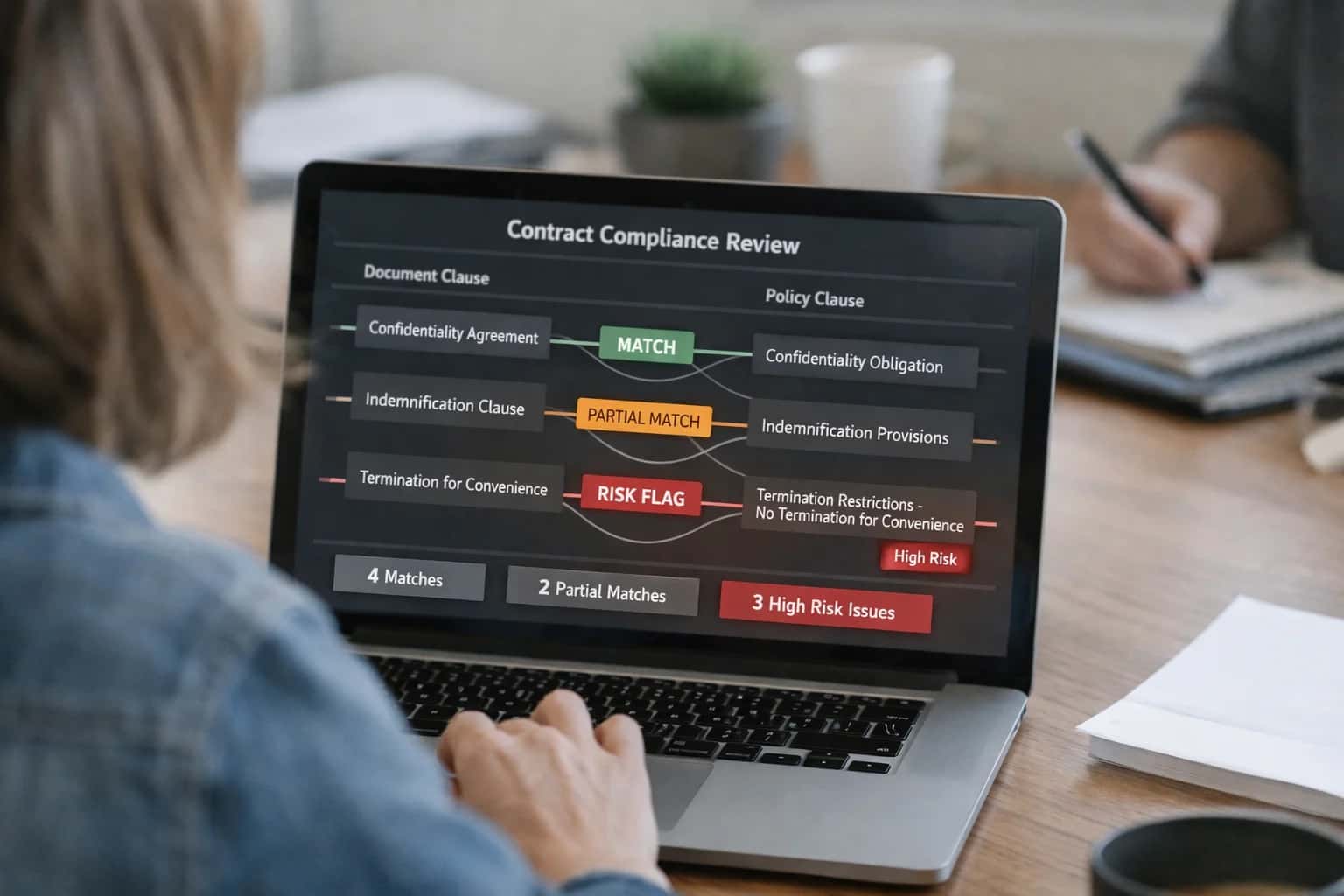
Engineer legal AI systems with auditable rationales for regulatory acceptance and human-in-the-loop validation.
Our explainability frameworks are engineered for regulatory scrutiny and human-in-the-loop workflows. Key components include:
- Counterfactual Explanations: Show how a slight change in a contract clause would alter the risk score.
- Feature Attribution: Visually highlight the specific text, clauses, or metadata driving the AI's output.
- Confidence Scoring & Uncertainty Flags: Quantify model certainty and surface areas requiring human expert review.
This technical transparency is critical for:
- Regulatory Acceptance: Demonstrating fairness and due process under frameworks like the EU AI Act.
- Audit Trails: Creating immutable logs of AI decision logic for internal and external audits.
- Attorney-in-the-Loop Adoption: Enabling legal professionals to validate, override, and learn from AI recommendations, accelerating integration into existing workflows like our Legal Discovery NLP System Development.
Move beyond opaque predictions. Deploy AI that builds trust and withstands scrutiny. Contact us to engineer compliant, explainable legal decision support.
DELIVERING REGULATORY CONFIDENCE AND OPERATIONAL EFFICIENCY
Business Outcomes of Explainable Legal AI
Our explainable AI systems for legal decision support are engineered to deliver auditable, defensible outputs. This translates directly into faster case resolution, reduced compliance risk, and stronger legal arguments, all while maintaining the rigorous standards required for regulatory acceptance.
01
Auditable Rationale Generation
Every AI-generated risk score, compliance flag, or case prediction is accompanied by a clear, step-by-step rationale. This creates a defensible audit trail, essential for regulatory reviews and human-in-the-loop validation, reducing the risk of black-box decisions.
100%
Traceable Outputs
EU AI Act
Compliance Ready
02
Reduced Legal Review Cycles
By providing pre-analyzed contracts with highlighted risks and clear explanations, our systems enable legal teams to focus on high-value strategic work. This accelerates contract review and due diligence processes significantly.
Up to 80%
Faster Review
< 2 Weeks
Deployment Time
03
Enhanced Litigation Strategy
Predictive models for case outcomes are grounded in explainable factors—historical rulings, judge tendencies, case similarities. This provides data-driven, transparent insights for settlement decisions and resource allocation, moving beyond gut feeling.
Higher Accuracy
vs. Baseline Models
Domain-Specific
Legal DSLM Training
04
Automated Compliance Auditing
AI agents continuously monitor internal policies and communications against evolving regulations (GDPR, CCPA, SEC). They flag potential gaps with specific citations, automating audit preparation and reducing manual oversight burden.
Continuous
Real-time Monitoring
Multi-Jurisdiction
Coverage
05
Mitigated Algorithmic Bias Risk
Built-in fairness frameworks and bias detection algorithms ensure legal AI outputs do not perpetuate historical disparities. This is critical for HR, lending, and law enforcement applications to prevent disparate impact claims.
NIST AI RMF
Alignment
Disparate Impact
Analysis
06
Scalable Discovery & Document Intelligence
Our NLP systems parse millions of unstructured documents for e-discovery, identifying privileged information and key themes. Explainability features show why a document was flagged, making the discovery process faster and more defensible.
Massive Scale
Document Processing
Legacy PDF
Parsing Capability
Our Proven Implementation Roadmap
Phased Delivery for Mitigated Risk
We deliver Explainable AI for Legal Decision Support through a structured, phased approach, ensuring each milestone is validated by your legal team before proceeding. This minimizes technical and compliance risk while guaranteeing the final system meets stringent audit requirements.
| Phase & Deliverables | Timeline | Key Outcomes | Your Commitment |
|---|---|---|---|
Phase 1: Discovery & Legal Corpus Audit | 2-3 weeks | Comprehensive data readiness report, explainability framework design, and project roadmap. | Provide access to sample documents and key legal SME stakeholders. |
Phase 2: Proof-of-Concept (POC) Development | 4-6 weeks | Functional POC on a defined use case (e.g., contract clause risk scoring) with full audit trail and rationale generation. | Validate POC outputs and explainability reports against legal standards. |
Phase 3: Pilot System & Integration | 6-8 weeks | Pilot system integrated with one data source (e.g., CLM), user training, and performance benchmark report. | Dedicate pilot users and provide feedback for tuning. |
Phase 4: Full Deployment & Scale | 8-12 weeks | Enterprise-grade system deployed, full integration complete, and comprehensive documentation for compliance (e.g., EU AI Act). | Final acceptance testing and internal policy alignment. |
Ongoing: Support & Model Governance | Post-launch | 99.9% uptime SLA, regular model retraining, bias monitoring, and updates for new regulations. | Optional managed service or co-managed model governance. |
Total Project Timeline | 20-29 weeks | Fully auditable, production-ready AI system with documented explainability for regulatory acceptance. | Strategic partnership for continuous legal AI advancement. |
TRUSTED, AUDITABLE DECISION SUPPORT
Primary Applications for Explainable Legal AI
Our explainable AI systems deliver clear, defensible rationales for every output, enabling legal teams to leverage AI with confidence for critical workflows. Built for regulatory acceptance and human-in-the-loop validation.
01
Contract Risk Assessment & Review
AI systems that analyze contracts to flag non-standard clauses, hidden liabilities, and compliance risks, providing a clear, point-by-point rationale for each flag. This reduces manual review time by up to 70% while maintaining a verifiable audit trail for stakeholder sign-off.
Learn more about our approach to AI Contract Lifecycle Management Development.
70%
Faster Review
Audit Trail
Built-in
02
Predictive Litigation Outcome Modeling
Machine learning models that analyze case law, judge histories, and case facts to predict outcomes and settlement ranges. Every prediction is accompanied by a transparent analysis of the most influential precedents and factors, empowering data-driven legal strategy.
Explore our dedicated service for Predictive Litigation Analytics Engineering.
Data-Driven
Strategy
Transparent
Factor Analysis
03
Automated Regulatory Compliance Auditing
AI agents that continuously monitor regulatory updates (GDPR, CCPA, SEC) and audit internal policies, communications, and contracts for compliance gaps. The system generates plain-English explanations for each identified gap and recommended remediation steps.
See how we implement this in Regulatory Compliance Auditing AI Development.
Continuous
Monitoring
Actionable
Remediation
04
E-Discovery & Legal Document Intelligence
High-precision NLP systems for e-discovery that parse millions of documents to identify privileged information, key themes, and responsive materials. The explainability layer shows the semantic reasoning behind document categorization, drastically reducing manual review costs and challenges.
High-Precision
NLP
Semantic
Reasoning Display
05
Due Diligence Acceleration for M&A
AI that automates the review of thousands of contracts and records during mergers and acquisitions. It identifies obligations, liabilities, and risks, providing a clear, attributable rationale for each finding to accelerate deal timelines and inform negotiation points.
Weeks vs. Months
Timeline
Attributable
Findings
06
Compliance Workflow Orchestration
Orchestration of specialized AI agents that execute multi-step compliance checks (e.g., AML, sanctions screening) across disparate data sources. The system provides a step-by-step audit log of each agent's decision process, essential for regulatory examinations and internal governance.
This builds on our expertise in AI Agent Orchestration for Compliance Platforms.
Multi-Step
Audit Log
Agentic
Coordination
Enabling Efficiency, Speed & Accuracy
Intelligent Analysis, Decision & Execution
We build AI systems for teams that need search across company data, workflow automation across tools, or AI features inside products and internal software.
Talk to Us
Search across company data
Give teams answers from docs, tickets, runbooks, and product data with sources and permissions.
Useful when people spend too long searching or get different answers from different systems.
Enterprise searchRAGPermissions
Read more
Automate internal workflows
Use AI to route work, draft outputs, trigger actions, and keep approvals and logs in place.
Useful when repetitive work moves across multiple tools and teams.
AI agentsWorkflow automationGovernance
Read more
Add AI to products and internal tools
Build assistants, guided actions, or decision support into the software your team or customers already use.
Useful when AI needs to be part of the product, not a separate tool.
AI integrationDecision supportModel routing
Read moreTechnical and Process Clarifications
Frequently Asked Questions on Legal Explainable AI
Common questions from CTOs and General Counsels about deploying auditable AI for legal workflows, covering timelines, security, and integration specifics.
We engineer explainability directly into the model architecture using frameworks like LIME and SHAP, coupled with a deterministic audit trail system. Every prediction—such as a contract risk score or compliance flag—generates a clear, human-readable rationale citing the specific clauses, precedents, or regulatory sections used. This output is stored in an immutable ledger, providing a complete chain of reasoning for regulatory review or internal validation. Our approach is designed to meet the transparency requirements of frameworks like the EU AI Act and internal governance standards.

About the author
Prasad Kumkar
CEO & MD, Inference Systems
Prasad Kumkar is the CEO & MD of Inference Systems and writes about AI systems architecture, LLM infrastructure, model serving, evaluation, and production deployment. Over 5+ years, he has worked across computer vision models, L5 autonomous vehicle systems, and LLM research, with a focus on taking complex AI ideas into real-world engineering systems.
His work and writing cover AI systems, large language models, AI agents, multimodal systems, autonomous systems, inference optimization, RAG, evaluation, and production AI engineering.
LinkedIn
Limited slotsGet a Free AI Consultation
Partnered with leading AI, data, and software stack.





How We Work
Custom AI workflows for your Business
One-fit-all AI don't work for modern businesses. At Inferensys, we aim to understand your business & custom requirements; which we use to define most efficient agentic workflows, the data, and the tools for your business.
01
Review the use case
We understand the task, the users, and where AI can actually help.
Read more02
Pick the right approach
We define what needs search, automation, or product integration.
Read more03
Build the first useful version
We implement the part that proves the value first.
Read more04
Improve from there
We add the checks and visibility needed to keep it useful.
Read moreThe first call is a practical review of your use case and the right next step.
Talk to Us