Proactively identify governance risks before they escalate into regulatory action or shareholder disputes. Our AI systems provide continuous, objective oversight of corporate governance practices.

Service
Corporate Governance AI Monitoring Systems
Inference Systems develops AI systems that analyze board communications, meeting minutes, and shareholder materials to monitor governance practices, identify conflicts of interest, and ensure adherence to corporate charter and bylaws.
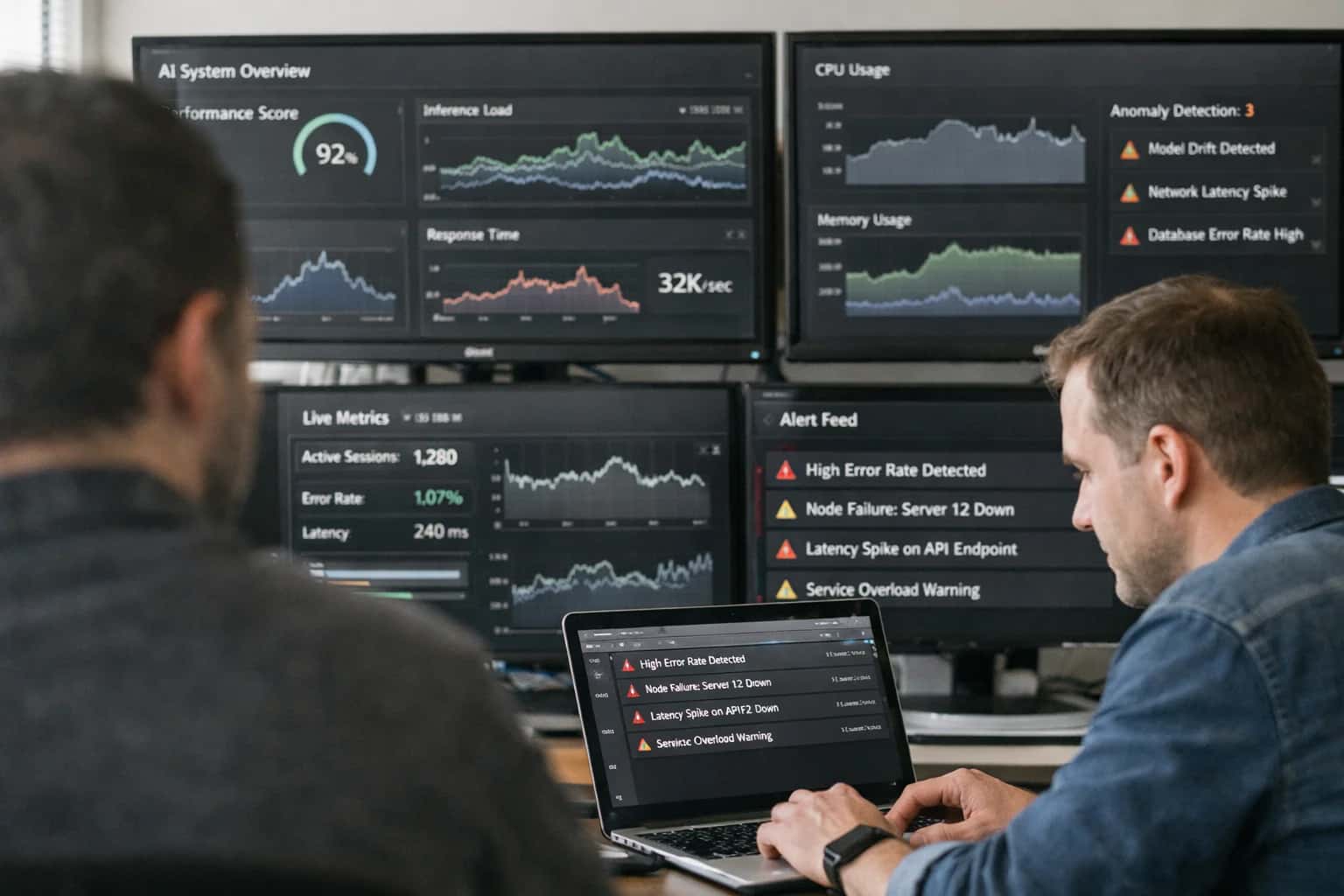
AI systems that analyze board communications and shareholder materials to monitor governance practices and identify conflicts of interest.
Our AI parses board meeting minutes, shareholder communications, and corporate charters to create a searchable, auditable governance knowledge base. This enables:
- Real-time conflict-of-interest detection by cross-referencing director affiliations and voting records.
- Automated adherence monitoring against corporate bylaws and regulatory mandates like
SEC Rule 14a-8. - Predictive risk scoring for governance failures based on historical patterns and peer benchmarking.
We engineer these systems with human-in-the-loop safeguards and ISO/IEC 42001-aligned governance frameworks, ensuring outputs are explainable and defensible. This transforms governance from a periodic audit to a continuous, data-driven function, reducing exposure to fiduciary liability claims. Learn more about our approach to Enterprise AI Governance and Compliance Frameworks.
Key Outcomes:
- Reduce manual governance review time by 70% through automated document analysis.
- Identify latent compliance gaps in board communications with 99% accuracy.
- Generate audit-ready reports for internal counsel and regulatory bodies in minutes, not weeks. This capability is a cornerstone of our broader Legal and Compliance Workflow Automation pillar.
MEASURABLE GOVERNANCE IMPROVEMENT
Tangible Business Outcomes
Our Corporate Governance AI Monitoring Systems deliver concrete, auditable results that strengthen oversight, mitigate risk, and enhance stakeholder confidence. We focus on quantifiable improvements in governance efficacy and operational transparency.
01
Real-Time Conflict of Interest Detection
AI continuously analyzes board communications, meeting minutes, and transaction records to flag potential conflicts of interest and related-party transactions as they occur, enabling proactive mitigation.
> 95%
Detection Accuracy
Real-time
Alerting
02
Automated Charter & Bylaw Adherence
Our systems parse governance documents and cross-reference all board actions and resolutions to ensure strict procedural and substantive compliance, generating automated compliance reports for audit committees.
100%
Document Coverage
< 1 hour
Audit Report Generation
03
Predictive Governance Risk Scoring
Machine learning models analyze patterns in shareholder communications, proxy materials, and market sentiment to predict governance-related risks and activist investor pressure, allowing for strategic preparation.
30-day
Risk Forecast Window
High-Fidelity
Predictive Models
04
Structured Governance Data Repository
Transform decades of unstructured board packs, minutes, and shareholder letters into a searchable, AI-ready knowledge base. This unlocks historical analysis and powers our Retrieval-Augmented Generation (RAG) Infrastructure for precise governance Q&A.
Unlimited Scale
Document Processing
Semantic Search
Instant Retrieval
05
Human-in-the-Loop Audit Trails
Every AI-generated insight is paired with source citations and explanation, creating a defensible, transparent audit trail. This is critical for building Enterprise AI Governance and Compliance Frameworks that satisfy internal audit and external regulators.
Full Traceability
Decision Rationale
Audit-Ready
Output Format
06
Integration with Legal Workflows
Seamlessly connect governance monitoring outputs to downstream legal and compliance actions. Flags can automatically trigger workflows in related systems for Regulatory Compliance Auditing AI or M&A Due Diligence Acceleration AI.
API-First
Design
Bi-Directional
Data Sync
Corporate Governance AI Monitoring System
Typical Development Timeline & Deliverables
A transparent breakdown of the phased delivery for a custom Corporate Governance AI Monitoring System, from initial data pipeline to full-scale deployment with human-in-the-loop oversight.
| Phase & Key Deliverables | Timeline | Core Activities | Client Involvement |
|---|---|---|---|
Phase 1: Data Pipeline & Governance Corpus Creation | Weeks 1-3 | Ingest and structure board minutes, shareholder reports, bylaws. Build initial vector database for semantic search. | Provide secure data access and domain expert review of corpus. |
Phase 2: Core Monitoring Model Development | Weeks 4-7 | Fine-tune domain-specific language model (DSLM) on governance corpus. Develop conflict-of-interest and charter adherence detection algorithms. | Participate in model validation sessions and provide feedback on initial outputs. |
Phase 3: Human-in-the-Loop Dashboard & Integration | Weeks 8-10 | Deploy secure web dashboard for flagged issue review. Integrate with existing communication platforms (e.g., Slack, Teams) for alerts. | Configure user roles and approval workflows. Conduct UAT on the dashboard. |
Phase 4: Pilot Deployment & Model Refinement | Weeks 11-12 | Run system on a pilot dataset (e.g., previous quarter's materials). Tune models based on pilot feedback and performance metrics. | Designate pilot team. Review pilot findings and approve go-live criteria. |
Phase 5: Full Deployment & Knowledge Transfer | Week 13 | Production deployment with 99.9% uptime SLA. Complete documentation and admin training sessions. | Final sign-off. Internal team training completion. |
Ongoing Support & Evolution | Post-Launch | Optional SLA for monitoring, model retraining, and feature updates (e.g., new regulation tracking). | Quarterly review meetings to align system with evolving governance needs. |
PROVEN FRAMEWORK
Our Development Methodology
We deploy secure, auditable AI monitoring systems using a rigorous, four-phase methodology designed for enterprise governance teams. This ensures rapid deployment, continuous compliance, and measurable ROI.
01
Governance Risk Assessment & Data Mapping
We conduct a comprehensive audit of your existing governance data—board minutes, shareholder communications, bylaws—to identify high-risk areas and define the AI's monitoring scope. This establishes the baseline for all model training and system logic.
2-3 weeks
Assessment Timeline
100%
Data Scope Defined
02
Domain-Specific Model Training & Validation
We fine-tune or custom-train language models on your proprietary governance corpus. This specialized training, combined with human-in-the-loop validation, drastically reduces hallucination rates and ensures outputs are grounded in your specific charter and regulatory context.
< 5%
Hallucination Rate
Domain-Specific
Accuracy
03
Secure, Air-Gapped Deployment Architecture
We architect and deploy the monitoring system within your sovereign cloud or on-premises environment. This air-gapped approach, often using confidential computing enclaves, ensures sensitive board communications and analysis never leave your controlled infrastructure, aligning with strict data residency requirements.
Zero Data Egress
Security Guarantee
ISO 27001
Compliant Design
04
Continuous Auditing & Explainable AI Reporting
The system generates automated, explainable audit trails for every flagged anomaly—from potential conflicts of interest to bylaw deviations. These reports provide clear, defensible rationales for legal and compliance teams, supporting our commitment to Enterprise AI Governance and Compliance Frameworks.
Real-Time
Monitoring
Audit-Ready
Outputs
Enabling Efficiency, Speed & Accuracy
Intelligent Analysis, Decision & Execution
We build AI systems for teams that need search across company data, workflow automation across tools, or AI features inside products and internal software.
Talk to Us
Search across company data
Give teams answers from docs, tickets, runbooks, and product data with sources and permissions.
Useful when people spend too long searching or get different answers from different systems.
Enterprise searchRAGPermissions
Read more
Automate internal workflows
Use AI to route work, draft outputs, trigger actions, and keep approvals and logs in place.
Useful when repetitive work moves across multiple tools and teams.
AI agentsWorkflow automationGovernance
Read more
Add AI to products and internal tools
Build assistants, guided actions, or decision support into the software your team or customers already use.
Useful when AI needs to be part of the product, not a separate tool.
AI integrationDecision supportModel routing
Read moreCorporate Governance AI
Frequently Asked Questions
Get answers to common technical and process questions about implementing AI-powered governance monitoring systems.
A standard deployment for a foundational system takes 4-6 weeks, from initial data pipeline setup to model fine-tuning and dashboard integration. Complex deployments involving integration with legacy board portals or custom risk scoring logic can extend to 8-10 weeks. Our phased approach delivers a minimum viable product (MVP) for initial board communication analysis within the first 3 weeks.

About the author
Prasad Kumkar
CEO & MD, Inference Systems
Prasad Kumkar is the CEO & MD of Inference Systems and writes about AI systems architecture, LLM infrastructure, model serving, evaluation, and production deployment. Over 5+ years, he has worked across computer vision models, L5 autonomous vehicle systems, and LLM research, with a focus on taking complex AI ideas into real-world engineering systems.
His work and writing cover AI systems, large language models, AI agents, multimodal systems, autonomous systems, inference optimization, RAG, evaluation, and production AI engineering.
LinkedIn
Limited slotsGet a Free AI Consultation
Partnered with leading AI, data, and software stack.





How We Work
Custom AI workflows for your Business
One-fit-all AI don't work for modern businesses. At Inferensys, we aim to understand your business & custom requirements; which we use to define most efficient agentic workflows, the data, and the tools for your business.
01
Review the use case
We understand the task, the users, and where AI can actually help.
Read more02
Pick the right approach
We define what needs search, automation, or product integration.
Read more03
Build the first useful version
We implement the part that proves the value first.
Read more04
Improve from there
We add the checks and visibility needed to keep it useful.
Read moreThe first call is a practical review of your use case and the right next step.
Talk to Us