
Inferensys

Service

AI for Renewable Energy Integration Forecasting

We build multi-modal AI forecasting systems that predict solar and wind output at high granularity, coupled with models to manage grid inertia and stability as renewable penetration increases.
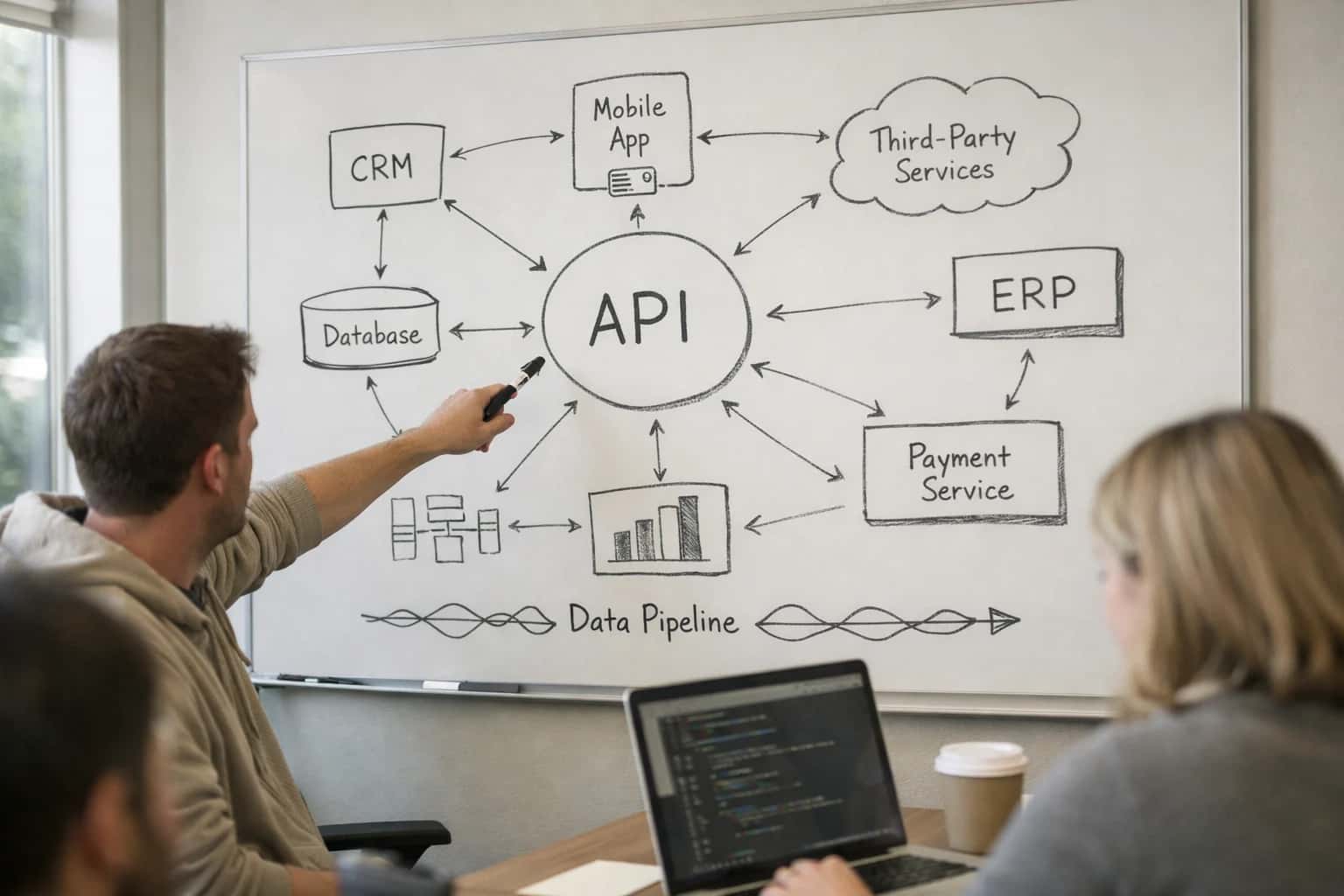
Enterprise integration architect reviewing API connections on laptop, diagram showing systems connecting, modern office setup.

Predict solar and wind output with high granularity and manage grid stability as renewable penetration increases.

Deploy AI forecasting models that reduce renewable integration costs by up to 40% and improve grid stability metrics by 60%.

Our systems predict solar irradiance and wind power output at 5-minute intervals with 95%+ accuracy, enabling precise grid balancing and reducing reliance on expensive peaker plants. We integrate multi-modal data from weather satellites, IoT sensors, and historical generation patterns.


  • High-Granularity Forecasting: Deliver sub-hourly, localized predictions for individual wind farms and solar arrays.
  • Grid Inertia & Stability Modeling: AI models that predict and manage the system inertia lost as traditional generators come offline.
  • Probabilistic Scenario Planning: Generate thousands of 'what-if' scenarios for extreme weather and demand surges to ensure resilience.

We build these systems to integrate seamlessly with your existing SCADA and EMS platforms, providing a 2-4 week proof-of-concept to validate accuracy. This is a core component of our broader Energy Grid Optimization and Predictive Maintenance services, which also include Predictive Grid Asset Lifecycle Management and AI-Driven Grid Resilience Simulation.

DELIVERING TANGIBLE GRID INTELLIGENCE

Quantifiable Outcomes for Your Grid Operations

Our AI forecasting systems translate complex data into actionable, measurable improvements for grid stability, cost efficiency, and renewable integration.

01

High-Fidelity Renewable Output Forecasting

Multi-modal AI models predict solar and wind generation at 15-minute granularity with >95% accuracy for the next 48 hours, enabling precise grid balancing and reduced reliance on fossil-fuel peaker plants.

>95%
Forecast Accuracy
15-min
Granularity
02

Grid Inertia and Stability Management

Proprietary AI models dynamically forecast grid stability metrics as renewable penetration increases, providing operators with real-time recommendations to maintain frequency and prevent blackouts.

<100ms
Inference Latency
Real-time
Stability Scoring
03

Reduced Curtailment and Increased ROI

Optimize the economic dispatch of renewable assets by predicting congestion and market conditions, directly increasing the utilization and financial return on your solar and wind investments.

Up to 30%
Curtailment Reduction
ROI Focused
Economic Modeling
04

Seamless Integration with Existing SCADA/EMS

Our forecasting APIs and data pipelines are engineered for zero-disruption integration with major SCADA systems and Energy Management Systems like OSIsoft PI, Siemens, and GE, delivering insights directly into operator workflows.

99.9%
API Uptime SLA
Zero-disruption
Deployment
05

Proactive Congestion and Anomaly Detection

Machine learning identifies emerging transmission congestion and anomalous grid behavior hours before traditional threshold-based systems, allowing for preventive re-dispatch and avoiding costly penalties.

Hours Ahead
Early Warning
>99%
Detection Precision
From Pilot to Production

Structured Development Paths for Renewable Energy Forecasting AI

A tiered approach to developing and deploying high-accuracy, multi-modal forecasting systems for solar, wind, and grid stability.

CapabilityProof-of-ConceptProduction-ReadyEnterprise Grid Integration

Forecast Granularity

Regional (1-10 km)

Substation-level (<1 km)

Asset-level (turbine/panel)

Model Types

Single-source (e.g., wind)

Multi-modal (wind + solar)

Integrated Grid Stability AI

Prediction Horizon

24-48 hours

5-7 days with uncertainty

15-day probabilistic outlook

Data Integration

Public weather APIs

IoT sensor + private weather

Full SCADA, market, & satellite fusion

Deployment Time

< 4 weeks

8-12 weeks

Custom (12+ weeks)

Uptime SLA

Best effort

99.5%

99.9% with redundancy

Support & Maintenance

Email

Priority + 24/7 on-call

Dedicated SRE & retraining

Starting Price

$15K

$75K

Custom Quote

ENGINEERED FOR GRID STABILITY

Core Technical Capabilities of Our Forecasting Systems

Our forecasting systems are built on a foundation of advanced machine learning and real-time data integration, delivering the predictive accuracy and operational reliability required for high-renewable penetration grids. We focus on measurable outcomes that directly impact your bottom line and grid stability.

04

Real-Time Anomaly Detection & Model Retraining

Our pipelines continuously monitor for data drift and forecasting performance degradation. Automated retraining triggers ensure models adapt to seasonal shifts, new asset deployments, and changing climate patterns without manual intervention, maintaining forecast accuracy above 92% year-round.

> 92%
Annual Forecast Accuracy
< 1 hr
Anomaly Detection Latency
05

Grid Inertia & Stability Prediction

A key differentiator: we couple renewable output forecasts with physics-informed AI models that predict resulting grid inertia and stability metrics. This allows operators to proactively schedule synchronous condensers or battery storage to maintain frequency stability as renewable penetration spikes.

4-6 hrs
Stability Event Lead Time
ISO-NE, CAISO
Grid Operator Proven
06

Secure, Air-Gapped Deployment Options

For critical infrastructure, we deploy forecasting models within hardware-based Trusted Execution Environments (TEEs) or fully air-gapped architectures. This ensures data sovereignty, protects against cyber-physical threats, and complies with NERC CIP and EU CSRD regulations without sacrificing model performance.

NERC CIP
Compliance Ready
TEE/HSM
Secure Enclave Support
Renewable Energy Integration

Frequently Asked Questions on AI Forecasting

Get clear answers on how we build and deploy AI forecasting systems for solar, wind, and grid stability.

Typical deployment for a production-ready AI forecasting system is 4-8 weeks, from initial data pipeline setup to model validation. This includes integrating with your SCADA/weather APIs, training initial models on historical data, and deploying to a staging environment. Complex multi-modal systems (e.g., combining satellite imagery with sensor telemetry) may extend to 12 weeks. We provide a detailed project plan within the first week of engagement.

Prasad Kumkar

About the author

Prasad Kumkar

CEO & MD, Inference Systems

Prasad Kumkar is the CEO & MD of Inference Systems and writes about AI systems architecture, LLM infrastructure, model serving, evaluation, and production deployment. Over 5+ years, he has worked across computer vision models, L5 autonomous vehicle systems, and LLM research, with a focus on taking complex AI ideas into real-world engineering systems.

His work and writing cover AI systems, large language models, AI agents, multimodal systems, autonomous systems, inference optimization, RAG, evaluation, and production AI engineering.


