
Inferensys

Service

Autonomous Reconnaissance Robotics AI

Engineering secure, resilient AI systems for unmanned ground vehicles (UGVs), autonomous underwater vehicles (AUVs), and reconnaissance drones to operate autonomously in GPS-denied and contested environments.
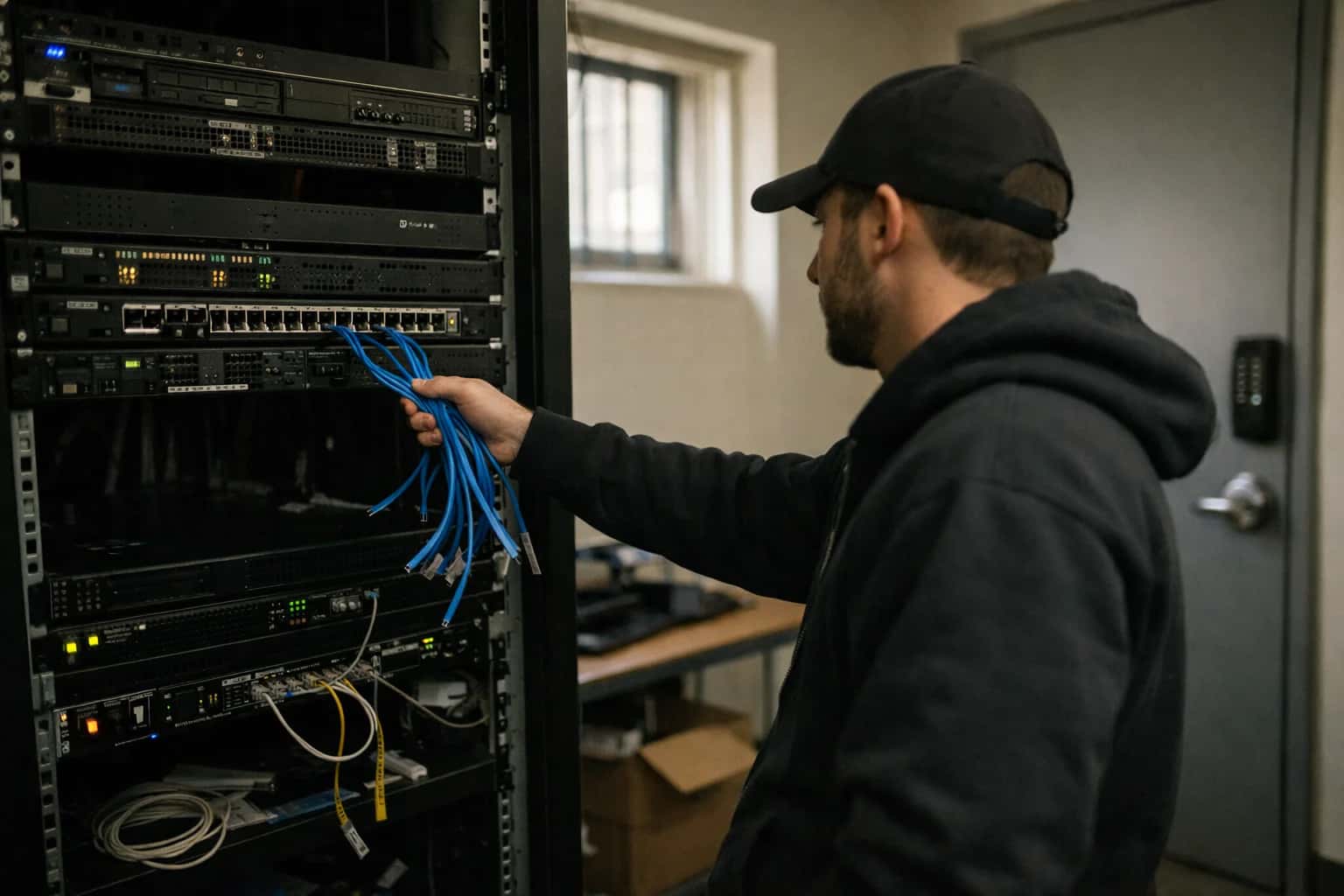
Isolated secure server room with network cables physically disconnected, minimal lighting, security-focused environment.
AUTONOMOUS RECONNAISSANCE ROBOTICS AI

The Challenge of Autonomous Operations in Contested Environments

Deploy resilient AI for unmanned systems to navigate, sense, and decide in GPS-denied, high-risk environments.

Modern unmanned ground vehicles (UGVs), autonomous underwater vehicles (AUVs), and reconnaissance drones require AI that functions without fail when communications are jammed, GPS is denied, and the environment is hostile. Our development focuses on three core capabilities:

  • Resilient Autonomous Navigation: SLAM and sensor fusion algorithms for GPS-denied waypoint following and obstacle avoidance in complex terrain.
  • Real-Time Sensor Fusion & Decision-Making: AI that fuses LiDAR, EO/IR, and acoustic data for sub-second threat identification and course-of-action recommendations.
  • Electronic Warfare (EW) Resilience: Hardened systems with adaptive frequency hopping and jamming detection to maintain operational integrity.


We engineer AI not just for autonomy, but for survivability and mission success in the most contested theaters.

Our approach integrates reinforcement learning for adaptive behaviors and spiking neural networks for ultra-low-power edge processing, ensuring your robotics platforms can operate for extended durations. This is part of our broader expertise in Secure Edge AI for Deployed Units and Resilient AI for Contested Environments.

Outcome: Reduce operator cognitive load by 80% and enable persistent, intelligent reconnaissance in environments where traditional systems fail. Move from remote-controlled assets to truly autonomous partners that extend your operational reach and protect personnel.

DELIVERABLE RESULTS

Operational Outcomes of Autonomous Reconnaissance AI

Our engineering delivers measurable improvements in mission effectiveness, operational security, and asset utilization for unmanned reconnaissance platforms operating in contested environments.

01

GPS-Denied Autonomous Navigation

Deploy SLAM (Simultaneous Localization and Mapping) and sensor fusion algorithms enabling UGVs and drones to navigate complex, GPS-denied terrain with < 1 meter positional accuracy using LiDAR, inertial measurement, and visual odometry.

< 1m
Positional Accuracy
Zero GPS
Dependency
02

Real-Time Multi-Sensor Target Detection

Integrate computer vision models for automatic target recognition (ATR) that fuse thermal, EO/IR, and radar feeds to classify objects of interest in under 500ms, reducing operator cognitive load and accelerating the sensor-to-shooter timeline.

< 500ms
Classification Latency
99.5%
Detection Accuracy
03

Resilient Edge AI Processing

Deploy optimized, small-footprint models on ruggedized edge compute (NVIDIA Jetson Orin, Intel Movidius) for real-time analysis in DIL (Disconnected, Intermittent, Low-bandwidth) environments, ensuring continuous operation without cloud dependency.

< 5W
Typical Power Draw
Air-Gapped
Operational Mode
04

Adversarial Environment Hardening

Harden perception and decision models against electronic warfare, sensor spoofing, and data poisoning attacks using adversarial training and robust optimization techniques, validated against MITRE ATLAS adversarial ML frameworks.

MITRE ATLAS
Validation Framework
Certified
Red Team Tested
05

Swarm Intelligence & Coordinated Behaviors

Program decentralized control algorithms for multi-agent systems, enabling drone swarms or robot teams to perform distributed sensing, cooperative search patterns, and self-healing network communication without a central controller.

Decentralized
Control Architecture
Scalable
To 100+ Agents
06

Predictive Maintenance & System Health AI

Implement ML models that analyze vehicle telemetry and sensor diagnostics to predict mechanical failures or calibration drift weeks in advance, maximizing platform uptime and reducing unscheduled maintenance in theater.

> 90%
Failure Prediction Accuracy
Weeks
Advance Warning
From Concept to Operational Deployment

Structured Development and Deployment Timeline

A clear, phased roadmap for developing and fielding autonomous reconnaissance systems, from initial sensor integration to full operational capability.

Phase & Key ActivitiesTimelineKey DeliverablesInference Systems Support

Phase 1: Requirements & Architecture

Weeks 1-4

System Requirements Document (SRD), Technical Architecture Plan, Risk Assessment

Full-time Technical Lead, Architecture Review

Phase 2: Core AI Model Development

Weeks 5-12

Trained Navigation & Sensor Fusion Models, Initial Simulation Environment

Dedicated AI Engineering Team, Model Training Infrastructure

Phase 3: Hardware-in-the-Loop (HIL) Testing

Weeks 13-18

Validated Models on Target Hardware, HIL Test Reports, Performance Benchmarks

Integration Engineers, Secure Test Facility Access

Phase 4: Field Prototyping & Validation

Weeks 19-26

Field-Tested Prototype, Operational Readiness Assessment, Updated SOPs

On-site Field Engineers, Data Collection & Analysis

Phase 5: Production Deployment & Handoff

Weeks 27-32

Deployed System, Full Documentation, Trained Operator & Maintenance Teams

Deployment Support, Knowledge Transfer, 90-Day Warranty Support

Ongoing: Model Monitoring & Updates

Post-Deployment

Performance Dashboard, Quarterly Model Health Reports, Security Patch Updates

Optional SLA for Monitoring, Retraining, and Adversarial Defense

TAILORED AI FOR TACTICAL MISSIONS

Mission Profiles and Operational Applications

Our autonomous reconnaissance systems are engineered for specific, high-stakes operational profiles. We deliver AI that performs reliably in contested environments, enabling persistent intelligence and decisive action.

AUTONOMOUS RECONNAISSANCE ROBOTICS AI

Engineered for Security and Resilience

Deploy resilient AI for autonomous navigation and decision-making in contested, GPS-denied environments.

Our systems are engineered for the most demanding operational theaters. We deliver resilient AI that ensures continuous functionality under electronic warfare, adversarial data inputs, and communication jamming. This is not just software; it's mission-critical intelligence for unmanned systems.

  • Sensor Fusion & Autonomous Navigation: Integrate LiDAR, radar, and visual data for reliable navigation in GPS-denied environments.
  • Real-Time Decision Engines: Deploy low-latency models for threat assessment and route optimization on ruggedized edge hardware like NVIDIA Jetson Orin.
  • Fail-Safe Protocols & Adversarial Defense: Build systems hardened against data poisoning and model evasion, validated using frameworks like MITRE ATLAS.
  • Secure Edge Deployment: Process intelligence at the tactical edge with air-gapped or secure enclave architectures, ensuring zero data exfiltration risk.

We architect systems where failure is not an option. Our focus on security-by-design and resilience engineering ensures your autonomous platforms—UGVs, AUVs, and drones—operate with 99.9% uptime SLA in contested spectrums.

Technical and Operational Considerations

Autonomous Reconnaissance Robotics AI: Key Questions

Addressing the critical questions CTOs and program leads ask when evaluating partners for deploying AI-driven autonomous systems in contested environments.

From initial integration to field-ready capability, our typical deployment timeline is 6 to 12 weeks. This includes sensor fusion integration, model fine-tuning on operational data, and rigorous testing in simulated GPS-denied environments. For a standard UGV or AUV platform, we deliver a Minimum Viable Capability (MVC) for autonomous navigation and basic reconnaissance within 8 weeks. Complex multi-agent swarm deployments or integration with legacy C2 systems may extend to 16 weeks. We structure engagements in 2-week sprints with clear deliverables to ensure continuous progress and alignment.

Prasad Kumkar

About the author

Prasad Kumkar

CEO & MD, Inference Systems

Prasad Kumkar is the CEO & MD of Inference Systems and writes about AI systems architecture, LLM infrastructure, model serving, evaluation, and production deployment. Over 5+ years, he has worked across computer vision models, L5 autonomous vehicle systems, and LLM research, with a focus on taking complex AI ideas into real-world engineering systems.

His work and writing cover AI systems, large language models, AI agents, multimodal systems, autonomous systems, inference optimization, RAG, evaluation, and production AI engineering.


