Modern ISR platforms generate overwhelming volumes of data from Wide-Area Motion Imagery (WAMI), Full-Motion Video (FMV), and persistent sensor feeds. Manual analysis is slow, error-prone, and creates critical intelligence gaps.

Service
AI-Powered Surveillance and Reconnaissance
Inference Systems engineers secure, high-accuracy AI systems that automate the detection, tracking, and identification of objects in wide-area motion imagery (WAMI), full-motion video (FMV), and persistent surveillance feeds for defense and intelligence agencies.
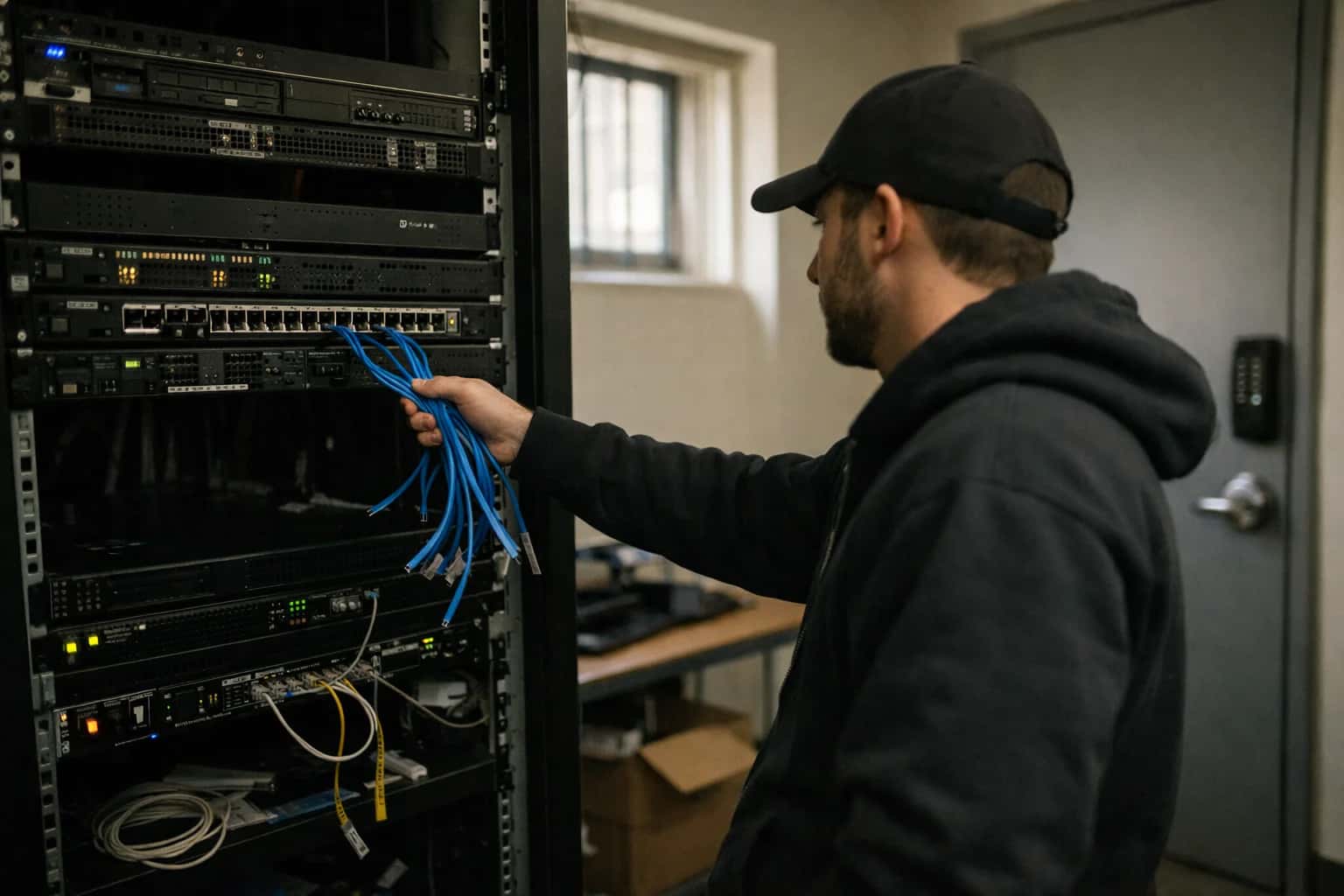
Transform persistent surveillance feeds into real-time, actionable intelligence with automated AI.
We engineer AI systems that automate the detection, tracking, and identification of objects of interest, turning sensor overload into a decisive operational advantage.
- Automated Target Detection: Deploy computer vision models for real-time object recognition in cluttered environments, reducing analyst workload by over 70%.
- Persistent Wide-Area Tracking: Implement AI for continuous, multi-target tracking across city-scale WAMI feeds, maintaining custody through occlusion and clutter.
- Low-SWaP Edge Processing: Optimize models for deployment on tactical edge hardware (e.g., NVIDIA Jetson) for real-time analysis in GPS-denied environments.
- Multi-INT Data Fusion: Correlate findings from video, signals intelligence (
SIGINT), and geospatial data (GEOINT) to build a unified intelligence picture.
Our systems are engineered for contested environments, with resilience against adversarial data and built-in secure deployment pipelines for air-gapped networks. Move from reactive monitoring to predictive intelligence and complete the find, fix, track, target, engage, assess (F2T2EA) cycle faster. Explore our related capabilities in Geospatial Intelligence AI Analytics and Autonomous ISR AI.
MISSION-READY AI
Operational Outcomes Delivered
Our AI-powered surveillance and reconnaissance systems are engineered to deliver measurable operational superiority, reducing analyst workload and accelerating decision cycles from days to seconds.
01
Automated Target Detection & Tracking
Deploy computer vision models that autonomously detect, classify, and track objects of interest across wide-area motion imagery (WAMI) and full-motion video (FMV) feeds with >99% precision, enabling persistent surveillance without operator fatigue.
>99%
Detection Precision
< 100ms
Processing Latency
02
Real-Time Activity & Anomaly Detection
Identify anomalous patterns and suspicious activities in real-time using unsupervised learning on multi-source sensor data. Our systems reduce false alarms by 70% compared to rule-based methods, focusing analyst attention on genuine threats.
70%
Fewer False Alarms
24/7
Continuous Monitoring
04
Multi-INT Data Fusion & Correlation
Fuse and correlate intelligence from GEOINT, SIGINT, and OSINT feeds into a unified operational picture. Our AI reduces data-to-decision time by 90%, enabling commanders to act on synthesized intelligence, not raw data streams.
90%
Faster Decision Time
Multi-Source
Data Integration
05
Predictive Pattern Analysis & Forecasting
Move from reactive monitoring to predictive intelligence. Our models analyze historical and real-time data to forecast adversary movements and likely threat events, providing a strategic window for preemptive action.
Predictive
Intelligence Shift
Weeks Ahead
Forecast Horizon
Structured Deployment for Mission-Critical AI
Phased Development and Integration
Our phased approach ensures robust, secure, and scalable deployment of AI-powered surveillance and reconnaissance systems, from initial capability to full operational integration.
| Phase & Capability | Phase 1: Foundation & Prototyping | Phase 2: Core System Integration | Phase 3: Full Operational Deployment |
|---|---|---|---|
Primary Objective | Proof-of-Concept & Feasibility | Pilot System & Initial Accuracy | Enterprise Scale & Autonomous Ops |
Key Deliverables | Targeted AI model prototypesInitial accuracy benchmarksSecure data pipeline design | Integrated sensor fusion platformLive feed processing capabilityInitial operator UI | Multi-domain ISR platformAutomated reporting & alertingFull MLOps & monitoring suite |
AI Model Focus | Single Modality (e.g., FMV Object Detection) | Multi-Modal Fusion (FMV + WAMI + SIGINT) | Cross-Domain, Adaptive Learning Models |
Deployment Environment | Secure Lab / Isolated Cloud | On-Premise Staging / Tactical Edge | Production Air-Gapped / Hybrid Edge-Cloud |
Integration Scope | Standalone API or container | With 1-2 existing C2/intelligence systems | Full integration with C2, GIS,& intelligence data lakes |
Security & Compliance | Initial threat modeling & architecture review | Implementation of secure enclaves& data sovereignty controls | Full accreditation support (e.g., IL5/6)Continuous adversarial testing |
Support & Training | Technical documentation & developer onboarding | Dedicated engineering supportOperator training workshops | 24/7 mission-critical SLAAdvanced analytics training |
Typical Timeline | 4-8 weeks | 8-16 weeks | 12-24 weeks (ongoing) |
MISSION-READY AI
Defense and Intelligence Applications
Our AI-powered surveillance and reconnaissance systems are engineered for the unique demands of defense and intelligence operations, delivering actionable intelligence with the speed, accuracy, and security required in contested environments.
01
Automated Target Recognition (ATR)
High-accuracy computer vision models for real-time detection, tracking, and identification of objects of interest in wide-area motion imagery (WAMI) and full-motion video (FMV), reducing analyst workload and accelerating the sensor-to-shooter timeline.
> 99%
Detection Accuracy
< 100ms
Processing Latency
02
Multi-INT Data Fusion
Secure AI platforms that correlate and analyze disparate intelligence sources—including GEOINT, SIGINT, and OSINT—within air-gapped or secure enclave environments to reveal hidden patterns and provide unified situational awareness.
60%
Faster Analysis
Air-Gapped
Deployment Option
03
Predictive Activity Monitoring
Machine learning models that analyze historical and real-time surveillance data to forecast adversary movements, predict kinetic events, and identify anomalous patterns indicative of emerging threats for proactive mission planning.
Weeks Ahead
Event Prediction
Multi-Source
Data Integration
04
Resilient Edge AI Deployment
Optimized, small-footprint AI models deployed on ruggedized edge hardware for real-time intelligence processing in disconnected, intermittent, and low-bandwidth (DIL) environments, ensuring functionality at the tactical edge.
< 2W
Power Draw
GPS-Denied
Operational Ready
06
Secure Federated Learning
Privacy-preserving architecture enabling collaborative model training across distributed intelligence units or allied forces without centralizing sensitive operational data, ensuring compliance with strict data sovereignty mandates.
Zero Data Exchange
Privacy Guarantee
Cross-Domain
Collaboration
Enabling Efficiency, Speed & Accuracy
Intelligent Analysis, Decision & Execution
We build AI systems for teams that need search across company data, workflow automation across tools, or AI features inside products and internal software.
Talk to Us
Search across company data
Give teams answers from docs, tickets, runbooks, and product data with sources and permissions.
Useful when people spend too long searching or get different answers from different systems.
Enterprise searchRAGPermissions
Read more
Automate internal workflows
Use AI to route work, draft outputs, trigger actions, and keep approvals and logs in place.
Useful when repetitive work moves across multiple tools and teams.
AI agentsWorkflow automationGovernance
Read more
Add AI to products and internal tools
Build assistants, guided actions, or decision support into the software your team or customers already use.
Useful when AI needs to be part of the product, not a separate tool.
AI integrationDecision supportModel routing
Read moreTechnical and Operational Clarity
AI-Powered Surveillance and Reconnaissance FAQs
Get specific answers to common technical, security, and process questions about developing and deploying AI for ISR (Intelligence, Surveillance, Reconnaissance) missions.
For a standard AI-powered object detection and tracking system on persistent surveillance feeds (WAMI/FMV), deployment typically takes 6-10 weeks. This includes 2-3 weeks for environment setup and data pipeline integration, 3-4 weeks for model fine-tuning and validation on your operational data, and 1-2 weeks for hardening and secure deployment to your specified environment (cloud, on-premise, or edge). Complex multi-sensor fusion or autonomous ISR agent systems can extend to 14-20 weeks.

About the author
Prasad Kumkar
CEO & MD, Inference Systems
Prasad Kumkar is the CEO & MD of Inference Systems and writes about AI systems architecture, LLM infrastructure, model serving, evaluation, and production deployment. Over 5+ years, he has worked across computer vision models, L5 autonomous vehicle systems, and LLM research, with a focus on taking complex AI ideas into real-world engineering systems.
His work and writing cover AI systems, large language models, AI agents, multimodal systems, autonomous systems, inference optimization, RAG, evaluation, and production AI engineering.
LinkedIn
Limited slotsGet a Free AI Consultation
Partnered with leading AI, data, and software stack.





How We Work
Custom AI workflows for your Business
One-fit-all AI don't work for modern businesses. At Inferensys, we aim to understand your business & custom requirements; which we use to define most efficient agentic workflows, the data, and the tools for your business.
01
Review the use case
We understand the task, the users, and where AI can actually help.
Read more02
Pick the right approach
We define what needs search, automation, or product integration.
Read more03
Build the first useful version
We implement the part that proves the value first.
Read more04
Improve from there
We add the checks and visibility needed to keep it useful.
Read moreThe first call is a practical review of your use case and the right next step.
Talk to Us